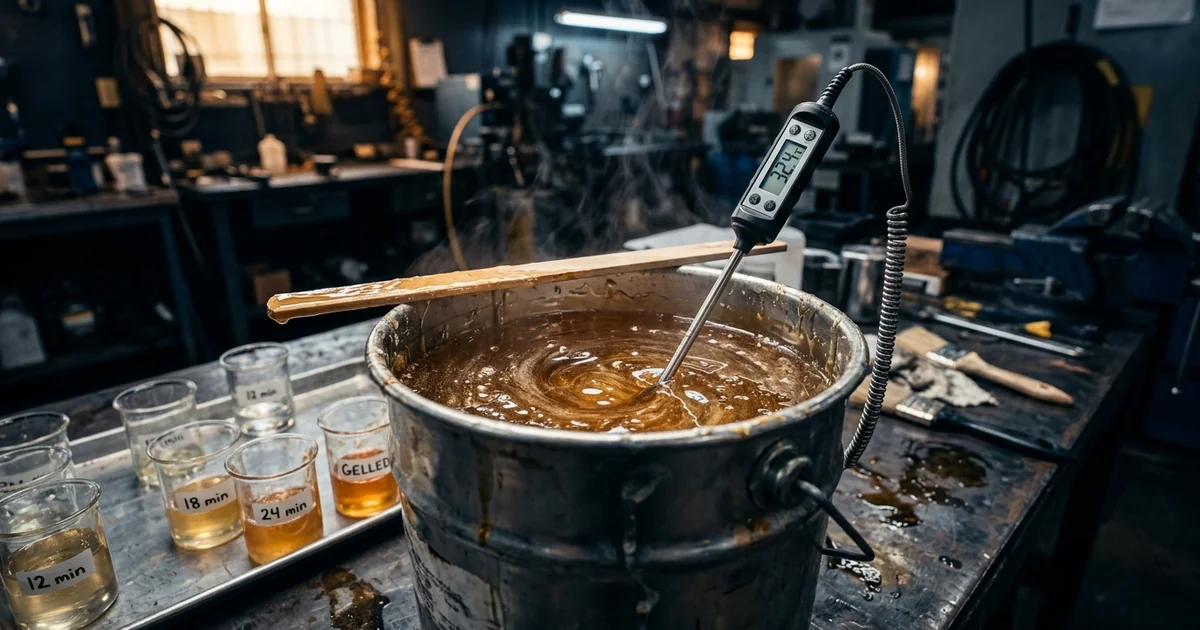
A crew mixes a five-gallon kit of two-component epoxy coating, starts rolling, and twenty minutes later the material left in the pail has gone from pourable to a hot, rubbery mass that will not level. The batch is wasted, the schedule slips, and the site supervisor wants to know why a product rated for a longer working time failed in a fraction of that time. Epoxy coating pot life is not a fixed number printed on a data sheet — it is the outcome of a live exothermic reaction responding to batch mass, ambient temperature and hardener chemistry all at once, and treating it as a constant is where most site failures start. This guide breaks down what actually happens inside the pail between mixing and gelation, why some hardener systems demand an induction time before they perform, and how formulators and applicators predict and extend usable working time without touching the resin-to-hardener ratio. It draws on the same reaction chemistry and process-control principles behind our paints and coatings consulting work, building on the fundamentals in our guide to epoxy coatings generally.
Epoxy Coating Pot Life and Induction Time: What Each Term Means
Pot life, working time, induction time and recoat window all describe different windows in the life of a mixed two-component epoxy, and mixing them up is the fastest way to blame the wrong variable for a failed batch. Pot life measures how long the material stays usable while sitting mixed in its container, while working time is often used interchangeably but can specifically describe the time available once the material is out of the pot and spread as a film. Induction time runs in the opposite direction: it is a mandatory rest period some hardener chemistries require after mixing and before application, not a warning about running out of time. Confusing these terms with each other, or with total cure time, leads to either wasted material or a coating applied before it is chemically ready.
| Term | What it measures | Main driver |
|---|---|---|
| Pot life (working life) | Time from mixing until the bulk mixture in the container becomes too viscous or hot to use | Batch mass, ambient temperature, hardener reactivity |
| Thin-film working time | Time available once material is spread as a coating film | Film thickness and substrate temperature — thin films dissipate heat faster than bulk material |
| Induction time (sweat-in) | Rest period some hardeners require between mixing and application | Hardener chemistry class, specified on the technical data sheet |
| Recoat window | Time between one coat curing enough to accept the next and losing intercoat adhesion | Cure progression, temperature, surface chemistry |
| Full cure time | Time to reach final mechanical and chemical resistance properties | Hardener chemistry, temperature, film thickness |
Pot life and induction time sit at opposite ends of the same mixed batch: one tells you how much time you have left, and the other tells you how much time you must wait before you can start using it at all. Both trace back to the same reaction, which is where the real chemistry begins.
The Cure Chemistry Behind Epoxy Coating Exotherm
Two-component epoxy coatings cure through an addition reaction, not a solvent-evaporation process, which is why pot life behaves so differently from a lacquer or a waterborne paint drying by evaporation alone. Mixing the epoxide resin with an amine, polyamide or polyamidoamine hardener opens the strained three-membered epoxide ring, and reactive hydrogens on the hardener's amine groups form new carbon-nitrogen bonds, building a three-dimensional crosslinked network. That ring-opening reaction is exothermic, releasing heat as the crosslinks form, and because reaction rate itself increases with temperature, the released heat accelerates the very reaction that produced it. Left unmanaged in a mass of material, this feedback loop is what turns a slow, controllable gel into a batch that suddenly goes hard and hot within minutes.
Formulators fix the resin-to-hardener mix ratio using two measured material properties, not site judgment:
- Epoxide equivalent weight — the mass of resin containing one reactive epoxide group.
- Amine hydrogen equivalent weight — the mass of hardener containing one reactive N-H hydrogen.
- Stoichiometric mix ratio — the ratio between the two equivalent weights, which is where a technical data sheet's stated mix ratio actually comes from, not from a mixer's judgment on site.
The exotherm is the same reaction every time; what changes is how fast that heat builds up and how much of it a given batch can shed. That difference is exactly what separates ordinary cure behavior from a hardener that specifically requires an induction period, covered next.
Induction Time in Polyamide and Amine Hardener Systems
Not every epoxy needs to rest before use, and treating induction time as a universal habit is as much a mistake as skipping it when the data sheet calls for it. Certain hardener chemistries — particularly some polyamide and polyamidoamine curing agents used in high-build and protective coatings — specify a mandatory wait between mixing and application, sometimes called sweat-in time, to let the reaction begin building viscosity and reactivity before the material meets the substrate. Skipping a required induction period on these systems does not just waste a convenience step; it produces measurable film defects that surface well after the coating looks finished, an outcome closely related to the failure modes covered in our guide to two-pack epoxy flooring systems.
Applying an epoxy before a required induction period has elapsed typically shows up as:
- Reduced gloss — a duller, less even finish than the product is capable of delivering.
- Amine or polyamide blushing — a waxy surface film that undermines intercoat adhesion.
- Lower corrosion and chemical resistance in the finished film.
- Poorer overall film formation and slower, less complete cure development.
Induction times vary enormously by chemistry: many high-solids polyamide epoxy primers specify a wait of roughly fifteen minutes to an hour at normal ambient temperature, while some polyamide systems used in marine and protective coatings call for induction periods measured in hours — occasionally up to a full day — ahead of a pot life measured in days. The figure is never a guess; it sits on the same technical data sheet that specifies the mix ratio and pot life, and it shortens with rising temperature the same way pot life does.
Whether or not a system needs an induction period, the clock that follows it runs on the same variables: batch mass, temperature and hardener class. Those are the levers formulators and applicators actually control.
What Shortens or Extends Two-Component Epoxy Working Time
Two batches of the identical epoxy coating, mixed from the same kit on the same day, can have working times that differ by a factor of two or more depending on how they are handled after mixing. None of these variables change the chemistry printed on the data sheet; they change how quickly that fixed chemistry runs. Knowing which ones the crew controls, and which ones the weather controls, is the difference between planning around pot life and being surprised by it.
- Batch mass and container shape — a full mixing pail retains heat at its center far more effectively than a thin, spread-out film, so identical material can gel in the pot in a fraction of the time it would take once applied to a wall; this mass effect is exactly why our guide to industrial tank lining coatings treats large-volume mixing as a distinct process risk.
- Ambient and material temperature — following the roughly-halves-per-10°C rule from the previous section, both the resin and hardener storage temperature and the site temperature at the moment of mixing shift the clock.
- Hardener chemistry class — aliphatic amines generally react fastest and give the shortest pot life, polyamide and polyamidoamine hardeners react more slowly and give longer working times, and cycloaliphatic amines typically fall in between.
- Mix ratio accuracy — because the ratio is fixed by epoxide and amine equivalent weights, an inaccurate ratio does not just change pot life, it leaves unreacted resin or hardener in the finished film, a mistake that belongs on the same checklist as the batching errors covered in our guide to dangerous formulation mistakes.
- Humidity and moisture exposure — less central to gel time itself, but atmospheric moisture reacts with certain amine hardeners at the surface, a variable that becomes important in the application-temperature discussion ahead.
Every one of these factors is manageable once it is named, which is exactly why pot-life problems are usually a process failure rather than a defective batch. Ambient conditions decide more than the working time in the pot, though — they also set separate limits on when the coating should go onto the substrate at all.
Testing and Measuring Epoxy Coating Pot Life
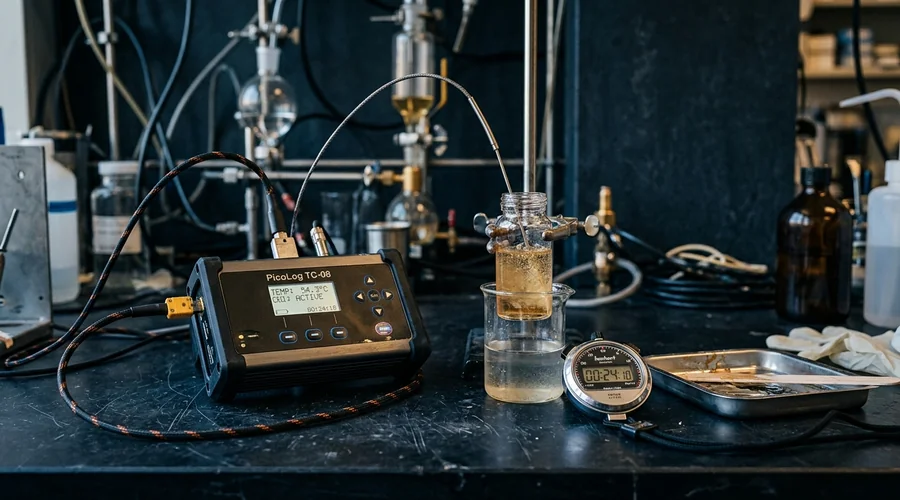
Pot life printed on a technical data sheet is a measured value, not an estimate, and formulators validate it with defined test procedures rather than a stopwatch and a guess. The current international standard for this measurement is ISO 10364, which specifies test methods for determining the pot life, or working life, of multi-component adhesives, including epoxy and polyurethane systems, giving formulators a repeatable way to compare hardener chemistries under identical conditions. An older ASTM method, D2471, covered gel time and peak exothermic temperature of reacting thermosetting resins in much the same way for decades before it was withdrawn in 2008, and the viscosity-doubling concept it popularized is still the informal industry shorthand for a pot-life endpoint.
| Method | What it measures | Typical use |
|---|---|---|
| ISO 10364:2007 (structural adhesives) | Time from mixing to a defined loss of workability, under a specified test mass and temperature | Formal comparison between hardener chemistries and batches |
| Rotational viscometry | Time for mixed viscosity to double from its initial reading | Common informal field and quality-control benchmark |
| Reaction calorimetry / DSC | Heat flow and peak exotherm temperature across the full reaction | R&D characterization of new hardener and resin combinations |
Whichever method generates the number on the label, it is always tied to a specific test mass and reference temperature — exactly why real-world pot life on a hot roof or inside a sealed container can differ so much from the number on the can. Temperature does not only decide how long you have in the pot; it also decides whether the coating should be going down at all.
Epoxy Application Temperature Window: Pot Life Isn't the Whole Story
A batch can still have plenty of pot life left and still be the wrong material to apply at that moment, because ambient and substrate temperature set a second, independent set of limits. Most ambient-cure epoxy coatings specify a minimum application temperature, commonly in the region of 10°C (50°F), below which the crosslinking reaction slows so much that the film never reaches full hardness or chemical resistance, regardless of how long it is left to cure. At the other end, high substrate or air temperature does not just shorten pot life — on solvent-borne systems it can flash off solvent too fast for the film to level and outgas properly, leaving surface defects behind.
- Minimum substrate temperature — keeps the crosslinking reaction fast enough for full cure; going below it risks a soft, under-cured film even after the stated cure time has passed.
- Dew point spread — ISO 8502-4 gives the standard method for estimating condensation risk before painting steel, and the widely applied rule is to keep the substrate surface at least 3°C above the calculated dew point.
- Moisture and amine blush — atmospheric moisture reacting with amine hydrogens at the curing surface, a carbamation reaction, produces a waxy blush that can undermine intercoat adhesion, a failure mode closely related to the blistering mechanisms covered in our guide to paint blistering.
- Maximum application temperature — set by the same exotherm and flash-off risks discussed earlier, tightening the usable pot life further on hot days.
Getting the temperature window right protects the chemistry that pot life and induction time already set up; getting the mixing and batching right is what keeps that chemistry from being sabotaged before the material ever reaches the substrate.
Mixing Practice and Batch-Size Strategy to Avoid Pot-Life Failures
None of the chemistry above changes how a crew mixes and manages a batch on site, but the practices below are what actually convert a known pot life into a coating job that finishes without waste. Each one addresses a specific failure mode already covered in this guide, from the mass effect to mix-ratio accuracy, and together they form the checklist that separates predictable jobs from expensive surprises.
- Weigh components, don't eyeball volume — resin and hardener typically have different densities, so a volumetric measurement can drift from the correct mass ratio even when it looks right in the cups.
- Mix smaller batches more frequently in hot conditions — a smaller mass has more surface area relative to its volume, dissipating heat faster and buying real working time on a hot day.
- "Box" the mixed material immediately — transferring it from a deep mixing pail into a wide, shallow tray increases surface area and lets heat escape faster than it would in the original container, extending usable time without touching the ratio.
- Track elapsed time against the site temperature, not the label's reference condition — a pot life quoted at a mild reference temperature can be a fraction of that on a hot slab, per the doubling rule covered earlier.
- Never mix fresh hardener into a partially reacted batch to "stretch" it — this is exactly the kind of shortcut covered in our guide to dangerous formulation mistakes, and it produces an unpredictable, partially cured mixture rather than more usable material.
- Respect the induction period on systems that specify one, and apply promptly on systems that do not — the technical data sheet, not habit carried over from a different product, decides which applies.

Applied together, these six practices turn pot life from a constant risk into a scheduling input — something the crew plans around instead of discovers the hard way. The chemistry has not changed since the first section of this guide; what changes is whether the people handling the batch understand it.
Frequently Asked Questions
What is the difference between epoxy coating pot life and induction time?
Why does a large mixed batch of epoxy gel faster than the same material spread as a thin film?
Do all two-component epoxy coatings need an induction time before application?
Can I extend epoxy coating pot life by adding solvent to the mix?
How much does temperature actually affect epoxy coating pot life?
What happens if I apply an epoxy coating below the minimum recommended temperature?
Why does epoxy coating sometimes develop a hazy, waxy surface known as blush?
How is epoxy coating pot life officially tested and measured?
Need Expert Formulation Support?
Our team provides end-to-end technical consultancy — from coating chemistry development and scale-up to plant design and regulatory strategy for paints and coatings manufacturers.
Get a Free Consultation