Fire Retardant Wood Coatings: Chemistry & Standards
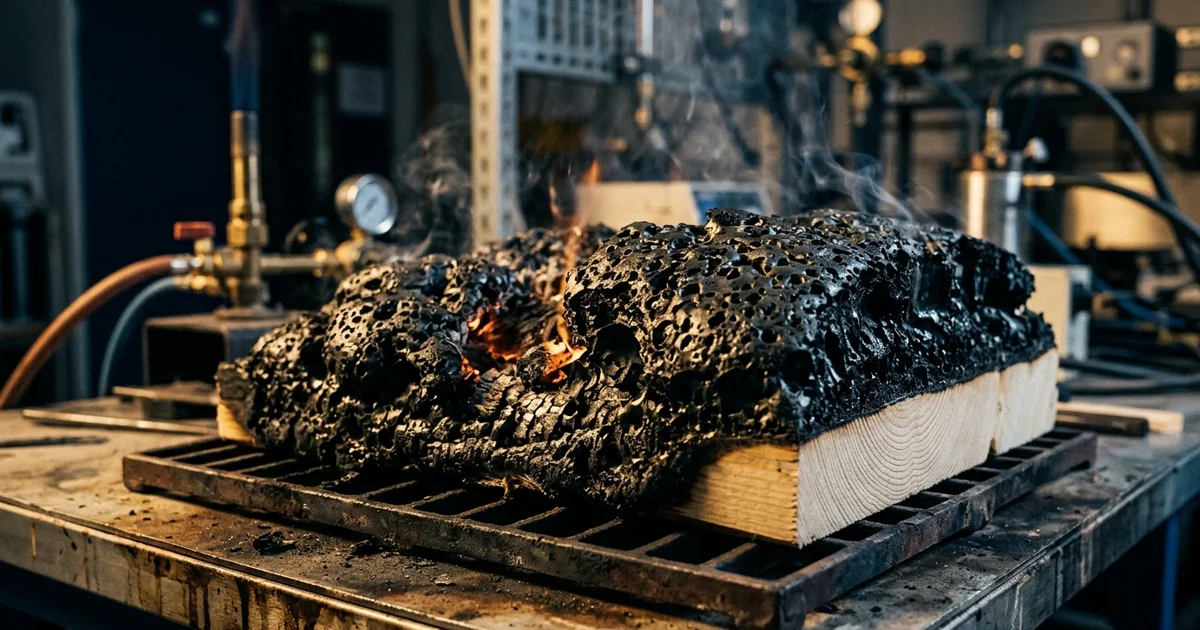
An architect specifies exposed timber for a public stair, the building control officer asks for the reaction-to-fire evidence, and the project stalls because nobody costed a fire retardant wood coating into the joinery package. This is a routine problem: timber is back in favour for its look and its carbon story, but it is combustible, and codes limit how much exposed wood a room can carry unless its surface spread of flame is controlled. A fire retardant wood coating is the usual answer, and choosing one badly — an interior product used outdoors, a clear varnish assumed to match an opaque paint, a film applied too thin — is how a compliant design turns into a failed inspection. This guide covers how wood burns and what a coating changes, the intumescent char chemistry that does the protecting, the phosphorus-nitrogen systems behind modern products, where clear varnishes fit, and how the EN 13501 and ASTM E84 fire ratings work. It reflects the pattern we see across paints and coatings projects, where the chemistry is well understood but the specification and documentation are where things go wrong.
Why Wood Burns and What a Coating Changes
To choose a coating you need a clear picture of what it is fighting. When wood is heated it does not burn directly; it first pyrolyses, breaking down into flammable gases, tars and a solid char residue. The flammable volatiles feed the flame above the surface, the char slowly smoulders, and the flame front travels across the wood as fresh material is heated ahead of it. A protective coating interrupts that cycle at one or more points, and the two main chemistries do it differently.
- Intumescent coatings — insulate. On heating they swell into a thick, low-density carbon foam that slows heat transfer into the wood, delaying the temperature rise that drives pyrolysis
- Non-intumescent (chemical) flame retardants — change how the wood decomposes, catalysing it toward more solid char and fewer flammable gases, so the surface releases less fuel to the flame
- Both approaches — reduce the rate of surface flame spread and the heat the burning surface contributes to a room, which is precisely what reaction-to-fire tests measure
The key expectation to set with a client is that neither approach makes wood non-combustible. As the fire safety standards bodies put it, a treated timber surface still burns; the coating buys time and slows the spread. That distinction runs through the rest of this article, and it is the first thing to explain before a specification conversation.
Intumescent Char Chemistry: The Acid-Carbon-Gas Engine
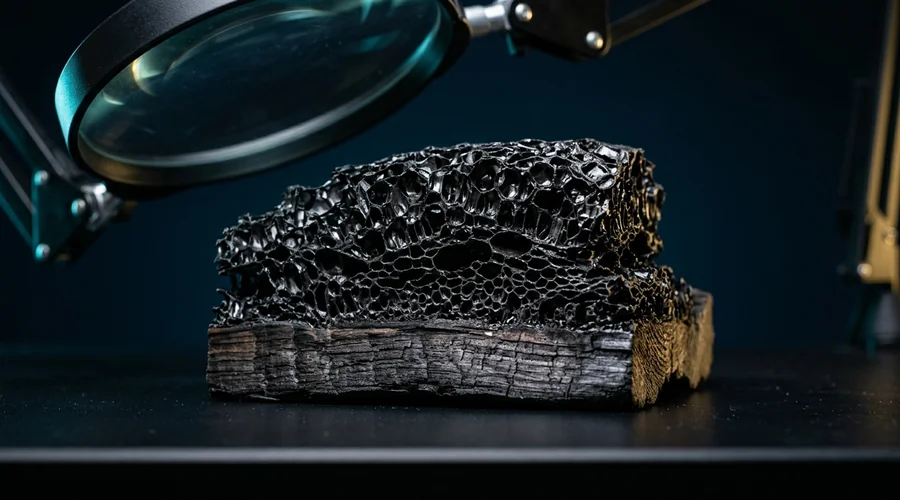
The intumescent coatings used on both steel and wood run on the same three-part reaction, and understanding it explains why these products are formulated the way they are. An intumescent film contains an acid source, a carbon source and a gas-releasing blowing agent, held in a binder that softens at the right temperature. When the film is heated in the correct sequence, it turns into a foamed char many times its original thickness.
| Component | Typical chemistry | Role on heating |
|---|---|---|
| Acid source (catalyst) | Ammonium polyphosphate and related phosphates | Releases phosphoric / polyphosphoric acid that catalyses dehydration of the carbon source |
| Carbon source (carbonific) | Polyols such as pentaerythritol; the wood substrate also contributes | Dehydrates to a carbon-rich residue that becomes the char skeleton |
| Blowing agent (spumific) | Melamine and other nitrogen compounds | Decomposes to release non-flammable gas that expands the softened char into foam |
| Binder | Acrylic, vinyl acetate copolymer, or reactive resins | Holds the system as a film; must soften in step with the reactions, not before or after |
The timing is everything. If the binder melts and the gas is released before the char has formed, the foam collapses; if the char sets before the gas evolves, it never expands. On wood there is an extra factor the steel case does not have: the substrate itself is a carbon source and can be pushed to char by the same acid catalyst, so a wood intumescent can rely partly on the timber to build the protective layer. That interaction is also why a coating tested on one wood species cannot be assumed to perform identically on another.
The acid at the centre of that sequence is almost always phosphorus-based, and pairing it with nitrogen is what makes a modern wood system work.
Phosphorus-Nitrogen Flame Retardant Systems
Nearly every current fire retardant wood coating is built on a phosphorus-nitrogen combination, because the two elements do complementary jobs and reinforce each other in the condensed phase. Older chemistries based on halogens have largely been designed out on environmental and smoke-toxicity grounds, and mineral-only systems such as borates work well for some purposes but not for surface intumescence. The phosphorus-nitrogen approach is now the mainstream, and knowing why helps a formulator or specifier read a product's data sheet critically.
- Phosphorus drives condensed-phase char — on heating, phosphates form phosphoric and polyphosphoric acid that catalyse the dehydration of cellulose and of the coating's polyol, so decomposition yields solid carbon rather than flammable tar and gas
- Nitrogen dilutes and expands — nitrogen compounds such as melamine release ammonia, nitrogen and other non-flammable gases that thin the flame's fuel supply and inflate the char into a foam
- The two are synergistic — nitrogen helps hold phosphorus in the condensed phase instead of letting it volatilise, and the pair produces a denser, more thermally stable char with better smoke suppression than either alone
- Delivery formats vary — ammonium polyphosphate is the workhorse acid source; phosphorylated resins, phosphonates and bio-based phosphorus-nitrogen compounds derived from phytic acid or chitosan are active development areas for durability and lower environmental impact
Published research on phosphorus-nitrogen wood coatings reports large reductions in peak heat release rate and total heat release against untreated wood, confirming the mechanism, though the exact numbers depend heavily on loading, wood species and test method. For a specifier the takeaway is simpler: if a wood coating claims serious fire performance and its chemistry is not phosphorus-nitrogen based, ask hard questions about how it achieves the rating and how durable that performance is.
Clear Fire Retardant Coatings for Wood
Half the demand for these products comes from projects that want the wood grain to stay visible — panelling, feature staircases, exposed structural timber, heritage joinery — so clear intumescent varnishes are a category in their own right. They use the same acid-carbon-gas chemistry as opaque paint, but the formulator is working with a much tighter set of constraints, and the performance gap between a clear system and the best opaque one is real.
- No pigment or high filler loading — the titanium dioxide and mineral fillers that reinforce an opaque char and carry extra active are not available, so a clear film holds less intumescent material per coat
- Higher total film build — clear systems generally need more coats or a thicker wet film to reach a given classification, which affects cost, drying schedule and appearance
- Greater moisture sensitivity — the water-soluble salts are closer to the surface and less buffered, so clear varnishes can turn milky or bloom if wetted, and almost always need a compatible clear sealer coat
- Appearance trade-offs — a heavy clear intumescent build can look plastic or slightly cloudy, and it changes how the wood ages, which matters on visible heritage work
A clear varnish is a legitimate choice and will deliver a genuine improvement in surface spread of flame, but it has to be specified on its own tested classification, not by analogy to an opaque product from the same brand. Where the wood also needs weather or biological protection, coordinate the fire coating with the rest of the wood coatings system so the layers are compatible.
Fire Rating Standards for Coated Wood
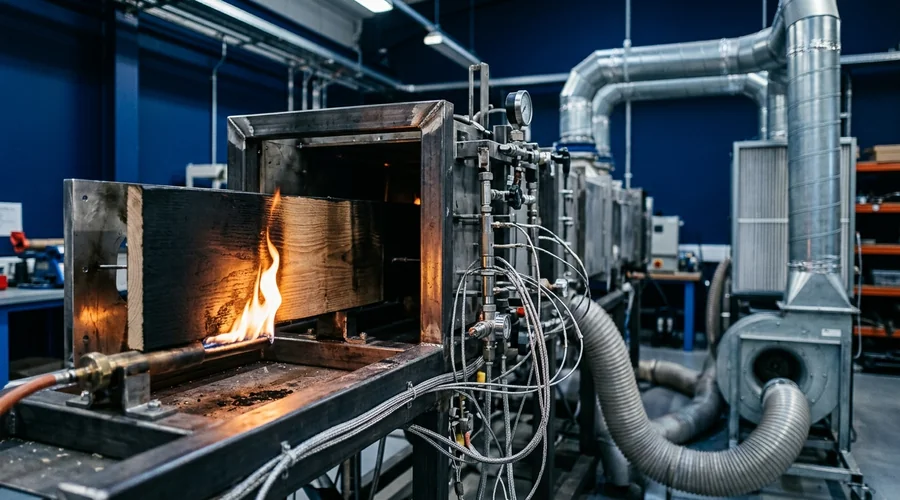
The classification on a fire coating's data sheet is the whole point of the product, so a specifier has to read it precisely. Reaction-to-fire standards measure how a surface contributes to the start and early growth of a fire — ignitability, flame spread, heat release and smoke — and they are distinct from fire-resistance standards, which measure how long an element holds back a fully developed fire. Coated wood is almost always a reaction-to-fire question.
| Region / standard | What it measures | How the result is expressed |
|---|---|---|
| Europe — EN 13501-1 | Single burning item test plus small-flame ignitability | Euroclass A1, A2, B, C, D, E, F, with smoke (s1-s3) and flaming droplet (d0-d2) sub-classes; treated timber typically targets B or C |
| North America — ASTM E84 (Steiner tunnel) | Surface flame spread and smoke over a 10-minute tunnel exposure | Flame Spread Index and Smoke Developed Index; Class A = FSI ≤ 25 and SDI ≤ 450 |
| United Kingdom — legacy BS 476 Parts 6 & 7 | Fire propagation and surface spread of flame | Class 1 surface spread and a fire propagation index; still referenced in some specifications alongside Euroclass |
| Fire resistance (separate) | Load-bearing capacity, integrity, insulation under a standard fire curve | Time in minutes (e.g. 30, 60); not what a surface coating provides |
The fire retardant mechanism — forming a carbonaceous char that resists further burning — is common to all of these tests, but the numbers are not interchangeable between them, and none of them transfer to a different substrate or a reduced film build. A classification report will state the wood species, the density, the coating, the number of coats and the total film thickness it applies to. If the installed system differs from any of those, the rating no longer holds. The rest of the work is making sure the installed system matches the tested one.
Specifying and Applying the System
Most fire coating failures on site are not chemistry failures — the product was capable — they are specification and application failures. The coating was applied too thin, over the wrong sealer, in the wrong conditions, or without the records to prove any of it. Treating the fire coating as a documented system from the specification stage onward is what prevents that, and it follows a clear sequence.
- Confirm the target classification and the substrate — the required Euroclass or ASTM class, the exact wood species and density, and whether the exposure is interior, humid or exterior
- Select a system with a matching tested classification — a report that covers your species, your class, and an interior or weather-aged condition as applicable; do not extrapolate from a different substrate
- Specify the full build — sealer or primer, number of intumescent coats, wet film thickness or spreading rate per coat, and the topcoat, all as tested
- Control application conditions — temperature, humidity and drying time between coats, because an under-cured or over-thinned intumescent will not expand correctly
- Verify and record — wet film comb checks during application, dry film thickness afterwards, plus batch numbers and coat count, forming the evidence pack for inspection
- Set the maintenance interval — especially for exterior or high-wear areas, define when the system is inspected and recoated so the rating stays valid over the building's life
Do that and the fire retardant wood coating becomes a reliable, inspectable part of the fire strategy rather than a risk. Skip the documentation and even the right product can fail third-party sign-off. For the steel side of the same problem, our guide to intumescent fire resistant paints for structural steel covers how the identical chemistry is engineered for a very different substrate, and the ASTM International test methods sit behind both.
Frequently Asked Questions
How does a fire retardant wood coating actually protect the timber underneath?
Most performance coatings for wood are intumescent: on heating they melt, react and swell into a thick carbonaceous foam that can be many times the applied film thickness. That char is a poor conductor, so it slows the rate at which heat reaches the wood surface, delays the point at which the wood itself starts to pyrolyse and release flammable gases, and starves the flame of fuel and oxygen.
Non-intumescent chemistries also exist that work by chemically changing how the wood burns rather than by insulating it, pushing the wood to form more char and fewer flammable volatiles. In both cases the coating does not make wood non-combustible; it buys time and reduces how fast flame spreads across the surface, which is exactly what the reaction-to-fire standards measure.
What is the phosphorus-nitrogen synergy in flame retardant coatings?
Phosphorus compounds such as ammonium polyphosphate break down on heating to phosphoric and polyphosphoric acid, which catalyses the dehydration of the coating's carbon source and of the wood's own cellulose, steering decomposition toward solid char instead of flammable tars and gases. Nitrogen sources such as melamine release non-flammable gases as they decompose, which both dilute the flame and blow the softened char into an insulating foam.
Used together, the phosphorus and nitrogen components reinforce each other: the nitrogen helps retain phosphorus in the condensed phase where it does its work, and the combination gives a denser, more coherent char than either element alone. This is why almost every modern intumescent wood system is built on a phosphorus-nitrogen backbone.
Can a clear varnish give real fire protection, or does it have to be an opaque paint?
Clear intumescent varnishes are real products and are widely used where the appearance of the wood grain has to be kept, for example on panelling, staircases and heritage joinery. They work on the same acid-carbon-gas principle as opaque intumescent paint, but the formulator has far less room to manoeuvre: the pigments and high filler loadings that make an opaque system robust are not available, so a clear film carries less active per coat and usually needs a higher total film build to reach the same rating.
Clear systems are also more sensitive to moisture and handling, and most need a compatible clear sealer coat on top. Expect a clear varnish to deliver a solid improvement in surface spread of flame, but read the tested classification carefully rather than assuming it matches the best opaque system.
Which fire standards apply to coated wood, and what do the classes mean?
In Europe the governing standard is EN 13501-1, which combines the single burning item test and a small-flame ignitability test into a reaction-to-fire Euroclass from A1 down to F, with additional smoke (s1 to s3) and flaming droplet (d0 to d2) sub-classes. Treated timber realistically targets Class B or C. In North America the reference is ASTM E84, the Steiner tunnel test, which reports a Flame Spread Index and a Smoke Developed Index; a Class A rating requires a Flame Spread Index of 25 or less and a Smoke Developed Index of 450 or less.
The critical point for a formulator or specifier is that these ratings belong to a specific coating on a specific wood species at a specific film build, tested as a system, so they cannot be transferred to a different substrate or a thinner coat.
Do fire retardant wood coatings survive outdoors, or are they interior only?
Most fire retardant wood coatings are interior products, because the active salts that drive the char are water-soluble and will slowly leach or migrate if the film is repeatedly wetted, which destroys the fire performance and can leave surface deposits. Exterior and humid-area systems exist, but they rely on a durable, weather-resistant topcoat sealing the intumescent layer away from liquid water and on a binder chosen to resist hydrolysis.
Even then, exterior fire coatings carry a defined maintenance and inspection interval, and the tested classification is usually conditional on that topcoat being present and intact. If a project is genuinely exterior, specify a system that has been weathering-aged and re-tested for reaction to fire, not an interior product with a varnish over it.
How is film thickness controlled and verified on a fire retardant coating?
Fire performance is directly tied to how much intumescent material is on the surface, so the coating is specified as a wet film thickness or a spreading rate per coat, and the applicator checks it during application with a wet film comb and afterwards with a dry film thickness gauge. Because wood is porous and absorbs the first coat unevenly, a sealer or primer is often specified first so that the intumescent coats build to a predictable thickness.
Records of the batch, the number of coats, the measured thickness and the sealer and topcoat used form the evidence that the installed system matches the tested one. Skipping that documentation is the most common reason a fire coating fails third-party inspection even when the right product was used.
Is treated wood a substitute for a fire-rated wall or a sprinkler system?
No. A reaction-to-fire coating changes how the wood surface contributes to the early growth of a fire, slowing flame spread and reducing the fuel a room adds in the first minutes. It does not give the wood element a fire-resistance rating, which is a separate property measured in minutes of load-bearing or compartment integrity under a standard fire curve.
Building codes treat the two things independently, and a fire retardant coating is one input to a fire strategy that also covers compartmentation, detection, escape routes and, where required, sprinklers. Present it to a client as what it is: a way to use exposed timber safely within a compliant design, not a way to avoid the rest of the fire engineering.
Developing or Specifying a Fire Retardant Coating?
Global Formulation provides coatings consultancy — intumescent system development, flame-retardant chemistry, substrate testing strategy and classification support from concept to specification.
Talk to Our Coatings Team