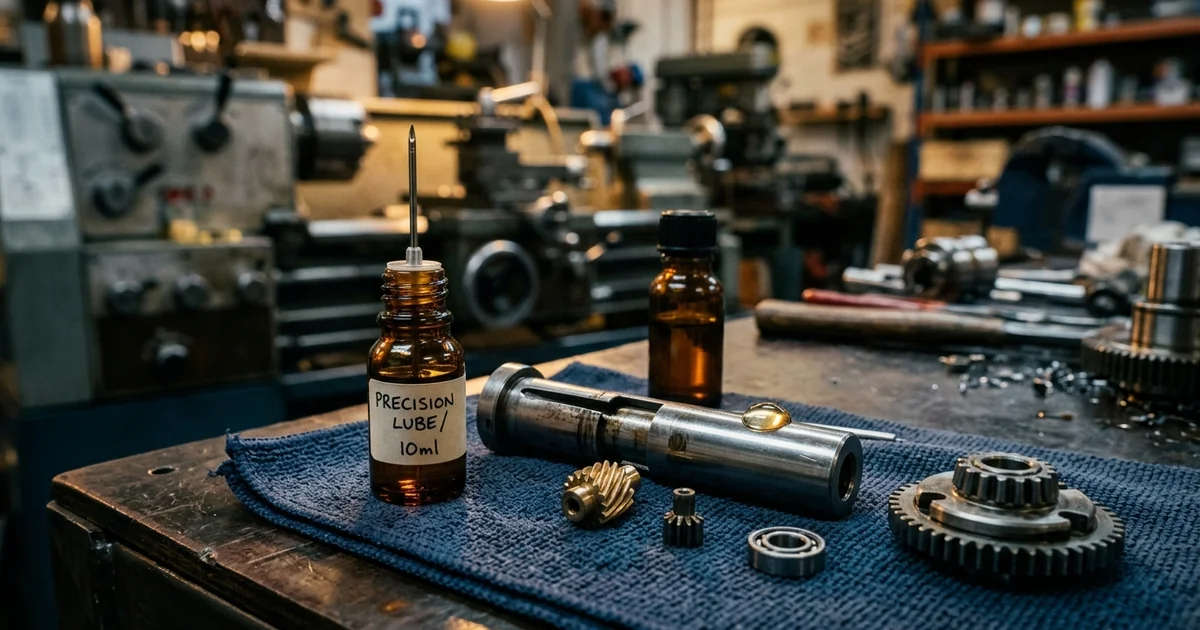
A hunting rifle that cycles flawlessly in autumn deer season can jam solid after a winter spent in an unheated truck bed, and a watch movement lubricated with the wrong oil can grind to a stop after years sitting in a drawer. Both failures trace back to the same root cause: a lubricant chosen for viscosity alone, without accounting for the corrosive residues, extreme temperature swings and long dormancy periods these mechanisms actually face. A firearm precision instrument lubricant has to do more chemistry in one small bottle than almost any other lubricant category — cutting friction, fighting corrosion from combustion residue and handling moisture, and surviving months or years of storage without oxidizing into varnish. This guide breaks down the multi-functional chemistry behind gun oils, PTFE dry-film lubricants, and the specialized oils used in watchmaking and optics, and shows how formulators balance these competing demands against recognized performance benchmarks. It draws on the same base-oil and additive-selection principles behind our lubricants consulting work.
What Makes a Firearm or Precision Instrument Lubricant Different
General industrial lubricants — engine oil, gear oil, hydraulic fluid — mainly need to survive continuous operating conditions and get replaced on a schedule. A firearm precision instrument lubricant lives a different life: it spends most of its time sitting completely idle, exposed to whatever residue was left on the metal at last use, and it still has to work instantly and predictably the moment the mechanism is called on. That single difference in duty cycle is what separates this category from almost every other lubricant this site covers, and it drives every formulation decision that follows.
| Requirement | Why it matters here specifically | Consequence if unmet |
|---|---|---|
| Corrosion protection | Combustion residue and handling moisture sit on tight-tolerance steel through extended dormant periods | Pitting, and rust bonding moving parts together |
| Low-temperature fluidity | Fine actions and movements must cycle freely across a wide climate range | Sluggish or failed cycling in cold conditions |
| Oxidative and storage stability | The lubricant may sit unused for months or years between uses | Gum or varnish formation that seizes fine clearances |
| Low migration, non-gumming | Fine mechanisms have tiny clearances and, in optics, sensitive surfaces nearby | Lubricant creep fouls adjacent parts or lens elements |
Every one of these four requirements shows up again later in this guide, because none of them can be solved by a single additive in isolation. The most distinctive of the four — and the one unique to firearms specifically — is corrosion protection against a very particular chemistry.
Combustion Residue and Corrosion: The Chemistry Unique to Firearms
Firing a cartridge deposits combustion byproducts directly onto bare steel inside the bore and action, and for decades that residue was far more damaging than it is today. Older ammunition relied on potassium chlorate-based primers, which decompose on firing into potassium chloride — an intensely hygroscopic salt that pulls atmospheric moisture straight onto the metal and drives rapid pitting corrosion if the residue is not cleaned promptly. Modern civilian primers have largely eliminated that specific salt, but firing still leaves carbon soot and traces of copper and lead from the bullet sitting on unprotected steel, which is a gentler but still real corrosion risk.
Precision instruments face a quieter version of the same underlying problem: no combustion chemistry, but handling moisture, sweat and fingerprint residue sitting on fine steel and brass components between uses. Either way, the additive classes doing the actual corrosion-inhibition work — oil-soluble sulfonates, amine derivatives and vapor-phase inhibitors — are the same families covered in our guide to rust preventive oils, though a firearm formulation must also stay chemically compatible with the specific residue it will meet rather than a generic industrial soil.
Understanding what residue a lubricant is actually protecting against explains why corrosion inhibitors matter, but it does not explain why so many firearm lubricants deliberately abandon a liquid film altogether in favor of a dry one.
PTFE Dry-Film Lubricant Technology for Precision Mechanisms
Polytetrafluoroethylene, or PTFE, is a fully fluorinated polymer that is chemically inert to nearly everything it contacts and has one of the lowest coefficients of friction of any known solid — commonly cited in the range of roughly 0.05 to 0.10 against steel, and as low as about 0.04 under favorable conditions. In a dry-film lubricant, fine PTFE particles are suspended in a volatile carrier, sprayed or wiped onto the working surface, and left to dry as the carrier evaporates, bonding a thin, low-friction PTFE film directly to the metal rather than leaving an ongoing liquid layer.
That absence of a persistent liquid layer is the real selling point in the field, not friction reduction alone:
- No dust or grit attraction — a wet oil film collects airborne dust and grit almost immediately, turning into an abrasive paste in sandy or dusty conditions, while a dry PTFE film has nothing sticky left on the surface to hold particulate.
- Chemical resistance — PTFE resists combustion byproducts and bore-cleaning solvents that can degrade some organic oils over repeated exposure.
- Wear-limited lifespan — the trade-off is that the film wears away under heavy cycling and needs periodic reapplication, unlike a wet oil that continuously replenishes itself at the contact point.
- Common placement — bolt carrier groups, rails and other high-cycle sliding surfaces, where dust ingestion rather than raw friction is usually the dominant failure mode.
Firearms are not the only mechanisms that demand this kind of low-migration behavior. Precision instruments push the same requirement even further, into chemistry most gun oil formulations never need to touch.
Precision Instrument Lubrication: Why Watchmakers and Optics Reach for PFPE
Watch movements, optical instruments and fine scientific mechanisms share the low-migration, non-gumming requirement from the first section, but push it to an extreme most other lubricated systems never face: clearances measured in microns, and dormancy periods measured in years rather than weeks. Perfluoropolyether, or PFPE, oils dominate this niche because of two measurable properties rather than marketing claims — an extremely low vapor pressure that keeps outgassing and migration to a minimum, and a fully fluorinated backbone that resists oxidation essentially indefinitely under normal storage.
| Base fluid class | Key property | Best fit |
|---|---|---|
| Mineral oil | Low cost, moderate oxidation resistance | General-purpose mechanisms with short storage periods |
| Synthetic ester | Good low-temperature fluidity, moderate migration resistance | Mid-tier precision mechanisms, moderate-duration storage |
| Silicone oil | Wide temperature range, chemically stable, but prone to surface migration | Mechanisms located away from optical or electrical contact surfaces |
| PFPE | Extremely low vapor pressure and outgassing, near-zero oxidation over decades | High-end watch movements, optics, vacuum and aerospace mechanisms |
The silicone row matters more than it looks: silicone oil's tendency to creep by capillary action makes it a real contamination risk in a camera, telescope or rifle scope, where a stray film on a lens element is a defect that is difficult to fully remove. PFPE oils and purpose-formulated esters avoid that migration risk, which is why serious optics work steers away from silicone near any lens assembly. None of these chemistry choices solve the temperature-range problem on their own, though — that comes down to base-oil selection.
Low-Temperature Viscosity and the MIL-PRF-63460 Benchmark
A lubricant thick enough to build a durable, corrosion-resistant film at warm temperatures can become too viscous to allow reliable cycling once the mercury drops well below freezing, and for a hunting rifle or a mechanism used outdoors, that is not a minor inconvenience. Formulators manage this primarily through base-oil selection — synthetic esters, polyalphaolefins and light mineral fractions with an inherently low pour point and high viscosity index — rather than leaning only on viscosity index improver polymers, whose long molecular chains can shear down and lose effectiveness under the sharp mechanical stress of a reciprocating action.
Formulators rarely have to invent a temperature target from scratch, because a published benchmark already exists:
- MIL-PRF-63460 is the current US military performance specification for combined cleaner-lubricant-preservative products for weapons and weapons systems, requiring reliable performance across roughly -51°C to +71°C (-60°F to +160°F) and identifying the category by military symbol CLP and NATO code S-758.
- Base oil sets the ceiling — no additive package can fully compensate for a base oil with an inherently high pour point.
- Testing at both extremes is essential, since a formulation that performs at room temperature can still fail at either end of its stated range.
Getting the temperature range right protects the mechanism while it is in use. The next challenge is protecting it while it is doing nothing at all.
Oxidative Stability and Long-Term Storage Performance
Firearms and precision instruments often sit unused for months between hunting seasons, in a safe, or on a shelf between calibration cycles, and unlike an industrial lubricant that gets continuously circulated and replaced on a schedule, a dormant film just sits exposed to air the entire time. The failure mode that matters here is oxidative gumming: a thin oil film left in contact with atmospheric oxygen slowly polymerizes into a sticky varnish that can bond fine moving parts together, which is exactly the "preservative" half of the CLP category name from earlier in this guide.
The same free-radical oxidation chemistry covered in our guide to turbine oil oxidation stability applies here, and formulators fight it the same way: hindered phenolic and aminic antioxidants interrupt the oxidation chain reaction before it can propagate through the film. Base oil selection reinforces that protection rather than replacing it, since some synthetic ester chemistries and PFPE oils are inherently far more oxidation-resistant than mineral oil even before any antioxidant is added.
A lubricant that survives dormancy without gumming has cleared the last major hurdle unique to this category. What remains is turning all of the chemistry above into an actual formulation decision.
Formulating a Firearm or Precision Instrument Lubricant: A Decision Framework
None of the individual chemistry choices above matter in isolation; what matters is the order in which they get decided, since each one narrows the options for the next. The six steps below follow the same order a formulator would actually work through, from defining the product's job to validating it against a recognized benchmark.
- Define the primary duty — a pure lubricant, or a combined clean-lubricate-protect product — because that single decision sets the entire formulation strategy.
- Select base oil and viscosity for the coldest temperature the product must guarantee, not the average condition it will usually see.
- Choose wet-oil or PTFE dry-film delivery based on the operating environment — dusty or sandy conditions favor dry film, general use favors a wet oil or a hybrid of both.
- Build the corrosion-inhibitor package around the residue chemistry the product will actually meet, whether that is combustion byproducts or handling moisture.
- Validate oxidative stability under realistic dormant-storage conditions rather than short bench tests alone.
- Benchmark finished performance against a recognized specification such as MIL-PRF-63460 where the target market expects it, even for a purely civilian product.
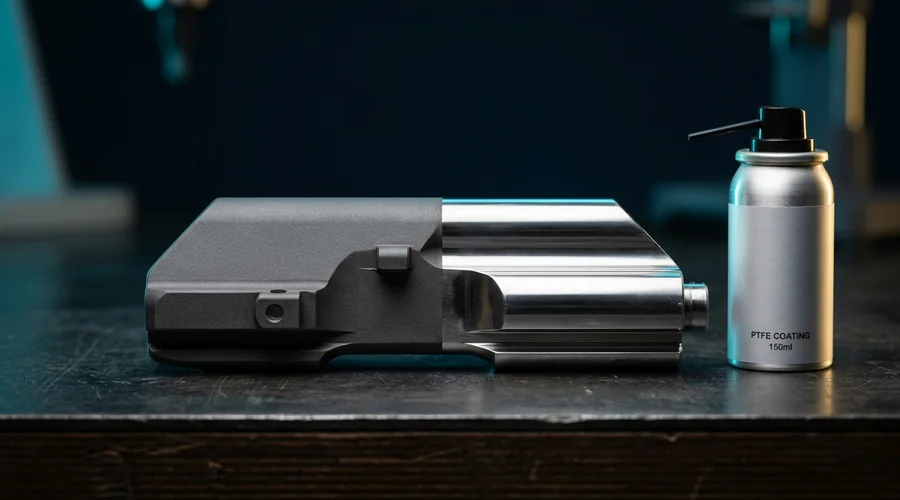
Applied in this order, the six decisions above turn a firearm or precision instrument lubricant from a single generic product into a formulation matched to a specific residue, climate and storage profile — which is the entire point of treating this as its own category rather than a repackaged machine oil.

Frequently Asked Questions
What is the difference between a gun oil and a general-purpose machine oil?
Why do firearm lubricants need to resist corrosion specifically, beyond normal rust prevention?
What is a CLP (Cleaner, Lubricant, Preservative) product?
Is PTFE dry-film lubricant better than a regular wet gun oil?
Why do watchmakers use PFPE oil instead of a regular synthetic oil?
Can silicone oil be used to lubricate precision optics or camera mechanisms?
Does modern non-corrosive ammunition mean gun oil no longer needs corrosion inhibitors?
What temperature range should a firearm lubricant perform across?
Need Expert Formulation Support?
Our team provides end-to-end technical consultancy — from lubricant chemistry development and additive selection to plant design and regulatory strategy for specialty lubricant manufacturers.
Get a Free Consultation