Geopolymer Cementitious Binders: Low-Carbon Concrete Guide
Portland cement production is responsible for nearly 8% of global CO2 emissions, and construction chemical buyers, architects, and regulators are now asking suppliers for a genuinely lower-carbon alternative. Most of that demand lands on one technology: geopolymer cementitious binders made from industrial byproducts like fly ash and slag instead of calcined limestone. The chemistry is not new, but it behaves differently enough from Portland cement that formulators who treat it as a drop-in replacement get failed batches, curing-schedule surprises, and durability complaints. This guide explains how geopolymer chemistry actually works, which precursor materials and activator systems are viable at commercial scale, and how much embodied carbon a geopolymer binder genuinely saves. It also maps where the technology already makes commercial sense today, reflecting how Global Formulation approaches low-carbon construction chemical development for manufacturers and entrepreneurs entering this market.
Why Geopolymer Cementitious Binders Are Reshaping Construction Chemicals
Cement manufacturers, admixture formulators, and construction chemical brands face real commercial pressure to cut embodied carbon, not just market around it. Green building certifications increasingly award credit for supplementary cementitious materials, and some public infrastructure tenders now specify a maximum embodied-carbon budget per cubic meter of concrete. Geopolymer cementitious binders answer that pressure directly, because they replace most or all of the Portland clinker in a mix with industrial byproducts activated by an alkaline solution. Getting the chemistry right, however, is the difference between a genuine low-carbon product and a batch that never sets properly.
- Regulatory and market pressure — green building codes and procurement standards increasingly reward measured embodied-carbon reduction, not marketing claims.
- Byproduct utilization — fly ash and slag are industrial byproducts that would otherwise go to landfill or storage ponds.
- No calcination step — geopolymer binders skip the high-temperature limestone calcination that generates most of Portland cement's process CO2.
- A genuinely different chemistry — geopolymer binders do not hydrate the way Portland cement does, so mix design, curing, and testing all need to be relearned, not copied.
That last point is the one formulators underestimate most, which is exactly why the next section starts with the chemistry itself.
Geopolymer Chemistry: Aluminosilicate Precursors and Alkali Activation
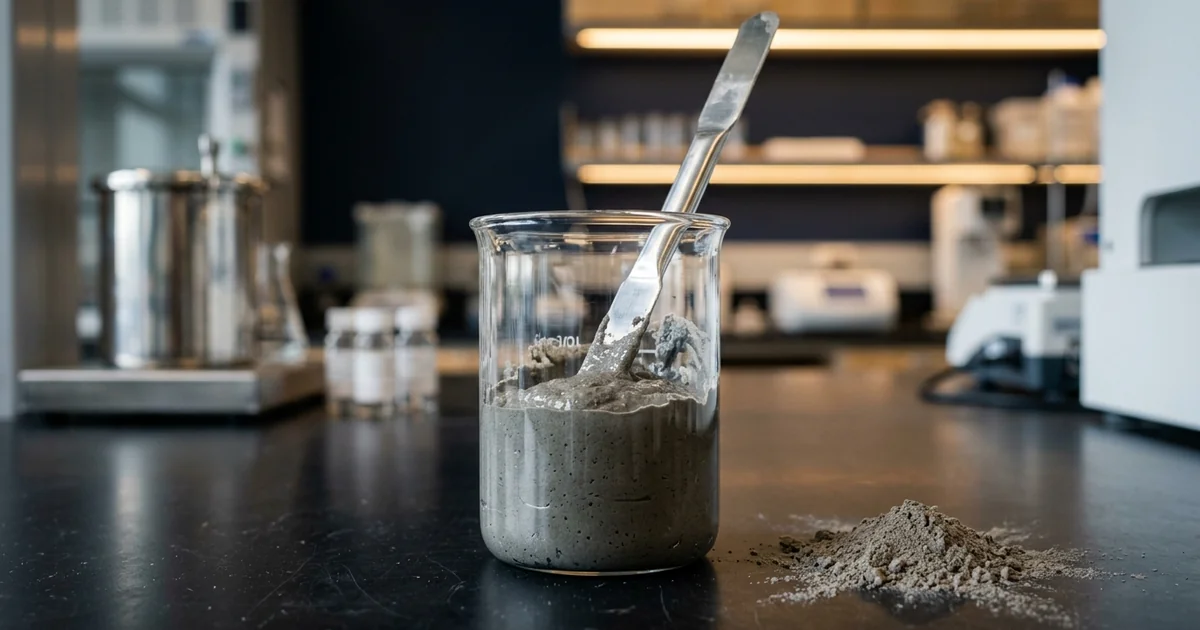
Geopolymer cementitious binders form through a fundamentally different reaction than Portland cement hydration. An aluminosilicate-rich powder, most commonly fly ash, ground granulated blast-furnace slag, or metakaolin, is mixed with a strongly alkaline activator solution instead of water alone. Wikipedia's overview of geopolymer chemistry describes how the aluminosilicate source dissolves into the alkaline solution, then cross-links and polymerizes into a growing gel phase that sets and hardens. The resulting network is a three-dimensional aluminosilicate polymer, not the calcium-silicate-hydrate gel that gives Portland cement its strength.
- Dissolution — the alkaline activator breaks down the glassy aluminosilicate phase in the precursor material, releasing silicate and aluminate species into solution.
- Polycondensation — the dissolved species link together into oligomers and then into a three-dimensional aluminosilicate polymer network.
- Hardening — the growing polymer network densifies and rigidifies, producing a binder matrix with no calcium-silicate-hydrate phase required.
This mechanism explains why geopolymer binders tolerate raw materials that would ruin a Portland cement mix. It is also why precursor choice, covered next, matters more here than it does for ordinary concrete.
Precursor Materials: Fly Ash, Slag, and Metakaolin Compared
Not every aluminosilicate byproduct performs the same way once activated, and precursor selection is the first real formulation decision in a geopolymer program. Fly ash divides into Class F and Class C under ASTM C618, and that distinction changes how the material behaves under alkaline activation. Ground granulated blast-furnace slag brings its own calcium content into the reaction, while metakaolin offers the most reactive and most consistent chemistry at a materially higher cost. The table below compares the three precursors used most often in practice.
| Precursor | Source | Reactivity | Key Formulation Note |
|---|---|---|---|
| Class F fly ash | Bituminous or anthracite coal combustion, low lime (under 7%) | Lower reactivity, typically needs heat curing | Most widely available and lowest-cost precursor |
| Class C fly ash | Lignite or sub-bituminous coal combustion, high lime (over 20%) | Some self-cementing behavior even before full activation | Can set faster, but is less consistent between coal sources |
| Ground granulated blast-furnace slag (GGBS) | Blast-furnace steelmaking byproduct | High reactivity, calcium-bearing | Often blended with fly ash to enable ambient curing |
| Metakaolin | Calcined kaolin clay | Highest and most consistent reactivity | Most expensive; used where batch-to-batch consistency matters most |
Blending precursor materials at plant scale raises the same homogeneity and dust-control challenges covered in our guide to dry-mix mortar manufacturing. Fly ash source variability is the single most common cause of geopolymer batch failure. Ash from different power plants, or even the same plant on different coal shipments, reacts differently even under identical alkali dosing.
Once a precursor is qualified, the activator system decides how it actually cures — the next design variable, and the one most formulators get wrong first.
Alkali Activator Systems and Mix Design Variables
The activator solution does more than trigger the reaction. Its chemistry sets the final network structure, the working time, and the hazard profile of the entire process. Sodium hydroxide and sodium silicate, also known as water glass, are the two most common activators, usually blended together rather than used alone. Because the activator does most of the chemical work, its concentration and silicate modulus are the two variables formulators tune first, never the amount of precursor.
- Sodium hydroxide concentration — raises alkalinity and dissolution rate, but excessive concentration reduces workability and can cause premature stiffening.
- Sodium silicate modulus — the silica-to-soda ratio in the water glass component controls gel structure and strength development.
- Activator-to-precursor ratio — sets workability and, together with the precursor's own reactivity, determines whether the mix needs heat curing.
- Handling and safety — concentrated activator solutions are highly caustic and require the same personal protective equipment and spill controls as any strong alkali on a construction site.
Getting the activator system right decides whether the mix cures at all, which is exactly the variable the next section examines directly.
Curing Requirements: Heat-Cured vs Ambient-Cured Systems
Curing is where geopolymer binders diverge most sharply from Portland cement in practice, and it is the single biggest constraint on where the technology can be used today. Many fly-ash-based geopolymer systems require heat curing in the region of 60 to 80°C to reach useful strength within a practical timeframe. That is straightforward in a precast plant, but impractical on a cast-in-place job site. Blending in ground granulated blast-furnace slag, which reacts at ambient temperature because of its own calcium content, is the most common route to an ambient-curing geopolymer system. Our guide to curing compounds and their mechanisms covers the moisture-retention side of curing that still applies once a geopolymer mix is placed.
| Curing Approach | Typical Precursor Basis | Practical Setting | Trade-off |
|---|---|---|---|
| Heat-cured (60–80°C) | High Class F fly ash content | Precast plants with curing chambers | Fastest strength gain, but unsuitable for cast-in-place work |
| Ambient-cured | Slag-blended or high-Class-C-fly-ash systems | Cast-in-place, ready-mix | Slower early strength gain, more sensitive to ambient temperature swings |
A curing plan chosen this early determines which applications, covered later in this guide, are realistic. First, though, the mix has to prove itself against Portland cement on strength and durability.
Mechanical Performance and Durability vs Portland Cement
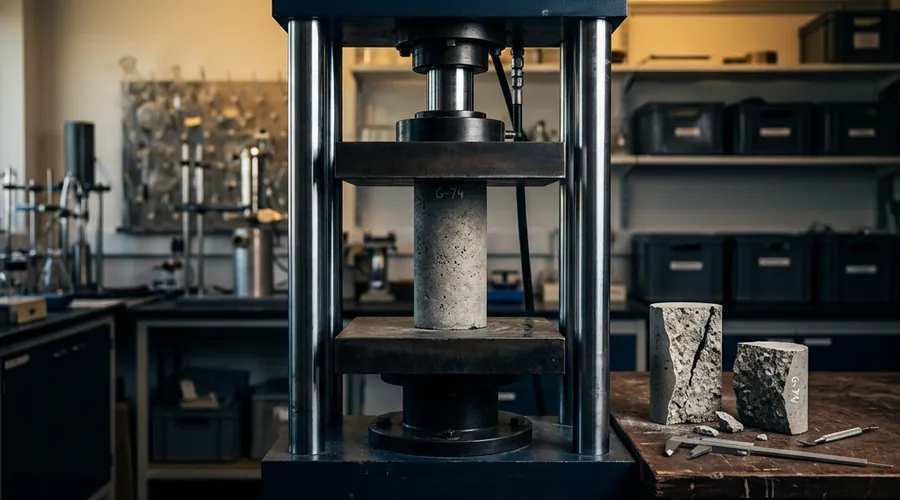
Formulators and specifiers ultimately care about one thing: does the geopolymer binder perform as well as, or better than, ordinary Portland cement concrete in the finished structure? Compressive strength testing under ASTM C39, or the equivalent EN 12390-3 procedure, shows well-designed geopolymer concretes reaching strength classes comparable to conventional concrete. Several durability properties are frequently reported as favorable, resistance to sulfate attack and to some acid environments in particular. That advantage exists because the aluminosilicate matrix lacks the calcium hydroxide that leaves Portland cement concrete vulnerable. The properties that still need project-specific verification are long-term creep, shrinkage, and steel reinforcement passivation behavior, since the pore solution chemistry differs from Portland cement.

- Compressive strength — comparable strength classes are achievable, but the precursor blend and curing regime must be qualified for each project, not assumed from published literature values.
- Sulfate and acid resistance — often reported as improved, because the binder matrix contains little to no calcium hydroxide for aggressive ions to attack.
- Shrinkage and creep — behavior differs from Portland cement and needs project-specific testing, particularly for slag-rich ambient-cured systems.
- Steel passivation — the alkaline pore solution differs from Portland cement's, so reinforcement corrosion protection needs its own verification program rather than an assumption carried over from ordinary concrete.
Strong mechanical performance is necessary but not sufficient. The business case ultimately depends on the carbon numbers actually adding up, which the next section quantifies.
Carbon Footprint: How Much Lower Is the Embodied CO2?
Cement production accounts for nearly 8% of global CO2 emissions, split between the fuel burned to heat the kiln and the CO2 released directly when limestone is calcined into clinker. Geopolymer binders eliminate the calcination step entirely, since they use industrial byproducts that are already in an oxide form. This is where most of the carbon saving actually comes from. Published life-cycle studies vary widely by precursor source, activator dosage, and transport distance. Well-designed geopolymer concretes have still been reported to cut global warming potential by up to roughly 64% compared to equivalent Portland concrete. That figure is not automatic, though: activator manufacturing carries its own embodied carbon, particularly for sodium silicate. An honest carbon claim has to account for the full activator supply chain, not just the avoided clinker.
- Avoided calcination — the largest single carbon saving, since geopolymer precursors need no high-temperature limestone decomposition step.
- Activator manufacturing footprint — sodium silicate and sodium hydroxide production both carry meaningful embodied carbon that must be included in any life-cycle comparison.
- Transport distance — fly ash and slag are heavy, low-value byproducts, so hauling them long distances can erode much of the carbon benefit.
- Byproduct diversion credit — some life-cycle methodologies award an additional credit for diverting fly ash or slag away from landfill or storage ponds, which other methodologies exclude.
A carbon claim built this carefully survives scrutiny from a green-building auditor or a skeptical customer. It only matters commercially, though, if the finished binder is actually allowed on the project — which brings the discussion to codes and standards.
Standards, Codes, and Regulatory Recognition
Portland cement has a century of standardized specifications behind it, and geopolymer binders are still catching up in most jurisdictions. No geopolymer-specific cement standard exists inside the traditional EN 197 or ASTM C150 Portland cement specification framework. Geopolymers are chemically a different material class, not a variant of Portland cement. That gap does not mean geopolymer concrete cannot be used. It means qualification usually runs through performance-based approval routes rather than a prescriptive cement standard.
- Performance-based qualification — many jurisdictions accept geopolymer concrete through performance specifications, covering strength, durability, and service-life testing, rather than a prescriptive cement-type standard.
- Precursor-material standards still apply — fly ash and slag used as geopolymer precursors are typically still qualified against their existing specifications, such as ASTM C618 for fly ash.
- Project-by-project approval — public infrastructure and building-code approval for geopolymer concrete is often granted on a project or product-specific basis rather than blanket code recognition.
- Growing research and pilot-project base — a substantial body of published research and completed pilot and demonstration projects supports performance-based approval submissions.
Navigating that approval path successfully depends on which application is being targeted, since some market segments already have an established track record and others do not.
Applications Where Geopolymer Binders Make Sense Today
Geopolymer cementitious binders are not yet a universal cement replacement, and the strongest commercial opportunities sit in specific segments rather than across the entire concrete market. Precast concrete is the most mature application, because a controlled plant environment solves the heat-curing constraint that limits cast-in-place use. Specialty and infrastructure segments where sulfate or acid resistance matters more than upfront cost are also strong early targets. Ready-mix and cast-in-place structural concrete remain the hardest segments to enter, because ambient curing, code approval, and contractor familiarity all still favor Portland cement.
- Precast elements — panels, blocks, and pipe benefit from controlled heat curing and from a manufacturer that can qualify one precursor source consistently.
- Sulfate- and acid-exposed structures — wastewater infrastructure and some industrial environments reward geopolymer's chemical resistance enough to justify the qualification effort.
- Specialty repair mortars and grouts — smaller batch sizes make precursor variability easier to control and justify a premium price point.
- Green-building-certified projects — projects chasing certification credit for embodied-carbon reduction can absorb the extra qualification and testing cost more readily than commodity ready-mix work.
Choosing the right first application, rather than trying to replace Portland cement everywhere at once, is what separates a real product from a lab curiosity. That focus is exactly what a structured development program is built to manage.
Building a Development Program and Choosing a Partner
A geopolymer formulation that performs in a university lab does not automatically survive contact with a real fly ash supply chain and a real batching plant. It still has to clear a real specifier's approval process. A structured program treats precursor qualification, activator safety, and code approval as sequential gates rather than parallel afterthoughts. The sequence below reflects how Global Formulation structures low-carbon binder development for construction chemical manufacturers and entrepreneurs entering this space.
- Precursor sourcing and qualification — secure a consistent fly ash, slag, or metakaolin source and run activation trials against it specifically, not against published literature values.
- Activator system and mix design — select the alkali activator chemistry and dosing that meets the target curing regime, workability, and cost target.
- Curing-regime confirmation — verify strength development under the actual curing conditions the target application will use, heat-cured or ambient.
- Durability and code-approval testing — run the sulfate, acid, shrinkage, and reinforcement-compatibility testing that a performance-based approval route will require.
- Pilot and plant-scale trial — confirm the mix design holds at batching-plant scale, including activator handling and worker-safety procedures.
Choosing who executes this program matters, because geopolymer chemistry punishes formulators who treat it as Portland cement with different ingredients. A capable partner needs direct fly-ash or slag qualification experience and safe handling procedures for concentrated alkali activators. It also needs a track record navigating performance-based code approval rather than a prescriptive standard. Our guide to construction chemical scale-up from lab to plant covers technology-transfer challenges that apply just as strongly to geopolymer binders as to conventional construction chemicals. Our guide to choosing a construction chemicals formulation consultant expands on how to vet a partner for this kind of specialty formulation work.
- Precursor experience — has the partner qualified fly ash, slag, or metakaolin from the specific source the project will actually use?
- Activator handling capability — does its facility have the safety procedures and equipment for batching concentrated caustic alkali solutions?
- Code-approval track record — can it show a completed performance-based approval submission for a comparable geopolymer application?
- Admixture compatibility — has it tested how conventional plasticizers and superplasticizers behave in the alkaline geopolymer pore solution, since compatibility does not transfer automatically from Portland cement systems?
A construction chemicals partner active in low-carbon binder development is the one positioned to carry a geopolymer product to a specified, code-approved commercial mix. Look for one that answers all four questions above with data, not assurances. Global Formulation provides geopolymer cementitious binder consulting, low-carbon binder technology development, and alkali-activated binder scale-up support for manufacturers entering the green-building market. See our broader green chemistry and eco-friendly product development work across the industry.
Frequently Asked Questions
What is the actual difference between geopolymer cement and Portland cement?
Portland cement hardens through hydration: water reacts with calcium silicate compounds in the clinker to form a calcium-silicate-hydrate gel. Geopolymer cementitious binders harden through a completely different mechanism, called geopolymerization. An alkaline activator dissolves an aluminosilicate precursor such as fly ash or slag, and the dissolved species then cross-link into a three-dimensional aluminosilicate polymer network.
The practical consequence is that geopolymer binders contain little to no calcium hydroxide, which is the phase in Portland cement concrete most vulnerable to sulfate and acid attack. They also skip the high-temperature limestone calcination step that generates most of Portland cement's process CO2, which is the main source of their carbon advantage.
Can geopolymer concrete be made without fly ash?
Yes. Ground granulated blast-furnace slag and metakaolin are both viable aluminosilicate precursors. Slag in particular is increasingly important because coal-fired power plant closures are shrinking the long-term fly ash supply in many markets. Metakaolin gives the most consistent, most reactive chemistry of the three, at a materially higher raw material cost.
Blended precursor systems, combining two of these materials, are common in practice, because blending can balance reactivity, cost, and curing behavior better than any single precursor alone. The right blend depends on which curing regime and application the final product targets.
Why does geopolymer concrete need heat curing, and can that be avoided?
Many fly-ash-based geopolymer systems need curing in the range of roughly 60 to 80°C to develop useful strength within a practical timeframe. Class F fly ash alone simply reacts too slowly at room temperature otherwise. That requirement is easy to meet in a precast plant with a curing chamber, but impractical on a cast-in-place job site.
Blending in ground granulated blast-furnace slag is the most common way to enable ambient-temperature curing, because slag's own calcium content drives a faster, room-temperature reaction alongside the geopolymerization process. Ambient-cured blends generally gain strength more slowly than heat-cured systems and are more sensitive to temperature swings during placement.
Is the alkali activator solution dangerous to handle?
Yes. Concentrated sodium hydroxide and sodium silicate solutions are highly caustic and can cause severe skin burns, respiratory irritation, and eye damage if handled without proper protective equipment. Batching and storage procedures need to treat these activators as hazardous chemicals, not as an ordinary mix-water substitute.
Facilities working with geopolymer binders need the same personal protective equipment, spill-containment, and staff training that any operation using strong caustic chemicals requires. This handling requirement is one of the practical costs of geopolymer production that a business case has to include alongside the raw-material savings.
Does geopolymer concrete actually cut carbon emissions, or is that a marketing claim?
The carbon saving is real, but its size depends heavily on how it is calculated. Cement production is responsible for nearly 8% of global CO2 emissions, and geopolymer binders avoid most of that by skipping limestone calcination entirely. Published studies have reported reductions in global warming potential of up to roughly 64% compared to equivalent Portland concrete, under favorable precursor and activator choices.
A rigorous carbon claim has to subtract the embodied carbon of manufacturing the alkali activator, particularly sodium silicate. It also has to account for the transport distance of the fly ash or slag precursor. Skipping either factor overstates the real saving, so ask any supplier for a full life-cycle accounting rather than a headline percentage alone.
Can geopolymer concrete be used in place of Portland cement in any project?
Not yet, in most jurisdictions. No geopolymer-specific standard exists inside the traditional Portland cement specification framework, so approval typically runs through performance-based routes rather than a prescriptive cement-type standard. That process takes time and project-specific testing.
Precast elements, sulfate- or acid-exposed infrastructure, and specialty repair products are the strongest current opportunities, because their scale and controlled production conditions make qualification more manageable. Ready-mix and cast-in-place structural concrete remain harder markets to enter until code recognition catches up.
What should a construction chemicals company prepare before starting a geopolymer development program?
Secure a consistent fly ash, slag, or metakaolin source first, because precursor variability is the leading cause of failed geopolymer batches. Also identify the target application and its curing setting, whether that is a precast plant or a cast-in-place site. Both decisions shape every formulation choice that follows.
Beyond the raw materials, prepare a realistic view of the activator-handling infrastructure the project will need and the code-approval path the target market requires. A development partner can move much faster with this information in hand than starting from a blank precursor and no defined application.
Developing a Low-Carbon Binder Product?
Global Formulation provides geopolymer cementitious binder consulting, precursor and activator system development, and code-approval support from bench trial through validated commercial scale-up.
Talk to Our Formulation Team