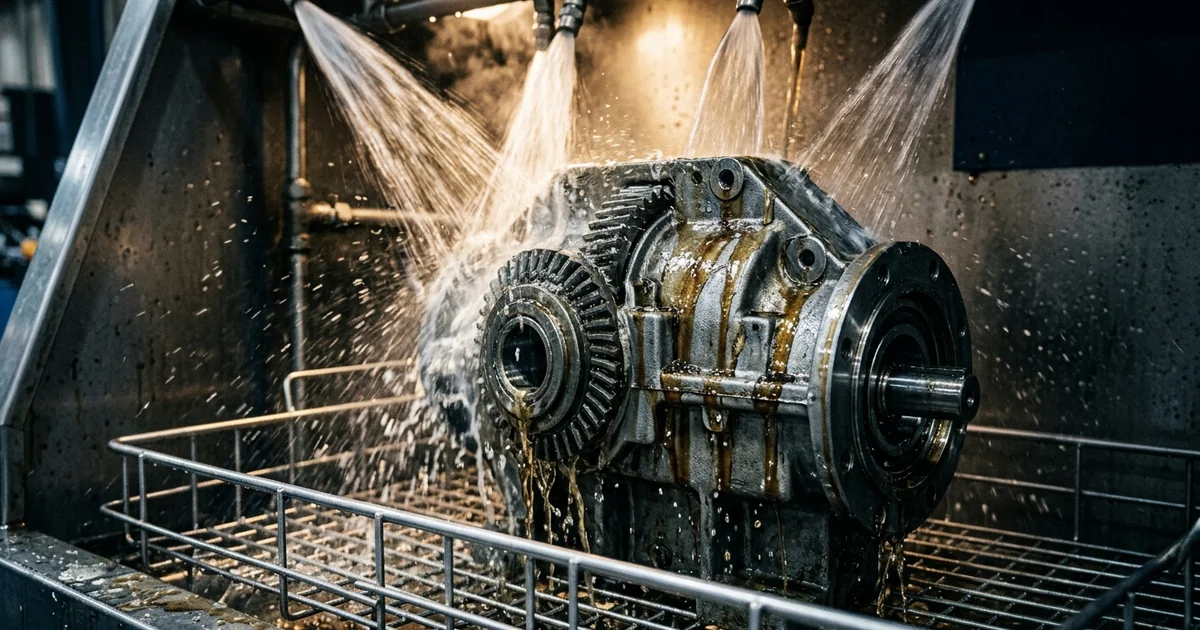
A machined part leaves the shop floor carrying cutting oil, swarf, and coolant residue, and the washer that follows has one job: return it clean, dry, and rust-free. Many washers fail at that job because the detergent was chosen in isolation, without regard to the machine, the metal, or the soil. Foam stalls the pumps, aluminium etches, steel flash rusts within hours, and the bath needs dumping long before it should. Every one of those failures means rework, poor coating adhesion, or corrosion in storage. Industrial parts washer chemistry works only as a system of machine, metal, soil, and bath management, and this article walks through each link in turn. It draws on established cleaning science and shop-floor practice, so engineers and cleaner manufacturers can specify and formulate with confidence.
Industrial Parts Washer Chemistry Starts With the Sinner's Circle
Every cleaning process balances four variables, and a shortfall in one must be paid for by the others. The framework is known as the Sinner's circle: chemistry, mechanical action, temperature, and time. Industrial parts washers make the trade-offs visible, because each machine type supplies a different amount of mechanical action. Once you know which variables the machine already provides, the detergent's job becomes clear.
- Chemistry — the detergent, builders, surfactants, and inhibitors that loosen soil and protect the metal.
- Mechanical action — spray impact, agitation, or ultrasonic cavitation that physically removes soil.
- Temperature — heat that thins oils, speeds reactions, and softens waxy soils.
- Time — the contact period that lets chemistry and mechanics finish the job.
A spray cabinet supplies strong mechanical action and short contact time, so its detergent must behave very differently from one built for a still immersion tank. The spray cabinet, the most common industrial design, sets the first constraint.
Spray Cabinet Parts Washing Chemical: Why Low Foam Is Non-Negotiable
A spray cabinet recirculates cleaner through pumps and nozzles at high velocity, and that turbulence whips air into any surfactant solution. Foam reduces spray impact, starves the pump, and overflows the sump, so a foaming detergent cannot work in this machine however well it cleans in a beaker. Formulators therefore build spray detergents around low-foaming nonionic surfactants. These surfactants foam least near and above their cloud point, so formulators match the cloud point to the wash temperature. Our guide to foam control in cleaning products covers the wider toolkit.
- Surfactant choice — low-foam nonionics such as alcohol alkoxylates emulsify oil without building stable foam.
- Cloud point matching — the wash temperature sits near the surfactant's cloud point, so foam collapses while cleaning continues.
- Alkalinity source — builders and silicates lift soil and buffer the bath against acidic drag-in.
- Soil interaction — cutting fluids and oils carried into the bath change foam behavior, so foam control must be tested on a contaminated bath.
Spray relies on impact, but where parts are too intricate for jets to reach, immersion and ultrasonic systems take over, and their chemistry changes accordingly.
Ultrasonic Cleaning Solution Chemistry for Immersion Tanks
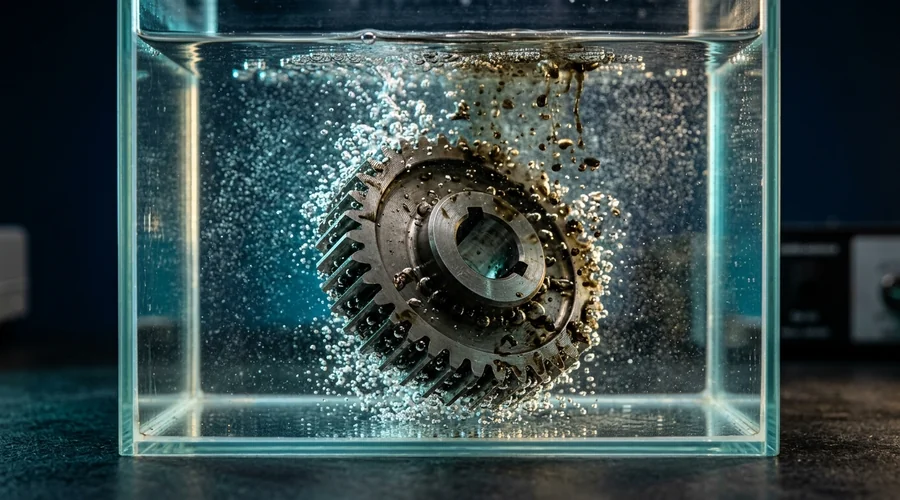
Ultrasonic tanks clean by cavitation: sound waves create microscopic bubbles that collapse violently at the part surface. The collapse drives micro-jets into crevices, blind holes, and threads that spray cannot reach. Chemistry supports this process rather than replacing it, which reverses the priorities of a spray detergent. The articles on ultrasonic cleaning and on cavitation explain the physics, and the formulation consequences follow directly.
- Degassing — dissolved gas cushions bubble collapse, so fresh solution runs empty until cavitation reaches full strength.
- Surface tension — surfactants must wet the soil so cavitation can reach it, but heavy foaming damps the sound field.
- Frequency — lower frequencies give larger, more aggressive bubbles for heavy soil, and higher frequencies clean delicate parts more gently.
- Metal sensitivity — strong cavitation erodes soft metals, and an aluminium foil test maps where intensity is highest in the tank.
| Machine type | Mechanical action | Best suited to | Chemistry priority | Main limitation |
|---|---|---|---|---|
| Spray cabinet | Impact of pressurized jets | Bulk soil on accessible surfaces | Low foam, cloud point matching | Shadowed areas and blind holes stay dirty |
| Immersion soak | Bath circulation or part movement | Heavy or baked-on soil needing long dwell | High solvency or alkalinity, inhibitors | Slow, and soil can redeposit without agitation |
| Ultrasonic tank | Cavitation | Complex geometry, precision parts, blind holes | Wetting, low foam, cavitation-friendly solution | Soft-metal erosion and shadowing from loaded baskets |
Machines and frequencies set how hard the soil is hit. The wrong detergent chemistry can still ruin the metal underneath, so the next question is what the parts are made of.
Aqueous Parts Washer Detergent: Matching Alkalinity to Metal and Soil
The detergent must remove oil and swarf without attacking the metal it cleans, and different metals set different limits. Strong alkalinity cleans steel well but dissolves aluminium and zinc and dulls brass. Neutral and mildly alkaline cleaners protect soft metals but work harder to lift heavy oil. Formulators resolve the conflict with builders, chelating agents, and metal-specific inhibitors. The approach builds on the pH principles in our guide to pH and cleaning and the surfactant logic in our surfactant selection guide.
| Metal in the load | Sensitivity to detergent | Common protection approach |
|---|---|---|
| Carbon steel | Tolerates alkalinity, but flash rusts after rinsing | Alkaline builders with rust inhibitors, followed by prompt drying |
| Aluminium and zinc | Attacked by strong alkalinity | Silicate inhibitors, or a neutral to mildly alkaline pH |
| Copper and brass | Tarnish and staining | Azole inhibitors such as tolyltriazole |
| Mixed-metal loads | The most sensitive metal sets the limit | Inhibited, moderate-pH detergent, with loads segregated where possible |
Water quality matters as well. Hardness ions precipitate builders and leave spots on finished parts. That is why these detergents carry chelating agents such as gluconate, GLDA, or MGDA, and why deionised rinse water is common. Our article on hard water challenges in detergent formulation explains how hardness undermines a formulation.
Even a perfectly matched detergent leaves bare steel exposed the moment the rinse ends, which is why rust protection is a separate design step.
Parts Washer Rust Inhibitor Options: Stopping Flash Rust After the Wash
Aqueous washing strips the protective oil film from steel, and a thin film of water then sits on bare metal in contact with air. Flash rust can appear within minutes to hours, long before the part reaches assembly or coating. Prevention is a design choice made at three points: the wash, the final rinse, and the drying and storage step. The corrosion inhibitor article describes the basic mechanisms, which form protective films or shift the surface chemistry.
- Inhibitor in the wash — alkaline builders with film-forming inhibitors give short-term protection during the process.
- Inhibited final rinse — a dilute rust preventive in the last stage leaves a thin protective film through drying.
- Hot-air drying — removing water quickly is the most effective single step and reduces reliance on inhibitors.
- Follow-up preservative — a light oil or wax from a separate stage carries protection through longer storage, as covered in our guide to rust preventive oils.
Formulators avoid combining nitrites with amines because the pair can form nitrosamines, and many inhibited systems are now nitrite-free. Suppliers verify protection by humidity cabinet exposure under ASTM D1748, and they check surface cleanliness after washing with the water-break test described in ASTM F22.
Getting the part clean and protected once is the easy half, and keeping the bath performing for weeks is where operating cost is won or lost.
Bath Life, Oil Separation, and Control in Aqueous Parts Washing
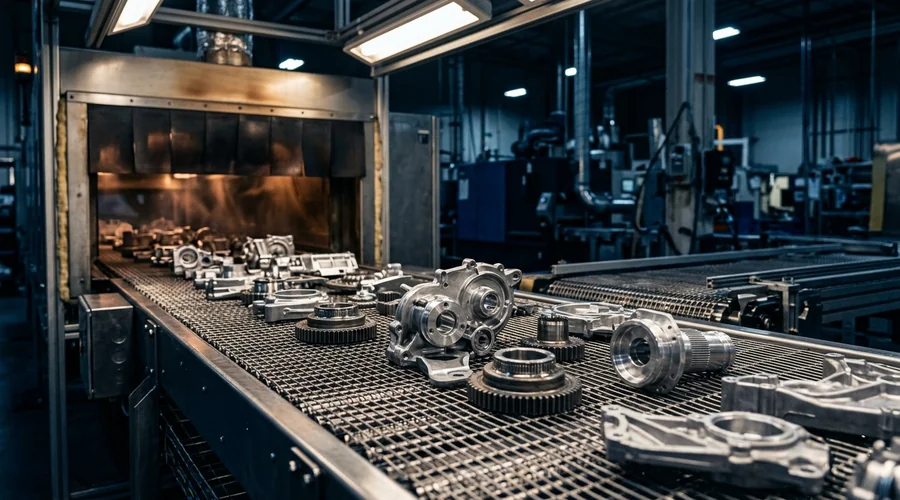
Every part that enters the washer adds oil, swarf, and coolant to the bath, and each addition erodes cleaning performance. A bath dumped early wastes chemistry and wastewater treatment capacity, while one run too long deposits soil back onto parts. Bath life is decided by how well the system separates oil and controls chemistry. Cleaner design, machine design, and monitoring all contribute.
- Demulsifying vs emulsifying cleaners — demulsifying cleaners let tramp oil rise so it can be skimmed, while emulsifying cleaners hold oil in suspension for more cleaning power but need filtration.
- Oil removal — skimmers, coalescers, and membrane ultrafiltration take oil out of the bath and extend its life.
- Particle filtration — bag or cartridge filters remove swarf that would otherwise recirculate through the nozzles.
- Concentration control — titration, refractometer, or conductivity readings keep detergent strength inside its working range.
- Microbial control — warm baths at neutral pH can grow bacteria that cause odour and pH drift, so alkalinity and biocide choice matter.
When foaming persists despite these controls, our guide to excessive foaming in industrial cleaning applications traces the usual causes. These routines turn a wash cycle into a repeatable process, and the final section shows how to decide on a system from the start.
A Decision Framework for Parts Washer Chemistry
Selection works best in a fixed order, because the machine and the metal constrain the chemistry before cost or preference enters. Start with the soil and the part, then the machine, then the detergent, then protection and bath control. Skipping a step usually costs more later than it saves now. The sequence below suits both plant engineers and cleaner manufacturers writing a product specification.
- Identify the soils: cutting oil, coolant residue, swarf, wax, or baked-on carbon.
- List every metal in the load, and note which is most sensitive to alkalinity.
- Choose the machine format, spray, immersion, or ultrasonic, from part geometry and throughput.
- Match the detergent: low-foam nonionics for spray, wetting-led chemistry for ultrasonic, and inhibitors for the most sensitive metal.
- Design the rust protection stage against the required storage time.
- Set bath monitoring and oil-removal routines before the first production run.
For cleaning-chemical manufacturers, the same sequence doubles as a product-development brief. A parts-washer range needs low-foam spray grades, ultrasonic grades, and a soft-metal-safe option, each with a stated inhibitor package. Solvent systems remain an option where drying or wastewater limits apply, and our comparison of solvent and aqueous degreasers weighs that choice. The wider set of formulations sits in our complete guide to industrial degreaser formulation and our household and industrial cleaners hub. Get the machine, the metal, and the soil right first, and the chemistry becomes the easy part.
Frequently Asked Questions
What is the difference between an emulsifying and a demulsifying parts washer cleaner?
Why does my spray parts washer foam, and how do I stop it?
Can one detergent clean both steel and aluminium parts?
How does an ultrasonic cleaning solution differ from a spray-cabinet detergent?
How do I prevent flash rust on steel parts after washing?
How do I know when a parts washer bath is exhausted?
Should I choose a solvent or an aqueous parts washer?
Need Expert Formulation Support?
Our team provides end-to-end technical consultancy — from cleaner formulation and inhibitor selection to test coordination and plant setup for industrial cleaning chemical manufacturers.
Get a Free Consultation