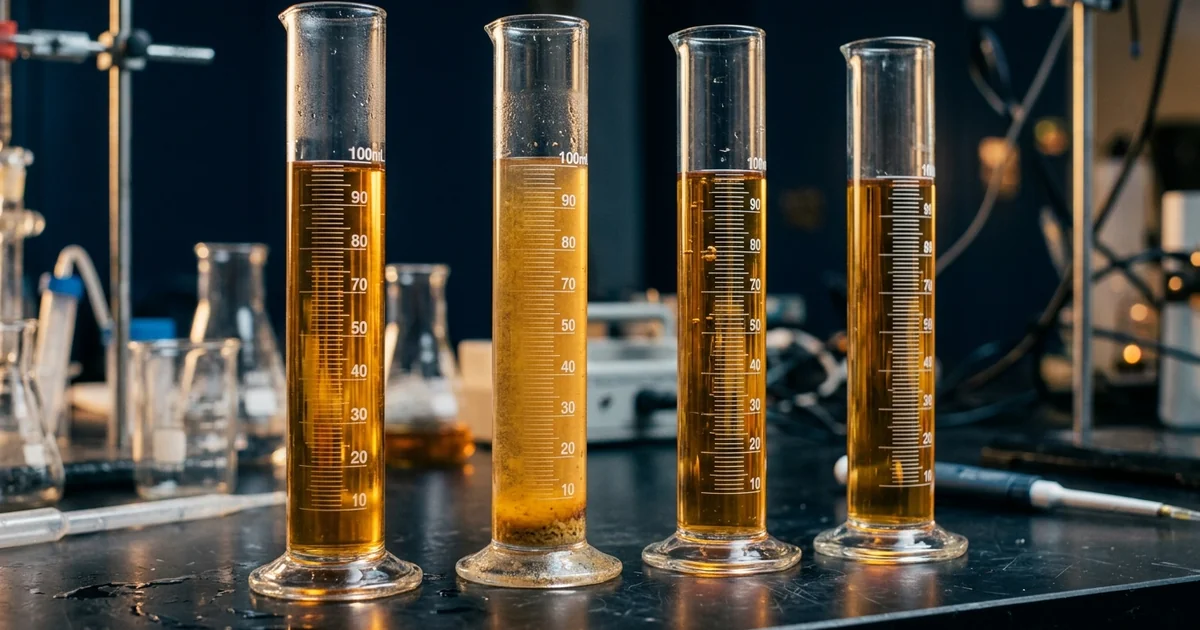
A hydraulic system that ran clean for years can start leaking within weeks of a lubricant change — not because the new oil failed its viscosity or additive spec, but because nobody ran lubricant additive compatibility testing against the seals already installed in that system. The additive package that performed perfectly in a mineral oil base can drop out of solution entirely in a different base stock, and a fluid that stays perfectly clear can still shrink an O-ring past the point where it holds pressure. Both failures are invisible on a standard oil analysis report, which is why compatibility testing is treated as a discipline of its own rather than an afterthought bolted onto viscosity and oxidation testing. This guide explains how additive solubility actually breaks down, which ASTM and ISO standards test elastomer and blend compatibility, and how to build a testing sequence that catches these failures on the bench instead of in a customer's machine. It draws on the same standards-led approach we bring to formulation work across our lubricants practice, and it pairs with our guides to common lubricant formulation errors and lubricant additives for the wider formulation context.
Why Additives Lose Solubility in the Base Oil
Every additive in a finished lubricant has to stay dissolved, not just at the moment of blending but across the fluid's entire storage and service temperature range. Solubility is a chemistry problem before it is a testing problem: an additive dissolves because its polarity is compatible with the base oil's polarity, and it drops out when that balance shifts. Different base oil groups offer very different starting points for that balance, which is why the same additive package that works in one base stock can fail in another without any change to the additive itself.
ASTM D611 measures aniline point — the lowest temperature at which equal volumes of aniline and the oil sample stay fully miscible — and it is the standard way to rank a base oil's solvency. Aromatic hydrocarbons give the lowest aniline points and the strongest solvency; paraffins give the highest aniline points and the weakest. That ranking maps directly onto the API base oil groups:
- Group I (solvent-refined mineral) — retains meaningful aromatic and naphthenic content, giving it the lowest aniline point and the strongest natural solvency of the mineral groups
- Group II and III (hydrotreated/hydrocracked) — higher saturate content and lower aromatics raise the aniline point, so these oils dissolve polar additives less readily than Group I despite their superior oxidation stability
- Group IV (PAO) — a fully saturated, essentially non-polar synthetic hydrocarbon with a high aniline point and weak solvency for polar additive chemistry on its own
- Group V (esters, PAG and other non-hydrocarbon bases) — inherently polar, so esters are often blended into Group IV formulations specifically to restore the solvency that PAO lacks
This is why a straight swap from mineral oil to PAO can strand additives that were perfectly stable in the original formulation. The treat rate that dissolved cleanly in Group I mineral oil can sit right at, or past, the solubility limit in Group III or Group IV base stock, and the only way to know is to test the actual formulation rather than assume the additive package will behave the same way twice.
Base oil polarity sets the ceiling on how much additive a formulation can carry, but staying under that ceiling on paper does not guarantee stability once the fluid meets storage, temperature swings and time — which is where precipitation actually shows up.
Additive Precipitation: Causes and Warning Signs
Precipitation is what happens when an additive that was fully dissolved at blending falls out of solution later, and it rarely happens for a single reason. The base oil's solvency sets how much margin the formulation has, but the trigger is usually an environmental or handling factor that pushes a marginal formulation past its limit. Recognising the common triggers is what separates a formulation that only fails occasionally, in the field, from one that is genuinely stable.
- Low-temperature exposure — solvency drops as temperature falls, so an additive package with adequate margin at room temperature can crystallise or cloud out during cold storage or winter operation
- Thermal cycling — repeated warm-cold cycles during transport and storage give dissolved additive repeated opportunities to nucleate, which is often more damaging than a single sustained cold soak
- Water contamination — water ingress in service can hydrolyse certain additives or disrupt the solvation shell around detergents and dispersants, triggering precipitation independent of temperature
- Blending errors — adding additive concentrate too quickly, at the wrong temperature, or without adequate mixing can exceed the local solubility limit even when the bulk formulation is within spec
- Incompatible top-up or field blending — mixing with a different oil during service tops up the treat rate of overlapping components without warning, which is a separate risk covered in the next section
Visual inspection catches the obvious cases: haze, sediment at the bottom of a sample jar, or a separated layer after storage are all signs that something has exceeded its solubility limit in that base oil. What visual inspection cannot quantify is how much precipitate forms, how fast, or whether it is enough to block a filter — for that, formulators turn to filterability testing, covered next.
Testing Blend Miscibility and Filterability
Once a formulation is suspected of marginal solubility, or once it needs to be qualified for field top-up with other oils, the question moves from "does it look clear" to a measured result. Two families of standard test cover this: miscibility testing checks whether a blend of two oils stays homogeneous, and filterability testing checks whether contamination triggers a precipitate fine enough to block a filter.
ASTM D6922 — written for automotive engine oils but widely used as a reference methodology for other lubricant blends — determines whether an oil composition is homogeneous and stays that way, and whether it remains miscible with standard reference oils after a prescribed cycle of temperature changes. It exists because operators frequently top up with whatever oil is on hand, without knowing whether it matches the oil already in the system, so the standard tests the worst realistic case rather than a like-for-like blend.
Filterability testing takes a more direct route to the same underlying question — will this oil form a precipitate that blocks a filter under realistic contamination conditions:
- ASTM D6794 — doses the oil with varying amounts of water and heats it for a long (6-hour) period, simulating a fluid that has picked up moisture and then sat in storage; filter flow is measured before and after
- ASTM D6795 — doses the oil with water and dry ice for a short (30-minute) heating period, simulating a fluid that ran briefly in a new engine before a long storage period with residual water still present
Both methods were developed for engine oils, but the underlying logic — contaminate under controlled conditions, then measure the drop in filter flow — is the standard reference approach formulators reach for whenever a broader precipitation risk needs a quantified answer rather than a visual judgement call. A formulation that passes visual inspection but fails filterability testing has a precipitation problem that simply has not shown itself yet.
Why Seal Compatibility Is Tested Separately From Additive Solubility
Additive solubility and elastomer seal compatibility sound like the same question, but they test entirely different failure modes. Solubility asks whether the additive package stays inside the oil. Seal compatibility asks what the finished oil — additives, base stock and all — does to the rubber components it touches once it is in service. A fluid can be perfectly clear and pass every filterability test while still ruining every O-ring in the system it is installed in.
The mechanism runs in the opposite direction from precipitation. Where precipitation is about additive leaving the oil, seal interaction is about small molecules in the oil — often the same polar esters and additives that solubility depends on — migrating into the elastomer itself. A polar fluid can swell and soften a seal by penetrating its polymer network, while a non-polar fluid can extract the plasticiser that keeps a seal flexible, shrinking and hardening it instead. Both directions cause leaks; they just get there differently.
This is where the PAO-versus-mineral-oil story reappears from a different angle. Mineral oil's natural aromatic content gives it enough polarity to swell elastomer seals to roughly the dimension they were designed around. A pure PAO fluid, being non-polar, tends to shrink those same seals instead — which is exactly why formulators blend polar esters into PAO-based lubricants, not only to help dissolve additives but to restore the seal swell that all-hydrocarbon synthetic base oils lack on their own.
Because the effect depends on both the fluid's chemistry and the specific elastomer, there is no shortcut around testing the actual pairing. That testing is standardised, and the next section covers exactly how it is run.
ASTM D471, ASTM D4289 and ISO 6072: How Seal Compatibility Testing Works
Three standards cover most elastomer compatibility testing for lubricants, and each has a slightly different scope. Together they answer the practical question a specifier actually has: if this fluid sits against this seal material at this temperature for this long, what happens to the seal?
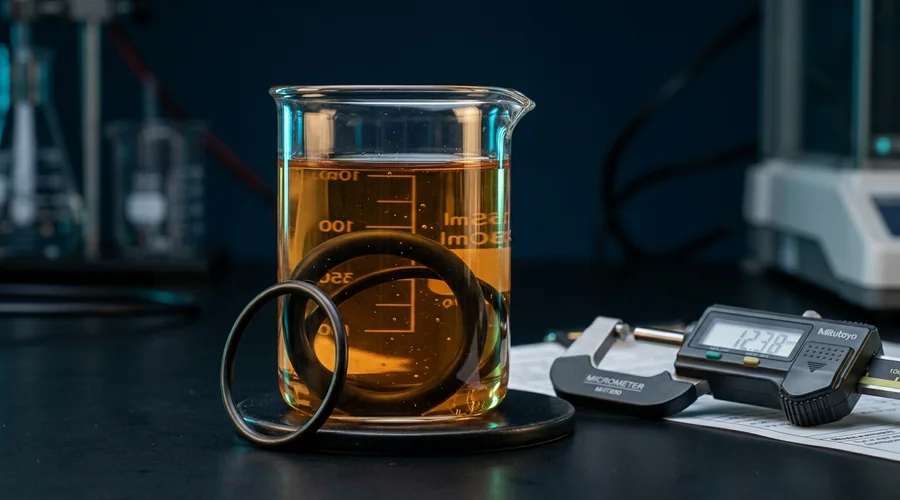
- ASTM D471 — the general-purpose rubber immersion test, applicable to vulcanised rubber and rubber-like compositions in almost any liquid. Specimens are immersed at a controlled temperature and time, then measured for change in volume, mass, hardness and tensile properties against an unexposed reference.
- ASTM D4289 — purpose-built for lubricating greases and fluids in contact with seals, boots and O-rings under everyday, non-extreme service conditions. Coupons are totally immersed for 70 hours at either 100°C or 150°C, and the result is reported as change in volume and change in Durometer A hardness.
- ISO 6072 — the hydraulic-fluid-focused equivalent, specifying formulations for five standard reference elastomer compositions (two NBR grades, one FKM, one EPDM and one HNBR) so that different fluids can be compared against the same baseline elastomer batch rather than whatever rubber happens to be on hand.
Elastomer families do not respond to fluids uniformly, which is why the test always has to be run against the actual seal material in the actual fluid rather than generalised from a similar-sounding rubber:
| Elastomer | Common name | Typically compatible with | Typically avoided with |
|---|---|---|---|
| NBR | Nitrile, Buna-N | Mineral oils, many PAO and ester synthetics, general-purpose greases | Phosphate ester fluids; degrades under sustained ozone/UV exposure |
| EPDM | — | Phosphate ester fluids, glycol-based brake and hydraulic fluids, water-based fluids | Petroleum mineral oils and most synthetic hydrocarbon lubricants |
| FKM | Fluorocarbon, Viton | Broadest range of fluid chemistries; mineral oils, synthetic hydrocarbons, many esters, high-temperature service | Some ketones, amines and low-molecular-weight esters |
| Silicone | VMQ | Food-grade applications, wide service temperature range, low-temperature flexibility | Hydrocarbon oils, which tend to swell and soften it; concentrated acids |
| HNBR | Hydrogenated nitrile | Mineral oils and PAO, with better heat and ozone resistance than standard NBR | Same general exclusions as NBR, at a higher material cost |
These are general industry tendencies, not a substitute for testing a specific fluid against a specific elastomer grade — formulation additives and cure systems shift the boundaries within each family. The standards above exist because a general compatibility chart narrows the candidates; only immersion testing under ASTM D471, D4289 or ISO 6072 confirms the pairing.
Additive Package and Supplier Blend Compatibility
Most compatibility failures in the field trace back not to a single additive package but to two packages meeting each other unexpectedly — a top-up with a different brand, a switch in additive supplier mid-production run, or a contract blender substituting a component without flagging the change. Additive packages are formulated as balanced systems, and disturbing that balance is a different failure mode from simple solubility.
- Detergent-dispersant antagonism — metal-containing detergents from one package can interact with the dispersant chemistry of another, displacing it from solution or reducing its effectiveness at holding contaminants in suspension
- Treat-rate stacking — blending two fully treated oils does not average their additive concentration; overlapping components can combine to exceed the solubility limit that either package respected on its own
- Antioxidant and inhibitor conflicts — some antioxidant chemistries interfere with each other's radical-scavenging mechanism when mixed, reducing the oxidative protection below what either package delivers alone
- Foam and air-release interactions — anti-foam and air-release agents from different packages can counteract one another, showing up as foaming or slow air release that neither individual oil exhibited
None of these interactions are visible from the individual data sheets of the two oils involved — each can meet its own specification perfectly and still produce an unstable blend. That is precisely the gap ASTM D6922 is designed to close, by testing the blend itself under a temperature cycle rather than trusting the sum of two compliant components.
A qualification protocol built around this risk is straightforward in principle: identify every additive supplier and every base oil source that could plausibly end up mixed with the product in the field, then run miscibility and storage-stability testing on the worst realistic combinations rather than only the intended, single-supplier formulation. Skipping this step because "the specification passed" is the single most common reason a lubricant that tested perfectly in isolation fails once it meets the real world of field top-ups and supplier substitutions.
Building a Lubricant Additive Compatibility Testing Program
Solubility, precipitation and seal compatibility are three separate risks with three separate test protocols, and treating them as one undifferentiated "compatibility check" is how gaps appear. A structured program runs them in a deliberate order, so that each stage narrows the field before the more time-consuming tests begin.
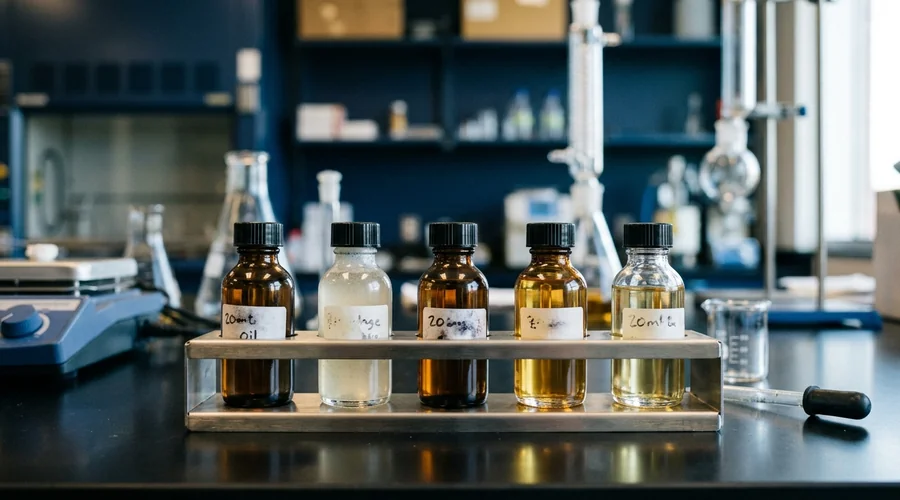
- Map every contact material — list every elastomer, seal and gasket the fluid will actually contact in service, not just the primary O-ring, since secondary seals are often overlooked until they fail
- Rank base oil solvency — confirm the aniline point of the intended base oil under ASTM D611, then verify actual additive solubility at the target treat rate rather than relying on the ranking alone
- Qualify likely blends — if the product may be top-up blended with competitor oils in the field, run ASTM D6922 miscibility testing against the most likely oils it will meet
- Test filterability under contamination — run ASTM D6794 or D6795, or an equivalent water-and-heat protocol, to confirm the formulation does not precipitate a filter-blocking residue under realistic contamination
- Run elastomer immersion testing — test every seal material identified in step one under ASTM D471, D4289 or ISO 6072, at the actual service temperature rather than a generic reference condition
- Validate with extended storage — run low-temperature and thermal-cycling storage trials over weeks, not days, before releasing the specification, since slow additive fallout often only appears with time
- Document pass/fail criteria per pairing — publish the tested elastomer/fluid combinations and their results on the product data sheet, so field engineers are matching a seal to documented data rather than guessing from a general compatibility chart
The reference standards in this guide are summarised below for quick lookup when scoping a testing program:
| Standard | What it measures | Primary scope |
|---|---|---|
| ASTM D611 | Aniline point — base oil polarity and solvency ranking | Petroleum products and hydrocarbon solvents |
| ASTM D6922 | Homogeneity and miscibility of a blended oil through a prescribed temperature cycle | Automotive engine oils; used as reference methodology elsewhere |
| ASTM D6794 | Filterability after water treatment with a long (6 h) heating period | Engine oils |
| ASTM D6795 | Filterability after water/dry-ice treatment with a short (30 min) heating period | Engine oils |
| ASTM D471 | Change in volume, mass, hardness and tensile properties after rubber immersion in a liquid | General — rubber and rubber-like compositions in any liquid |
| ASTM D4289 | Change in volume and Durometer A hardness after 70 h immersion at 100°C or 150°C | Lubricating greases and fluids |
| ISO 6072 | Compatibility between hydraulic fluids and five standard reference elastomer compositions | Hydraulic fluid power |
No single test replaces the others, because each one is built to catch a different failure. A program that runs all seven in the right order — narrowing from solvency ranking down to full elastomer immersion — catches the compatibility failures that a standard viscosity and oxidation specification was never designed to find.
Frequently Asked Questions
What is the difference between additive solubility and elastomer seal compatibility?
Why do synthetic PAO-based lubricants sometimes need a co-base oil that mineral oils don't?
What does the ASTM D471 seal swell test actually measure?
Can two lubricant additive packages from different suppliers be blended together safely?
How is additive precipitation detected before a lubricant fails in service?
Which elastomer is the safest default choice for lubricant seals?
How long should a compatibility testing program take before a new lubricant formulation ships?
Need Expert Formulation Support?
Our team provides end-to-end technical consultancy — from chemistry development and scale-up to plant design and regulatory strategy for lubricant and specialty-fluid ventures.
Get a Free Consultation