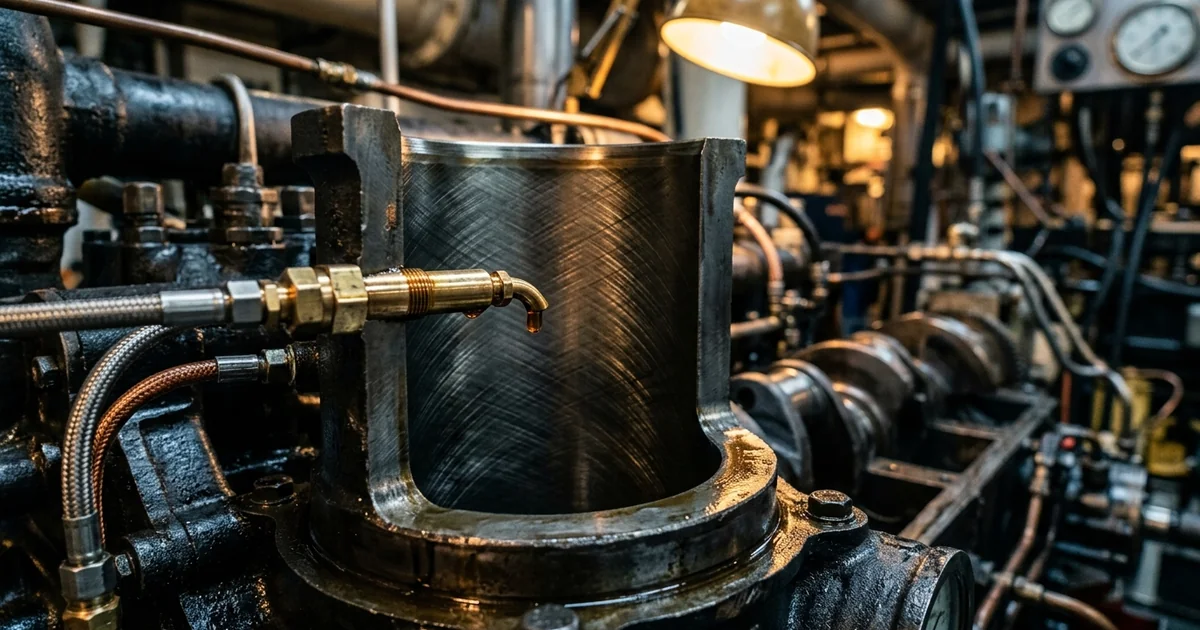
Since January 2020, most ships have burned fuel containing a fraction of the sulfur they burned before, yet many kept feeding the same high-alkalinity cylinder oil. The result appears on the piston crown as hard deposits and on the liner as a glazed, polished bore. Marine cylinder oil BN selection is now a fuel-matching decision rather than a default purchase, and a wrong choice costs liners, rings, and engine availability. This article explains how base number neutralizes sulfuric acid, how BN grades map to fuel sulfur, and how feed rate and scrape-down analysis complete the picture. It follows the way lubricant engineers, fuel suppliers, and engine builders treat the problem in practice, so a formulator, blender, or ship operator can apply it directly.
How IMO 2020 Reshaped Marine Engine Lubricant Requirements
Global regulation is the reason cylinder oil selection changed overnight. The International Maritime Organization's global sulfur cap took effect on 1 January 2020. It cut the permitted sulfur content of marine fuel outside emission control areas from 3.50 to 0.50 percent by mass, as the IMO sulphur 2020 page sets out. Inside emission control areas the limit was already 0.10 percent. Cylinder oil is a chemical answer to fuel sulfur, so any change in the fuel shifts the whole lubrication problem. Owners responded in three ways, with three different oil demands.
- Very-low-sulfur fuel oil (VLSFO) — compliant blends at or below the global cap, and the most common route; the acid load drops sharply and BN demand falls with it.
- Scrubber-equipped ships — exhaust gas cleaning systems let vessels keep burning high-sulfur heavy fuel oil, so high-BN cylinder oils stay in service.
- Distillate and gas fuels — marine gas oil in emission control areas, and LNG in dual-fuel engines, carry little or no sulfur and call for the lowest-BN cylinder oils.
Ships operating in saltwater and corrosive environments face further lubrication stresses, which we cover in our guide to marine and saltwater environments. Each fuel route sets a different acid load on the liner. To see why BN is the lever that matches it, we need the chemistry of acid formation and neutralization.
Cylinder Oil Base Number: How Alkaline Additives Neutralize Sulfuric Acid
Sulfur in the fuel burns to sulfur dioxide, and a small fraction oxidizes further to sulfur trioxide inside the cylinder. Sulfur trioxide combines with water vapor from combustion to form sulfuric acid, which condenses on the liner wherever the wall temperature falls below the acid dew point. That dew point rises with fuel sulfur content and cylinder pressure, so an engine can corrode at low load and run clean at high load. Cylinder oil counters the acid with an alkaline reserve, measured as base number, that reacts with the acid before it attacks the iron.
- Acid formation — sulfur trioxide and water vapor form sulfuric acid that condenses on the cooler liner surface.
- Contact — the acid meets the oil film, which carries colloidal overbased detergent particles across the liner.
- Neutralization — the calcium carbonate core of each detergent particle reacts with sulfuric acid to form calcium sulfate, water, and carbon dioxide.
- Removal — spent detergent and calcium sulfate leave with the scraped-down oil, and fresh oil from the lubricator restores the reserve.
Base number is the acid-neutralizing capacity of one gram of oil, expressed in milligrams of potassium hydroxide equivalent. Laboratories measure it by potentiometric titration under ASTM D2896, and the total base number article gives the general background. Formulators build the reserve from overbased calcium sulfonate, phenate, or salicylate detergents in a high-viscosity base stock, usually of SAE 50 grade, and add dispersants and anti-wear components. Detergent type and colloid size govern how fast the reserve reacts, which matters more than the headline number when acid arrives in short bursts. The base stock follows the classification in our guide to lubricant base oil types. The additive logic sits within the wider field described in our overview of lubricant formulation and technology.
Because cylinder oil, system oil, and trunk piston oil all carry a BN yet do very different jobs, the next question is which oil belongs where.
Ship Engine Oil Families: Cylinder Oil vs System Oil vs Trunk Piston Oil
Marine engines use three distinct oil families, and confusing them is a costly error. Large slow-speed two-stroke engines use a crosshead design, which separates the combustion space from the crankcase with a sealed stuffing box. That separation lets the crankcase run on a clean, low-BN system oil while a different, high-BN oil serves the liner. Medium-speed four-stroke trunk piston engines have no such barrier, so one oil must handle both jobs. The two-stroke diesel engine article explains why two-stroke marine engine oil is split into these separate circuits.
| Oil family | Engine type | Delivery | BN level | Main role |
|---|---|---|---|---|
| Cylinder oil | Slow-speed two-stroke crosshead | Timed injection onto the liner; total loss | Low to high, matched to fuel sulfur | Neutralize acid, protect liner and rings |
| System oil | Same engines, crankcase side | Circulated, filtered, reused | Low | Bearings, crosshead, camshaft; oxidation and water handling |
| Trunk piston engine oil | Medium-speed four-stroke | Circulated, shared with the cylinder | Moderate to high, matched to fuel | All duties in one: bearings, cooling, acid neutralization |
With each oil's role fixed, the practical question becomes how to match a BN grade to the fuel actually in the tank.

Marine Cylinder Oil BN Selection by Fuel Sulfur Level
Cylinder oils are labelled by nominal BN, and the grades in common use span roughly 15 to 140. Engine builders and oil suppliers recommend a grade by fuel sulfur band, because the acid load on the liner tracks the sulfur burned. The right grade neutralizes the acid formed without leaving surplus alkalinity behind. The table below summarizes the logic, while the engine maker's approval list decides the exact grade for a given engine.
| Fuel or operating condition | BN class in common practice | Risk if mismatched |
|---|---|---|
| Distillate fuel or LNG dual-fuel gas mode | Lowest grades in the range | Ash deposits and bore polishing from surplus alkalinity |
| VLSFO at or below the global cap | Low to medium, around 40 to 70 | Overbasing if too high; corrosive wear if too low |
| Scrubber ship burning high-sulfur heavy fuel oil | High, around 100 or above | Cold corrosion and liner wear if BN falls short |
| Ship that switches between fuels | Two cylinder oils on board, or one mid-BN oil with adjusted feed rate | Poor changeover timing leaves the liner under- or over-neutralized |
Choosing the grade is only half of the job, because the other half is how much of that oil actually reaches the liner.
Feed Rate and Overbasing: The Hidden Risk in Low-Sulfur Marine Fuel Lubrication
Feed rate, the mass of oil injected per unit of engine work, decides how much BN meets the acid. Under-feeding lets acid corrode the liner. A high-BN oil fed against a low-sulfur fuel leaves surplus alkaline detergent with no acid to react with. Engine builders reported this second failure, called overbasing, once fuel sulfur dropped, and its consequences build on one another.
- Ash deposits — unreacted calcium carbonate builds up on the piston crown and top land.
- Bore polishing — hard deposits burnish the liner and erase the honing pattern that holds the oil film.
- Scuffing risk — a polished bore retains less oil, and ring-to-liner contact can degrade into scuffing.
- Wasted oil — every extra gram of cylinder oil is a cost with no protective benefit.
Engine builders answer with a feed rate proportional to fuel sulfur and engine load, rather than a fixed one. Sulfur-proportional schemes such as MAN's Alpha Adaptive Cylinder-oil Control (Alpha ACC) apply this logic. A minimum feed rate keeps a lubricating film on the liner whatever the sulfur level. The two variables then work together: BN sets the neutralizing capacity per gram, and the feed rate sets how many grams arrive.
Neither BN nor feed rate can be tuned by calculation alone, which is why the liner has to be checked directly while the engine runs.
Scrape-Down Oil Analysis: Reading BN Consumption From the Liner
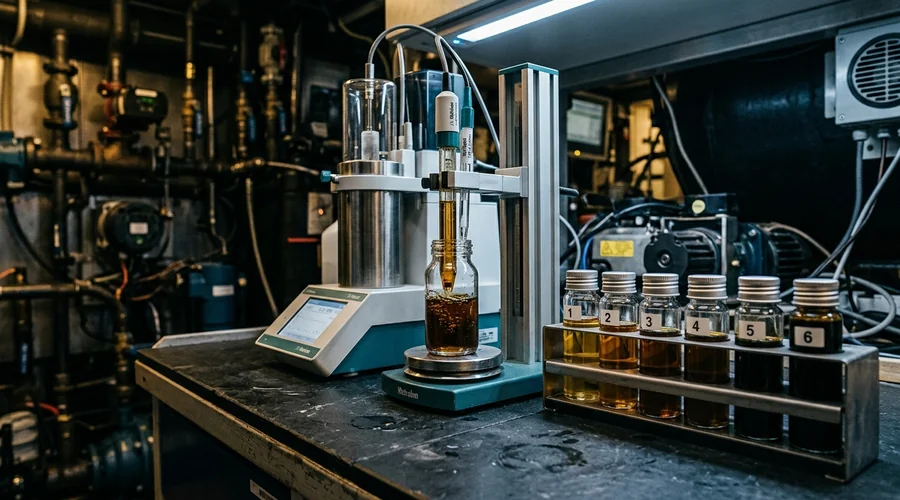
Scrape-down analysis tests oil drained from the scavenge space beneath the piston for residual BN and wear metals. The sample shows what the acid left behind, meaning how much neutralizing reserve survived and how much iron the liner shed. It is the only routine check that reports on the liner while the engine runs, and engine builders publish target windows for the results. The same trend-based logic applies across all lubricant condition monitoring, as covered in our guide to lubricant oxidation and service warning signs.
- Residual BN — a value falling toward the engine builder's lower limit signals under-neutralization, and a very high value shows surplus alkalinity passing through unused.
- Iron content — rising iron indicates liner and ring wear, and a sudden climb after a fuel change points to acid attack or abrasives.
- Cat fines — aluminium and silicon from refinery catalyst fines in the fuel are abrasive and explain wear that has no acid link.
- Trend over time — one sample can mislead, so the slope across several samples drives feed-rate adjustments.
With measurement data in hand, the remaining task is to turn it into a repeatable selection process, which the final section lays out.
A Practical Decision Framework for Cylinder Oil Selection
Selection works best as a sequence, because each answer narrows the next. Start with what the engine builder approves, then establish the fuel burned, and only then choose grade and feed rate. Finish with measurement, since scrape-down data corrects the assumptions made earlier. The steps below apply whether you operate a fleet or supply cylinder oil to one.
- Confirm the engine builder's approved cylinder oils and their BN ranges for the engine model.
- Establish the fuel: its type, its declared sulfur, and how often it changes.
- Match the BN class to sulfur using the table above, and choose a mid-BN oil or a two-oil strategy for ships that switch fuels.
- Set the feed rate against actual sulfur and load, with the engine builder's minimum as the floor.
- Sample scrape-down oil on schedule, and adjust feed rate or grade on the trend.
- Repeat the selection whenever the fuel supplier, fuel type, or operating profile changes.
For blenders and brand owners, the lesson is commercial as well as technical. A cylinder oil range that stops at legacy high-BN grades no longer covers the market, because low-sulfur fuel demands a full ladder of grades backed by engine builder approvals. Cylinder oil is one branch of a wider field, and our lubricants formulation hub maps the rest. Matching BN to sulfur, then confirming it on the liner, is the discipline that protects both the engine and the margin.
Frequently Asked Questions
What does BN mean on a marine cylinder oil label?
Why can't a ship keep using a high-BN cylinder oil with very-low-sulfur fuel?
Is marine cylinder oil the same as system oil?
How does a scrubber change the choice of cylinder oil?
What is cold corrosion, and when does it happen?
What does scrape-down oil analysis measure, and how often is it done?
Can one cylinder oil serve both LNG dual-fuel and fuel-oil operation?
Need Expert Formulation Support?
Our team provides end-to-end technical consultancy — from lubricant formulation and additive selection to test coordination and plant setup for marine and industrial lubricant manufacturers.
Get a Free Consultation