A plant that cooks alkyds from raw soya oil is asked for a paler grade, while another, running distilled fatty acid, is told to cut raw material cost. Both find that the route is not a simple swap. A monoglyceride process alkyd line and a fatty acid line reach the same polyester but charge the reactor differently, evolve water at different stages and fail differently. A wrong choice costs batch hours, resin colour and, in the worst case, a reactor cleaned out by hand. This guide explains what alcoholysis makes, how its endpoint is judged, where the fatty acid route carries its extra water and how the two compare on plant criteria. It builds on our overview of alkyd resin manufacture and oil length and reflects the route-selection work we do in our chemical reaction engineering practice.
The Monoglyceride Process Alkyd Route: What Alcoholysis Actually Makes
The word monoglyceride oversells what the first stage produces, and that gap is where the route's quality problems start. Alcoholysis of vegetable oil for alkyd resin is a transesterification. The oil's ester bonds redistribute onto added polyol, giving a mixture of mono- and diglyceride oils rather than a pure monoglyceride. A triglyceride carries no free hydroxyl group, so only the hydroxyl-bearing species can take part in polyesterification, which makes the finished batch only as good as its alcoholysis.
Four features define the first stage:
- Frees hydroxyl groups — fatty ester bonds move onto shared polyol, leaving hydroxyl-bearing glycerides that the anhydride can react with later.
- Evolves no water — transesterification exchanges ester bonds without condensing any, so no separator duty falls in this stage.
- Attaches the fatty chains before any acid is present — the oil-derived groups are already on the polyol when the phthalic anhydride arrives.
- Leaves a mixture, not a compound — mono-, di- and residual triglyceride coexist with unreacted polyol, and the balance shifts with conditions and oil composition.
The second stage begins when phthalic anhydride is charged onto the alcoholysis product. The anhydride ring opens on a hydroxyl group to give a monoester without releasing water. Per the phthalic anhydride reference page, the second esterification "is more difficult and requires removal of water", which is where the reflux condenser and separator earn their place. Our guide to alkyd resin manufacture covers the choice between azeotropic and fusion water removal, so this article takes it as given.
The plant consequence is a split in duty. Stage one is limited by chemistry and by how it is tested, while water-removal capacity matters only from stage two onward. The next section takes up that test, because it decides whether stage two starts from the intermediate the recipe assumed.
Alcoholysis Catalyst and the Methanol Tolerance Endpoint
Stage one is catalysed, and it ends on a solubility test rather than an analytical number. That makes it the route's most variable quality gate and its most common source of batch-to-batch drift. Lithium hydroxide is the alkyd alcoholysis catalyst named in the peer-reviewed example we cite, run with glycerin as the polyol. Two alcoholysis batches can look identical to the operator yet contain different amounts of convertible oil.
How Do You Know When Alcoholysis Is Complete?
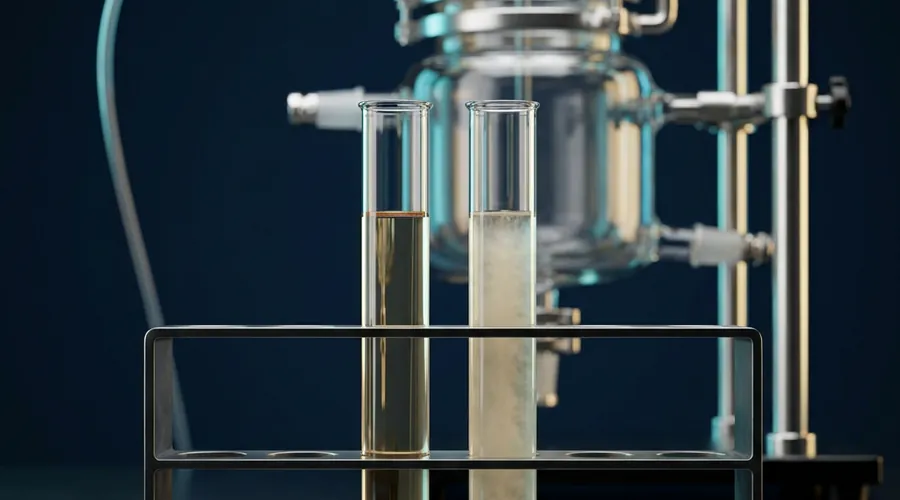
In the methanol tolerance test for alkyd alcoholysis, operators mix a sample with methanol. The principle is simple: "Methanol does not dissolve the oil but monoglycerides are soluble in it", so a clear solution means enough hydroxyl-bearing glyceride has formed to proceed. The cited example treats one part of sample fully dissolved in three parts of methanol as a complete reaction. Ratio, temperature and methanol grade belong in each product's validated batch record, not in a general article.
A sample reads one of three ways:
- Clear — conversion has reached the point where the sample dissolves, and the anhydride can be charged.
- Cloudy or with oil droplets — unconverted triglyceride remains, so the batch is held and re-tested rather than moved on.
- Different answers from different operators — the method is out of control, because sample size, temperature or the water content of the methanol is drifting.
Treat the methanol tolerance test as a controlled measurement with a written method. It is the only gate between the alcoholysis product and everything that follows.
Why the Alcoholysis Catalyst Stays in the Batch
The cited flowsheet charges phthalic anhydride straight onto the alcoholysis product, so the catalyst stays in the vessel and ends up in the finished resin. A study in Surface Coatings International Part B compared lithium hydroxide, butyl tin oxide and dibutyl tin chloride in soya-oil alkyds. It evaluated each catalyst's effect on process time and film properties. The catalyst is therefore a whole-batch decision, and it should be chosen with the film specification in view.
Glycerol or Pentaerythritol as the Alcoholysis Polyol
The polyol sets the branching before any acid is charged. Glycerol carries three hydroxyl groups and pentaerythritol carries four, so a pentaerythritol-based intermediate branches harder and leaves less gel-point margin at a given conversion. Pentaerythritol is also a solid that melts at 260.5 °C, so it has to dissolve and react into the oil rather than simply blend with it. The catalyst study above ran soya oil with pentaerythritol, so the pairing appears in published alkyd work.
Choose the polyol with the Carothers equation and the Patton alkyd constant in hand, because the branching bought in stage one is the margin lost in stage two. The fatty acid route sidesteps both the test and the intermediate, at a price the next section quantifies.
The Fatty Acid Route: One Stage, More Water, Tighter Control
The fatty acid route replaces alcoholysis with direct esterification of acids, so every ester bond forms in the same cook. That moves the plant's effort from a stage-one endpoint test to feedstock specification and water removal. Each monomer is metered individually, so the charge sets the composition, and Wikipedia's alkyd article credits this route with higher-quality, higher-performance resins. The trade is a costlier raw material and a heavier water load in one vessel.
Four things change at the reactor:
- Water load — fatty ester bonds now condense inside the reactor, so the condenser and separator carry more distillate than in stage two of the monoglyceride route.
- Feedstock specification — unsaturation, acid value and colour arrive with the raw material, so goods-in testing is the control point. Use iodine value (ISO 3961 for fats and oils, ASTM D5768 for tall oil fatty acids), acid value and Gardner colour (ASTM D1544).
- Hydroxyl competition — fatty acid and anhydride compete for the same polyol hydroxyls in one vessel, with no preformed glyceride to fix where the fatty chains sit.
- Feedstock cost — fatty acids come from hydrolysed and distilled oil or from tall oil, and that processing sits in the price.
The water-of-esterification load of the fatty acid route is the difference most often underestimated when a product changes route. As an illustration only, building a triglyceride from glycerol and three fatty acid molecules releases three molecules of water. For trilinolein, the idealised triglyceride of linoleic acid, the molar masses are 879 g/mol for the triglyceride, 280.5 g/mol for linoleic acid and 92.1 g/mol for glycerol. That is 54.0 g of water per 879 g of triglyceride built, roughly 6 kg per 100 kg. Alcoholysis of a natural oil releases none of it, and the figure shows direction and scale, not a plant number.
With both routes described, the comparison can be made on plant criteria instead of slogans.
Monoglyceride vs Fatty Acid Alkyd: Head-to-Head on Plant Criteria
A route comparison that stops at cheaper versus better hides the criteria that actually decide a transfer. The table compares the routes on four plant variables: where water leaves, where the quality gate sits, how often the batch is held hot and what the feedstock must meet. It does not repeat the cost-and-colour summary in our alkyd resins manufacturing guide. Read it as a checklist of what must be true of a site before a product changes route.
| Criterion | Monoglyceride route | Fatty acid route | Plant consequence |
|---|---|---|---|
| Fatty raw material | Refined triglyceride oil | Fatty acid from hydrolysed and distilled oil, or tall oil fatty acid | Feedstock cost against feedstock control |
| Water from the fatty ester bonds | None; alcoholysis is a transesterification | Evolved during the cook; about 6 kg per 100 kg of triglyceride built (illustrative) | Condenser and separator duty |
| Stage-one quality gate | Methanol tolerance test, a visual pass or fail | None; specification checked at goods-in | Where variation is caught |
| Alcoholysis catalyst | Alkaline catalyst stays in the batch (lithium hydroxide in the cited example) | No alcoholysis catalyst to carry through | Catalyst residue and film properties |
| Thermal history | Two holds at temperature; anhydride charged after cooling in the cited example | One hold in a single cook | Colour budget and cycle time |
| What sets composition | Alcoholysis equilibrium mixture plus the charge | The charge alone | Recipe transfer between sites |
| Typical position | More economical; end-product quality control less paramount | Higher-quality, higher-performance alkyds | Grade positioning |
Three rows carry most of the decision. Water duty decides whether existing equipment can host the fatty acid route. Quality-gate design decides how much operator judgement a transfer must carry. Thermal history decides whether a colour target is reachable at all. The raw material and positioning rows matter commercially but rarely settle feasibility.
The takeaway is an order of operations. Confirm water duty first, the endpoint method second and the colour budget third, and only then argue about the price of the fatty raw material.
Route-Specific Failure Modes: Reading the Signature
The two routes fail at different points, and the point of failure names the cause. In the monoglyceride route, trouble concentrates at the alcoholysis gate and in thermal history. In the fatty acid route it concentrates in water removal and charge accuracy. Diagnosis is quickest when the first question is which stage owns the variable.
Monoglyceride Route: Cloudy Samples, Haze and Drift
Most monoglyceride-route problems trace to an alcoholysis that ended too soon or was judged inconsistently. Because the second stage builds on the intermediate, the fault surfaces later as haze, colour or viscosity drift rather than at its source. Reading the symptom back to stage one is the fastest route to a fix.
- Sample stays cloudy in methanol — conversion is incomplete. Alkaline transesterification is highly sensitive to water and to free fatty acids, and water drives saponification to soap, so check the oil and polyol for moisture and acidity. Poor contact between polyol and oil also slows the exchange. Hold and re-test rather than charge the anhydride on a failed sample.
- Haze in the thinned alkyd resin — triglyceride carried through from a marginal alcoholysis, or an oil length mismatched to the thinning solvent. Our oil length and route guide covers the second cause.
- Dark alkyd resin — two thermal holds instead of one, oxygen entering at the anhydride charge, or iron pickup from the vessel wall. Our guide to reactor materials of construction covers the last hazard.
- Batch-to-batch viscosity drift — the alcoholysis endpoint varies with the operator's reading, and the fatty acid composition of a natural oil varies between lots. Trend hydroxyl value (ISO 4629-2) and acid value (ISO 2114) across lots to separate the two causes.
Fatty Acid Route: Stalled Acid Value and Charge Errors
Fatty acid route problems concentrate where the water leaves and where the monomers are weighed. There is no intermediate stage to catch an error, so a wrong charge or a weak condenser shows up in the cook itself. The signatures are distinct enough to separate at the reactor.
- Acid value falls slowly or stalls — water removal is limiting, through a flooded condenser, wet returned solvent or an inadequate inert-gas sweep. This route evolves more water, so check distillate duty first.
- Viscosity climbs faster than the acid value suggests — the charge functionality is off. Check the weighed charge against the Carothers and Patton calculation before suspecting the reactor, and see our guide to gelation in alkyd reactors.
- Film drying is off-specification on a good-looking resin — the fatty acid unsaturation differs from what the recipe assumed. Verify the iodine value at goods-in against the specification.
Sorting a failure by stage before touching the recipe saves the batch or, failing that, the next one. Once the failure modes are mapped, route choice becomes a short sequence of questions.
Choosing the Route: A Five-Question Framework
Route selection is a sequence, not a preference, and working it in order settles the constraints that eliminate an option before the ones that only rank it. The answers also become the core of a technology transfer package, so the analysis is not wasted effort. Each question below points at a measurable property of the product or the plant. Answer them for the specific grade, not for alkyds in general.
- What colour and reproducibility does the specification demand? A tight Gardner colour limit (ASTM D1544) points to the fatty acid route, because it removes the second thermal hold and a variable intermediate.
- Can the equipment carry the water? Compare the fatty acid route's distillate against condenser and separator capacity before quoting a cycle time.
- Where is feedstock risk lower? Weigh refined oil against distilled fatty acid on raw material cost and supply, with goods-in specifications either way.
- Can the site run the endpoint test consistently? A monoglyceride route needs a written, audited methanol tolerance method and trained operators.
- What must survive transfer? A recipe whose stage-one gate is a visual judgement travels only if the test method travels with it, while a charge-based recipe travels on its numbers.
Grades where cost leads and colour tolerance is wide sit naturally on the monoglyceride route. Pale, reproducibility-critical grades sit naturally on the fatty acid route. The value lies in knowing which criterion decided it, because that is what makes the route defensible at a new site or a toll manufacturer.
For producers in India, the Gulf and elsewhere adding alkyd capacity, these route decisions are made early and are expensive to reverse. A reaction engineering consultant can test them against real equipment before capital is committed. Our process development consulting covers route selection and contract process development for resin producers. Our scale-up support works as a scale-up partner through pilot plant support, and our lab-to-market work carries the chosen route through technology transfer. Vessel temperature control also shapes the outcome, as set out in our guide to cascade temperature control on jacketed reactors. The downstream side lives in our paints and coatings resources and our resins hub.
Frequently Asked Questions
What is the monoglyceride process in alkyd manufacture?
The monoglyceride process is a two-stage route that starts from a natural triglyceride oil rather than from fatty acid. In the first stage the oil is heated with extra polyol and an alkaline catalyst. Ester bonds redistribute, giving a mixture of mono- and diglycerides that carry free hydroxyl groups.
In the second stage phthalic anhydride is charged onto that intermediate and the polyester is built while water is removed. It is the more economical route because oil costs less than distilled fatty acid. Its quality depends on how completely and how consistently the first stage is finished.
How do you know when alcoholysis is complete?
The standard check is a methanol tolerance test. Methanol does not dissolve triglyceride oil, but monoglycerides are soluble in it, so a sample that dissolves fully has converted far enough to proceed. The peer-reviewed example we cite accepts one part of sample dissolved in three parts of methanol.
A cloudy sample means unconverted oil remains, so the batch is held and re-tested before the anhydride is charged. Sample size, temperature and methanol dryness must be fixed in a written method, otherwise different operators read the same batch differently. The exact acceptance ratio for a product belongs in its validated batch record.
Why does the fatty acid route usually give a paler alkyd?
Two features work in its favour. The batch is held at temperature once in a single cook, where the monoglyceride route holds it twice, so the resin sees less thermal history. The feedstock is also a distilled fatty acid rather than a whole oil.
Colour is read on the Gardner scale under ASTM D1544, and oxygen ingress, iron pickup from the vessel and time at temperature all darken a batch on either route. The fatty acid route removes some of those opportunities rather than all of them. Published summaries of alkyd manufacture likewise credit this route with higher-quality resins.
Does the fatty acid route make more water than the monoglyceride route?
Yes, because the fatty ester bonds form inside the reactor instead of arriving already formed in the oil. Building a triglyceride from glycerol and three fatty acid molecules releases three molecules of water. For trilinolein, the idealised triglyceride of linoleic acid, that is 54.0 g of water per 879 g of triglyceride, roughly 6 kg per 100 kg.
Alcoholysis of a natural oil evolves none of it, so the monoglyceride route only removes water from the phthalic anhydride esterification. The figure illustrates scale and is not a plant number. The practical consequence is a heavier duty on the condenser and separator, so check that capacity before moving a product to the fatty acid route.
Is the fatty acid process more expensive than the monoglyceride process in alkyd resin production?
The raw material costs more, because fatty acid comes from hydrolysed and distilled oil or from tall oil, and that processing sits in the price. Published summaries describe the monoglyceride route as the more economical one for that reason. Raw material price is only one line in the cost of a saleable tonne, though.
The single-stage fatty acid cook removes an alcoholysis hold and a methanol tolerance test, which shortens the cycle and removes one source of variation. Colour downgrades and off-specification batches carry their own cost on either route. Compare the routes on cost per saleable tonne for the specific grade, not on raw material price alone.
Why is a catalyst used in the alcoholysis step?
Ester exchange between a triglyceride and a polyol is slow without a catalyst. A base such as lithium hydroxide brings stage one to its endpoint in a practical time. Lithium hydroxide is the catalyst named in the peer-reviewed example we cite. A published comparison in Surface Coatings International Part B also tested butyl tin oxide and dibutyl tin chloride.
The catalyst is not removed before the anhydride is charged, so it stays through polyesterification and into the resin. That makes its choice a film-property and cycle-time decision as well as a stage-one decision. Alkaline catalysts are highly sensitive to water and free fatty acids, so oil and polyol quality matter.
Can an existing alkyd be switched from the monoglyceride to the fatty acid route?
Not as a drop-in. The charge has to be recalculated with fatty acid in place of oil, and the gel-point margin rechecked with the Carothers equation and the Patton alkyd constant. Water duty must be checked against the condenser and separator, because the fatty acid route evolves more water.
Treat the change as a new product development. Compare a pilot batch against the current resin on acid value, viscosity, Gardner colour and film tests, and keep the customer's approval process in view. Our process development consulting team plans this comparison work as part of route selection and technology transfer.
Why does my alcoholysis product stay cloudy in methanol?
A cloudy sample means unconverted triglyceride is still present. The usual causes are moisture or free fatty acids in the oil or polyol, poor contact between polyol and oil, and too short a hold at temperature. Moisture and free fatty acids impair an alkaline catalyst.
Hold the batch and re-test rather than charging the anhydride on a failed sample. If the sample stays cloudy, review the oil and polyol at goods-in for water and acidity and check agitation. Finally, confirm the test itself, because sample size, temperature and methanol water content must match the written method.
Choosing or Transferring an Alkyd Route?
Global Formulation provides alkyd route selection, process development and scale-up partnership for resin manufacturers, from alcoholysis control and water-duty checks to a defensible endpoint regime, technology transfer and R&D outsourcing.
Talk to Our Process Team