Ophthalmic Formulation Development: Sterility & Viscosity

A sterile, chemically stable eye drop can still fail commercially if it stings on contact, because that sting triggers the exact reflex tearing and blinking that washes the drug back out before it can work. This is the central tension in ophthalmic formulation development: sterility, tonicity, viscosity, and preservative strategy all interact, and optimizing one in isolation routinely undermines another. Manufacturers entering this category discover quickly that eye drop formulation is not a simplified version of general sterile liquid manufacturing, it is its own specialty with its own physiological constraints. This guide explains how sterility assurance is actually achieved, why viscosity and tonicity decide whether a formulation even reaches the eye's absorbing surface, and how preservative strategy is shifting under real clinical pressure. It reflects how Global Formulation approaches ophthalmic and sterile product development for pharmaceutical manufacturers and formulation teams entering this space.
Why Ophthalmic Formulation Development Is Its Own Discipline
Formulators who treat ophthalmic products as just another sterile dosage form consistently underestimate how much the eye's own physiology constrains every formulation decision. Unlike an oral solid or a topical cream, an ophthalmic product is applied directly to one of the body's most sensitive and reflexive surfaces, and the eye actively fights to remove anything it perceives as irritating. Every excipient choice, from buffer to preservative to viscosity modifier, has to be evaluated against that reflex response, not just against sterility and chemical stability data.
- Reflex clearance — blinking and tearing actively remove foreign material from the eye's surface, working directly against drug retention and absorption.
- Narrow comfort tolerance — tonicity, pH, and preservative concentration all have comfort limits well inside what is chemically or microbiologically achievable.
- Sterility is mandatory, not optional — unlike most topical products, ophthalmic formulations must be sterile at the point of use, given the eye's vulnerability to infection.
- Low forgiveness for irritation — a stinging or blurring product drives poor patient compliance, which undermines therapeutic outcomes regardless of how well the formulation performs on paper.
Sterility is the requirement with zero tolerance for compromise, so it is the right place to start before any comfort or performance trade-off can even be considered.
Sterility Assurance: Terminal Sterilization vs Aseptic Processing
Ophthalmic products must be sterile at the point of manufacture because the eye is directly vulnerable to infection, and a contaminated product can cause a rapidly progressing, sight-threatening infection rather than a mild adverse reaction. Regulators consistently favor terminal sterilization, most often moist-heat autoclaving, over aseptic processing whenever the formulation can tolerate it, because terminal sterilization delivers a higher, more reliably validated sterility assurance level. That preference shapes formulation strategy from the earliest stage of development, since heat-stability testing against real sterilization conditions has to happen well before the formula is otherwise finalized.
- Terminal sterilization — moist-heat autoclaving of the final filled container, preferred whenever the drug substance and packaging can withstand it.
- Aseptic processing — sterile filtration combined with an aseptic fill, required when the active ingredient or a critical excipient is heat-labile.
- Sterility assurance level — the probability of a non-sterile unit surviving the process; terminal sterilization routinely achieves a materially better level than aseptic processing.
- Container qualification — the primary packaging itself must be validated to survive the chosen sterilization method without leaching or degrading.
Sterility protects the patient from infection, but it says nothing about whether the eye will tolerate the product long enough to benefit from it. That question turns on tonicity and pH, covered next.
Tonicity and pH: Matching the Eye's Physiology
Tears sit close to isotonic with blood plasma, and an ophthalmic formulation that deviates too far from that baseline causes stinging severe enough to trigger reflex tearing. Reflex tearing is a formulation problem, not just a comfort problem, because it dilutes and physically flushes the drug from the eye's surface, undermining the very effect the product was designed to deliver. Tonicity agents such as sodium chloride, mannitol, and glycerin are used to bring the formulation into a physiologically tolerable range, while buffer systems, commonly borate, phosphate, or citrate, manage pH against the eye's own buffering capacity.
- Isotonicity target — formulations are generally designed close to the tonicity of tears, since larger deviations increase the likelihood of stinging on instillation.
- Buffer selection — the buffer system has to balance drug solubility and chemical stability against the comfort limits of the ocular surface.
- pH compromise — many active ingredients are most stable or most soluble outside the eye's natural pH range, forcing a formulation compromise that the eye's own tear buffering has to help absorb.
- Reflex tearing consequence — any tonicity or pH mismatch severe enough to sting triggers dilution and drainage that reduces effective drug exposure, regardless of how well the formulation performed in stability testing.
Getting tonicity and pH right keeps the drug on the eye long enough to matter, but even a perfectly comfortable formulation still faces a much bigger obstacle: most of an eye drop's dose never reaches the tissue it targets, which the next section explains.
Why Ocular Bioavailability Is So Low
Ocular bioavailability from a conventional topical eye drop is strikingly low, commonly cited at only a few percent of the instilled dose reaching intraocular tissue. Most of an eye drop's volume is lost within minutes through blinking, reflex tearing, and drainage through the nasolacrimal duct into the nasal cavity and systemic circulation, well before meaningful corneal absorption can occur. The cornea itself adds a second barrier, since its epithelial tight junctions restrict paracellular passage of hydrophilic drug molecules, meaning even the fraction that stays on the eye's surface still has to cross a genuinely selective barrier.
| Dosage Form | Typical Precorneal Residence | Relative Ocular Bioavailability | Primary Loss Mechanism |
|---|---|---|---|
| Conventional solution | Minutes | Lowest | Blinking and nasolacrimal drainage |
| Viscosity-enhanced solution | Longer than conventional solution | Improved over conventional solution | Slower drainage, still cleared over time |
| In-situ gelling system | Extended, forms gel on contact | Higher than solution forms | Residual drainage of unconverted liquid before gelation |
| Ointment | Hours | Highest contact time | Gradual erosion of the oily base, plus blurred vision limiting daytime use |
Every formulation strategy covered in the rest of this guide, from viscosity enhancement to in-situ gelling, exists specifically to push more of the applied dose toward absorption and away from drainage. Viscosity is the most widely used lever for that job, and it deserves a closer look.
Viscosity Enhancement and Precorneal Residence Time
Raising a formulation's viscosity is one of the most direct ways to fight the drainage problem described above, because a more viscous liquid resists being flushed out by blinking and nasolacrimal drainage. Polymers such as hydroxypropyl methylcellulose, carbomers, polyvinyl alcohol, and hyaluronic acid are the standard viscosity-enhancing excipients in ophthalmic formulation, each offering a different balance of viscosity, comfort, and clarity. Choosing among them is rarely just about the target viscosity number, since each polymer also interacts differently with tear film stability and patient-perceived comfort.

- Cellulose derivatives — hydroxypropyl methylcellulose is widely used for its established safety profile and moderate, well-tolerated viscosity contribution.
- Carbomers — cross-linked acrylic acid polymers that can achieve higher viscosity at lower concentrations, often used in gel-like formulations.
- Hyaluronic acid — valued for its lubricating, moisture-retentive properties in addition to its viscosity contribution, common in dry-eye and lubricant products.
- In-situ gelling polymers — materials such as gellan gum or certain poloxamers stay liquid at room temperature for easy dosing, then gel on contact with the tear film's ionic or thermal environment, combining the convenience of a drop with the residence time of a gel.
Viscosity solves the drainage side of the bioavailability problem. The other major formulation lever, protecting a multi-dose product from contamination without ruining ocular tolerability, is preservative strategy, covered next.
Preservatives and the Preservative-Free Shift
Any multi-dose ophthalmic product needs a preservative system to control microbial contamination introduced each time the patient opens and uses the bottle, since a multi-dose container cannot rely on sterility from the moment of manufacture alone. Benzalkonium chloride has long been the most common ophthalmic preservative because it offers reliable broad-spectrum antimicrobial activity at low concentration. That same activity, though, comes with a well-documented cost to the ocular surface itself when used chronically.
- Broad-spectrum efficacy — benzalkonium chloride reliably passes antimicrobial effectiveness testing at low use concentrations, which is why it became the default choice for decades.
- Cumulative toxicity — chronic exposure is well documented to damage the corneal epithelium and destabilize the tear film, producing dry-eye-like symptoms in long-term users.
- High-risk populations — patients on long-term daily therapy, glaucoma patients being the clearest example, bear the largest cumulative exposure and the greatest clinical impact from preservative toxicity.
- Alternative approaches — gentler preservative chemistries, single-use preservative-free unit-dose vials, and specialized multi-dose bottles using a one-way valve or in-line filter instead of a chemical preservative are all now used to reduce this burden.
Preservative strategy has to be decided in parallel with container-closure design, since a preservative-free approach usually depends on specialized packaging engineering rather than the formulation alone. That interdependency carries directly into the dosage-form decision covered next.
Choosing the Dosage Form: Solutions, Suspensions, Ointments, and Gels
Dosage form selection in ophthalmic development is driven by the drug substance's solubility, the target residence time, and how much blurred vision the intended use case can tolerate. A drug with adequate aqueous solubility defaults to a solution, the simplest and best-tolerated format, while a poorly soluble active forces a suspension, ointment, or an alternative delivery approach instead. Our guide to pharmaceutical stability testing under ICH guidelines covers how dosage-form choice also shapes the stability program that will eventually validate shelf life for whichever format is selected.
- Solutions — the default choice when solubility allows, offering the best comfort and clearest vision immediately after instillation.
- Suspensions — necessary for poorly soluble actives, but require tight particle-size control, since larger particles cause a gritty, uncomfortable sensation on instillation.
- Ointments — petrolatum and mineral-oil-based formats that maximize contact time at the cost of blurred vision, generally reserved for overnight dosing or surface-protective use.
- In-situ gelling systems — liquid at instillation for easy, comfortable dosing, then transitioning to a gel on the eye's surface to extend residence time without the vision impact of a true ointment.
Whichever format is chosen, the formulation still has to satisfy the regulatory and compendial expectations that apply specifically to ophthalmic products, which the next section covers.
Regulatory and Compendial Requirements
Ophthalmic products are held to a distinct set of compendial requirements beyond the general sterility and stability expectations that apply to most dosage forms. Pharmacopeial standards define both the sterility and particulate-matter limits ophthalmic products must meet, and multi-dose products face an additional preservative-efficacy requirement that solutions intended for single use do not. Meeting these requirements is not a late-stage documentation exercise, it has to be designed into the formulation and packaging from the start.
- Sterility and quality testing — pharmacopeial general chapters define the sterility, quality, and particulate-matter limits specific to ophthalmic products, distinct from general parenteral standards.
- Particulate matter limits — suspensions and solutions alike are held to defined particulate limits, since undissolved particulate above a threshold size causes discomfort and potential corneal irritation.
- Preservative efficacy testing — any multi-dose formulation has to demonstrate that its preservative system controls microbial challenge organisms across the product's labeled in-use period.
- Container-closure validation — packaging has to be validated alongside the formulation, not treated as an independent decision made after the formula is finalized.
Meeting these requirements on paper is only half the job. The manufacturing process and the container itself have to reliably deliver on that promise batch after batch, which is where the discussion turns next.
Manufacturing and Container-Closure Design
An ophthalmic formulation that performs well in the lab still has to survive a real manufacturing line without compromising the sterility it was designed to have. Sterile filling for ophthalmic products demands the same class of environmental control used in parenteral manufacturing, since even a formulation that will not be terminally sterilized still has to be filled under conditions that preserve the sterility achieved upstream. Container design adds a second layer of risk, since a multi-dose bottle's dispensing tip is itself a potential route for microbial ingress every time a patient uses the product.
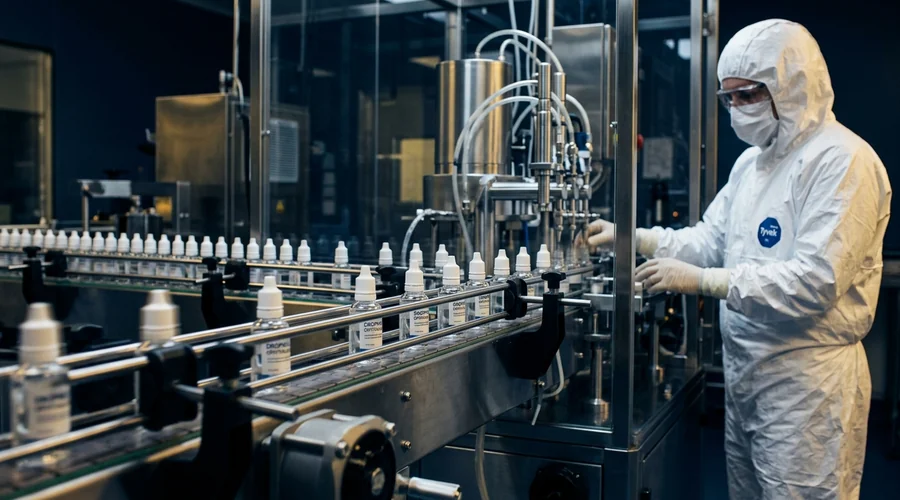
- Cleanroom environmental control — sterile filling operations require classified cleanroom conditions matching the sterility assurance level the formulation depends on.
- Dispensing tip design — the bottle tip geometry itself is engineered to minimize the chance of contamination during repeated patient use over the product's in-use life.
- Preservative-free packaging engineering — one-way valve and in-line filter mechanisms replace the chemical preservative's job, shifting the contamination-control burden onto the container design itself.
- Batch-to-batch consistency — viscosity, tonicity, and preservative efficacy all have to hold within specification across every batch, not just in the original development lot.
Bringing all of these requirements, sterility, comfort, viscosity, and container design, together into one validated commercial product is what a structured ophthalmic development program is built to manage, which the final section covers.
Building an Ophthalmic Development Program and Choosing a Partner
An ophthalmic formulation that performs well on the bench still has to survive sterilization, hold its viscosity and preservative efficacy over shelf life, and pass patient comfort expectations before it can succeed commercially. A structured development program sequences these requirements deliberately, confirming sterilization compatibility and core physiological tolerability early, rather than discovering a blocking issue after the formulation is otherwise finished. The sequence below reflects how Global Formulation structures ophthalmic and sterile product development for pharmaceutical manufacturers and entrepreneurs entering this category.
- Sterilization pathway confirmation — establish early whether the drug substance and formulation can survive terminal sterilization, since this decision shapes everything downstream.
- Tonicity and pH optimization — balance drug stability and solubility against ocular comfort limits before committing to a buffer and tonicity-agent system.
- Viscosity and residence-time design — select and qualify the viscosity-enhancing polymer system needed to achieve target ocular contact time.
- Preservative and container-closure strategy — decide between a preserved formulation and a preservative-free packaging approach, and validate the container-closure system alongside it.
- Compendial and stability qualification — confirm sterility, particulate-matter, and preservative-efficacy testing all pass before advancing to scale-up.
Choosing who executes this program matters, because ophthalmic formulation punishes teams that treat it as a scaled-down parenteral product rather than its own physiological specialty. Our guide to parenteral formulation development covers the sterility and tonicity fundamentals that carry over directly into ophthalmic work, while our guide to multi-dose pharmaceutical preservative selection expands on the preservative-system tradeoffs introduced earlier in this guide.
- Sterile processing capability — does the partner run validated terminal sterilization and aseptic filling capability under one roof?
- Ophthalmic-specific formulation experience — has it developed viscosity-enhanced or in-situ gelling ophthalmic formulations previously, not just general sterile liquids?
- Preservative-efficacy track record — can it demonstrate prior products that passed preservative-efficacy testing on the first attempt, avoiding a costly reformulation cycle?
- Container-closure engineering — does it have experience qualifying specialized preservative-free dispensing systems, if that route is being considered?
A pharmaceutical and healthcare formulation partner active in sterile and ophthalmic product development is positioned to carry a formulation from bench trial through a validated, patient-tolerable commercial product. Global Formulation provides ophthalmic formulation development, sterility and viscosity optimization, and preservative-system strategy for pharmaceutical manufacturers and entrepreneurs bringing an eye care product to market.
Frequently Asked Questions
Why can't an ophthalmic solution just be made the same way as any other sterile liquid?
An ophthalmic product has to satisfy sterility, tonicity, and comfort requirements simultaneously, and optimizing for one can work against another. A solution can be perfectly sterile and still be unusable if its pH or tonicity causes stinging severe enough to trigger reflex tearing, which physically washes the drug back out of the eye before it can act.
This is why ophthalmic formulation is treated as its own specialty rather than a variant of general sterile liquid manufacturing. Every excipient choice, from the buffer system to the tonicity agent to the preservative, has to be evaluated against ocular tolerability data, not just chemical compatibility and sterility.
What is the real difference between preserved and preservative-free eye drops?
Preserved multi-dose eye drops contain an antimicrobial agent, most commonly benzalkonium chloride, that controls microbial contamination introduced each time the bottle is opened and used over its in-use period. Preservative-free formats avoid that chemical entirely, either through single-use unit-dose vials or through specialized multi-dose bottles that use a one-way valve or in-line filter instead of a chemical preservative.
The tradeoff is cost and convenience against long-term ocular surface tolerability. Preservatives like benzalkonium chloride are well documented to cause cumulative corneal epithelial toxicity and dry eye symptoms with chronic use, which is why preservative-free options are increasingly preferred for patients on long-term therapy, such as glaucoma patients using drops daily for years.
Why does viscosity matter so much for how well an eye drop actually works?
A large fraction of an instilled eye drop's volume is cleared from the eye's surface within minutes through blinking and nasolacrimal drainage, long before much of the drug can cross the cornea. Raising the formulation's viscosity with a polymer slows that drainage rate and keeps the drug in contact with the ocular surface longer, directly increasing the amount that gets absorbed.
This is why viscosity-enhancing polymers are one of the most consequential formulation levers in ophthalmic development. Getting the viscosity too low wastes most of the dose to drainage, while getting it too high can blur vision or feel uncomfortable enough that patients stop using the product as directed.
How much of a topically applied eye drop dose actually reaches the eye?
Ocular bioavailability from a conventional topical eye drop is low, commonly cited in the range of only a few percent of the instilled dose. Most of the drop is lost to reflex tearing, blinking, and drainage through the nasolacrimal duct into the nasal cavity and systemic circulation, rather than being absorbed across the cornea into ocular tissue.
This low bioavailability is precisely why formulation strategy matters so much in this category. Viscosity enhancement, in-situ gelling systems, and even nanoparticle or liposomal carriers are all approaches formulators use specifically to push more of the applied dose toward absorption instead of drainage.
When would an ointment be used instead of a solution or suspension?
Ointments, typically built on a petrolatum and mineral oil base, dramatically increase precorneal residence time compared to a solution or suspension, often keeping the drug in contact with the eye for hours rather than minutes. That makes them useful for overnight dosing or for surface-protective and lubricating indications where prolonged contact matters more than immediate clarity.
The tradeoff is that an ointment's oily base blurs vision noticeably while it sits on the eye, which most patients find unacceptable during waking hours. This is why ointments are typically reserved for bedtime dosing or specific indications, while solutions and suspensions remain the default for daytime use.
What sterilization method is preferred for ophthalmic products?
Terminal sterilization, most often by moist heat autoclaving, is the preferred method whenever the drug substance and formulation can tolerate it, because it achieves a higher, more reliably validated sterility assurance level than any alternative. Regulators consistently favor terminal sterilization over aseptic processing for exactly this reason.
Aseptic processing, combining sterile filtration with an aseptic fill, becomes the necessary alternative when the active ingredient or a critical excipient is heat-labile and cannot survive autoclave conditions without degrading. Aseptic processing demands significantly more validation and facility control to reach an acceptable sterility assurance level, which is part of why it costs more to run than a terminally sterilized process.
What should a company building an ophthalmic product prioritize first?
Confirm the sterilization pathway before finalizing the formulation, since discovering late that a formula cannot survive terminal sterilization forces a costly redesign around aseptic processing instead. This decision touches every other formulation choice, from preservative strategy to container closure.
Beyond sterilization, prioritize early tolerability data on tonicity, pH, and preservative system, since these variables determine whether patients will actually use the product as prescribed. An ophthalmic formulation that is technically stable and sterile but stings on instillation will still fail commercially if patients stop using it.
Developing an Ophthalmic or Sterile Product?
Global Formulation provides ophthalmic formulation development, sterility assurance strategy, viscosity and preservative-system design, from bench trial through validated commercial scale-up.
Talk to Our Formulation Team