Water for Injection System: Purified Water and WFI Design
Water is the most commonly used excipient in medicines, yet it is drawn from the system on demand and is not tested and released like a batch. Microbiological results arrive days after the water has been used, so quality has to be designed into the system rather than checked at the end. A weak loop, a dead leg or a poorly chosen sanitisation method shows up as a failed product or an inspection finding. This guide explains the water for injection system and its purified water feed, from grades and generation to loop design, sanitisation, qualification and monitoring. It draws on WHO and EMA guidelines, plus the formulation support Global Formulation gives pharmaceutical developers.
Water for Injection System Basics: Grades and Where Each Is Used
Pharmacopoeias set standards for several grades of water, and each grade fits a defined set of uses. The EMA guideline on the quality of water for pharmaceutical use lists Water for Injections (WFI), Purified Water and Water for preparation of extracts as the European Pharmacopoeia grades. Potable water has no monograph but is the prescribed source feed water for the pharmacopoeial grades. The grade a product needs follows its intended use and the stage at which the water is used.
| Use | Minimum Water Grade in the EMA Guideline |
|---|---|
| Parenteral medicines | Water for Injections |
| Biologics, including vaccines and ATMPs | Water for Injections |
| Haemofiltration, peritoneal dialysis and irrigation solutions | Water for Injections |
| Oral, nasal, ear, cutaneous, rectal and vaginal preparations | Purified Water |
| Granulation and tablet coating | Purified Water |
| Formulation before sterile lyophilisation | Water for Injections |
| Synthesis of active substance intermediates | Potable water, with Purified Water where greater chemical purity is needed |
| Final rinse of equipment, containers and closures | The same quality as the water used in the related manufacturing stage |
WHO's guideline adds the role of the top grade. Bulk water for injections (BWFI) should meet the relevant pharmacopoeial specifications for chemical and microbiological purity, including endotoxins, and it is the highest quality of pharmacopoeial water for pharmaceutical use. BWFI is not a final dosage form. It is an intermediate bulk product used as an ingredient and for final rinses of equipment that contacts injectable products. Our guide to parenteral formulation development explains where this water enters the product.
Once the grade is chosen, the next question is how the water is made.
Purified Water System Pharma Design: Pretreatment, RO, EDI and Distillation
Every pharmacopoeial grade starts from drinking water, so the generation train begins with pretreatment. The WHO guideline on water for pharmaceutical use makes the manufacturer responsible for assuring that the source water meets drinking-water requirements. It lists desalination, filtration, softening, disinfection by ozone or sodium hypochlorite, iron removal and precipitation as typical drinking-water processes. It also asks for controls on microbial growth in sand filters, carbon beds and softeners, such as backflushing, sanitisation and regeneration.
| Stage | Techniques Named in the Guidance | Notes |
|---|---|---|
| Drinking-water feed | Desalination, filtration, softening, disinfection, iron removal, precipitation | The manufacturer must assure feed quality at a defined point and test at defined intervals |
| Bulk purified water | Ion exchange, reverse osmosis, RO with electro-deionisation, ultrafiltration, or a combination | Ambient-temperature systems such as ion exchange and ultrafiltration are especially susceptible to microbial contamination when static |
| WFI by distillation | Distillation as the final purification step | Generator sizing avoids over-frequent start-stop cycles; blow-down, dump and cool-down venting functions are considered |
| WFI by other means | Single- or double-pass RO with deionisation, electro-deionisation, nanofiltration, ultrafiltration, softening, descaling, degasification and UV treatment | Needs attention to feed water, pretreatment, sampling points, dead legs and in-line monitoring |
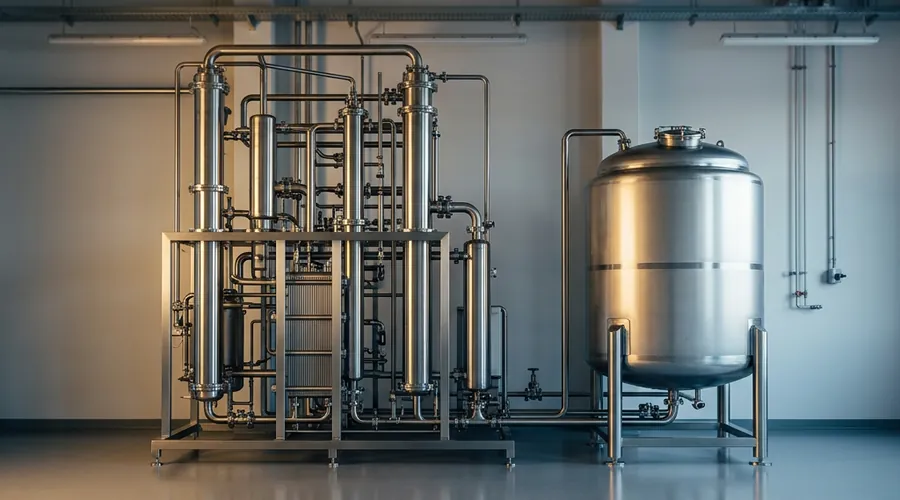
The route to WFI changed in 2017. EMA reports that the Ph. Eur. monograph 0169 was revised, effective 1 April 2017, to allow a purification process equivalent to distillation, such as reverse osmosis coupled with electro-deionisation, ultrafiltration or nanofiltration. The USP wording allows distillation or a process proven equivalent or superior to distillation, and the Japanese Pharmacopoeia allows distillation or reverse osmosis and ultrafiltration. EMA asks manufacturers to notify the GMP supervisory authority before introducing reverse osmosis at a site. WHO's guideline on production of water for injection by means other than distillation asks for a risk assessment and a control strategy covering each life-cycle stage.
Generation only matters if the water reaches the user points in the same condition, which is the job of the loop.
Pharmaceutical Water Loop Design: Materials, Dead Legs and Storage
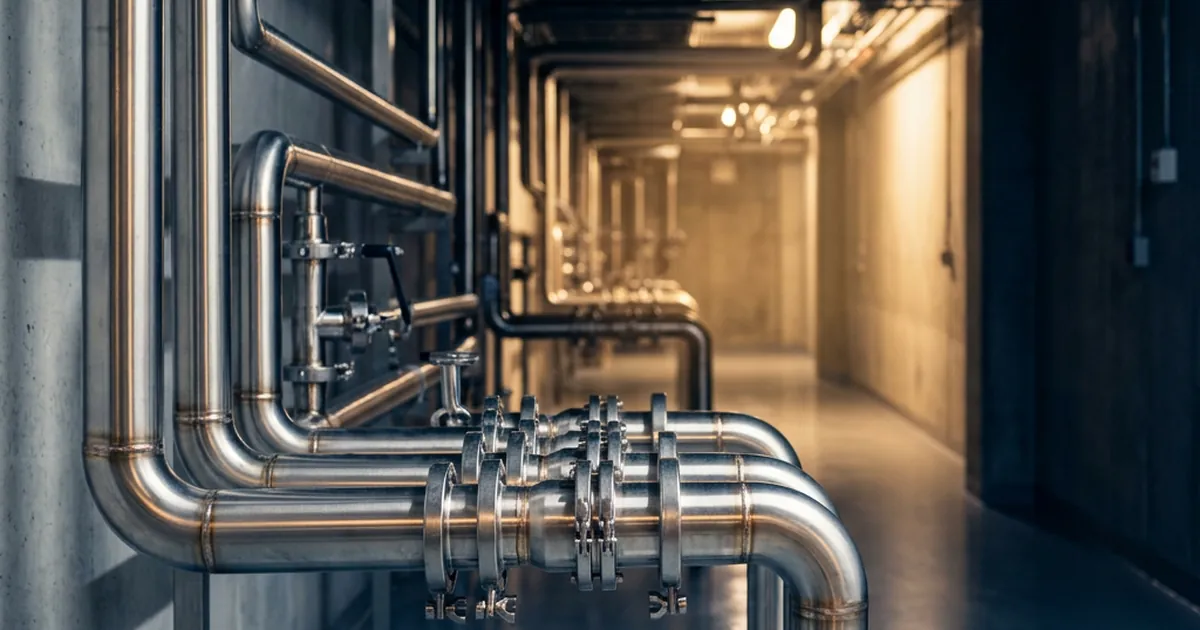
The loop is where most pharmaceutical water systems fail, because it is where water sits in contact with materials for hours. WHO asks that components stay suitable across the full range of temperature and pressure, at rest, in operation and during sanitisation. Distribution should be designed as a loop with continuous circulation, and a one-way system needs a justification and robust monitoring. Filtration should not be used in distribution loops or at user take-off points.
| Element | Expectation in the WHO Guideline |
|---|---|
| Materials | Non-leaching, non-adsorbing, non-absorbing and corrosion resistant; 316L stainless steel is generally recommended, chosen with the sanitisation method in mind |
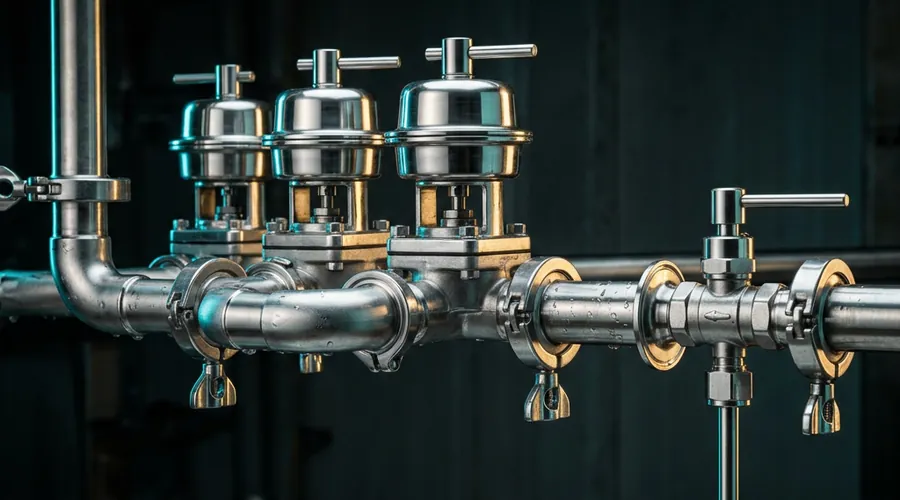
| Joints | Orbitally welded stainless steel with weld records and inspection; sanitary clamp connections; threaded joints not permitted for purified water and WFI |
| Surfaces and passivation | Smooth internal finish; passivation considered after installation and after significant modification |
| Valves and sample points | Diaphragm valves drainable at points of use; sanitary sample valves with roughness of 1.0 µm Ra or lower |
| Drainability | Installation with a recommended minimum slope of 1 in 100 |
| Flow | Continuous circulation with turbulent flow, for example a Reynolds number above 4000 |
| Dead legs | Zero dead-leg diaphragm valves where possible; possible dead legs measured and calculated |
| Instruments | In-line measurement of TOC, conductivity, pressure, flow and temperature |
Storage vessels add their own requirements. WHO asks for vessels that drain, with spray balls or distributors that wet the inner surfaces and prevent stagnant water in the headspace. Vents carry bacteria-retentive hydrophobic filters with integrity testing, and pressure relief devices have external rupture indicators so that a loss of integrity is detected. Heat exchangers sit in circulating loops, and double tube sheet or double plate designs should be considered. Our guide to GMP facility design for pharmaceutical manufacturing places the utility room within the wider plant.
Even a perfect loop needs a way to control microbial growth over time, which is sanitisation.
Pharmaceutical Water Loop Sanitisation: Thermal, Chemical and Ultraviolet Control
Sanitisation controls the bioburden that no design can fully exclude. WHO asks that treatment, storage and distribution systems be subject to controls that reduce contamination and microbial proliferation. Procedures can be chemical, thermal or both, and the conditions, times, temperatures and frequency must be defined and proven effective for every relevant part of the system. The technique has to be chosen at the design stage because it affects the components and materials.
| Control | How the Guideline Describes It |
|---|---|
| Elevated temperature | Systems kept above about 70 °C are generally less susceptible to microbiological contamination; components can be thermally sanitised above 70 °C for a defined time |
| Chemical sanitisation | Agents such as ozone, hydrogen peroxide or peracetic acid; the procedure must be validated and the removal of the agent proven |
| Ultraviolet disinfection | Lamps at appropriate locations, with independent monitoring where needed |
| Circulation and turbulence | Continuous flow to prevent stagnation, with turbulent flow evidenced by a Reynolds number above 4000 |
| Temperature control | Heat exchangers or room cooling to reduce the risk of microbial growth in lower-temperature systems |
| Records | Sanitisation records are maintained |
The temperature choice has a practical consequence. WHO notes that when lower temperatures are needed because of the treatment process or the use temperature, special precautions must prevent the ingress of microorganisms. It also asks that any cooling for processing happen for the minimum necessary time, with the cooling cycles proven satisfactory during qualification. Ambient systems such as ion exchange and ultrafiltration need sanitisation at intervals set by validation data, because static periods raise the contamination risk.
Controls only count once the system has been qualified and is monitored for the long term.
Water System Qualification: Three-Phase Validation and Continuous Monitoring
Water systems are qualified and validated because water is used before its microbiological result is known. WHO describes qualification stages that can include the user requirement specification, factory and site acceptance tests, and installation, operational and performance qualification. Commissioning is documented but is not a replacement for qualification. The scope of the work follows a risk assessment, and the quality unit approves release at the appropriate stage.
| Phase | Duration and Scope | Use of the Water |
|---|---|---|
| Phase 1 | At least two weeks of intensive testing: feed water, each purification step, points of use, sanitisation, provisional alert and action levels | Not used for product manufacture |
| Phase 2 | At least a further two weeks with all standard operating procedures deployed and the same sampling programme | Can be used if Phase 1 and ongoing Phase 2 data show suitable quality and QA approves |
| Phase 3 | Follows Phase 2 so that the three phases cover at least 12 months across different seasons; sampling reduced to a routine plan; trended quarterly and reviewed | Water can be used |
Monitoring continues after validation. WHO asks for a combination of online and offline instruments linked to qualified alarms, with flow, pressure and temperature monitored online, and conductivity and TOC online where possible. Offline testing confirms the online results and covers microbiological attributes. For WFI made by non-distillation methods, the WHO guideline encourages rapid microbiological methods and asks for TOC and conductivity to be monitored with online instruments. Results are analysed statistically at defined intervals, held within control limits such as 3 sigma, and used to set alert and action levels from historical data.
Developers do not build these systems alone, but they define what the system must deliver.
Water Systems and Formulation: What Developers Need to Specify
A formulation team owns the water grade even when engineering owns the pipework. The EMA guideline says the grade used at different stages should be discussed in the marketing authorisation application and should take account of the product and the stage of use. WHO's lists of design inputs read as a user requirement specification checklist. Writing that checklist early avoids a utility that is the wrong size or the wrong grade for the pipeline.
- Grade by use — name the grade for each use: ingredient, granulation, coating, lyophilisation, cleaning and final rinse.
- Quantity — define minimum, average and maximum demand, including peaks.
- Feed water — record the quality of the drinking-water feed and its variation over the seasons.
- Specification — set the required quality and alert and action levels from data.
- Points of use — decide the number and location of sampling points and user take-offs.
- Sanitisation strategy — choose thermal, chemical or combined, with the materials chosen to match.
- Instrumentation and data — specify TOC, conductivity, flow, pressure and temperature, plus data integrity and audit trail.
EMA's tables set WFI for formulation before sterile lyophilisation and purified water before non-sterile lyophilisation, and our guide to pharmaceutical lyophilisation covers the process itself. Our guide to the FDA, ICH and USP regulatory pathway covers how such choices are documented in a filing.
Choosing a partner who can carry this through is the last decision.
Working With a Pharmaceutical Formulation Consultant and CDMO
Pharmaceutical water sits between formulation, utilities engineering, microbiology and regulation, so a decision in one area affects the others. A pharmaceutical formulation consultant maps each water use to its grade, drafts the user requirements and reviews the qualification plan. Pharmaceutical product development services extend that into stability design, specifications and regulatory documentation. Contract formulation CDMO support then relies on a partner whose water system is qualified, monitored and reviewed on a documented schedule.
- Map water uses — grade for each ingredient, process and rinse step.
- Draft the user requirements — demand, feed water, specification and points of use.
- Review the design — materials, loop, dead legs, storage and sanitisation.
- Plan qualification — phases, sampling points and alert and action levels.
- Assess a CDMO's system — qualification status, trend data, annual review and deviation history.
- Document the grade — record the water grade and rationale in the regulatory file.
Our pharmaceutical and healthcare range shows where water-dependent dosage forms sit. Our guide to choosing a pharmaceutical formulation consultant explains how to select a partner. Global Formulation provides water grade selection, requirement drafting, qualification review and CDMO assessment support for pharmaceutical developers. Pharmacopoeial limits, site-specific operating setpoints and proprietary designs stay outside this guide by design.
Frequently Asked Questions
What is a water for injection system?
A water for injection system is the set of pretreatment, purification, storage and distribution equipment that produces and delivers bulk water for injections (BWFI). WHO calls BWFI the highest quality of pharmacopoeial water for pharmaceutical use.
BWFI is not a final dosage form. It is an intermediate bulk product used as an ingredient in formulation and for final rinses in injectable manufacture.
The system is normally built as a continuously circulating loop with online monitoring and a validated sanitisation method.
What is the difference between purified water and water for injections?
Purified water is the grade for medicines that do not need to be both sterile and apyrogenic, unless otherwise justified and authorised. WFI is the grade for parenteral medicines and for dissolving or diluting substances for parenteral use.
WHO says BWFI must meet pharmacopoeial specifications for chemical and microbiological purity, including endotoxins, and it is the highest pharmacopoeial grade.
EMA's guideline lists WFI as the minimum for parenterals, biologics including vaccines and ATMPs, haemofiltration, peritoneal dialysis and irrigation solutions, and purified water for oral, nasal, ear and cutaneous preparations.
Can water for injections be produced without distillation?
Yes. The Ph. Eur. monograph 0169 was revised with effect from 1 April 2017. It now allows a purification process equivalent to distillation, such as single-pass or double-pass reverse osmosis coupled with electro-deionisation, ultrafiltration or nanofiltration.
EMA notes that this brings the Ph. Eur. closer to the US and Japanese pharmacopoeias and asks manufacturers to notify the GMP supervisory authority before introducing reverse osmosis.
WHO's guidance for non-distillation production stresses feed-water quality, pretreatment, sampling points, avoidance of dead legs and in-line monitoring.
Why must a pharmaceutical water loop circulate continuously?
Stagnant water allows microbial growth and endotoxin formation. WHO asks for distribution as a loop with continuous circulation of purified water and WFI, unless a non-recirculating system is justified and robustly monitored.
It also suggests maintaining turbulent flow, for example a Reynolds number above 4000, and using zero dead-leg diaphragm valves.
Pipework is installed with a fall of not less than 1 in 100 so that the system can drain.
How are pharmaceutical water systems sanitised?
Systems are sanitised with heat, chemicals or a combination. WHO notes that systems kept above about 70 degrees Celsius are generally less susceptible to microbial contamination. Components can also be thermally sanitised above 70 degrees Celsius for a defined time.
Chemical options include ozone, hydrogen peroxide and peracetic acid, and ultraviolet lamps with independent monitoring can add control. Any chemical sanitisation must be validated and the removal of the agent proven.
Times, temperatures and frequency are defined and records are kept.
How long does water system validation take?
WHO describes a three-phase approach that covers at least one year of operation across different seasons. Phase 1 lasts at least two weeks with intensive testing, and the water is not used for product.
Phase 2 adds at least a further two weeks. The water can be used for product if Phase 1 and ongoing Phase 2 data show suitable quality and QA approves. Phase 3 follows so that the three phases together cover at least 12 months.
Source water tests are included, because feed-water quality changes with the season.
What should be monitored in a pharmaceutical water system?
WHO asks for continuous monitoring with a combination of online and offline instruments linked to qualified alarms. Flow, pressure and temperature are monitored online, with conductivity and total organic carbon online where possible.
Offline tests confirm the online readings and cover microbiological attributes. Results are trended, statistically analysed at defined intervals, and held within control limits.
Alert and action levels come from historical data, and adverse trends are investigated for root cause.
Specifying or Qualifying a Pharmaceutical Water System?
Global Formulation supports water grade selection, user requirement specifications, qualification planning and CDMO assessment for pharmaceutical developers.
Talk to Our Formulation Team