Polyurethane Injection Grout for Active Water Leaks
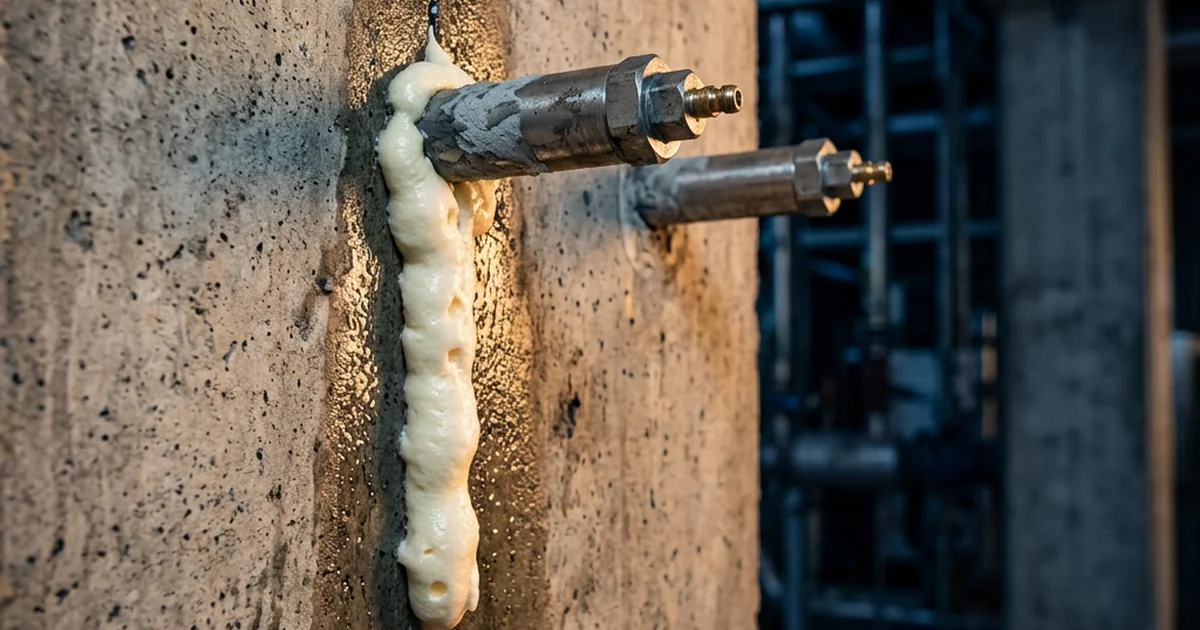
A concrete wall that weeps at a crack or a cold joint cannot wait for a repair product that needs a dry surface. A quick-set cement patch slows the flow, but trade guidance warns that it only stops the leak temporarily and leaves water inside the structure. Water left behind can weaken the bond of any lining applied later. This guide to polyurethane injection grout explains how PU injection resin reacts with the leaking water itself to form a foam or gel seal. It covers hydrophilic and hydrophobic chemistry, injection method, EN 1504-5 and the isocyanate rules, drawing on the US Army Corps of Engineers grouting manual and two open-access reviews. It also reflects the formulation support Global Formulation gives construction chemical manufacturers.
Why Active Water Leaks Defeat Dry-Cure Repairs
A leaking crack is a repair problem and a hydraulics problem at once. Water moving through the defect keeps both faces wet and pushes against anything placed in its path. A repair that depends on a dry, still surface cannot outrun a leak that keeps the surface wet. Polyurethane chemistry avoids the race by using the water as one of its reactants.
- Quick-set cement patches — a WaterWorld guide to polyurethane grouting notes that hydraulic cement over active infiltration stops the leak only temporarily. Water stays within the primary structure, which can weaken the bond or fail a lining installed over it.
- Hard resin grouts — the US Army Corps of Engineers chemical grouting manual (EM 1110-1-3500) describes epoxy and polyester grouts as hard resins formed when a hardener is added. It rates them as rarely used for reducing water flow.
- Urethane grouts — the same manual rates urethanes as commonly used for concrete repair and sewer repair. It states they can be injected directly into flowing water as a water stop and can seal openings as small as 0.01 mm.
The manual explains that all urethane grouts depend on isocyanates cross-linking into a rubbery polymer, in contrast to the hard resin of an epoxy grout. Structural bonding of stable cracks remains the job of epoxy, covered in our guide to epoxy injection grout chemistry. Water stopping with PU injection resin is the subject here, and the wider range sits under construction chemicals. To see why water helps instead of hurting, look at what happens inside the drum and the crack.
Polyurethane Injection Grout Chemistry: Isocyanate, Polyol and Water
Every polyurethane grout is built around one reactive group, the isocyanate (-NCO), and what that group meets decides what the grout becomes. With a polyol, it forms urethane links that build the polymer chain. With water, it releases carbon dioxide gas that expands the mix into a foam. Formulators tune the balance between those two reactions to control cure speed, foam density and final stiffness.
- Isocyanate — the 2025 review of polyurethane grouting materials names MDI as the most widely used in grouts. TDI offers better reaction control, but its volatility and toxicity limit its use.
- Polyol — polyols form the soft segments that give flexibility and set low-temperature performance. Polyether polyols resist hydrolysis, while polyester polyols give higher strength but are prone to hydrolysis in humid environments.
- Catalysts — organometallic catalysts promote the gel reaction and tertiary amine catalysts promote the foaming reaction. Their ratio sets foaming speed and curing time.
- Surfactants — they stabilise the bubbles formed during foaming, which gives a uniform cell structure, and they improve wetting and penetration.
- Diluents — the Corps manual warns that solvents used to dilute prepolymers and control viscosity are potential groundwater pollutants.
| Reaction | Reactants | Result in the Grout |
|---|---|---|
| Gel reaction | Isocyanate with polyol | Urethane links form the polymer backbone and carry strength and elasticity |
| Foaming reaction | Isocyanate with water | Carbon dioxide gas is released and an amine forms, which expands the mix |
| Chain growth | Water-derived amine with more isocyanate | Urea links form in a fast second step |
| High-temperature side reaction | Urea with excess isocyanate | Biuret compounds form, according to the 2022 review of water-active polyurethane grouts |
The same review reports that the first step of the water reaction is slow and the second, amine with isocyanate, is fast. Corps of Engineers guidance describes the two product architectures that exploit this chemistry. One-part grouts are prepolymers made by partly reacting isocyanate with a cross-linking compound, which leaves unreacted isocyanate groups that react with water to finish the polymerisation. Two-part grouts react an isocyanate liquid directly with a polyol.
| Feature | One-Component Prepolymer | Two-Component A/B System |
|---|---|---|
| Make-up | Isocyanate partly reacted, with free isocyanate groups left | Isocyanate liquid and polyol kept apart until injection |
| Cure trigger | Water in the leak or the environment | Mixing of the two components |
| Cured form | Gel or foam, depending on the water available | Hard or flexible foam, depending on the formulation |
| Viscosity range in the Corps manual | 50 to 100 cP | 100 to 1,000 cP |
| Field handling | No on-site proportioning, suited to emergency work | Metering equipment, with finer control of cure time and foaming ratio |
| Main limitation | Narrower adjustment range, and cure speed follows humidity | Mix ratio must be held during injection |
Whether the cured polymer rejects or absorbs water is the next decision, and it splits leak-sealing grouts into two families.
Hydrophilic vs Hydrophobic PU Grout for Water Leaks
The words hydrophilic and hydrophobic describe how the cured polymer behaves toward water, and that behaviour sets what a grout can and cannot do. The 2025 review classifies polyurethane grouts by the response of the cured body to water. Hydrophilic grouts are built to take water into the reaction, while hydrophobic grouts cure to a water-resistant solid. The choice decides how a repair copes with continued wetness, movement and drying.
- Hydrophilic structure — these grouts carry hydrophilic groups such as ionic groups and polyethylene oxide segments. The review reports strong reaction with water and expansion ratios above six times.
- Hydrophobic structure — a hydrophobic molecular structure gives excellent water resistance after curing, which suits long-term immersion according to the review.
- Foam or gel — hydrophilic grouts give either a closed-cell foam or a non-cellular gel, set by the amount of water mixed in. Hydrophilic gels are typically injected with water through a manifold that briefly mixes the two.
- Catalyst control — a manufacturer guide notes that hydrophobic resins need a catalyst blended into the resin before injection, and the catalyst level controls reaction time and foam volume.
| Property | Hydrophilic PU Grout | Hydrophobic PU Grout |
|---|---|---|
| Relation to water | Takes leak water into the reaction and the cured network | Cures to a water-repelling solid |
| Cured form | Flexible foam or non-cellular gel | Rigid foam, per trade guidance |
| Movement | Foams are flexible and resilient. Gels should stay out of moving joints and cracks | Rigid cell structure does not recover from compression, so movement can reopen the leak |
| Hydration | Gels shrink when water is absent and need permanent moisture | Water-repelling, so no hydration requirement |
| Role in trade guidance | Sealing non-structural cracks and joints, and backing up a first stage | Stopping a gushing leak and filling voids outside the structure |
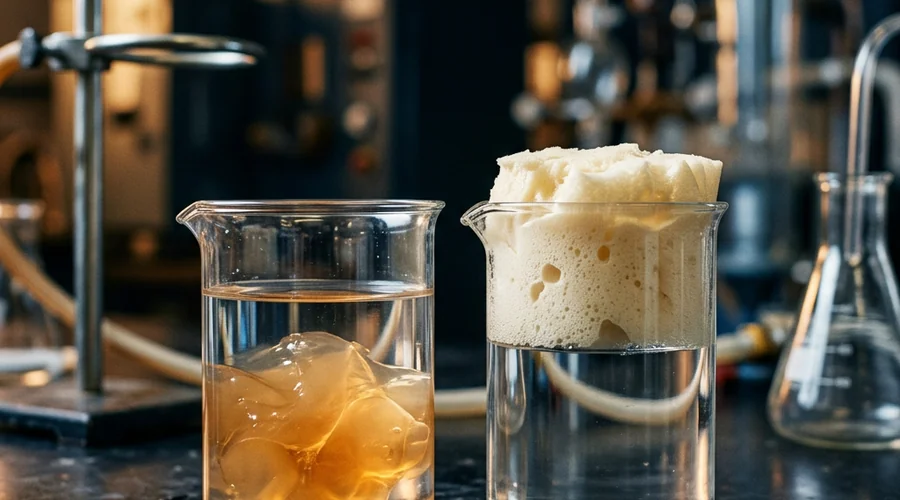
These roles come from the WaterWorld guide, which was published with a grout manufacturer's technical input. Treat its product preferences as supplier practice and confirm them against the data sheet of the grout in use. The guide advises a hydrophilic grout for a non-structural defect unless job conditions dictate otherwise. For a gushing leak it advises the aggressive expansion of a hydrophobic grout first, then a hydrophilic resin injected to back it up. It also advises against installing a hydrophobic grout to repair a minor crack or joint leak, because it expects the repair to be temporary.
Choosing the chemistry is only half of the job, because the grout still has to reach the water path.
Controlling Gel Time, Expansion, Viscosity and Heat
A grout that reacts in the pump line is useless, and a grout that reacts after the water has moved on does not seal. Formulators design reaction timing as carefully as final properties. Four variables dominate the design: how fast the mix reacts, how far it expands, how thin it is while it travels, and how much heat it releases. Each one trades against the others.
| Design Variable | What It Controls | Trade-Off in the Sources |
|---|---|---|
| Catalyst balance | Foaming speed and curing time | The Corps manual notes that grouts gelling quickly have a limited range of treatment and need close hole spacing and rapid injection |
| Water available | Gel versus foam, foam density and cell size | In studies of water-blown foams, more water means lower density and lower tensile, flexural and compressive strength |
| Viscosity | How far the resin travels into fine openings | Diluting solvents lower viscosity but are potential groundwater pollutants |
| Polyol type | Flexibility against strength | Polyester polyols are stronger but prone to hydrolysis in humid service |
| Reaction heat | Fire safety and thermal stress | The 2025 review reports maximum reaction temperatures above 140 °C for conventional polyurethane grouts |
Water content shows the trade-off most clearly. The 2022 review pooled studies of water used as the foaming agent. Density falls as water content rises, because more carbon dioxide forms, more cells appear and the cell walls thin. Tensile, flexural and compressive strength fall with it, and cell structure becomes larger and less uniform. A grout designed for maximum expansion fills a void well, but it buys that volume with strength.
Heat deserves its own attention. The 2025 review states that intense exotherms pose fire safety hazards and cause thermal stress in the cured material. It lists high brittleness and insufficient temperature resistance among the weaknesses of unmodified grouts. Research it surveys uses heat-absorbing fillers, flame retardants and phase-change additives to lower the peak temperature.
Flowing water adds a further problem. The same review states that traditional polyurethane grouting materials are easily washed away and diluted in dynamic water environments, which lowers the solidification strength and the plugging effect. One route it describes is a viscosity-enhancing resin that raises the slurry viscosity and leaves a hydrophobic membrane at the surface. A washed-out grout never reaches the water path, which is why method matters as much as chemistry.
Crack Injection Water Stopping: Method and Sequence
Even a well-designed grout fails if it never reaches the water path. Injection method decides whether resin fills the full wall thickness or only the first few centimetres of a defect. Field practice for crack repair is consistent on the basics: intersect the defect below the surface, space the ports to the crack, and follow a planned sequence. The steps below combine transport agency guidance on port geometry with trade guidance on leak sealing.
- Read the leak — establish whether water is flowing or only present under pressure, where the water path runs, and whether the defect moves. These answers choose the chemistry.
- Drill ports at an angle — the TxDOT crack repair procedure, written for epoxy, angles the holes when debris sits near the surface. Ports then intersect the crack beneath it. Port spacing stays at or below the crack depth.
- Let the water help — for manhole leaks the WaterWorld guide injects through a hole drilled near the leak into the water source. The flow then pulls the reacting resin back into the structure and seals from the outside in. Where the flow is too weak, the resin is injected directly into the defect and its expansion drives it through.
- Stage the injection — for a gushing leak, use the aggressive hydrophobic grout first to cut the flow. Then inject a hydrophilic grout into the defect to back it up.
- Sequence the ports — transport agency practice for crack injection starts at the lowest port and works upward, holding pressure until resin appears at the next port. Confirm the order against the supplier data sheet, because flowing water changes where the resin travels.
- Verify and follow up — confirm the flow has stopped, then re-inspect after the structure has been in service. Tight cracks and minor leaks need patience, because the trade guide calls them the most difficult to repair long term.
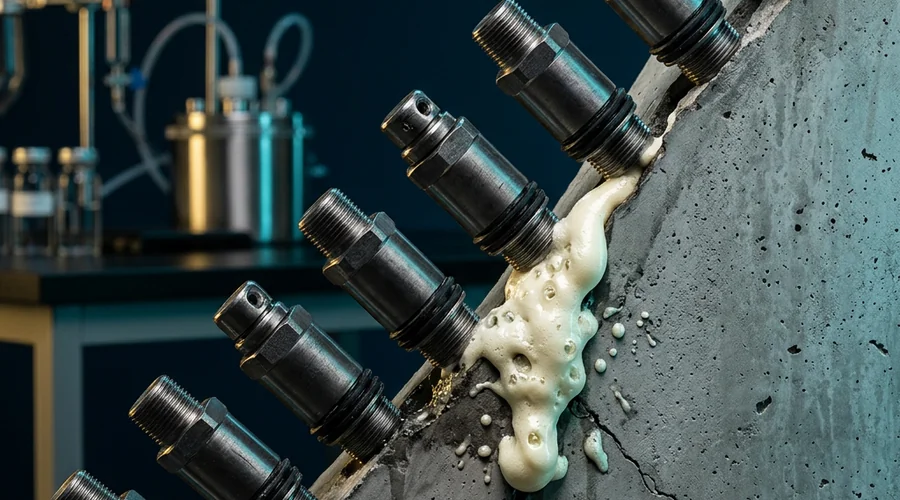
Lining and coating work depends on this stage being done properly. The trade guide notes that groundwater infiltration must be eliminated before a lining system is installed, which is why injection comes first in a manhole rehabilitation. Movement is the other common threat to a repair. Our guide to construction sealant joint design and movement capability explains how to size a joint so the repair is not asked to do the impossible.
Method gets the grout to the leak, and standards and regulation decide whether the product can be sold and used.
EN 1504-5, Test Methods and Isocyanate Rules
An injection resin is judged by how it behaves in a crack, not in a bucket. European practice organises that judgement under EN 1504-5, and the isocyanate in the drum carries its own regulatory load. Both are easier to design in than to retrofit. This section sets out what each covers.
- Scope — EN 1504-5:2013 sets requirements and conformity criteria for identification, performance and safety. It covers injection products for force-transmitting (F), ductile (D) or swelling-fitted (S) filling of cracks, voids and interstices in concrete.
- Exclusions — it does not cover widening a crack and sealing it with an elastomeric compound. It also excludes external filling of cavities in the surrounding soil, which falls under contact grouting in EN 12715.
- Preliminary injection — the standard excludes preliminary injection works used to temporarily stop water passage during waterproofing injection.
- Edition status — the Genorma listing shows the 2013 edition at the standard-to-be-revised stage, so check the current edition before specifying.
| Test Method | What It Measures | Relevance to Leak Sealing |
|---|---|---|
| EN 1771 | Injectability in a capillary network, and adhesion by splitting strength of mortar cylinders from a sand column injection | Shows whether the grout penetrates fine paths |
| EN 12618-2 | Adhesion of injection products to hydraulic concrete by tensile bond strength | Shows whether the cured seal holds to the concrete |
| EN 14068 | Watertightness of injected cracks in concrete with a defined crack width | Shows whether the sealed crack holds water |
| EN 14498 | Volume and weight changes after air drying and water storage cycles for swelling-fitted filling products | Shows whether a swellable gel or foam survives wet and dry cycling |
The standard's exclusion matters for two-stage repairs. A stop-flow stage and a permanent filling stage are judged differently, so a specifier should ask which stage a data sheet addresses. The wet-and-dry cycle test for swelling-fitted products matches the trade warning that hydrophilic gels shrink when water is absent.
Isocyanates add a second layer. The Corps manual states that isocyanates are toxic to varying degrees depending on the formulation, and that some grouts are highly flammable before and after setting. In the European Union, Commission Regulation (EU) 2020/1149 added entry 74 on diisocyanates to REACH Annex XVII. After 24 August 2023, industrial and professional use is not permitted unless the diisocyanate concentration is below 0.1 percent by weight or the employer ensures users have completed safe-use training. The training must include instructions for controlling dermal and inhalation exposure.
With the rules mapped, the formulation questions become concrete.
Formulating PU Injection Resins for Wet Service
A product that reacts with water by design must be made, packed and stored away from water. That single constraint shapes raw material handling, packaging and shelf life. The same chemistry then has to perform for years in a wall that stays wet. Both demands guide the formulator's choices.
- Moisture control in manufacture — prepolymers hold unreacted isocyanate that reacts with water, so any moisture in the polyols, fillers or packaging starts the cure inside the drum.
- Solvent strategy — the Corps manual flags diluting solvents as groundwater pollutants. The 2025 review describes solvent-free grouts with 100 percent solids, no volatile organic compounds and low curing shrinkage as suited to projects with strict environmental requirements.
- Polyol system for durability — polyether polyols resist hydrolysis, which matters in wet service. Polyester polyols add strength but are prone to hydrolysis in humid conditions, and blended polyol systems appear in dispersion-resistant formulations.
- Dispersion resistance — a grout meant for flowing water needs viscosity or surface behaviour that resists washout, since traditional grouts are easily washed away in dynamic water.
- Hydrophilic network design — water uptake is built in, so gel stability, shrinkage on drying and swelling behaviour need testing through wet and dry cycles.
- Quality control — free isocyanate content, viscosity, gel time and expansion in a defined water contact test give batch-to-batch consistency. A two-component pair also needs a stable mix ratio in the metering equipment.
Two neighbouring systems are covered elsewhere on this site. Our guides to two-component polyurethane foam sealants and to polymer-modified cementitious waterproofing explain foam sealant and waterproofing coating chemistry. Injection stops water passing through a defect, while those systems seal a joint or a surface, so the right choice depends on where the water is entering.
Working With a Construction Chemicals Formulation Consultant
Formulation decisions made at the bench shape how a PU injection resin behaves in the field. A prepolymer that thickens in storage, a catalyst balance that gels too early and a gel that shrinks in a dry season all trace back to bench decisions. A construction chemicals formulation consultant tests those decisions against realistic leak conditions before launch. Construction chemical product development services extend that work through documentation and manufacturing.
- Resin and catalyst system design — isocyanate and polyol selection, catalyst balance and surfactant package matched to the target leak type and substrate.
- Hydrophilic and hydrophobic ranges — product pairs that work as a staged system, including compatible grades for the stop-flow and filling stages.
- Test programme — injectability, adhesion, watertightness and wet-dry cycling, aligned with the EN 1504-5 family where European sales are planned.
- Regulatory documentation — safety data sheet, diisocyanate concentration, labelling and the training information the EU restriction requires.
- Field trial design — controlled test leaks and monitored repairs that produce evidence a specifier will accept.
- Scale-up and contract manufacturing — moving a bench formulation into a dry, controlled plant with a contract formulation scale-up partner.
Anyone planning a new range can start with our guide to starting a waterproofing chemical manufacturing unit. Before committing to a grout, run a short trial on a representative wet crack and record flow, cure time and the condition of the seal after a drying cycle. That small test produces more useful data than a data sheet alone.
Frequently Asked Questions
What is polyurethane injection grout used for?
It seals leaking cracks, joints and penetrations in concrete by reacting with the water in the leak to form a foam or gel. The US Army Corps of Engineers manual rates urethane grouts as commonly used for concrete repair and sewer repair.
The same manual states that urethane grouts can be injected directly into flowing water as a water stop. They are a water-stopping and sealing material, not a structural bonding material, which is the role of epoxy injection.
What is the difference between hydrophilic and hydrophobic PU grout?
The terms describe how the cured polymer behaves toward water. Hydrophilic grouts carry groups such as ionic groups and polyethylene oxide segments, react strongly with water and give either a flexible foam or a gel. Hydrophobic grouts cure to a water-repelling solid, usually a rigid foam.
Trade guidance uses hydrophilic grouts to seal non-structural cracks and joints and hydrophobic grouts to stop gushing leaks and fill voids. Gels need permanent moisture and a stable defect, and rigid foams do not recover from compression.
Does polyurethane grout work on actively flowing water?
Yes, that is its main strength. The Corps of Engineers manual says urethane grouts can be injected directly into flowing water as a water stop. The reaction with the leaking water builds the seal.
Flowing water also dilutes the grout. A 2025 review states that traditional polyurethane grouts are easily washed away in dynamic water. Trade practice for gushing leaks is to cut the flow with an aggressive hydrophobic grout, then back it up with a hydrophilic one.
Is a polyurethane grout repair permanent?
Permanence depends on matching the grout to the moisture and movement of the defect. Hydrophilic gels shrink when water is absent, rigid hydrophobic foams do not recover from compression, and polyester-based polyols are prone to hydrolysis in humid service.
A grout manufacturer's technical guide states that the right grout with correct installation can outlast the structure. That is a supplier view, and it holds only when the chemistry, the defect and the installation technique all agree.
How is polyurethane injection different from epoxy injection?
Epoxy grouts form a hard resin when a hardener is added and are used to bond stable cracks. Urethane grouts depend on isocyanates cross-linking into a rubbery polymer, and they react with water instead of being disturbed by it.
The Corps of Engineers manual rates epoxy and polyester resin grouts as rarely used for reducing water flow, while urethanes are commonly used for concrete repair. The choice follows the job: epoxy where the crack must carry load, urethane where water must be stopped.
What standards apply to polyurethane injection resins?
In Europe, EN 1504-5 covers injection products for force-transmitting, ductile and swelling-fitted filling of cracks, voids and interstices in concrete. It excludes preliminary injection used to temporarily stop water, so a stop-flow stage sits outside its scope.
Related test methods include EN 1771 for injectability, EN 12618-2 for adhesion to concrete and EN 14068 for watertightness of injected cracks. EN 14498 covers volume changes of swelling-fitted products after drying and water storage cycles. Check which edition is current before specifying.
Are there regulatory limits on isocyanates in PU grouts?
In the European Union, Regulation 2020/1149 added entry 74 to REACH Annex XVII. After 24 August 2023, industrial and professional use of diisocyanates requires either a concentration below 0.1 percent by weight or completed safe-use training.
Suppliers must also give the buyer information on the training requirement and place a visibly distinct statement on the packaging. The training covers control of dermal and inhalation exposure, so manufacturers need to know the diisocyanate concentration of each product.
How can a formulation consultant help with PU injection resin development?
A consultant designs the isocyanate, polyol, catalyst and surfactant system for the target leak type, and matches hydrophilic and hydrophobic grades into a staged product range. The work includes viscosity, gel time and expansion targets that hold across temperature and water conditions.
The same team builds a test programme covering injectability, adhesion, watertightness and wet-dry cycling, prepares the safety and isocyanate documentation, and runs controlled field trials. Contract manufacturing and scale-up then move the approved formulation into a repeatable, moisture-controlled plant.
Developing a PU Injection Grout Range or Solving a Leak Repair Failure?
Global Formulation supports construction chemical manufacturers with hydrophilic and hydrophobic PU grout formulation, test programme design, isocyanate compliance documentation, product development and contract manufacturing.
Talk to Our Formulation Team