Prefilled Syringe Formulation and Autoinjector Delivery
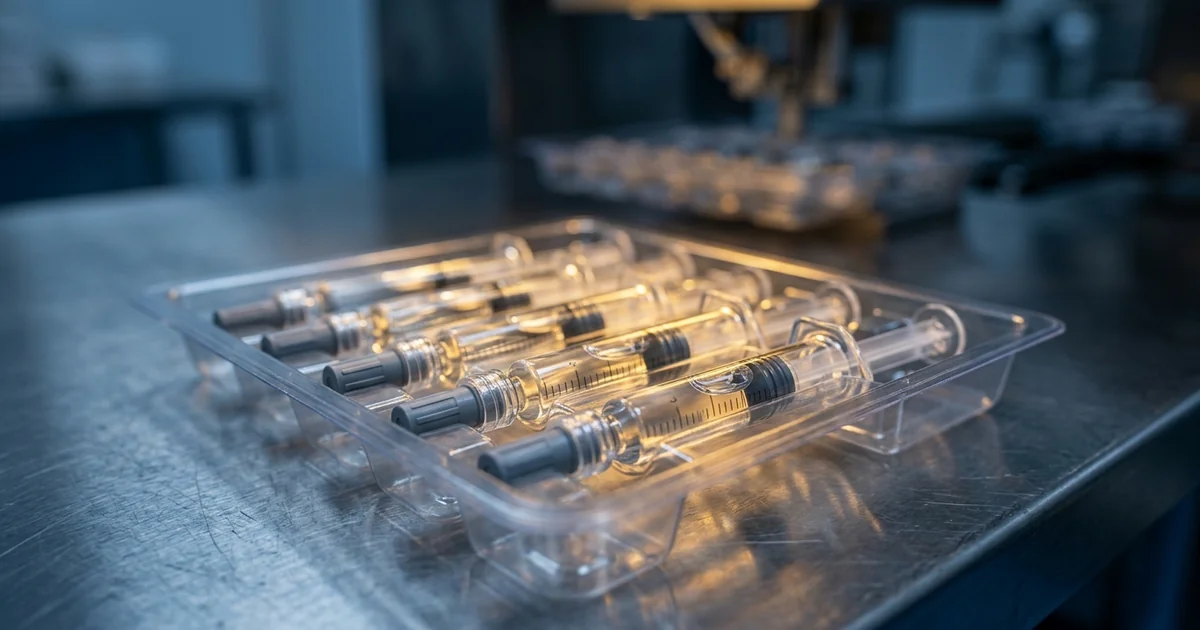
A monoclonal antibody that is stable in a vial can lose monomer, shed particles or resist the plunger once it sits in a prefilled syringe. The container is no longer inert packaging, because the barrel, the lubricant, the stopper and the injection device all touch or act on the formulation. A failure shows up as aggregation, subvisible particles, a rising injection force or a regulatory question about the device. This guide explains prefilled syringe formulation for autoinjector delivery: silicone oil, barrel materials, viscosity and injection force, and combination product rules in the US and EU. It draws on open peer-reviewed studies, the EMA guideline for medicines used with devices and 21 CFR. It also reflects the formulation and technology transfer support Global Formulation gives pharmaceutical manufacturers.
Prefilled Syringe Formulation Basics: Drug, Container and Device as One System
A prefilled syringe turns the package into part of the dosage form, because the drug sits against glass or polymer, a lubricant and an elastomer throughout shelf life. An autoinjector adds a spring-driven mechanism that the formulation must also work with. Regulators treat the result as a combination product, so formulation scientists need to understand the device and the rules that govern it. The table below maps each part to the question it raises.
| Component | Formulation Question | Where the Evidence Sits |
|---|---|---|
| Barrel (borosilicate glass or cyclic olefin polymer) | Surface reactivity, delaminated glass, silicone need, residues from manufacture | Barrel and tungsten studies |
| Silicone oil lubricant | Droplets, particle counts, protein adsorption and aggregation | EMA guideline and silicone studies |
| Plunger stopper | Leachables, silicone-free coating options, interaction with surfactant | Syringe material studies |
| Autoinjector mechanism | Activation force, injection time and dose accuracy with the product's viscosity | ISO 11608-1 primary functions |
Under 21 CFR 3.2(e), a combination product comprises two or more regulated components, such as drug and device, that are combined and produced as a single entity. The EMA's guideline calls the equivalent EU configuration an integral medicinal product. Neither framework treats the syringe as a passive container. Our guides to parenteral formulation development and biologics protein stability cover the formulation side, and the wider category sits under pharmaceuticals and health care.
The first interaction to check is the one the EMA names explicitly: silicone oil.
Syringe Silicone Oil Interaction: Particles, Aggregation and Surfactants
Silicone oil lubricates the plunger in glass syringes, and that same film is a source of droplets that interact with proteins. The EMA guideline states that silicone oils released from the device can nucleate the formation of proteinaceous particles and aggregates with protein products. Peer-reviewed work shows that the size of the effect depends on the barrel, the buffer and the surfactant. Understanding those three levers lets a formulator separate a device effect from a formulation effect.
- Lubricated versus oil-free barrels — a 2015 Journal of Pharmaceutical Sciences study found that oil-free glass and polymer syringes gave similar aggregate and particle levels.
- Lubrication effect — in the same study silicone oil caused insoluble aggregates in most samples, and lubricated glass syringes gave the highest particle counts.
- Buffer — for the same lubricated syringe type, particle counts were higher in acetate buffer than in phosphate-buffered saline.
- Surfactant trade-off — in a 2017 International Journal of Pharmaceutics study, polysorbate 20 limited antibody aggregates during agitation but increased silicone oil droplet numbers.
- Measurement — the 2017 study used three orthogonal techniques because each gave complementary but distinct information on aggregates and droplets between 0.1 and 10 microns.
The immunogenicity question is more nuanced than the particle counts suggest. In a 2015 ovalbumin study in mice, high concentrations of silicone oil microdroplets gave antibody responses equivalent to those from alum, a vaccine adjuvant. Lower levels taken directly from commercial siliconised syringes did not enhance the response significantly. Droplet dose therefore matters, which is why droplet levels are worth controlling and monitoring.
Silicone is only one of the materials the drug contacts, so the barrel and its manufacturing residues come next.
Glass Syringe Protein Stability: Barrel Material, Tungsten and Leachables
Barrel material changes surface chemistry as well as breakage risk. The 2015 study lists the disadvantages of glass as breakage, surface reactivity, the possibility of delaminated glass contamination and the need for silicone lubrication. Cyclic olefin polymer barrels answer some of those problems and bring their own, such as higher susceptibility to scratches and higher gas permeability. Manufacturing residues add a further variable, as the tungsten case below shows.
| Barrel | Reported Advantages | Reported Watch-Outs |
|---|---|---|
| Borosilicate glass | Long history of use and proven reliability | Breakage, surface reactivity, possible delaminated glass, silicone lubrication needed |
| Cyclic olefin polymer | Higher break resistance, lower surface reactivity, wide pH compatibility, oil-free option with a coated stopper | Scratch susceptibility, fair chemical resistance to strong acids and alkalis, higher gas permeability, shorter use history |
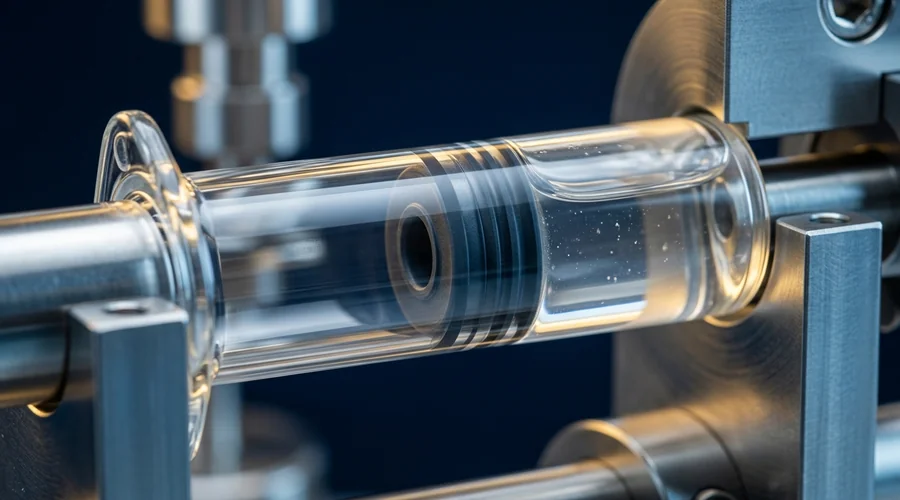
A 2012 Pharmaceutical Research paper shows how a residue can surprise a development team. Two batches of an epoetin alfa product in syringes showed unusually high aggregation, and soluble tungsten was found in the syringes, most likely from pins used to make them. Spiking the protein with sodium polytungstate, or with an extract of the pins, induced dimers that appeared to be disulphide-linked, and higher-order aggregates. The same paper recalls that replacing albumin with polysorbate 80 and glycine preceded a rise in antibody-mediated pure red cell aplasia. Investigators proposed that polysorbate 80 enhanced leaching from uncoated rubber stoppers.
The barrel advantages and watch-outs above are as reported in the 2015 study, whose polymer syringes were supplied by their manufacturer. The EMA guideline turns the wider lessons into a compatibility checklist for every material that contacts the product:
- Sorption and precipitation — test whether the drug adsorbs to a surface or precipitates in contact with it.
- Extractables and leachables — assess what migrates from device materials and processing aids into the product.
- Worst-case orientation — study compatibility in the orientations and in-use conditions most likely to cause an effect.
- Simulated transport — include vibration and shipping studies where actual transport data are absent.
Compatibility sets what the product can survive, and the device decides what it takes to deliver the dose.
Injection Force, Viscosity and Autoinjector Delivery
A syringe that is stable on the shelf still fails if the patient cannot push the plunger or the autoinjector cannot finish the dose. Viscosity, needle bore and flow rate set the pressure the device must supply. For a Newtonian liquid, the Hagen-Poiseuille equation says the pressure drop rises with viscosity, needle length and flow rate and falls with the fourth power of the needle radius. The equation assumes Newtonian flow, so measured glide force remains the specification test.
- Release tests — the EMA guideline lists delivered dose uniformity, extractable volume, glide force, needle penetration force and delivery time.
- Device tests — it also lists exposed needle length after activation, activation force and lock-out control against over-dosing.
- Primary functions — an open-access 2023 framework paper names holding force, cap removal force, activation force, extended needle length, injection time, dose accuracy and needle guard lockout.
- Fit with the product — the EMA asks applicants to justify the suitability of the device for the drug product, considering its rheological properties.
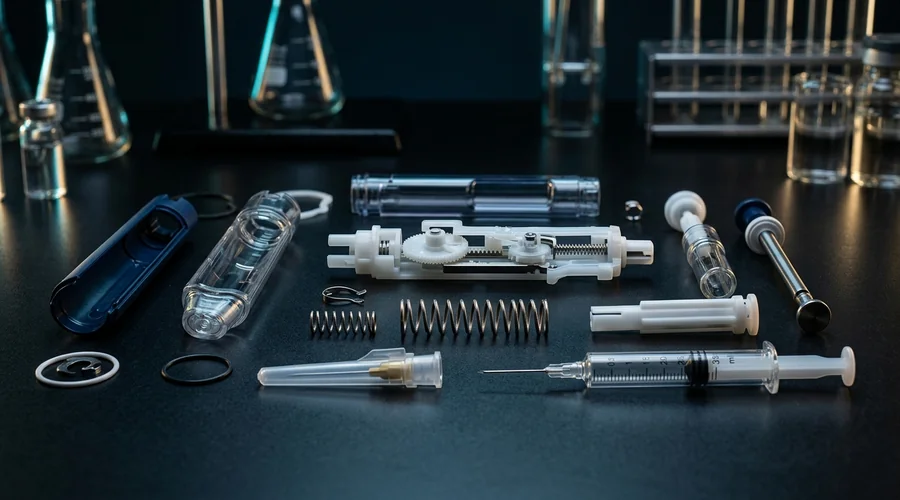
Patient tolerance is a separate question from device force. A 2015 study in 24 healthy adults injected placebo solutions through 27-gauge, 6 mm needles. It concluded that volumes up to 3 mL and viscosities up to 15 to 20 cP, delivered within 10 seconds, were well tolerated without pain concerns. The paper notes that an autoinjector must stay on the skin, which limits injection time to approximately 10 seconds.
Performance data are only half the file, because regulators also decide how the combination is assessed.
Autoinjector Device Combination Product: US and EU Pathways
A drug in a prefilled syringe or autoinjector is a combination product in the US and an integral medicinal product in the EU. Each system has its own evidence expectations: FDA applies drug and device manufacturing rules to the constituent parts, and the EMA expects device conformity evidence inside the quality dossier. Formulation work feeds both, so the paperwork is worth understanding early.
| Topic | United States (FDA) | European Union (EMA) |
|---|---|---|
| Definition | Two or more regulated components combined and produced as a single entity (21 CFR 3.2(e)) | Integral medicinal product, where the device part is integral to the medicine |
| Manufacturing rules | Drug CGMP in parts 210 and 211 for the drug constituent, and part 820 (QMSR) for the device constituent (21 CFR 4.3) | Assembly, sterilisation and filling covered by process validation in Module 3.2.P |
| Showing compliance | One operating system can show compliance with both sets, or with one set plus specified provisions of the other (21 CFR 4.4) | Device part qualified for functional performance, with in-use and transport studies |
| Device conformity evidence | Device constituent is a finished device under the QMSR | Conformity with Annex I of Regulation (EU) 2017/745 under Article 117, usually shown through a Notified Body opinion |
The EMA guideline, in force from 1 January 2022, adds two points that matter to formulators. The device should be as advanced as possible by the time pivotal trials begin, which reduces the bridging data needed at the marketing authorisation stage. Changes to the product, such as volume or viscosity, can also affect device performance enough to require further verification and validation. Our guide to the pharmaceutical regulatory pathway covers the wider submission framework.
With the technical and regulatory pieces in view, the practical question is how a team assembles the skills to deliver them.
Working With a Pharmaceutical Formulation Consultant and CDMO Support
Prefilled syringe projects cross formulation, packaging, device engineering and regulatory work, and few teams hold all four in-house. A pharmaceutical formulation consultant links the stages so a formulation decision is checked against the container, the device and the dossier before it hardens. Independent pharmaceutical product development services also keep supplier claims separate from measured compatibility data. The sequence matters more than any single study.
- Container screening — comparing glass, polymer, oil-free and lubricated options against the product's buffer and surfactant system.
- Compatibility design — planning sorption, extractables and leachables, agitation and transport studies.
- Injectability — linking viscosity and fill volume to glide force and the autoinjector's capability.
- Technology transfer — preparing the process and specifications for contract formulation CDMO support and scale-up.
Our guide to selecting a CDMO partner covers the transfer stage. Before locking a presentation, run a short decision check. Choose the barrel and lubricant on measured particle data, then confirm the surfactant does not trade aggregates for droplets. Test glide force and delivery time on the final viscosity, and confirm the device and dossier route. A syringe presentation chosen this way rests on evidence, and one chosen by supplier default rests on a catalogue.
Frequently Asked Questions
What is a prefilled syringe combination product?
Under 21 CFR 3.2(e), a combination product is two or more regulated components, such as a drug and a device, combined and produced as a single entity. A drug inside a prefilled syringe or autoinjector fits that definition in the United States.
The EMA's guideline calls the equivalent EU configuration an integral medicinal product. Under both frameworks the device part is assessed together with the medicine, not as passive packaging.
Why does silicone oil matter in prefilled syringes?
Silicone oil lubricates the plunger in most glass syringes, and droplets from that film can interact with proteins. The EMA guideline states that silicone oils released from the device can nucleate the formation of proteinaceous particles and aggregates.
Studies show the effect depends on the barrel, the buffer and the surfactant. In one comparison, lubricated glass syringes gave the highest particle counts, while oil-free glass and polymer syringes behaved similarly.
Are polymer syringes better than glass for biologics?
Not categorically. In a 2015 comparison, oil-free glass and oil-free polymer syringes gave similar aggregate and particle levels, and lubricated glass syringes were the worst case.
Polymer barrels offer higher break resistance and lower surface reactivity, but they are more susceptible to scratches and have higher gas permeability. The right choice depends on the product's measured behaviour.
How does viscosity affect autoinjector delivery?
For a Newtonian liquid, the pressure needed to push it through a needle rises with viscosity, length and flow rate. It falls with the fourth power of the needle radius, so higher viscosity raises glide force and lengthens delivery time.
The EMA lists glide force and delivery time among the product specification tests, and asks applicants to justify device suitability considering the product's rheological properties. Autoinjectors must stay on the skin, which limits injection time to roughly 10 seconds.
What did the tungsten case show about glass syringes?
In a 2012 study, two batches of an epoetin alfa product in syringes showed unusually high aggregation. Soluble tungsten was found in the syringes, most likely from pins used to make them.
Spiking the protein with sodium polytungstate or a pin extract induced aggregates and denatured the protein. The lesson is to test the finished syringe system, not only the supplier specification.
What device tests does the EMA expect for an integral product?
The guideline expects dose delivery to be demonstrated as accurate and reproducible from release to the end of shelf life and during in-use storage. Its specification examples include delivered dose uniformity, glide force, needle penetration force, delivery time, exposed needle length, activation force and lock-out control.
Applicants also include in-use and simulated transport studies, evidence of device conformity under Article 117 of the MDR, and a usability study where needed.
Can a formulation change affect device performance?
Yes. The EMA guideline tells the marketing authorisation holder to consider whether product changes, such as volume or viscosity, affect device performance. Where they do, use of the device can need further verification or validation.
The guideline also advises that the device be as advanced as possible by the time pivotal trials begin. Late changes to either the formulation or the device can mean extra bridging data.
Moving a Biologic Into a Prefilled Syringe or Autoinjector?
Global Formulation supports pharmaceutical manufacturers with container-closure screening, compatibility study design, injectability assessment, technology transfer packages and CDMO selection for prefilled and autoinjector presentations.
Talk to Our Formulation Team