Reactive Hot Melt PUR Adhesives: Moisture-Cure Chemistry Explained
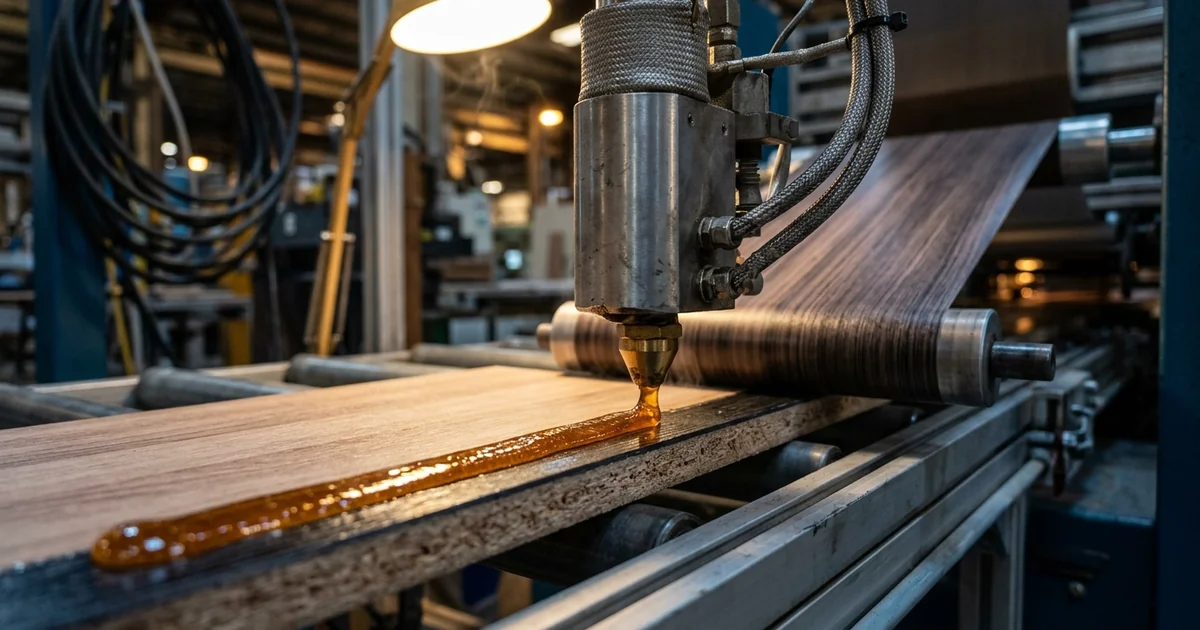
A furniture plant speeds up its edgebanding line with a new adhesive and starts getting panels back from customers with the edge strip peeling after a hot delivery run. A carmaker finds headliners drooping in vehicles left in summer sun. Both failures come from the same decision: using a thermoplastic hot melt where the job needed a reactive hot melt PUR adhesive. Reactive polyurethane hot melts sit between ordinary hot melts and two-part structural adhesives. They are applied molten like an EVA glue, then cure chemically into a cross-linked network that no longer softens when it warms up. That one difference is what lets a PUR bond survive heat, oils, plasticisers and cold flexing that would defeat a thermoplastic. This guide walks through the two-stage set-then-cure mechanism and the isocyanate prepolymer chemistry behind it. It covers how open time and green strength are balanced, how bond strength develops and is tested, and where PUR earns its cost in automotive, woodworking and filtration assembly. It reflects the substrate-and-service-first approach we bring to adhesives and sealants consulting, where a failed bond is traced back to the job it was asked to do.
Why Reactive Hot Melt PUR Adhesive Displaced Solvent and Thermoplastic Systems
Industrial assembly bonding has long been served by three families, and each has a weakness PUR was designed to remove. Solvent-borne contact adhesives are strong and versatile but release volatile organic compounds and need flash-off time. Thermoplastic hot melts — based on EVA, amorphous poly-alpha-olefins or polyamides — set in seconds and run clean. But they stay meltable for the life of the bond, so heat resistance is capped near their softening point and they creep under load. Reactive PUR keeps the solvent-free, fast-handling character of a hot melt and adds a permanent thermoset final state.
Compared with a thermoplastic hot melt, a cured PUR bond offers a specific set of gains:
- Heat resistance — no softening point to creep past; many grades hold strength to around 150 °C
- Chemical resistance — the cross-linked film resists oils, fuels, plasticisers and many solvents
- Difficult substrates — better adhesion to coated papers, printed films, foam-backed skins and engineering plastics
- Cold flexibility — the bond stays flexible well below freezing rather than turning brittle
- Lower application temperature — PUR is applied cooler than most EVA hot melts, protecting heat-sensitive films and veneers
- Thinner glue line — a stronger cured film meets the same specification with less adhesive add-on
| Property | Thermoplastic hot melt (EVA) | Reactive PUR hot melt |
|---|---|---|
| Final state | Thermoplastic — remelts on reheating | Thermoset — cross-linked, no remelt |
| Heat resistance | Limited to near the softening point | High; many grades to ~150 °C |
| Set speed | Seconds, on cooling | Seconds for green strength; cure over 1–3 days |
| Application temperature | Higher | Lower |
| Equipment | Open melt tank | Sealed, moisture-protected melter with purge |
| Adhesion to low-energy plastics | Poor | Better, best after surface treatment |
| Tank stability once molten | Long | Limited — skins and cures if exposed to air |
The chemistry of the thermoplastic option is covered in our guide to hot melt adhesive chemistry and industrial applications. The payoff for accepting sealed equipment and isocyanate handling is a bond that behaves like a thermoset. How that thermoset forms — in two distinct stages — is where formulation and process design begin.
The PUR Adhesive Moisture Cure Mechanism: Set First, Cross-Link Second
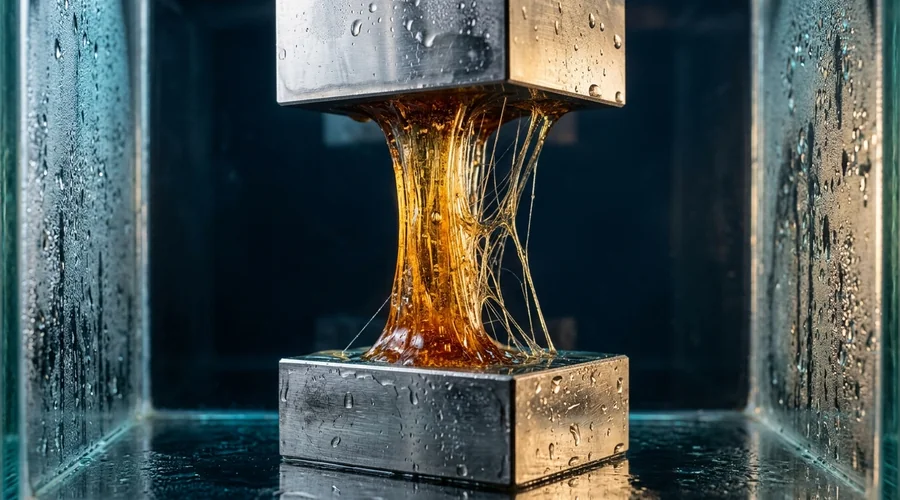
The defining behaviour of a reactive PUR hot melt is that it bonds in two separate stages on very different timescales. Stage one is purely physical. The molten adhesive loses heat to the substrate, thickens, and — in crystalline grades — crystallises, building enough green strength to move the part in seconds. Stage two is chemical and slow: the free isocyanate groups on the prepolymer react with water drawn from the surrounding air and from the substrate itself. This is why a PUR-bonded part can be handled almost immediately but is not at full strength for a day or more.
The cure chemistry runs in a fixed sequence:
- An isocyanate group reacts with a water molecule to form an unstable carbamic acid
- The carbamic acid breaks down into a primary amine and carbon dioxide gas
- The new amine reacts with a neighbouring isocyanate group to form a stable urea linkage
- As ureas form throughout the film, the chains connect into a three-dimensional cross-linked network that no longer melts on reheating
The carbon dioxide released in step two matters in practice. In a thin, well-designed glue line it escapes harmlessly. In a thick bead applied in humid conditions it can nucleate bubbles and foam the adhesive, weakening the bond. This is the same moisture-cure chemistry used in one-part polyurethane sealants, applied as a thin film rather than a joint bead. As technical references on hot-melt adhesives put it, secondary curing with atmospheric or substrate moisture continues for several hours after the adhesive solidifies. Those cross-links give service temperatures reaching 150 °C. Cure speed depends on relative humidity, temperature, bead geometry and substrate porosity, because moisture has to diffuse inward from the surface.
With the mechanism clear, the next question is what the prepolymer is actually built from, because backbone choice controls almost everything the cured bond does.
Inside the Prepolymer: Isocyanate Hot Melt Adhesive Building Blocks
A reactive PUR hot melt is essentially one active ingredient — an isocyanate-terminated polyurethane prepolymer — plus a smaller set of modifiers. The prepolymer is made by reacting a blend of polyols with excess diisocyanate. Every chain end is left capped with a reactive isocyanate group, ready to meet water later. The polyol blend is the main design lever and decides open time, flexibility, heat resistance and adhesion. The diisocyanate is almost always methylene diphenyl diisocyanate, chosen for its very low vapour pressure.
The building blocks and what each one controls:
- Crystalline polyester polyols — solidify sharply on cooling for fast green-strength build and high cohesive strength; the backbone of fast-setting grades
- Amorphous polyester polyols — stay soft, extend open time and add tack and flexibility; they balance the crystalline fraction
- Polyether polyols — improve hydrolysis resistance, low-temperature flexibility and flow, used where humidity or cold service is severe
- Polyolefin and speciality polyols — push adhesion toward low-surface-energy plastics such as polypropylene and TPO
- Methylene diphenyl diisocyanate (MDI) — the standard isocyanate; the ratio of monomeric to polymeric MDI shifts cure speed and cross-link density
- Free isocyanate content — more unreacted groups means faster, denser cure and more carbon dioxide; less means a slower, more flexible film
- Catalysts, thermoplastics, tackifiers and moisture scavengers — tune cure rate, viscosity, tack and stability in the melt tank
Because MDI has an extremely low vapour pressure it is far less of an inhalation hazard than older aromatic isocyanates, though it remains a respiratory sensitiser that demands proper handling. Formulators keep exact free-isocyanate levels, catalyst loadings and polyol ratios proprietary, but the direction of each lever is well understood and predictable.
The crystalline-to-amorphous ratio in that polyol blend does more than set film properties — it also sets the clock the assembly line has to run to.
Reactive Hot Melt Open Time and Green Strength: The Central Trade-Off
Every reactive hot melt formulation is a negotiation between two clocks that usually run against each other. Reactive hot melt open time is the window after application during which the adhesive is still molten and tacky enough to wet out and bond the second substrate. Green strength is the handling strength the joint reaches once the adhesive has cooled and set, before chemical cure has contributed much. Push open time up and green strength usually drops; demand fast green strength and the working window shrinks.
The levers that move the balance:
- Polyol crystallinity — the primary lever; more crystalline content means faster set and shorter open time
- Application temperature and bead mass — a hotter, heavier bead holds working heat longer and extends open time
- Substrate temperature — a cold substrate quenches the bead fast; preheating lengthens the window
- Viscosity and tackifier balance — affects wet-out and how the adhesive grabs the second surface
- Line speed and press timing — a process lever that has to be matched to whatever the chemistry gives
| Assembly type | Open time need | Green strength need | Grade character |
|---|---|---|---|
| Edgebanding | Very short | Very high, immediate | Highly crystalline, fast-set |
| Profile wrapping / 3D lamination | Short | High | Crystalline, fast-set |
| Flat panel / foil lamination | Longer | Moderate | Balanced to amorphous-rich |
| Automotive trim skinning | Moderate | Moderate to high | Balanced, heat-resistant |
| Filter media potting | Longer | Low initially | Amorphous-rich, flexible |
Matching the grade to the line is the single most common place a PUR trial goes wrong. A long-open-time laminating grade on a fast edgebander never builds strength before the panel reaches the stacker. A fast-set wrapping grade on a slow contoured lamination skins over before the operator has positioned the part.
Building and Measuring PUR Adhesive Bond Strength
PUR adhesive bond strength is a moving target for the first few days after assembly. A freshly bonded part holds only a fraction of its ultimate strength, carried by the cooled adhesive alone. Full cross-link density arrives only once moisture has diffused through the entire glue line and the urea network has formed. This is why a PUR bond cannot be judged by pulling it apart an hour after assembly.
The strength-development curve has a predictable shape. There is an immediate step to green strength as the bead cools, then a rise over roughly 24 to 72 hours, flattening at full strength. Warm, humid air steepens the curve; cold, dry air flattens it. Once cured, the bond delivers a set of properties a thermoplastic cannot match:
- Heat resistance — sustained strength to around 150 °C for many grades, with no softening-point failure
- Creep resistance — holds under continuous shear and peel loads
- Fluid resistance — stands up to oils, fuels, plasticisers and hydrolysis
- Low-temperature performance — stays flexible well below 0 °C
- Adhesion range — bonds coated, printed and lower-energy surfaces after correct preparation
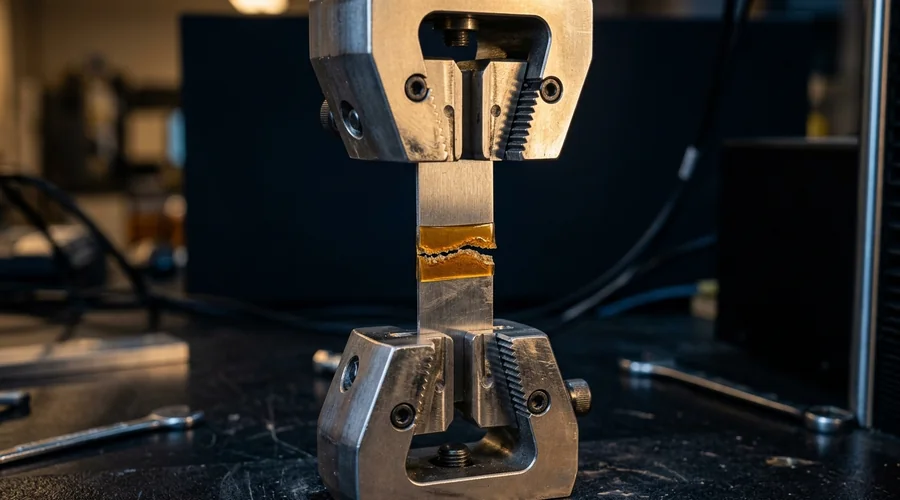
Bond strength is measured with the standard adhesive tests: tensile lap-shear on overlapped coupons, T-peel and cleavage. Heat-sag tests, static-load creep tests and humidity-aged strength retention round out the picture. Specimens must be fully cured and conditioned to a fixed protocol before testing. The failure mode is then read alongside the number. Cohesive, adhesive and substrate failures each point to a different problem, as our guide to adhesive failure modes explains.
With the mechanism, chemistry and performance established, the question becomes where that performance is actually worth paying for.
Automotive PUR Adhesive Application, Furniture and Filtration
Reactive PUR hot melts concentrate in assembly jobs that punish a thermoplastic bond — heat, sustained load, awkward substrates, or a thin bond line that still has to be structural. Transport is the largest single market, with woodworking and filtration close behind. The common thread is a part that has to survive a hot car cabin or an un-airconditioned warehouse without letting go.
The main sectors, and what PUR does in each:
- Automotive interior — headliner lamination, door-panel and pillar-trim wrapping, instrument-panel skin bonding and seating trim. A parked cabin can exceed 100 °C, and the foam-backed TPO and PVC skins defeat a thermoplastic — the classic automotive PUR adhesive application
- Automotive filtration and under-hood — potting cabin-air and engine-air filter media into their end frames, where oil and heat resistance are essential
- Furniture and woodworking — edgebanding, profile wrapping of MDF mouldings, foil and veneer lamination, and window and door profile assembly. PUR gives a heat- and water-resistant glue line that a PVAc or EVA joint cannot
- Textiles and technical laminates — bonding foams, films and fabrics for automotive, apparel and building membranes at low application temperature
- Footwear — sole and component bonding where flex-crack resistance over years of walking matters
- Graphic arts and book binding — spine and cover bonding, covered in depth in our guide to bookbinding and paper adhesives
- Electronics and appliance assembly — fast-handling structural bonding and sealing where a gap-tolerant, heat-resistant joint helps
Across all of these, the decision to adopt PUR is never only about the bond. It is also about the equipment and the safety programme that come with an isocyanate-cured adhesive.
Choosing PUR: A Decision Framework and the Handling Reality
PUR is the right answer when the service condition defeats a thermoplastic and the wrong answer when it does not. Its cost per kilogram, its sealed equipment and its handling overhead are all real, and they only pay back when the extra performance is genuinely needed. A structured choice works through service condition, then substrate, then line speed, then plant capability. Many failed PUR trials turn out to be the wrong grade or an under-prepared plant rather than the wrong chemistry.
A decision framework for adopting PUR:
- Define the worst service condition — peak temperature, sustained load, fluid exposure and cold flex; if a thermoplastic hot melt survives all of them, PUR is over-engineering
- Check the substrates — low-energy plastics, coated or printed surfaces and dense hardwoods usually need PUR plus a surface treatment such as flame, corona, plasma or primer
- Match grade to line speed — fast crystalline grades for edgebanding and wrapping, slower amorphous grades for large laminations and potting
- Size the bead for a thin film — design the joint for a thin, even glue line to avoid carbon-dioxide foaming and slow deep cure
- Audit plant capability — sealed melt-on-demand or drum melters with dry-gas or desiccant blanketing, purge routines on shutdown, and moisture-tight packaging
- Close the regulatory and training gap — isocyanate handling carries formal training and exposure-control duties that have to be in place before the first drum arrives
The handling reality deserves to be stated plainly. The adhesive must stay sealed from air through melting and application. Its pot life in an open tank is short, because it skins and cures, and unused material has to be purged on shutdown. Packaging is moisture-barrier — foil pouches, sealed cartridges or lined drums. Local exhaust ventilation and personal protective equipment are standard, because diisocyanates are respiratory sensitisers. In the European Union, a REACH restriction has applied since 24 August 2023. Industrial and professional use of products above 0.1 percent monomeric diisocyanate requires documented training, renewed at least every five years, and comparable exposure controls apply elsewhere. The raw-material side of that picture is set out in our guide to REACH restrictions on adhesive raw materials.
Two conditions make PUR pay. Its thermoset final state has to be genuinely needed, and the plant has to be ready for isocyanate chemistry. Meet both and a reactive hot melt PUR adhesive delivers a bond no thermoplastic can match. Miss either and it is a more expensive way to reach a result a simpler adhesive would have given.
Frequently Asked Questions
What is a reactive hot melt PUR adhesive?
A reactive hot melt PUR adhesive is a solvent-free polyurethane adhesive built on an isocyanate-terminated prepolymer. It is applied molten, like a conventional hot melt, but then cures chemically. On contact with the cooler substrate it solidifies and builds handling strength in seconds.
Over the following hours to days, its free isocyanate end groups react with moisture from the air and the substrate. That cross-links the adhesive into a thermoset network that no longer softens when reheated. This final state is what separates PUR from a thermoplastic hot melt such as EVA, which stays meltable for the life of the bond.
How does the PUR adhesive moisture cure mechanism work?
The prepolymer chains are capped with reactive isocyanate groups. When water molecules reach those groups, each isocyanate first forms an unstable carbamic acid that breaks down into an amine and carbon dioxide gas. The new amine then reacts with a neighbouring isocyanate group to form a stable urea linkage. As this repeats across the film, the chains stitch into a three-dimensional cross-linked network.
Because the reaction consumes atmospheric and substrate moisture, cure speed depends on relative humidity, temperature and bead thickness. Full cure typically takes one to three days. The carbon dioxide released is also why thick PUR beads can foam in humid conditions.
What is the difference between open time and green strength in a reactive hot melt?
Open time is the window after application during which the adhesive is still molten and tacky enough to wet out and bond the second substrate. Green strength is the handling strength the joint reaches once the adhesive has cooled and set, before chemical cure has contributed much.
The two usually trade against each other. A crystalline-rich formula sets fast with high green strength but a short open time. An amorphous-rich formula stays workable longer but is slow to build handling strength. Matching that balance to the line speed is the most common place a PUR trial succeeds or fails.
How long does a PUR hot melt take to reach full bond strength?
A PUR bond leaves the assembly station at only a fraction of its ultimate strength, held together by the cooled, solidified adhesive. Chemical cross-linking then builds strength over roughly 24 to 72 hours as moisture diffuses through the whole glue line and urea linkages form.
Warm, humid conditions speed this up; cold, dry air slows it down, and a thick bead cures from the outside in, so its centre lags the surface. For quality testing, specimens have to be fully cured and conditioned to a fixed protocol before they are pulled, or the reported strength will be misleadingly low.
Why does PUR outperform EVA hot melt for automotive and furniture parts?
A thermoplastic EVA hot melt has a softening point, and above it the bond creeps and eventually lets go. A parked car cabin in summer and an un-airconditioned warehouse both reach temperatures that put a standard EVA laminate under real stress.
Because a cured PUR film is cross-linked rather than merely frozen, it behaves differently. It holds strength to around 150 degrees Celsius for many grades, resists oils and solvents, and stays flexible well below freezing. That combination is why headliners, door-panel wraps, edgebanding and profile-wrapped mouldings are routinely specified in PUR, even though it costs more per kilogram and needs sealed equipment.
What equipment and safety measures does a reactive PUR hot melt need?
Because the adhesive reacts with moisture, it must be kept sealed from air throughout melting and application. That usually means melt-on-demand units or drum melters under a dry-gas or desiccant blanket, plus moisture-tight packaging such as foil pouches or sealed cartridges. A purge routine on shutdown stops material skinning and curing inside the machine.
Isocyanate chemistry also carries a health duty, because diisocyanates are respiratory sensitisers. Local exhaust ventilation and appropriate personal protective equipment are standard. In the EU, a REACH restriction has applied since 24 August 2023. Industrial and professional use of products above 0.1 percent monomeric diisocyanate requires documented training, renewed at least every five years, and equivalent exposure controls apply in other regions.
Can PUR hot melt bond polypropylene and other low-surface-energy plastics?
PUR adheres to a wider range of difficult substrates than a thermoplastic hot melt, including coated papers, printed films, foam-backed skins and many engineering plastics. Untreated polyolefins such as polypropylene and TPO still have a surface energy too low for a reliable bond on their own.
The practical route is a surface treatment first, such as flame, corona or plasma treatment, or an adhesion-promoting primer. That raises surface energy so the molten adhesive can wet out. Speciality PUR grades formulated with polyolefin-compatible polyols improve adhesion further, but surface preparation remains the deciding factor.
Specifying or Formulating a Reactive PUR Hot Melt?
Global Formulation provides adhesives consultancy — PUR grade selection, open-time and green-strength matching to your line, substrate and surface-treatment strategy, cure and bond-strength test protocols, and isocyanate handling compliance.
Talk to Our Formulation Team