Self Compacting Concrete Admixture: VMA and PCE Balance
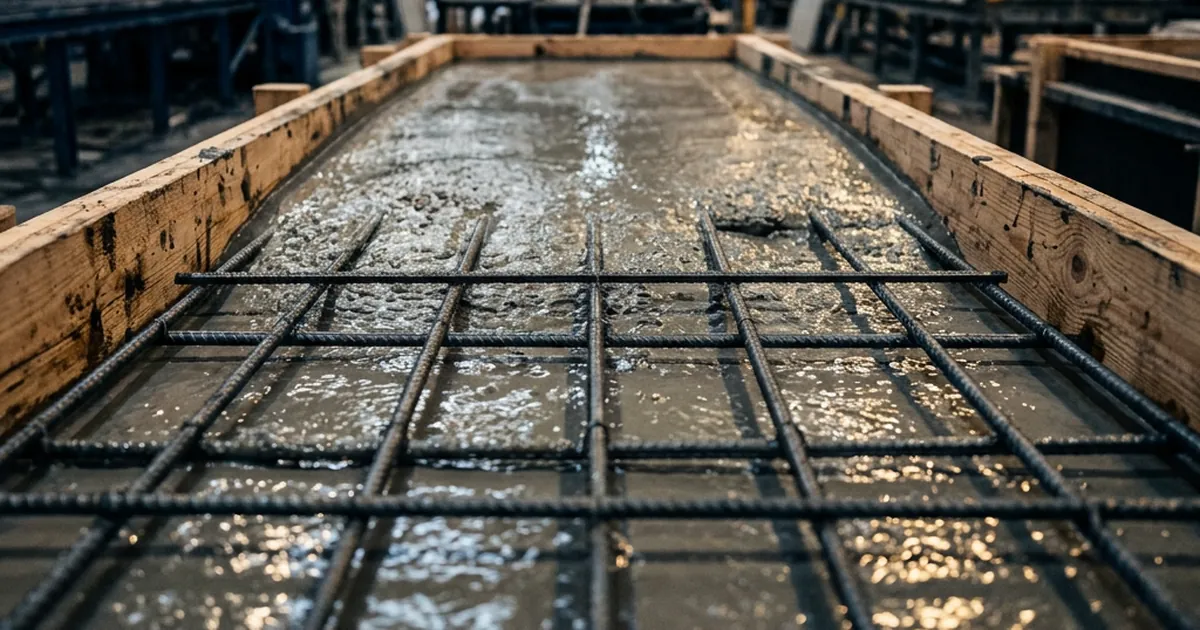
Self-compacting concrete has to do two opposite things at once: flow like a fluid through dense reinforcement and stay uniform like a solid while it does. A mix that is too fluid segregates and bleeds, and a mix that is too viscous blocks, traps air and leaves poor surfaces. The balance is set largely by the self compacting concrete admixture system, a polycarboxylate superplasticizer for flow and often a viscosity modifying agent for cohesion. This guide explains how the two work, how they interact, which classes and tests define success and how production practice protects the balance. It draws on the European Guidelines for Self-Compacting Concrete and open peer-reviewed studies, plus the formulation support Global Formulation gives construction chemical makers.
Self Compacting Concrete Admixture Basics: Four Properties That Define SCC
Self-compacting concrete flows and consolidates under its own weight, fills the formwork completely around dense reinforcement and stays homogeneous without any added compaction. That definition comes from the European Guidelines for Self-Compacting Concrete, prepared in 2005 by the European precast, cement, ready-mix, admixture and specialist construction chemicals federations. The guidelines break the behaviour into four fresh properties, and each one links back to an admixture decision. Admixtures therefore sit at the centre of SCC mix design.
| Property | What It Means | Preferred Test | Main Admixture Lever |
|---|---|---|---|
| Flowability, filling ability | Spread of the concrete in unconfined conditions | Slump-flow | Superplasticizer |
| Viscosity | Rate of flow once flow has started | T500 time in the slump-flow test, or V-funnel time | Superplasticizer and viscosity modifying agent |
| Passing ability | Flow through tight gaps between bars without blocking | L-box | Paste balance and aggregate, with admixture support |
| Segregation resistance | Homogeneity in the fresh state during and after placing | Sieve segregation test | Viscosity modifying agent and fines |
The mix design principles explain why. The guidelines adjust paste fluidity and viscosity in three steps. They select the cement and additions, limit the water to powder ratio, then add a superplasticizer and, optionally, a viscosity modifying admixture. Compared with vibrated concrete, SCC normally has a lower coarse aggregate content, more paste, a low water to powder ratio and a higher superplasticizer level. Our guide to plasticizers and superplasticizers covers the underlying admixture families.
The first lever is the dispersant, so polycarboxylate chemistry comes next.
Polycarboxylate Superplasticizer in SCC: Dispersion, Retention and Source Sensitivity
Superplasticizers are an essential component of SCC, according to the European guidelines. They bring the water reduction and fluidity, and they must keep dispersing the cement during transport and placing. A polycarboxylate superplasticizer does this with a comb-shaped molecule that adsorbs on the cement particles. Understanding that action explains both its power and its sensitivity.
A 2025 open-access review of additives and rheology describes the mechanism. The carboxylate groups adsorb on positively charged cement phases, while the polyethylene oxide side chains give steric hindrance that prevents flocculation. This releases entrapped water and lowers both yield stress and plastic viscosity. Our polycarboxylate ether synthesis guide covers how those side chains are built.
| Superplasticizer Type | How It Disperses | SCC Implication |
|---|---|---|
| Polycarboxylate | Adsorption through carboxylate groups plus steric hindrance from side chains | Lowers yield stress and plastic viscosity; the dominant choice for SCC |
| Naphthalene and melamine sulfonates | Electrostatic repulsion from adsorbed sulfonate groups; linear chains with no long side groups | Higher plastic viscosity than polycarboxylates; poorer compatibility with high-alkali cements |
| Ester-type polycarboxylate | More side chains and fewer anionic binding sites | Better slump retention in one account, but a higher dosage was needed in a four-source study |
| Acid-type polycarboxylate | More binding sites for adsorption | Lowest dosage to reach the target flow in that study |
Source sensitivity is the practical lesson. An open-access study of four polycarboxylate sources found that the dose needed to reach the same slump flow and stability varied among them. It also cites earlier work concluding that, despite apparent chemical similarity, admixtures from different sources cannot be used interchangeably. The type of superplasticizer also changes the air content of an SCC mix, which is why compatibility tests matter.
Dispersion alone produces a fluid mix, and the second admixture is what keeps that fluid mix together.
Viscosity Modifying Agent in Concrete: Chemistry, Mechanisms and Limits
A viscosity modifying agent adds cohesion to a fluid mix without making it stiff. The European guidelines define a viscosity modifying admixture as one added to fresh concrete to increase cohesion and segregation resistance. Its main job in SCC is robustness, meaning the mix keeps its properties when moisture, fines or grading vary slightly. Chemistry decides how each product achieves that.
Most viscosity modifying agents are water-soluble polymers. A 2026 open-access study of natural mucilages lists welan gum, xanthan gum, diutan gum and starch ether among those in widespread use. It notes that welan, diutan and xanthan are high molecular weight polysaccharides made by aerobic fermentation. The 2025 review adds acrylic polymers and cellulose-derived biopolymers, and names three mechanisms: water retention, polymer entanglement and adsorption with particle bridging.
| VMA Class | Examples Reported | Reported Behaviour |
|---|---|---|
| Microbial polysaccharides | Welan gum, diutan gum, xanthan gum | Bind water and raise yield stress and plastic viscosity; cut bleeding |
| Starch ethers | Starch ether | In mortar tests, mainly raises cohesion, through yield stress and storage modulus |
| Cellulose ethers and guar | Hydroxypropyl methyl cellulose, guar ether | Raise consistency and water retention; plastic viscosity tracks water retention |
| Acrylic polymers | Acrylic-based VMAs | Improve robustness against bleeding and segregation |
| Mineral-based agents | Silica and modified bentonite | Gave the best rheological results among six VMAs in one study |
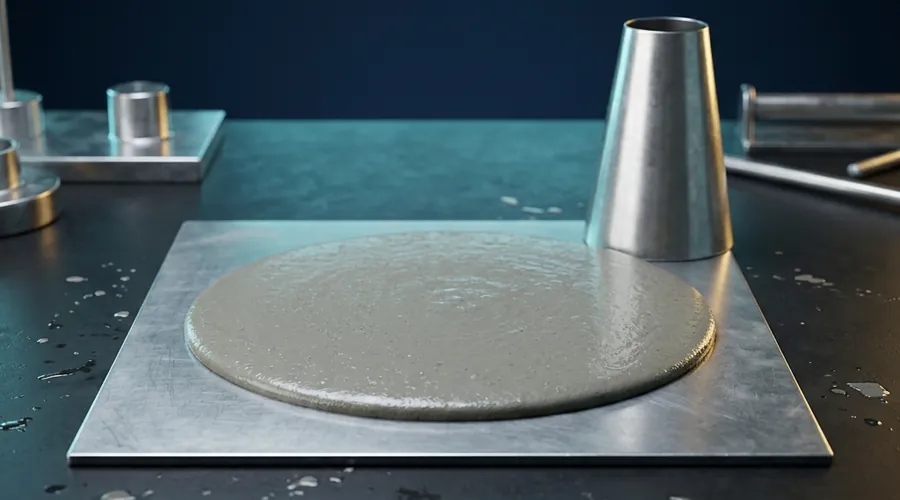
The trade-off is dispersion. VMA adsorption leads to poorer dispersion of cement particles, the 2025 review reports, seen as thixotropic behaviour with higher yield stress and plastic viscosity. It also notes that combining VMAs with superplasticizers can cause incompatibility through competitive adsorption at particle surfaces. A mix that is too viscous will not spread. The open-access mucilage study saw spread fall sharply and V-funnel times pass 40 seconds with the natural viscosity modifiers it tested. Our guide to rheology control in self-levelling underlayments shows the same trade-off in another product.
Both admixtures now have a job, so the real task is balancing them.
Balancing VMA and Superplasticizer: Flow, Viscosity and Segregation Resistance
The two admixtures pull rheology in opposite directions. The superplasticizer lowers yield stress so the mix spreads, while the viscosity modifier raises cohesion so the mix holds together. One open-access four-source study frames the target as a mix with low yield stress and sufficient viscosity to spread freely without compaction. The balance is found by diagnosis, and the guidelines give a symptom guide for that.
| Symptom | Likely Cause | Corrective Lever (European Guidelines) |
|---|---|---|
| Blow holes, long flow time, slow slump-flow | Viscosity too high | Reduce VMA dosage and review mix proportions |
| Vertical stripes or water scouring on the surface | Bleeding of water and fines; water to powder ratio too high; viscosity too low | Add fines or a VMA; consider an air entrainer |
| Uneven cast surface or deformed mould | High water to powder ratio, low plastic viscosity | Raise superplasticizer level or use a VMA |
| Honeycombing or incomplete filling | Too little paste or fines; segregation from low plastic viscosity | Increase fines, use a continuous grading, smaller maximum aggregate |
| Scaling at the top surface | Segregation and bleeding from too few fines | Increase powder content; use a VMA or an air entrainer |
Classes turn this balance into a specification. The guidelines list slump-flow classes SF1 for 550 to 650 mm, SF2 for 660 to 750 mm and SF3 for 760 to 850 mm. Viscosity classes follow as VS1 or VF1 and VS2 or VF2. They add that VS1 or VF1 gives the best finish but a higher risk of bleeding and segregation. VS2 or VF2 adds thixotropy that can help with segregation and formwork pressure. Higher slump-flow classes make segregation harder to control and call for a segregation class as well.
A balanced mix is only credible if it is measured, so the test set comes next.
SCC Admixture Testing: Slump-Flow, T500, V-Funnel, L-Box and Segregation
Admixture qualification for SCC is a multi-test exercise because each test isolates one property. The European guidelines describe five methods in their annex, grouped by property. Slump-flow is the primary consistence check, and T500, V-funnel, L-box and sieve segregation add viscosity, passing ability and segregation. Development work then repeats the tests at several slump-flow targets, not just one.
| Test | Property Assessed | What an Admixture Change Shows |
|---|---|---|
| Slump-flow | Flowability and filling ability | Whether the superplasticizer delivers the target spread; visual stability notes show bleeding or aggregate pile-up |
| T500 time | Viscosity, as rate of flow | Whether the VMA is making the mix too slow or too fast |
| V-funnel | Viscosity and filling ability | Flow time through a restricted opening; a second view of viscosity |
| L-box | Passing ability | Whether the mix blocks at the bars, linked to paste cohesion and aggregate size |
| Sieve segregation | Segregation resistance | How much paste passes a sieve, showing the stability the VMA provides |
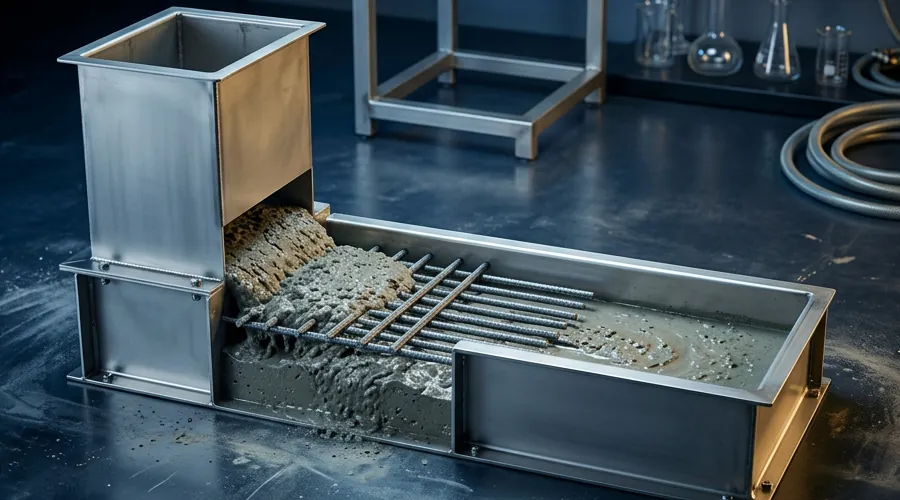
Standards have moved on since 2005. The guidelines say that none of the EN 12350 methods of the time suited SCC and expected the series to be extended to cover these tests. In the United States, ASTM publishes C1611 for slump flow of self-consolidating concrete. It also publishes C1610 for static segregation by the column technique and C1621 for passing ability by J-ring. Specifiers choose the current method set that applies in their market.
The four-source study shows how to qualify admixtures with these tests. It defined the optimum dosage as the minimum amount that reached the target slump flow and a stable visual rating. It then compared flowability, viscosity, stability, passing ability and filling ability. Acceptable properties were reachable with all four sources at the right dosing. The same study found the dosing differed between sources, which is why each source is qualified separately.
Qualification on the bench only helps if the plant reproduces it, so production practice matters next.
Production and Site Practice: Mixing Sequence, Dosing Control and Robustness
SCC is more sensitive than normal concrete to variation in its constituents, especially aggregate moisture, grading and shape. That sensitivity makes batching discipline part of the admixture system. The guidelines treat the mixing sequence, dosing accuracy and production checks as design decisions, not routine chores. A formulator who understands them can write better product guidance.
- Add admixtures with the water — admixtures should not go onto dry constituents but be dispensed together with or in the mixing water.
- Keep admixtures separate until dosing — different admixtures should not be blended before dispensing unless the admixture manufacturer approves it.
- Add the VMA late — in free-fall and truck mixers the VMA goes in after the superplasticizer and just before the final consistence adjustment.
- Allow more mixing time — SCC can need longer mixing than normal concrete to disperse and activate the superplasticizer.
- Start below target consistence — batching a lower consistence first avoids unmixed balls in free-fall mixers, and water and superplasticizer bring the mix up afterwards.
- Calibrate dispensers — modern superplasticizers are powerful, so dispensers need regular calibration and counting of multiple additions.
- Monitor moisture continuously — adjust the mix for changes in aggregate moisture, and test every load for slump-flow until results are consistent.
Site behaviour closes the loop. The guidelines warn that production stops can cause thixotropic gelling in concrete already placed, which can hurt filling ability on restart and leave lift lines. They also note that, with an appropriate level of thixotropy, formwork pressure below hydrostatic can be reached when casting from the top, but only on the basis of verification trials. The same viscosity modifier that gives robustness therefore also affects pressure, restarts and surface finish.
Pulling these elements into a product that works across many plants is the formulator's job.
Working With a Construction Chemicals Formulation Consultant
SCC admixture development sits between polymer chemistry, cement chemistry, rheology and plant practice, and a change in one area moves the others. A construction chemicals formulation consultant characterises the binder and aggregates, screens superplasticizer and viscosity modifier chemistries, and tests compatibility across cements. Construction chemical product development services extend that into robustness trials, technical data and dosing guidance. A contract formulation and scale-up partner then moves the validated product from the lab into manufacture.
- Characterise the binder system — cement, additions, fines content and aggregate moisture behaviour.
- Screen superplasticizer grades — side chain and charge design against flow and retention needs.
- Screen viscosity modifier classes — microbial gums, starch or cellulose ethers, acrylics or mineral agents.
- Test the interaction — competitive adsorption, viscosity and retention at several slump-flow targets.
- Prove robustness — vary water, fines and temperature and watch the four fresh properties.
- Decide the packaging — separate products or an approved combined product, with dosing instructions.
- Transfer to manufacture — write the specification, quality limits and release tests for production.
Our construction chemicals range shows where SCC admixtures sit among the other products. Our guide to scale-up from lab to plant covers the production side, and the air-entraining admixtures guide covers a third admixture that interacts with both. Global Formulation provides admixture screening, compatibility and robustness testing, specification support and contract manufacturing transfer for construction chemical makers. Dosage rates and mix proportions stay outside this guide by design, because each cement and aggregate system sets its own.
Frequently Asked Questions
What admixtures are used in self-compacting concrete?
The European Guidelines for Self-Compacting Concrete call superplasticizers, or high range water reducing admixtures, an essential component of SCC. A viscosity modifying admixture is an optional addition that reduces segregation and makes the mix less sensitive to variations in moisture and other constituents.
Air entraining, accelerating and retarding admixtures can be used as in vibrated concrete, with advice from the admixture manufacturer.
Most modern SCC relies on a polycarboxylate superplasticizer, with a viscosity modifier added when the mix needs more cohesion.
What does a viscosity modifying agent do in SCC?
A viscosity modifying agent increases cohesion and segregation resistance without significantly altering fluidity. It makes the concrete more robust when sand moisture, fines or grading vary slightly.
Most are water-soluble polymers such as welan, diutan and xanthan gum, starch ethers, cellulose ethers and acrylic polymers. They retain water, entangle with each other and bridge cement particles, which raises yield stress and plastic viscosity.
The European guidelines stress that a VMA should not replace good mix design and careful selection of the other constituents.
How do you balance a VMA and a superplasticizer in SCC?
The superplasticizer lowers yield stress so the mix spreads, and the VMA raises cohesion so the mix holds together. The target is low yield stress with sufficient viscosity to flow without segregating.
The guidelines advise adjusting consistence through the superplasticizer level. Changes in aggregate moisture, grading and batching sequence are the usual causes of drift and are hard to identify on the spot. If viscosity is too high, reduce the VMA; if bleeding or segregation appears, increase fines or consider a VMA.
Compatibility testing matters, because a 2025 review reports that VMAs and superplasticizers can compete for adsorption sites on cement particles.
What tests are used to check self-compacting concrete?
The European guidelines pair each fresh property with a test: slump-flow for flowability, T500 time or V-funnel for viscosity, L-box for passing ability and a sieve test for segregation resistance. No single test is enough, and slump-flow is the primary consistence check.
In the United States, ASTM C1611 covers slump flow, C1610 covers static segregation by the column technique and C1621 covers passing ability by J-ring.
Specifiers should confirm the current standard set in their own market.
What are the SCC slump-flow classes?
The European guidelines give SF1 as 550 to 650 mm, SF2 as 660 to 750 mm and SF3 as 760 to 850 mm. SF1 suits slabs, pump injection and sections that prevent long horizontal flow, while SF2 suits many walls and columns.
SF3 is typically used with small maximum aggregate size for very congested or complex structures, but segregation resistance is more difficult to control. Viscosity classes VS1 or VF1 and VS2 or VF2 are specified only in special cases.
Higher classes usually need closer control of segregation resistance.
Can you change the superplasticizer brand or type on an SCC mix?
Only after re-qualifying the mix. The European guidelines say that moving to another source, or another type from the same manufacturer, is likely to change SCC performance significantly. Any such change should be fully checked first.
An open-access study of four polycarboxylate sources found that the dose needed for the same slump flow and stability varied among them. It also cites earlier work concluding that admixtures from different sources cannot be used interchangeably.
Changes in cement, additions or other admixtures call for the same compatibility check.
Why is SCC more sensitive to batching variations than normal concrete?
SCC runs closer to the edge between flowing and segregating, so small changes in aggregate moisture, grading or shape show up quickly. The European guidelines say SCC is more sensitive than normal concrete to these variations and needs more frequent production checks.
They recommend monitoring aggregate moisture continuously, testing every load for slump-flow until results are consistent, and following a fixed mixing sequence set by plant trials.
A viscosity modifier reduces this sensitivity but does not remove it.
Developing an SCC Admixture System?
Global Formulation supports superplasticizer and viscosity modifier screening, compatibility and robustness testing, specification writing and contract manufacturing transfer.
Talk to Our Formulation Team