A solar module spends decades outdoors, and two optical losses drain its output every day. Sunlight reflects off the front glass before it reaches the cells, and dust then blocks part of what remains. Solar panel coating chemistry targets both losses with films far thinner than a human hair. The stakes are real, because a 2019 global review estimated that soiling alone cuts solar output by at least 3 to 4 percent a year, even with optimised cleaning. A weak coating choice wastes money and is expensive to undo once it is on the glass. This article explains how anti-reflective silica films and anti-soiling hydrophobic or hydrophilic layers work, how they are made, how they age, and how to choose between them. It relies on published optics, surface chemistry, and PV test standards, so manufacturers and project developers can judge any coating claim with confidence.
Solar Panel Coating Chemistry Starts With Two Optical Losses
Every coating on a PV module attacks a loss that happens before light reaches the cells. Reflection comes first, because bare glass turns away about 4 percent of light at normal incidence. Soiling comes second, as dust, soot, pollen, and mineral films block and scatter light on the outer face. The two losses have different physics, so they demand different coating chemistry.
| Loss | Physical cause | Coating strategy | Typical chemistry |
|---|---|---|---|
| Reflection | Step in refractive index between air and glass | Add a layer with an index between the two | Porous sol-gel silica, magnesium fluoride, multilayer stacks |
| Dust adhesion | Particles binding to high-energy glass, worsened by dew | Change surface energy so particles bind weakly and water carries them off | Hydrophobic silanes, hydrophilic and photocatalytic films |
| Electrostatic attraction | Charge build-up on dry glass | Dissipate charge through a conductive surface | Conductive and antistatic layers |
| Wear and ageing | UV, thermal cycling, humidity, and abrasion | Durable inorganic network bonded to the glass | Silica-based networks, sometimes with organic groups on top |
Soiling is measured, not guessed. IEC 61724-1 defines the soiling ratio as the actual output divided by the output expected if the array were clean, and soiling loss is one minus that ratio. Soiling rates typically run from zero to about one percent per day. A widely cited techno-economic review in Joule by Ilse and co-authors put the global average loss at 3 to 4 percent a year even with optimised cleaning. It priced that loss at 3 to 5 billion euros in 2018.
Both fixes belong to the same surface-chemistry toolbox that runs across our wider paints and coatings formulations. Reflection has the cleaner physics, so it is the right place to start.
Anti-Reflective Coating for Solar Panels: Why Porous Silica Works
Light reflects wherever it crosses between materials with different refractive indices. Air has an index near 1.0 and glass about 1.5, so that single abrupt step reflects about 4 percent of the light. A thin layer with an intermediate index softens the step, and reflections from the layer's two faces cancel by destructive interference. More light enters the glass, and more current flows from the cells.
A single-layer coating works when three conditions hold. They come from standard thin-film optics, as summarised in the literature on anti-reflective coatings.
- Index match — the coating index should equal the square root of the glass index, which is about 1.23 for glass with an index of 1.52.
- Quarter-wave thickness — the film must be one quarter of the design wavelength thick, measured inside the coating, so the two reflections arrive out of phase.
- Uniform coverage — thickness variation shifts the wavelength of best cancellation and leaves patchy reflection and visible colour.
No dense solid has an index near 1.23. Magnesium fluoride at 1.38 is the classic compromise and cuts bare-glass reflection from about 4 percent to about 1 percent. Dense silica sits near 1.46, which is closer to glass than to the target. Porosity closes the gap. Air-filled voids smaller than the wavelength of light pull the effective index of silica downward, and mesoporous silica films with indices as low as 1.12 have been made.
Index and thickness define what the film must be. Sol-gel chemistry explains how a factory actually builds it.
Sol-Gel Silica: How Anti-Reflective Films Are Built on PV Glass
Sol-gel chemistry builds a silica network from liquid precursors at modest temperatures, which suits the coating of large glass sheets. Silicon alkoxides such as tetraethyl orthosilicate react with water and condense into silica particles or chains. When the wet film dries, those particles pack with gaps between them, and the gaps are the pores that lower the index. A heat step then bonds the network to the glass. The sol-gel process follows four stages.
- Hydrolysis — water replaces alkoxy groups on silicon with silanol (Si–OH) groups and releases alcohol.
- Condensation — silanols link into siloxane (Si–O–Si) bonds, which grow nanoparticles or chains in the liquid sol.
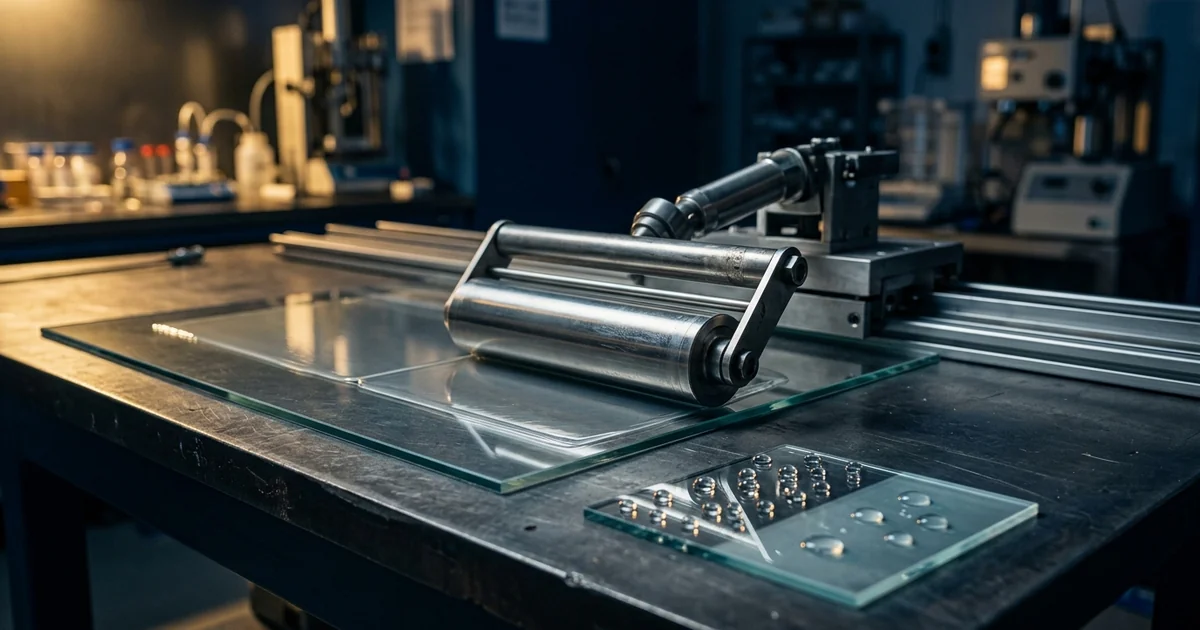
- Application — roller coating, spraying, or dipping lays a thin wet film on the glass.
- Drying and cure — solvent leaves, the network shrinks and densifies, and heat treatment strengthens the film and its bond to the glass.
In module factories, the cure step often shares the glass tempering furnace. The film is roller-applied to the cover glass, and the tempering heat hardens it while it strengthens the glass. That sequence explains why the process belongs to the factory: a patent on low-temperature anti-reflective films notes that finished and semi-finished modules cannot withstand those temperatures.
The payoff shows in measured output. Outdoor studies of silica coatings report module gains in the low single-digit percent range. A one-year desert trial led by Tecnalia in Chile's Atacama found about 2 percent higher energy yield, as reported by pv magazine. A critical review of coatings for desert modules cited 3.9 percent for an optimised silica layer on a CIGS module.
Those gains come from optics alone. The second job, keeping the glass clean, needs surface chemistry rather than interference physics.
Anti-Soiling Coating for Photovoltaic Modules: How Dirt Sticks and Releases
Dust lands on every module, but what happens next depends on the glass surface. Dry particles held by weak forces blow or wash off, while particles bonded by moisture stay put. Light rain and dew raise particle adhesion, which makes soiling harder to remove. Anti-soiling coatings therefore work by changing how the glass interacts with water and with electrical charge.
Field and laboratory work by Ilse and colleagues showed that dew significantly changes particle adhesion, removal, and soiling rates, whatever the dust type. Microscopy linked the effect to cementation, in which particles cake together and minerals crystallise at the wet glass surface. Heating the glass overnight to prevent dew formation reduced dust accumulation in the same study.
Four coating strategies respond to these mechanisms.
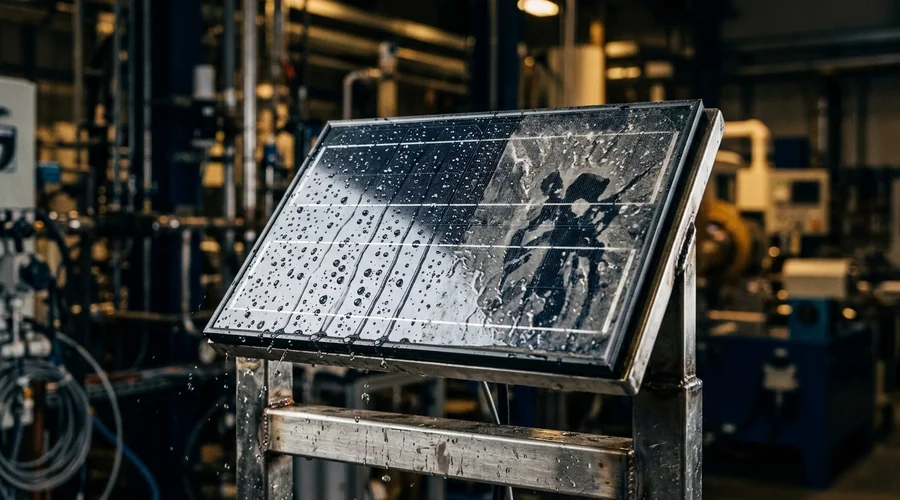
- Hydrophobic layers — low surface energy makes water bead up, and the droplets roll off with dust attached.
- Hydrophilic layers — high surface energy spreads water into a film that washes dust away.
- Photocatalytic layers — UV-activated titanium dioxide breaks down organic films and turns the surface hydrophilic.
- Antistatic layers — a conductive surface bleeds off the charge that would otherwise hold dust.
| Coating class | Surface behaviour | How it resists dirt | Main limitation |
|---|---|---|---|
| Hydrophobic | Water contact angle above 90°, droplets bead | Droplets roll off and carry particles | Organic groups age under UV, and water is still needed to move dirt |
| Hydrophilic | Low contact angle, water sheets out | A water film lifts and carries particles | Needs enough rain or dew to do the washing |
| Photocatalytic | Becomes hydrophilic under UV | Breaks down organic films, then water rinses | Needs UV, and does not decompose mineral dust |
| Antistatic | Little change in wetting | Conductive surface dissipates charge | Limits electrostatic attraction only |
Hydrophobic layers need the most chemistry to explain, because one family of molecules, the silanes, builds most of them.
Hydrophobic Coating for Solar Panels: Silane Chemistry and Contact Angle
Bare glass carries silanol groups on its surface, and those polar groups attract water. A hydrophobic coating hides them under low-energy organic groups. Silane molecules do the job: one end hydrolyses and bonds to the glass through Si–O–Si links, while the other end presents a methyl or fluorinated chain to the air. Water on that surface keeps a high contact angle and rolls instead of spreading.
Contact angle is the practical test. A water drop on a hydrophobic surface forms an angle above 90 degrees, and superhydrophobic surfaces exceed 150 degrees. Chemistry sets the baseline angle, while micro- and nano-scale texture pushes it higher, as the Wenzel and Cassie–Baxter models describe. Our guide to nano-coatings and hydrophobic surfaces covers the wetting science in more depth.
- Methylsilyl groups — give moderate water repellence and can line the pores of silica, which is how one film can reduce reflection and repel water.
- Fluoroalkylsilanes — give the lowest surface energy of the common choices and the strongest repellence.
- Polysiloxane and fluoropolymer films — form thicker organic layers applied over the glass.
- Textured surfaces — raise repellence further but rely on fine features that mechanical cleaning can degrade.
The organic groups that give water repellence are also the weak point. A 2022 critical review of anti-soiling coatings reported that superhydrophobic materials proved unstable under the UV spectrum because of their organic nature, and that organic coatings become unstable with age.
Fluorinated chemistry also carries regulatory weight. A REACH restriction proposal from Denmark, Germany, the Netherlands, Norway, and Sweden defines PFAS as any substance with at least one fully fluorinated methyl or methylene carbon atom. Many fluoroalkylsilanes and fluoropolymers fall inside that definition, and ECHA's scientific committees are assessing the proposal. Fluorine-free methylsilyl chemistry avoids the question, which is one reason it features in dual-function designs.
Self-Cleaning Solar Panel Coating: Photocatalytic and Dual-Function Designs
Self-cleaning is a marketing phrase that covers two different mechanisms. Photocatalytic films use light to break down organic dirt, while hydrophobic and hydrophilic films use water to carry dirt away. Both mechanisms depend on weather to finish the job. A critical review reported soiling reductions of up to 80 percent in short tests and 20 to 50 percent over longer periods, depending on environment and coating type.
Titanium dioxide, the standard photocatalyst, absorbs UV light and generates reactive species that oxidise organic films on the surface. UV exposure also makes the surface hydrophilic, so rain sheets across it and carries loosened dirt away. Mineral dust is not decomposed, so rain or washing must still remove it. The wider mechanism and its limits appear in our nano-coatings guide.
Dual-function designs put both jobs in one film. A porous silica layer provides the low index, and methylsilyl groups on the pore surfaces provide water repellence. In the Tecnalia desert trial, porous methyl-silylated silica was the best performer of seven silica-based configurations. The team identified an inner dense layer as a way to improve its long-term performance.
Combining functions brings trade-offs that a formulator has to weigh.
- Porosity versus hardness — voids lower the index but leave less solid network to resist abrasion.
- Function versus evidence — the 2022 critical review concluded that the market had yet to develop suitable coatings with several functions, such as anti-reflection and anti-soiling together.
- Cure temperature versus module stage — tempering heat suits bare glass, not finished modules, as the sol-gel section above explains.
Whether a dual-function film survives in service is a durability question, and durability is where most anti-soiling claims break down.
PV Module Coating Durability: UV, Damp Heat, Abrasion, and Cleaning
A module is built to last decades, so a coating that excels in a six-month trial but fails by year five becomes a liability. Durability is the weak point of anti-soiling technology: reviews report that, as of 2019, no anti-soiling technology had been widely adopted, mainly because of durability concerns. The cover glass endures UV, daily temperature swings, humidity, wind-blown grit, and repeated cleaning. Each stress attacks a different part of the coating.
| Stress | Test basis | What it exposes in a coating |
|---|---|---|
| UV exposure | IEC 61215 UV preconditioning | Organic groups degrade and water repellence fades |
| Thermal cycling | IEC 61215, −40 °C to +85 °C | Cracking or peeling from expansion mismatch between film and glass |
| Damp heat and humidity freeze | IEC 61215, 85 °C and 85 % relative humidity for 1000 hours | Moisture attack on the film and its bond to the glass |
| Salt mist | IEC 61701 | Chloride attack at coastal sites |
| Ammonia | IEC 62716 | Chemical attack near livestock and fertiliser sites |
| Abrasion | Brush and dry-cleaning cycles chosen to match the site | Wear of thin, porous, or textured films |
The IEC rows come from the module qualification standard IEC 61215-2 and its companion corrosion standards. They test modules, not coatings in isolation. The 2022 critical review noted that standard ageing tests had not yet been carried out for surface anti-dust coatings. A sound test plan therefore borrows exposure conditions from IEC 61215 and adds abrasion and cleaning cycles that match the site.
Durability evidence separates a coating worth buying from one worth avoiding, and it shapes the final decision.
Choosing a Solar Panel Coating: Factory or Field, Climate, and Cost
A coating decision is an economics problem wrapped around a chemistry problem. The value of the coating is the energy it recovers, set against its price, its lifetime, and the cleaning it fails to replace. The right answer for a desert plant differs from the right answer for a humid coastal site. A structured sequence prevents buying on brochure claims.
- Measure soiling first — a clean reference device and a naturally soiling device, as IEC 61724-1 describes, give a soiling ratio for the site. If losses are small, a coating cannot repay its cost.
- Map the water regime — rain frequency, dew, humidity, and fog decide between hydrophobic and hydrophilic chemistry.
- Prefer factory-applied optics on new modules — sol-gel anti-reflective films cured in tempering are the mature route, and the module maker stands behind the finished product.
- Treat retrofit coatings as a new component — confirm the manufacturer's warranty position, check that the cure conditions are safe for installed modules, and require ageing data.
- Price the whole programme — count the coating, its application, any re-application, and the cleaning that continues.
- Pilot with a control — coat a small section, keep a matched uncoated section, and track the soiling ratio through a full seasonal cycle.
| Route | Where applied | Strengths | Limits |
|---|---|---|---|
| Factory sol-gel anti-reflective film | Cover glass, cured during tempering | Mature process, module gains in the low single-digit percent range | Optical function only unless modified, and a porous film needs gentle cleaning |
| Factory dual-function film | Cover glass, before module assembly | One film delivers optics and water repellence | Long-term field data remain limited |
| Field-applied hydrophobic or nano coating | Installed modules | No change to module production, flexible timing | Low-temperature chemistry, limited ageing evidence, and a warranty question |
Coating choice is one part of module reliability. Our guide to solar panel encapsulation adhesives covers the laminate behind the glass, and the paints and coatings guide sets out the wider formulation principles.
Start with the soiling ratio, match the chemistry to the water regime, demand durability evidence, and pilot before scaling. Applied this way, solar panel coating chemistry becomes an investment with a measured return rather than a promise.
Frequently Asked Questions
Does an anti-reflective coating on solar panels increase power output?
What is the difference between an anti-soiling and an anti-reflective coating?
Are hydrophobic or hydrophilic solar panel coatings better?
How long does a solar panel coating last?
Can I apply a ceramic or nano coating to solar panels that are already installed?
Do anti-soiling coatings eliminate the need to clean solar panels?
Does the EU PFAS restriction affect fluorinated solar panel coatings?
Need Expert Formulation Support?
Our team provides end-to-end technical consultancy — from functional coating formulation and surface-chemistry selection to durability test programmes, plant setup, and scale-up for new coating brands.
Get a Free Consultation