Suspension Concentrate Formulation: Milling and Stability

A suspension concentrate can pass every release test and still fail later, because its particles settle, cake or grow during storage. A sticky cake at the bottom of the can, or coarse crystals that block spray nozzles, turns a good batch into a complaint. This guide explains suspension concentrate formulation from component classes and wet bead milling through stability, FAO/WHO and CIPAC tests, and scale-up. It draws on the FAO/WHO specification manual, CropLife's formulation catalogue, patent literature and peer-reviewed milling studies. It also reflects the formulation support Global Formulation gives agrochemical manufacturers.
Suspension Concentrate Formulation: What an SC Is and When It Fits
A suspension concentrate, or SC, is a stable suspension of active ingredient particles in water, intended for dilution with water before use. CropLife's catalogue lists the type under the code SC and treats flowable concentrate as the same thing. The format suits solid actives that dissolve poorly in water, so milling can set the particle size and dispersants can hold it. The patent literature adds a warning: a slightly water soluble active in an aqueous SC is prone to Ostwald ripening, so the choice of active and format comes first.
| Code | Formulation Type | CropLife Definition |
|---|---|---|
| SC | Suspension concentrate | A stable suspension of active ingredient(s) with water as the fluid, intended for dilution with water before use |
| OD | Oil dispersion | A stable suspension of active ingredient(s) in a water-immiscible fluid, intended for dilution with water before use |
| SE | Suspo-emulsion | A fluid, heterogeneous formulation with a stable dispersion of active ingredient(s) as solid particles and water-immiscible fine globules in a continuous water phase |
| WG | Water dispersible granules | Granules applied after disintegration and dispersion in water |
| WP | Wettable powder | A powder applied as a suspension after dispersion in water |
| EC | Emulsifiable concentrate | A liquid, homogeneous formulation applied as an emulsion after dilution in water |
The definitions come from CropLife International Technical Monograph 2, which sets the international coding system. One surfactant supplier's SC guide lists the format's limits. It asks for a solid active with a melting point above 60 °C, stability in water and solubility below 500 mg/L, and it flags crystal growth as a concern. Treat those figures as a screening aid and confirm them for your own active. For actives that dissolve in solvent instead, our guide to emulsifiable concentrate formulation covers the liquid route.
Once an active qualifies, the formulation is built from a short list of component classes, each with a defined job.
SC Formulation Components: Wetting Agents, Dispersants, Thickeners and Antifreeze
An SC is a solid active dispersed in water, and every additive exists to keep that dispersion intact through milling, storage and dilution. The usual component classes are the active, a wetting agent, a dispersant, an antifreeze, a thickener, an antifoam, a biocide and water. Each class has one main job, and the classes act on each other. This guide names the classes and their roles and gives no loadings.
| Component Class | Job in the SC | Chemistry Note |
|---|---|---|
| Wetting agent | Wets the hydrophobic active, eases milling by combining with newly generated surfaces, and avoids agglomeration | Mostly EO/PO block copolymers, which are bulky and also give steric stabilisation |
| Dispersant | Keeps particles apart through the shelf life and after dilution | Polymeric types carry several anchoring groups; their charge gives electrostatic and their size gives steric stabilisation |
| Antifreeze | Protects the water-based product against freezing | A glycol or glycerin |
| Thickener | Builds structure that slows settling | Xanthan gum is the usual example |
| Antifoam | Controls foam during milling, filling and dilution | Checked by the persistent foam test |
| Biocide | Protects the water-based product from microbial growth | Selected for compatibility with the other additives |
| Water | The continuous phase | FAO/WHO describes the SC as an aqueous continuous phase |
The wetting agent, dispersant and process notes in the table follow a surfactant supplier's SC technical guide. The same guide says phosphate ester dispersants give only electrostatic stabilisation through one or a few anchoring groups, so they may not suit high-loading formulations. Polymeric dispersants add steric stabilisation through their size. Xanthan gum is shear thinning: its viscosity falls at higher shear rates and rises again when shear is removed.
With the components chosen, the next step is turning a coarse slurry into a fine suspension, which is the job of the bead mill.
SC Wet Bead Milling: How the Particle Size Is Made
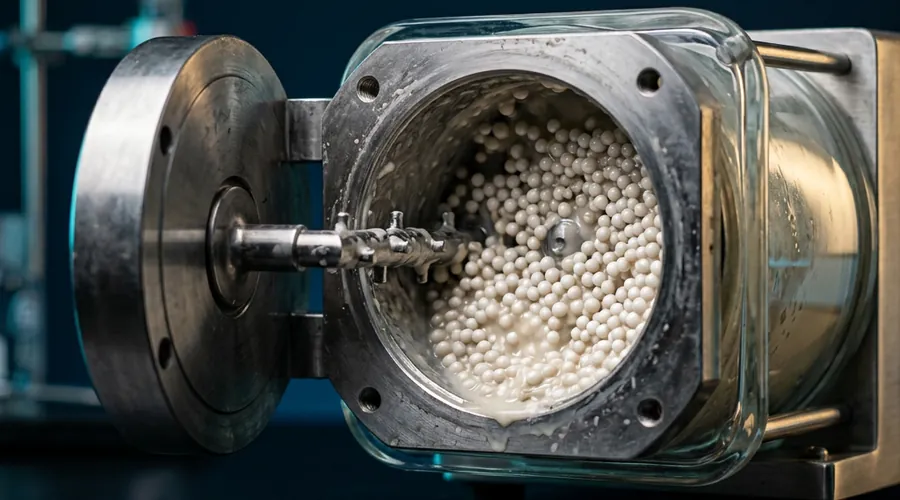
Wet bead milling gives an SC its particle size, and a review of wet media milling describes the principle. A coarse aqueous suspension and its stabilisers are fed into the mill with hard beads, and attrition between beads and particles reduces the particle size. Zirconium oxide, often yttrium stabilised, and polystyrene beads are the usual media in that literature. Beads, speed, time, temperature and stabiliser all set the result, so each needs a deliberate choice.
- Prepare the thickener stock — the supplier guide lists preparation of the xanthan gum solution and of the mill base as the first steps.
- Prepare the mill base — wet the solid active into the water phase with the wetting agent, dispersant and other additives.
- Bead mill to the target size — circulate the mill base through the mill until the particle size is reached.
- Let down and set the rheology — add the thickener solution and remaining additives, then mix to build structure.
- Release and storage tests — run the wet sieve, suspensibility and pourability tests, then the storage tests described below.
Published stirred-mill studies show which variables control the milling step, and the points below apply to SC development.
- Bead size — the common rule is that smaller beads give smaller particles, though not always, as with highly viscous suspensions. Contamination risk is also higher with larger beads.
- Stress intensity — a stirred-mill study applied Kwade's equation, which relates media size, media density and tip speed to stress intensity. Stress intensity rose roughly threefold across the tip speeds tested.
- Solids concentration — higher solids raise slurry viscosity, which reduces effective collisions and grinding efficiency in the same study.
- Milling time — more time means more collisions, but too long a time can induce aggregation, because extra mechanical energy overcomes repulsion between formed particles.
- Stabiliser — the review calls the type and concentration of stabiliser the key parameter for a stable suspension.
A fine suspension is only useful if it stays fine, so the next section covers what happens to it in the can.
Suspension Concentrate Stability: Sedimentation, Caking and Crystal Growth
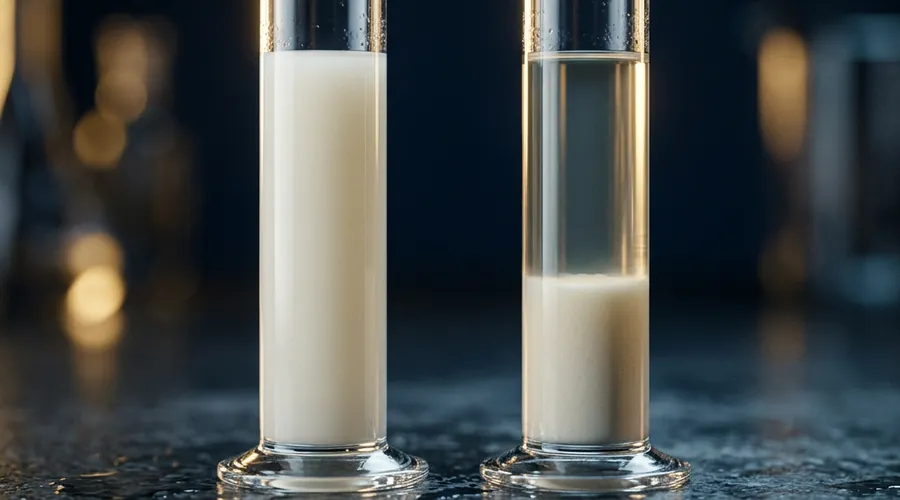
A suspension concentrate fails in three ways: particles settle, particles cake, or particles grow. The FAO/WHO manual notes that on standing, SCs usually develop a concentration gradient from top to bottom, which can even show as clear liquid on top and sediment below. A sticky layer of non-dispersed matter, called cake, is a defect the manual tells inspectors to check by probing with a glass rod. Crystal growth, the third failure, changes the particle size itself.
Stokes' law shows why particle size and viscosity matter so much. The settling velocity of a small sphere scales with the density difference and the square of the particle radius, and it falls as the fluid viscosity rises. Finer particles and a more structured liquid at rest therefore slow settling. Shear-thinning thickeners keep the liquid thick at rest and thin enough to pour.
| Failure | What Happens | Formulation Levers | Test |
|---|---|---|---|
| Sedimentation | Concentration gradient with clear liquid on top and sediment below | Finer particles; thickener structure | Pourability (MT 148.1); suspensibility (MT 184) |
| Caking | Sticky non-dispersed layer at the bottom of the container | Dispersant coverage and steric stabilisation | Probe with a glass rod; pourability; wet sieve |
| Crystal growth | Small crystals dissolve and large ones grow, giving coarse particles | Choice of active; milling temperature; dispersant selection | Wet sieve (MT 185); storage at 54 °C (MT 46.3) |
| Aggregation | Particles clump, for example after over-long milling | Stabiliser type and concentration; milling time | Particle size distribution (MT 187), where required |
| Freezing | Water-based product freezes in cold storage | Antifreeze | Storage at 0 °C (MT 39.3) |
| Foam | Persistent foam on dilution | Antifoam | Persistent foam (MT 47.3) |
Ostwald ripening is the mechanism behind crystal growth. Small particles first dissolve and then redeposit onto larger ones. Molecules at a particle surface are energetically less stable than those inside, and the equilibrium concentration is lower around larger particles. A Huntsman patent calls Ostwald ripening a major drawback of formulating a slightly water soluble ingredient as an aqueous SC. It adds that crystals that grow too large may plug spray equipment and may not stay suspended, and that a two-year shelf life is typically needed for a commercial agrochemical.
FAO/WHO turned these failure modes into a short list of tests, and that list is what a buyer or regulator will actually run.
FAO/WHO and CIPAC Tests for Suspension Concentrates
The FAO/WHO manual sets out a specification template for SCs that defines a sound product. Its performance tests are pourability, which shows the SC can be poured, plus water dispersibility, suspensibility, wet sieve and persistent foam, which show the diluted suspension can be sprayed. Storage tests then check that these properties survive cold and heat. The template leaves the numerical limits blank, so each active's specification sets its own.
| Test | CIPAC Method | What the Template Checks |
|---|---|---|
| Acidity, alkalinity or pH range | MT 191 or MT 75.3 | Where required |
| Pourability | MT 148.1 | Maximum residue left after pouring |
| Spontaneity of dispersion | MT 160 | Minimum share of the active in suspension after 5 minutes in CIPAC Standard Water D at 30 ± 2 °C |
| Suspensibility | MT 184 | Minimum share of the active in suspension after 30 minutes in CIPAC Standard Water D at 30 ± 2 °C |
| Wet sieve | MT 185 | Maximum share of the formulation retained on a test sieve |
| Persistent foam | MT 47.3 | Maximum foam volume after 1 minute |
| Particle size distribution | MT 187 | Only if required |
| Stability at 0 °C | MT 39.3 | After 7 days at 0 ± 2 °C, the product still complies with suspensibility and wet sieve, as required |
| Stability at elevated temperature | MT 46.3 | After 14 days at 54 ± 2 °C, the active content has not fallen below a stated share and the listed physical clauses still comply |
The manual notes that the wet sieve test detects coarse particles, for example from crystal growth, as well as agglomerates and extraneous material that could block spray nozzles or filters. Its general storage clause says the average active content should not fall below 95 percent of the pre-test average. The conditions may be modified where a formulation is not intended for hot climates and is hurt by very high temperature. Examples are 4 weeks at 50 °C, 8 weeks at 40 °C and 18 weeks at 30 °C. The manual also asks for the container to be homogenised before sampling and for the samples before and after storage to be analysed together, which reduces analytical error.
Passing these tests on a laboratory batch is the start, and the production mill has to reproduce them.
Scale-Up and Process Control: From Laboratory Mill to Production Mill
A bench mill and a production mill do not behave alike, so the process variables have to be controlled, not copied. The published stirred-mill studies track bead size, bead density, tip speed, solids concentration, milling time and temperature as the variables that matter. Our guide to scale-down models that predict the plant explains how to make a bench result carry over to full scale. The list below turns those variables into plant controls.
- Mill-base solids and viscosity — keep both inside the range developed on the bench, because higher solids raise viscosity and reduce grinding efficiency.
- Bead specification and tip speed — record bead size, bead density and tip speed, since stress intensity depends on all three.
- Temperature — log mill-base temperature through the run, because heat can promote crystal growth.
- Time and energy — track milling time and specific energy together, and watch for aggregation if a batch is milled for longer than the development runs.
- Sampling — homogenise before every quality sample, as the FAO/WHO manual requires, so results compare from batch to batch.
- Retained samples — keep a sample from every batch for the storage tests, and analyse before and after together.
Many brand owners meet capacity needs through contract formulation agrochemical manufacturer partners, and our guide to manufacturing without a factory explains how that model works. Making the product correctly is only part of the commercial path, because the product also has to be registered.
Registration and Compliance Context in India
In India, pesticide formulations are registered through the Central Insecticides Board and Registration Committee under the Insecticides Act, 1968. The PPQS website publishes the list of registered products. This article covers formulation science only and gives no crop doses, label claims or registration advice for a specific active ingredient. A formulation consultant supports the technical work behind a filing, but the registration decision belongs to the authority.
With the regulatory frame clear, the last question is who supports the technical work.
Working With an Agrochemical Formulation Consultant
Suspension concentrate development sits between colloid chemistry and milling engineering, and the tests that matter run on the real active. An agrochemical formulation consultant screens the active, selects the dispersant system and designs the milling trials. Agrochemical product development services also cover specification writing against the FAO/WHO template, pilot batches and storage studies. A contract partner then carries the product into a plant that can hold the specification.
- Characterise the active — water solubility, melting point and behaviour in the mill base.
- Screen wetting agents and dispersants — compare candidates on milling ease and on stability after storage.
- Run milling trials — vary bead size, tip speed and time while logging temperature.
- Set the rheology — choose the thickener system so the product pours but does not settle.
- Run the storage and release tests — wet sieve, suspensibility, pourability, 0 °C and 54 °C storage.
- Write the specification — build it on the FAO/WHO template and the CIPAC methods.
- Pilot and transfer — make pilot batches, then transfer the process and methods to the production site.
Our agro chemicals range and our overview of agrochemical technology and formulations show where suspension concentrates sit among the other formulation types. Entrepreneurs planning a unit will also find our agrochemical formulation business guide and our guide to starting a herbicide and pesticide formulation unit useful. Global Formulation provides SC formulation development, milling trials, specification support and scale-up for agrochemical manufacturers.
Frequently Asked Questions
What is a suspension concentrate in agrochemicals?
A suspension concentrate, or SC, is a stable suspension of solid active ingredient particles in water, intended for dilution with water before use. CropLife's catalogue treats flowable concentrate as the same formulation type.
The particles are made fine by wet milling and held apart by wetting agents and dispersants, while a thickener such as xanthan gum builds structure that slows settling.
Because the continuous phase is water, the format avoids the solvents that an emulsifiable concentrate needs.
Which active ingredients suit an SC formulation?
SC suits solid actives that dissolve poorly in water. One surfactant supplier's SC guide lists a melting point above 60 °C, stability in water and solubility below 500 mg/L as characteristics of a good fit. It flags crystal growth as the main concern.
A patent from Huntsman calls Ostwald ripening a major drawback when a slightly water soluble active is formulated as an aqueous SC, so moderate solubility deserves early testing.
Screen each candidate with milling trials and the 54 °C storage test before committing to the format.
Why is bead milling used to make suspension concentrates?
Wet bead milling reduces particle size by mechanical attrition. A coarse aqueous suspension of the active and its stabilisers is fed into the mill with hard beads, and collisions between beads and particles break the particles down.
Smaller particles settle more slowly, because Stokes' law makes settling velocity scale with the square of the particle radius. They are also less likely to block spray nozzles, which the wet sieve test checks.
The wetting agent and dispersant matter as much as the mill, because they stop the new surfaces from re-agglomerating.
What tests does a suspension concentrate have to pass?
The FAO/WHO template lists pourability (MT 148.1), spontaneity of dispersion (MT 160), suspensibility (MT 184), wet sieve (MT 185) and persistent foam (MT 47.3). It adds pH or acidity and an optional particle size distribution (MT 187).
Storage tests then check stability after 7 days at 0 °C (MT 39.3) and after 14 days at 54 °C (MT 46.3), with the physical clauses still complying.
The template leaves numerical limits blank, so the specification for each active sets them.
Why do suspension concentrates settle or cake, and how is it controlled?
On standing, SCs usually develop a concentration gradient, and the FAO/WHO manual notes this can even appear as clear liquid on top and sediment below. A sticky non-dispersed layer at the bottom is called cake.
Stokes' law shows that finer particles and a more viscous liquid at rest slow settling. Milling to a fine size and using a shear-thinning thickener such as xanthan gum are therefore the main controls.
The dispersant system controls caking, because it keeps particles apart through the shelf life.
What is crystal growth in an SC and how is it detected?
Crystal growth is Ostwald ripening: small particles dissolve and redeposit onto larger ones, so the average size drifts upward during storage. It is most troublesome for actives with some water solubility.
Coarse crystals can plug spray equipment and may not stay suspended. The wet sieve test detects the coarse particles, and storage at 54 °C accelerates the drift so it shows up in weeks.
Controlling milling temperature and selecting the dispersant for the active both reduce the risk.
How is an SC different from an OD or an EC?
An SC is a suspension of the active in water. An OD, or oil dispersion, is a suspension of the active in a water-immiscible fluid. The EC, by contrast, is a liquid, homogeneous formulation applied as an emulsion after dilution in water.
The choice follows the properties of the active: solids that are stable in water suit an SC, and actives that dissolve in solvent suit an EC.
Our guide to emulsifiable concentrate formulation covers the solvent route in detail.
Developing a Suspension Concentrate?
Global Formulation supports SC formulation, milling trials, specification writing and scale-up to a qualified plant.
Talk to Our Formulation Team