Veterinary Pharmaceutical Formulation: Design by Species
A dog can reject a tablet that a human patient would swallow without complaint, and a sweetener that is safe for people can poison a dog. A poultry house is medicated as a flock through water or feed, and every treated food-producing animal carries a residue question into the human food chain. Veterinary pharmaceutical formulation has to solve all of these problems at once. The target species range in body weight from a kitten to a horse, and their digestive systems work in fundamentally different ways. Products that ignore those differences fail in the field through low owner compliance, unsafe excipients, residue violations, or dose forms that cannot survive farm storage. This guide explains how species physiology, palatability, route of administration, and food-safety rules shape dosage form design, and how to structure a development program around them. It reflects how Global Formulation approaches animal health projects for manufacturers and start-ups, from bench formulation through scale-up.
Why Veterinary Pharmaceutical Formulation Is Not Human Formulation Scaled Down
Human pharmaceutical development assumes one species, a patient who follows instructions, and a narrow range of body weights. Veterinary work removes all three assumptions. Across products, the patient is a cat that hides a tablet in its cheek, a horse weighing several hundred kilograms, or a flock treated through a water line. The formulator therefore designs for the animal, for the person who administers the dose, and for the food chain that follows.
- Many target species — dose, metabolism, taste, and excipient tolerance differ across dogs, cats, cattle, pigs, horses, and poultry, so a formula proven in one species does not transfer automatically.
- A wide weight range inside one species — toy-breed and giant-breed dogs differ many times over in body weight, so one tablet strength rarely fits. Dose accuracy becomes a design problem.
- A non-clinical administrator — owners, farm workers, and stockmen give the dose, so the product must work without training, without a cooperative animal, and after farm storage.
- Food-chain consequences — in food-producing animals the formulation influences drug residues in meat, milk, and eggs, so withdrawal periods become part of the product design.
- Cost per treated animal — livestock products are bought and dosed by the herd, so cost per animal is a design constraint alongside efficacy.
Each of these constraints turns into a specific design question about the target species. Our pharmaceutical and healthcare knowledge base covers the human-side foundations that veterinary work builds on, and the next section starts where every project should: with the animal's physiology.
How Species Physiology Drives Dosage Form Design
Absorption, metabolism, and tolerance differ between species, so a dosage form that performs in one animal can fail or cause harm in another. The differences are structural: a ruminant carries a fermentation chamber where a dog has a simple stomach, and a cat glucuronidates phenolic drugs poorly. Species-specific pharmacokinetics formulation work starts from these differences, not from the human dose form. The table below summarizes the differences that most change design decisions.
| Species Group | Physiological Feature | Formulation Consequence |
|---|---|---|
| Dogs | A wide body-weight range across breeds. Some herding-breed lines carry the ABCB1-1Δ (MDR1) mutation, which impairs P-glycoprotein efflux at the blood–brain barrier. | Several strengths or weight-banded dosing for accuracy, plus labeling and dose selection for P-glycoprotein substrates such as ivermectin and loperamide. |
| Cats | UGT1A6 is a pseudogene, so glucuronidation of phenolic compounds is deficient. There is no functional sweet receptor, and cats readily reject bitter compounds. | Cat-specific safety data for drugs and excipients cleared by glucuronidation, savory palatants instead of sweeteners, and small-volume doses. |
| Cattle, sheep, goats | A large fermentative rumen with a dense microbial population dilutes, delays, and can degrade orally dosed drugs. | Injectable, pour-on, and rumen-retained formats dominate, and oral tetracyclines are poorly absorbed. |
| Horses | A large body weight, with oral products given by owners in the stable or field. | Weight-graduated oral paste syringes and palatable pastes or granules. |
| Pigs and poultry | Animals are treated as groups that share feed and water lines. | Water-soluble powders and liquids, and feed premixes. The drug must dissolve fully in farm water and survive feed processing. |
| Fish | A population that eats pellets in water. | Medicated feed that holds the drug in the pellet until eaten, and immersion (bath) products. |
The ruminant row shows the strongest effect. Inside the rumen, a dense microbial population can degrade or bind an oral drug before it reaches the intestine, and broad-spectrum antibacterials in turn depress that population. According to the Merck Veterinary Manual, tetracyclines at therapeutic concentrations should not be given orally to ruminants, because they are poorly absorbed and depress ruminal microbial activity. Digestive design therefore decides which routes work at all, while metabolic differences decide which excipients are safe, which is the subject of the next section.
Excipient Safety Is Species-Specific
An excipient that is routine in human medicines is not automatically safe for animals. Some species handle particular compounds badly, and the harm is severe enough to have driven regulation and public warnings. Veterinary pharmaceutical formulation therefore builds the excipient list species by species, starting from documented exclusions. Three well-established cases show the pattern.
- Xylitol in dogs — this sweetener is safe for people, but the FDA warns that dogs absorb it quickly. The resulting insulin release causes hypoglycemia and, at higher exposures, liver failure. Formulators screen xylitol out of canine chewables and liquids and check every other sweetener against the species.
- Propylene glycol in cats — 21 CFR 582.1666 excludes cat food from its recognition of propylene glycol as safe, because it causes Heinz body anemia in cats. A propylene glycol co-solvent in a product that cats swallow or lick off needs a documented safety justification.
- Glucuronidation-dependent compounds in cats — cats lack a functional UGT1A6 enzyme, so phenolic compounds clear slowly. Acetaminophen is the classic example of a human medicine that poisons cats.
Once the excipient list is safe for the species, the product still has to be taken, which makes palatability the next design problem.
Palatability: The Compliance Variable Human Formulation Rarely Faces
A veterinary medicine works only when the animal takes it. A tablet forced into a reluctant dog or cat invites skipped doses, and flocks that drink less because the water tastes of drug do not receive the intended dose. Palatability is therefore a core variable in veterinary pharmaceutical formulation, not a marketing extra. It has to be designed in from the first prototype, because flavor systems change texture, moisture, and stability.
- Dogs — accept savory palatants such as meat and liver digests readily and also respond to sweet flavors, which is why sweetener safety needs care.
- Cats — lack the TAS1R2 protein needed for a functional sweet receptor, so sweeteners add no appeal, and they readily reject bitter compounds. Their taste receptors respond strongly to certain amino acids and nucleotides, so amino-acid, fat, and digest-based palatants drive acceptance.
- Horses and livestock — horses, pigs, and ruminants are commonly offered sweet, molasses-based, or cereal-based carriers.
- Poultry and fish — acceptance depends on the drug leaving the taste, smell, and solubility of the feed and water unchanged.
Palatant choice is species-specific, and so is the format that carries it.
Palatability Formats for Companion Animals
The dosage form sets how much of the flavor system the animal experiences and how well a bitter active can be hidden. Chewable formats put the flavor in the matrix, while liquids and pastes rely on a flavored vehicle. Each format shifts the stability and manufacturing problem in a different direction. The table compares the four formats most used for dogs and cats.
| Format | How Flavor Is Delivered | Main Formulation Challenge |
|---|---|---|
| Hard chewable tablet | Palatant blended into a compressed matrix | Masking a bitter active while keeping the tablet soft enough to chew, and protecting flavor and active from moisture |
| Soft chew | Palatant and binder in an extruded or pressed moist matrix | Controlling water activity to protect the active and prevent microbial growth, and preserving texture through storage |
| Flavored oral liquid or paste | Palatant in a suspending or solvent vehicle | Suspension stability, dose accuracy, and screening of sweeteners and co-solvents for species safety |
| Film-coated tablet | Palatant in the coating or the core | Coat integrity under humidity and under the animal's chewing |
The taste-masking tools from human pediatric work apply here too: polymer coating, ion-exchange resins, cyclodextrin complexation, and lipid matrices. The added rule is that every masking agent and flavor must be safe for the labeled species. Our guide to pediatric formulation, taste masking, and dosage selection explains those tools in detail.
How Palatability Is Tested
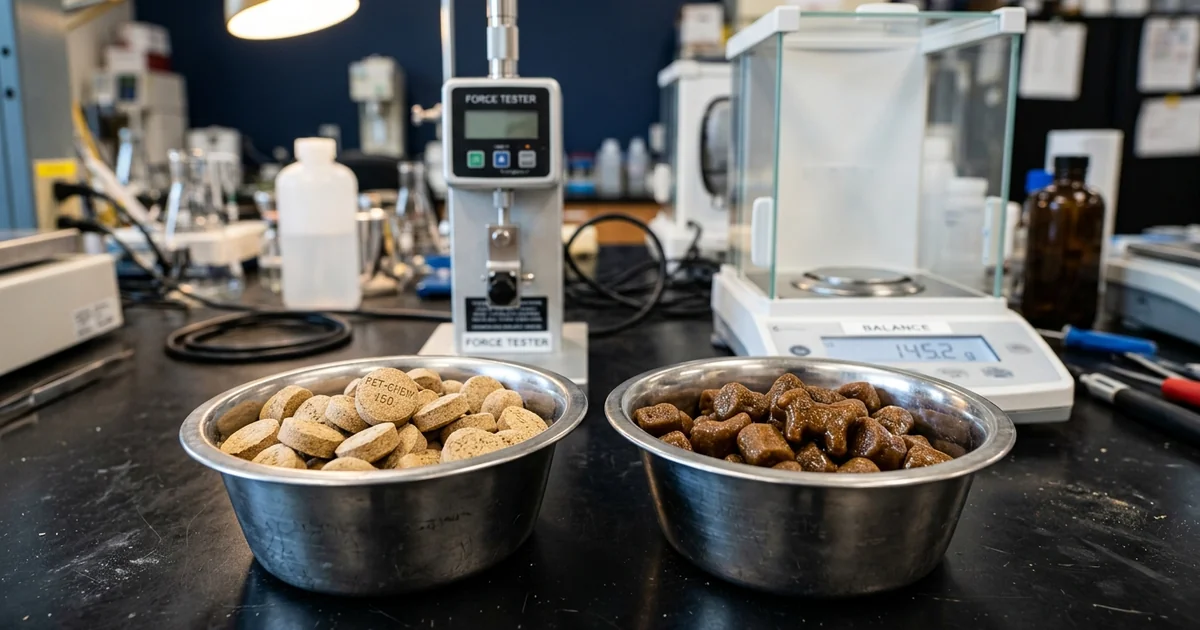
Palatability is measured in the target species, not inferred from human taste panels. Two test designs dominate. The two-bowl (choice) test offers two products side by side and records which is eaten first and how much of each is consumed. The one-bowl (monadic) test offers a single product and records whether the animal accepts it and how quickly.
- First choice — which product the animal approaches first in a two-bowl test.
- Intake ratio — the share of each product eaten in a two-bowl test.
- Voluntary acceptance — whether the animal takes the product from the hand or bowl without coaxing in a one-bowl test.
- Time to consume — hesitation before eating separates products that pass acceptance from products that are merely tolerated.
The two-bowl test detects small differences between candidates, while the one-bowl test mirrors real dosing, where the animal sees only one product. Programs use the two-bowl test to select a prototype and the one-bowl test to confirm acceptance.
Palatability solves the problem for animals dosed by hand. Herds and flocks need a different set of oral formats, covered next.
Oral Dosage Forms Across Species
Oral dosing dominates companion animal medicine and much of livestock treatment, but veterinary pharmaceutical formulation changes the dosage form with the animal. Individual dogs, cats, and horses take chews, tablets, liquids, and pastes by hand, while herds and flocks are treated as groups through drenches, feed, and water. Each format carries its own stability and dose-uniformity problem. The table lines up the main formats against the species they serve.
| Dosage Form | Typical Target | Key Formulation and Process Challenge |
|---|---|---|
| Chewable tablets and soft chews | Dogs, cats | Taste-masking, hardness against chewability, and moisture control |
| Oral pastes in dosing syringes | Horses, some companion animals | Weight-graduated dose accuracy, viscosity stability over storage, and palatability |
| Oral suspensions and drenches | Cattle, sheep, goats | Uniform particle dispersion, redispersibility, and accurate delivery through a drench gun |
| Boluses | Cattle, sheep | Size and density for rumen retention where sustained release is needed, and mechanical integrity |
| Water-soluble powders and liquid concentrates | Poultry, pigs | Complete dissolution in water of variable hardness, stability of the stock solution, and effects on water intake |
| Medicated feed premixes | Pigs, poultry, fish, cattle | Homogeneity when blended into feed, stability through pelleting heat, steam, and pressure, and carryover control |
Suspension physics matters in three of these formats. Our guide to oral liquid suspension and emulsion formulation covers sedimentation, redispersibility, and viscosity design. Our guide to excipient selection for oral solid dosage forms covers the binders, disintegrants, and fillers behind chewables and boluses.
Group Medication Through Water and Feed
In group medication, no person handles the animal, so the dose is set by how much each animal drinks or eats. That turns a formulation problem into a system problem. Water chemistry, line design, feed processing, and intake variation all decide whether the intended dose arrives. The formulator has to design for the farm's conditions, not for the laboratory's.
- Water chemistry — calcium and magnesium in hard water bind tetracyclines, and pH governs the solubility of weak-acid and weak-base actives. A powder that dissolves in laboratory water can precipitate in a farm's supply.
- Intake variation — water and feed consumption change with temperature, age, and disease, so consumption rather than the label sets the delivered dose.
- Feed processing — pelleting exposes medicated feed to heat, steam, and pressure, so a heat-labile drug needs proven stability or a post-pellet application step.
- Blend homogeneity — a premix has to distribute evenly through a large feed batch, so its carrier particle size and density must match the feed. Mismatches cause segregation.
Group routes are efficient but depend on each animal's appetite. When the dose must be certain, or the animal is not eating, the product moves to an injectable.
Injectable Veterinary Formulations and Long-Acting Depots
Injection removes the animal's cooperation and the gut's variability from the dose, which is why injectables are central to livestock and critical-care medicine. The trade-offs are sterility, local tolerance at the injection site, and, in food animals, tissue residues that depend on how the depot releases the drug. Many products are supplied as multi-dose vials that several animals share, which adds preservation and closure demands. Veterinary injectable manufacturer support therefore has to cover sterile process design, preservation, and container performance together.
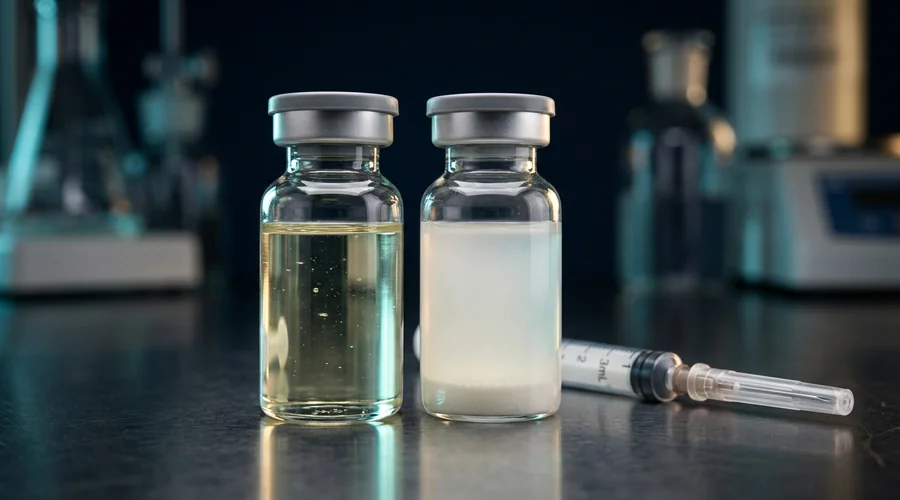
- Sterility and process — the requirements match human parenterals, with terminal sterilization where the drug survives it, aseptic processing where it does not, and pyrogen control. See our guide to parenteral formulation development.
- Multi-dose preservation — vials are punctured repeatedly over days or weeks, so the formulation needs an effective preservative system, preservative efficacy testing, and an in-use shelf life after first puncture. Our article on antimicrobial preservative selection covers the options.
- Local tolerance — pH, tonicity, solvent, and particle characteristics influence tissue reaction, and injection-site lesions in beef cattle damage carcass quality.
- Injection volume — large animals accept large volumes, but tissue at one site has a limit. Concentration and solvent system are therefore set so the dose per animal fits a practical injection volume.
- Closure and container — rubber stoppers must reseal after repeated punctures without shedding fragments or leaching into the product. Closure selection and extractables testing are therefore part of the formulation work.
Long-Acting Depots
A long-acting injectable holds the drug at the injection site and releases it over days to weeks, so one treatment replaces repeated handling of animals. The depot works by slowing the dissolution or diffusion of the drug away from the site. Release mechanism, not total drug amount, sets the duration of action. The table compares three common designs.
| Depot Design | How Release Is Controlled | Key Formulation Variables |
|---|---|---|
| Oil solution | Drug partitions from the oil into tissue fluid | Oil type, drug lipophilicity, and injection volume |
| Oil suspension | Suspended solid dissolves into the oil, then partitions into tissue fluid | Particle size, crystal form, and suspension stability in the vial |
| Aqueous suspension of a sparingly soluble form | Dissolution rate of the salt or crystal sets the release rate | Salt or crystal form, particle size, suspending system, and syringeability |
Procaine penicillin G, a sparingly soluble salt given as an aqueous suspension, is the classic example of the third design.
That link between release kinetics and residues is the defining constraint of food-animal products, and it applies to more than injectables.
Topical, Pour-On, and Sustained-Release Formats
Some of the most useful animal health products never enter the gut or the muscle. Topical and sustained-release formats treat parasites, deliver a drug over weeks or months, and reduce how often animals must be handled. Each depends on how the active moves across or along the skin, or how it escapes from a solid carrier. The pour-on route also resembles transdermal delivery in human medicine, with a vehicle carrying the active through the skin barrier.
- Spot-on products — small-volume liquids applied to one point on the skin of dogs and cats. The vehicle spreads the active across the skin surface and coat, so volume, viscosity, and spreading agents decide coverage.
- Pour-on products — larger volumes poured along the back of cattle. Some actives cross the skin for a systemic effect, so the carrier solvent controls absorption.
- Intramammary infusions — oil-based or aqueous vehicles delivered through the teat canal to treat mastitis. Dry-cow products are designed to persist through the dry period, whereas lactating-cow products are designed to clear so that milk can return to sale.
- Collars and ear tags — polymer matrices that release the active gradually onto the coat or hide. Polymer choice, active solubility in the matrix, and migration to the surface set the release rate.
- Intraruminal boluses — dense devices that stay in the reticulorumen and release drug or trace elements over an extended period. Density and size are engineered for retention.
- Subcutaneous implants — solid pellets placed under the skin that release drug over an extended period from a diffusion-controlled or slowly eroding matrix.
Every sustained-release format lengthens the time a treated animal carries the drug. In food-producing animals, that duration is a food-safety variable, which is why the next section treats residues as a formulation constraint.
Food-Producing Animals: Withdrawal Periods and Residue Control
When an animal is raised for meat, milk, or eggs, the formulation is judged by what remains in the food as well as by what it does in the animal. Regulators set a legal residue limit for the drug, and the approved withdrawal period keeps residues below it. The FDA defines the withdrawal period as the time between last treatment and the point at which the animal can be slaughtered, or its milk or eggs sold. Because the withdrawal period is set for each product, the formulation itself is a food-safety variable.
- Release profile — a depot or sustained-release product holds the drug in the animal for longer, so extending the duration of action extends the withdrawal period.
- Two layers of limits — in the EU, Regulation (EC) No 470/2009 sets residue limits for the active substance. The withdrawal period is set for each product in its marketing authorisation.
- Dairy and laying animals — milk and egg withdrawal times need their own data, so formats for these animals are designed for clearance as well as efficacy.
- Formulation changes — a change of vehicle, particle size, or concentration alters the release profile, so it has to be assessed against the approved withdrawal period before it is adopted.
- Export markets — livestock products sold abroad face the importing country's residue limits as well as those of the home market.
Regulators also assess the environmental fate of veterinary drugs, because treated animals excrete residues into soil and water. VICH guidelines GL6 and GL38 describe the phased environmental impact assessment, and the FDA lists both among its adopted VICH guidance documents. Residue data, safety data, and manufacturing controls all end up in one regulatory submission, and the structure of that submission differs by region.
Regulatory Pathways and Stability for Veterinary Products
A veterinary pharmaceutical formulation reaches the market through an animal-drug authority, not the human-drug pathway, and the evidence package is built around the target species. The regulatory route decides which studies to run and which manufacturing standard applies. Harmonized VICH guidelines reduce duplication between regions but do not remove regional differences. Planning the pathway before the formulation is frozen prevents costly rework.
| Region | Authority and Legal Basis | What the Formulation Team Must Deliver |
|---|---|---|
| United States | FDA Center for Veterinary Medicine, with a new animal drug application (NADA) for new drugs and an abbreviated application (ANADA) for generics | Technical sections on target animal safety, effectiveness, human food safety for food animals, chemistry, manufacturing, and controls, environmental impact, and labeling |
| European Union | European Medicines Agency and national authorities under Regulation (EU) 2019/6, applicable since 28 January 2022 | A quality, safety, and efficacy dossier, residue data for food-producing animals, and withdrawal periods in the marketing authorisation |
| India | Drugs and Cosmetics Act, 1940, whose definition of a drug covers medicines for animals as well as humans | Product approvals and manufacturing licences under the Act and its rules, with the route confirmed for each product class before development starts |
The FDA organizes its review around technical sections, and it requires human food safety data only for drugs intended for food-producing animals. The European Medicines Agency describes Regulation (EU) 2019/6 as the framework for the authorisation and use of veterinary medicines in the EU. General principles for the human-side pathways, including ICH and USP expectations, are set out in our pharmaceutical regulatory pathway guide. Three VICH guidelines shape formulation work directly.
- VICH GL3(R) — stability testing of new veterinary drug substances and medicinal products.
- VICH GL52 — blood-level bioequivalence study design, the basis for generic veterinary products. Our guide to generic drug formulation development explains the bioequivalence logic.
- VICH GL6 and GL38 — Phase I and Phase II environmental impact assessment for veterinary medicinal products.
Stability programs follow the same logic as human programs, but storage reality is harsher. Veterinary products sit in farm buildings, vehicles, and clinics without climate control, so the climatic zone of the target market decides the long-term storage condition. VICH GL58 covers stability testing for climatic zones III and IV, which span hot-dry and hot-humid markets. Multi-dose containers also need in-use stability data, and suspensions need physical stability data across temperature cycling. Our guide to pharmaceutical stability testing explains how these studies are designed. With pathway, stability, and residue constraints mapped, the remaining task is to sequence the work and choose who executes it.
Building a Development Program and Choosing a Manufacturing Partner
Veterinary programs succeed when species, route, and food-safety decisions come before bench work. A dependable program runs as a sequence of gates, and each gate retires a category of late, expensive failure. The same order applies whether the work is done in-house, with a consultant, or through a contract manufacturer. The sequence below reflects how animal health projects are run in practice.
- Target animal and claim definition — fix the species, class (companion or food-producing), indication, and dosing setting, because these determine the route and pathway.
- Dosage form and route selection — choose among chews, pastes, injectables, premixes, pour-ons, and sustained-release formats based on physiology and how the product will really be administered.
- Excipient screening by species — check every excipient and flavor against each labeled species and against other species in the same household or farm, before prototypes are made.
- Prototype work with palatability or tolerance testing — test oral products for acceptance in the target species and injectables for local tolerance.
- Stability and in-use studies — run climatic-zone storage, in-use shelf life, and physical stability programs on a near-final formula.
- Scale-up and technology transfer — confirm that process parameters, content uniformity, and the residue package hold at plant scale, under the GMP standard the target market requires.
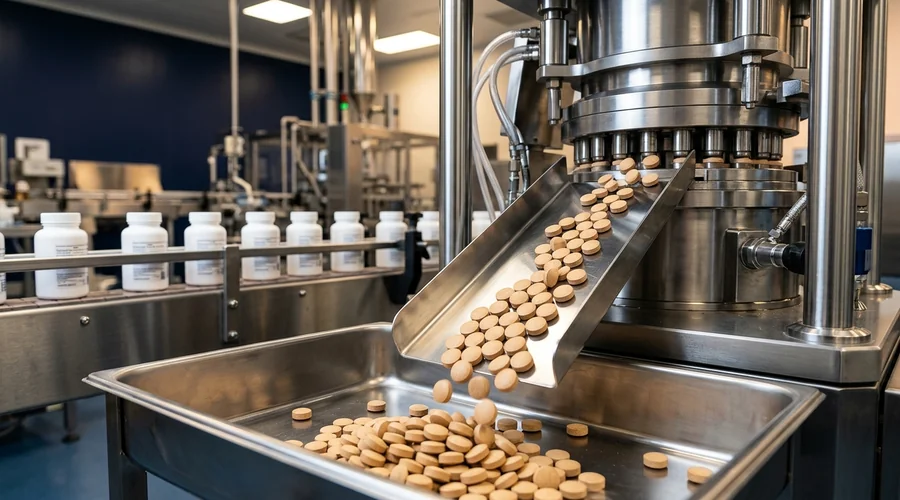
Partner selection then decides whether a veterinary pharmaceutical formulation program is executed as designed. Veterinary pharmaceutical manufacturers differ widely in the dosage forms they can make, the species they know, and the GMP standard they hold. Veterinary medicine manufacturing at scale adds its own demands, such as cross-contamination control for potent actives and segregated handling of antibiotics and hormones. A short set of direct questions separates capable partners from general-purpose plants.
- Species experience — has the partner formulated for the target species, and can it show palatability or local-tolerance data from earlier projects?
- Facility capability — does the site run the needed dosage form, whether sterile fill, soft-chew extrusion, or premix blending, under the GMP the target market requires?
- Regulatory support — can the partner prepare the chemistry, manufacturing, and controls section and support the NADA, ANADA, or marketing authorisation filing?
- Analytical capability — does it have validated methods for the active and for stability-indicating and residue-relevant testing?
- Ownership — who owns the formulation and the technology-transfer documentation when the project ends?
A partner that answers all five questions with documents rather than assurances can carry a project from species selection to launch. Our guides to choosing a pharmaceutical formulation consultant and pharmaceutical process validation from R&D to commercial scale expand on these criteria. Global Formulation works as an animal health formulation consultant and animal health R&D outsourcing partner. It provides veterinary dosage form product development services, palatability-led veterinary drug contract manufacturing support, and scale-up from species selection to a stability-verified product.
Frequently Asked Questions
Can a human drug formulation be used for animals?
Not without redesign, and not as a marketed animal product without animal-drug approval. Veterinary pharmaceutical formulation starts from the species. Animals differ in metabolism, taste preference, and excipient tolerance, so a human tablet can be poorly absorbed, unpalatable, or unsafe in the target animal. Acetaminophen in cats and xylitol in dogs are the standard examples of substances that are safe for people and harmful to animals.
Dose accuracy is the second problem. Human strengths are built for a narrow weight range, while animal doses span a much wider one. A product sold for animals also needs approval as an animal drug in each market, supported by species-specific safety and effectiveness evidence.
How is palatability tested for a veterinary drug?
Palatability is tested in the target species using two designs. A two-bowl test offers two products side by side and records which is eaten first and how much of each is consumed. A one-bowl test offers a single product and records whether the animal takes it and how quickly.
Development teams use the two-bowl test to choose between prototypes and the one-bowl test to confirm acceptance under realistic dosing conditions. Results in one species do not transfer to another, so each labeled species needs its own testing.
Why are cats harder to formulate for than dogs?
Cats differ from dogs in several ways that matter to formulation. They lack a functional UGT1A6 enzyme, so drugs and excipients cleared by glucuronidation, including phenolic compounds, need cat-specific safety data. They have no functional sweet receptor, so sweeteners do not improve acceptance, and they readily reject bitter compounds.
US feed rules also carve cat food out of the general recognition of propylene glycol as safe, because it damages feline red blood cells, which limits co-solvent choices. Small body size adds a practical problem, because doses must be delivered in very small volumes or tiny tablets. Together these constraints make palatability and excipient screening the two central tasks in feline products.
What is a withdrawal period, and how does the formulation affect it?
A withdrawal period is the wait between the last treatment and slaughter, or the sale of milk or eggs, so that residues stay within the legal limit. It is set for each approved product, so the formulation is part of the food-safety case.
Release kinetics drive the effect. A depot or sustained-release product holds the drug in the animal for longer, so lengthening the duration of action also lengthens the withdrawal period. Any change to the vehicle, particle size, or concentration alters the release profile and has to be assessed against the approved withdrawal period.
Which regulators approve veterinary drugs, and what do they require?
In the United States, the FDA Center for Veterinary Medicine approves new animal drugs through the NADA route and generics through the ANADA route. The evidence is organized into technical sections covering target animal safety, effectiveness, human food safety for food-producing animals, manufacturing quality, environmental impact, and labeling. In the European Union, Regulation (EU) 2019/6 has governed authorisation since 28 January 2022, with residue limits set under Regulation (EC) No 470/2009.
India's Drugs and Cosmetics Act, 1940 defines drugs to include medicines for animals. VICH guidelines harmonize technical requirements such as stability testing, bioequivalence, and environmental assessment across the major regions. Confirm the current route for each target market before the formulation is frozen.
Which dosage forms suit treating a whole herd or flock?
Group treatment uses water-soluble powders and liquid concentrates for drinking water, premixes for medicated feed, oral drenches for ruminants, injectables, and pour-ons for cattle. The right choice depends on how the animals are housed and fed, and on whether every animal will reliably eat or drink its dose.
Water medication depends on the drug dissolving completely in the farm's water, because calcium and magnesium in hard water bind tetracyclines. Medicated feed depends on even blending and on stability through pelleting heat and steam. Injectables and pour-ons give the most certain dose per animal, at the cost of handling time.
What should a start-up prepare before approaching a veterinary formulation consultant?
Prepare the target species, whether they are companion or food-producing animals, and the target markets, because these fix the regulatory route. Add the intended indication, the active ingredient and its supplier, and whether animals will be dosed individually or as a group.
Also decide the preferred dosage form, the cost per treated animal the business can support, and who will own the formulation and technology-transfer documents. A brief that covers these points lets a consultant scope the veterinary pharmaceutical formulation program accurately and avoids reformulation once palatability, residue, or stability data arrive.
Developing an Animal Health Product?
Global Formulation provides veterinary pharmaceutical formulation, species-specific dosage form development, and contract formulation from concept through stability-verified launch.
Talk to Our Formulation Team