Wall Putty Formulation: White Cement vs Acrylic
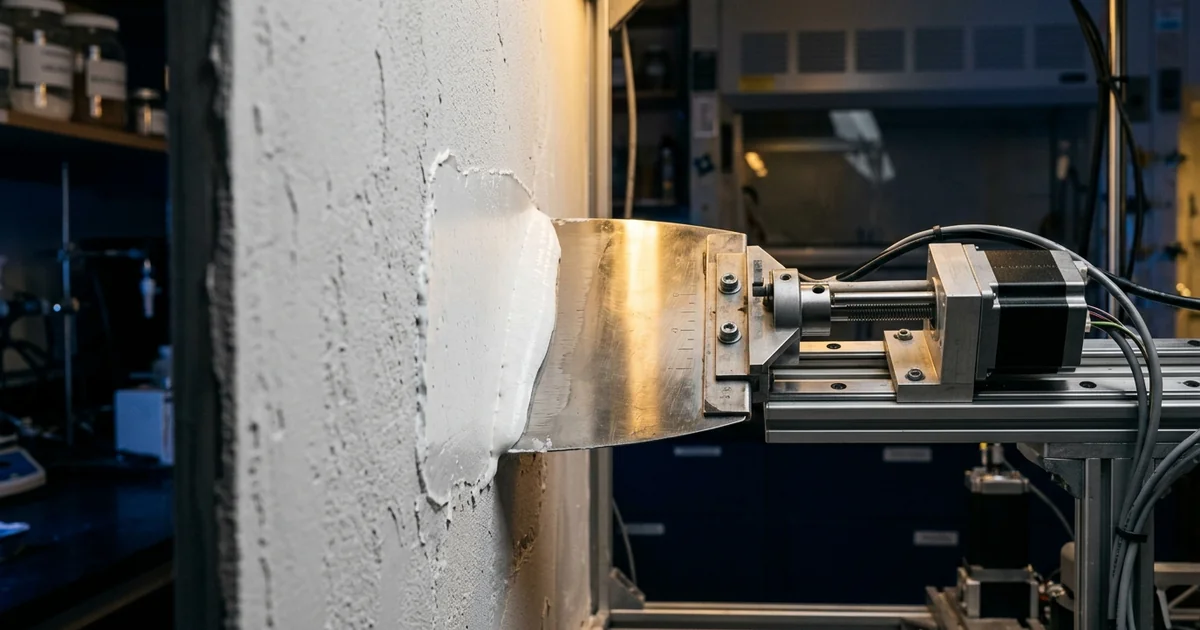
A painted wall shows hairline cracks within a few weeks, and the paint takes the blame while the putty underneath is the real cause. Wall putty is a thin skim coat, yet it decides whether the finished wall stays smooth, bonded, and paintable. Every failure costs the manufacturer a repaint, a dealer complaint, and some brand trust. This guide covers wall putty formulation for white cement and acrylic systems, from binder chemistry and raw material roles to waterproof claims, defects, and testing against IS 17545. It also shows where scale-up from laboratory to plant goes wrong. It reflects how Global Formulation supports construction chemical manufacturers with formulation, raw material selection, and contract development.
Wall Putty Formulation: What the Skim Coat Has to Achieve
A wall putty has one job: turn an imperfect plaster surface into a smooth, sound base for primer and paint. Plaster and concrete are porous and uneven, and they carry pinholes and hairline defects that paint alone cannot hide. The putty fills those defects, bonds firmly to the substrate, and then sands to a fine finish without crumbling. Each function pulls the formulation in a different direction, so wall putty formulation is a balancing exercise rather than a recipe.
| Requirement | Why It Matters | Main Formulation Lever |
|---|---|---|
| Adhesion to substrate | Putty that lifts takes the paint with it | Binder system, polymer content, water retention |
| Crack resistance | Shrinkage and wall movement open hairline cracks | Filler packing, polymer flexibility, water retention |
| Workability and open time | Applicators need time to level before the coat stiffens | Cellulose ether grade, polymer, water demand |
| Sandability | An overly hard or soft film clogs or gouges under abrasive paper | Filler type and particle size, binder level |
| Whiteness and opacity | Light topcoats show the base colour through a thin film | Binder whiteness, filler brightness |
| Alkali and moisture behaviour | The surface must accept primer and paint without attack or blistering | Binder type, hydrophobic additives, primer compatibility |
Two binder families answer these demands in very different ways, so the first decision is which family suits the product.
White Cement Putty vs Acrylic Wall Putty: Two Binder Families
Indian wall putty comes in two main families. White cement putty is a powder that hardens by cement hydration, while acrylic wall putty is a polymer-bound product that dries by film formation. The binder decides almost everything else, including alkalinity, flexibility, moisture behaviour, and the plant needed to make it. Choosing between them is therefore a manufacturing and market decision as much as a chemistry one.
| Feature | White Cement Putty | Acrylic Wall Putty |
|---|---|---|
| Product form | Dry powder mixed with water on site | Ready-to-use paste, or a polymer powder system |
| Hardening mechanism | Cement hydration plus polymer film formation | Emulsion particles coalesce into a film as water leaves |
| Surface alkalinity | High, from calcium hydroxide released by hydration | Lower, set mainly by the polymer and additives |
| Flexibility | Moderate, improved by polymer modification | Higher, set by the polymer's glass transition |
| Moisture behaviour | Porous mineral structure with added water resistance | Continuous polymer film that passes less vapour than a mineral layer |
| Shelf-life risk | Moisture exposure starts hydration in the bag | Microbial spoilage and freeze-thaw damage in the pail |
| Plant needed | Dry blender, bagging, dust control | Disperser, deaeration, preservation, filling |
| Main cost driver | White cement and polymer powder | Emulsion binder and additives |
In India, IS 17545:2021 prescribes requirements, sampling, and test methods for white cement based polymeric putty used as a finished skim coat on internal or external plastered surfaces. The standard covers the cement family, so acrylic putty sits outside its scope. Confirm current BIS certification obligations for your product type directly with the Bureau of Indian Standards before launch.
Start with the cement family, because its chemistry explains most of the defects discussed later.
White Cement Putty Manufacturing: Binder, Hydration and Whiteness
White cement putty works because cement, polymer, filler, and cellulose ether each solve a different problem in a very thin layer. White Portland cement matches ordinary Portland cement in every way except whiteness, which requires raw materials low in iron and manganese oxides. On contact with water, the cement hydrates to form calcium silicate hydrate, which gives strength, and portlandite, which is calcium hydroxide and makes the surface strongly alkaline. The challenge in a skim coat is keeping enough water in the layer for that hydration to finish.
Substrate suction makes that difficult. The EN 1015-8 method for water retentivity exists because plaster and render lose water into an absorbent substrate on application. That loss dries the layer out and stops hydration before it completes. Cellulose ethers such as hypromellose act as rheology modifiers and water retention agents in cement renders and tile adhesives, and putty borrows the same mechanism. Our guide to cellulose ether rheology control in grout and tile adhesive covers that chemistry in more depth.
- White cement — the hydraulic binder that develops hardness and supports a bright, alkaline base.
- Redispersible polymer powder — forms a flexible film between filler and cement phases, improving adhesion and crack tolerance.
- Cellulose ether — holds water in the thin layer and controls consistency and open time.
- Mineral fillers — ground calcium carbonate and similar fillers supply bulk, brightness, and sandability.
- Minor additives — defoamers, hydrophobic agents, and anti-sag aids fine-tune application and surface behaviour.
Acrylic putty replaces hydration with film formation, which changes the whole set of risks.
Acrylic Wall Putty: Binder, Film Formation and In-Can Preservation
Acrylic wall putty hardens by physical drying, not by reaction with water. Polymer particles in the emulsion pack together as water leaves, then fuse into a continuous film once conditions are above the binder's minimum film-forming temperature. The filler packs inside that film and gives the putty its body and sandability. Because the product is an aqueous paste, it also needs a preservation system that stops microbial growth in the pail.
- Binder selection — the polymer's glass transition, particle size, and minimum film-forming temperature decide flexibility, film quality, and low-temperature drying.
- Filler and binder balance — more filler improves sandability and lowers cost, while more binder improves adhesion and flexibility, so the ratio sets the trade-off.
- Rheology package — thickeners and dispersants give a putty that spreads easily, holds on a vertical surface, and does not slump in storage.
- Defoamer — controls entrained air, which otherwise leaves pinholes in the dry film.
- In-can preservation — biocides protect the aqueous paste from spoilage during storage.
Our guide to rheology modifiers in paint explains how thickeners shape application behaviour. Our guide to the biocidal products regulation for in-can and dry-film preservatives covers preservative choice and compliance. Acrylic putty is made on the same class of equipment as emulsion paint, and our guide to starting an interior emulsion paint manufacturing unit describes that plant.
Both families draw on the same raw material classes, so the selection criteria deserve their own section.
Putty Raw Material Selection: Binders, Fillers, Polymers, Cellulose Ethers
Raw materials decide putty performance and cost more than any process step does. The same formulation behaves differently when a filler changes particle size, a cellulose ether changes viscosity grade, or a cement lot changes fineness. Selection therefore needs specifications for the properties that drive performance, not just a product name. The table lists the main classes and the traps in each.
| Raw Material Class | Role | Selection Criteria | Risk When Wrong |
|---|---|---|---|
| White cement | Hydraulic binder and whiteness | Whiteness, fineness, supply consistency, IS 8042 compliance | Dull colour, variable setting, weak surface |
| Ground calcium carbonate or dolomite | Bulk filler and brightness | Brightness, particle size distribution, water demand | Poor sanding, high water demand, cracking |
| Redispersible polymer powder | Adhesion and flexibility | Polymer type, redispersibility, protective colloid | Weak adhesion, brittle film |
| Cellulose ether | Water retention and consistency | Viscosity grade, dissolution rate, batch consistency | Dry-out, sagging, lumps |
| Acrylic emulsion | Binder for paste systems | Glass transition, particle size, film-forming temperature, residual monomer | Cracking, poor adhesion, odour |
| Hydrophobic additive | Surface water repellence | Dispersibility, compatibility with cement alkalinity | Patchy repellence, recoating problems |
| Defoamer and biocide | Air control and preservation | Compatibility, regulatory status | Pinholes, spoilage |
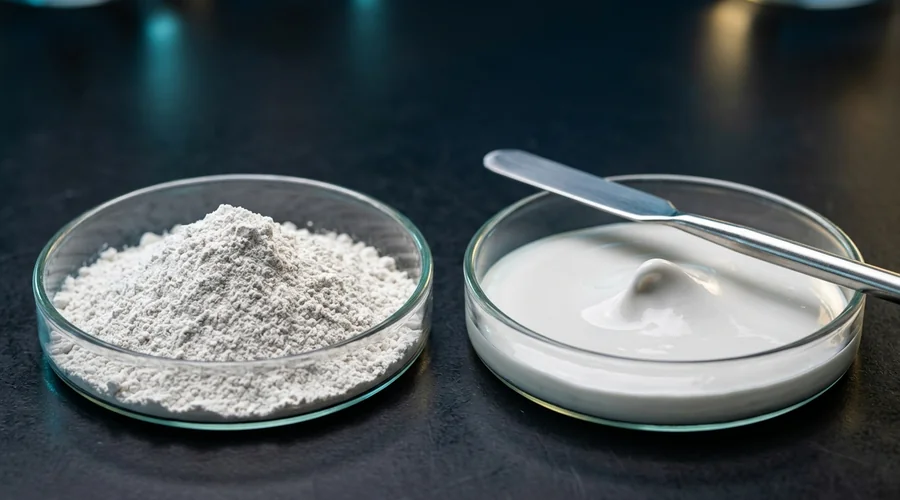
Our guide to dry mix mortar manufacturing, raw materials, and blending covers handling and moisture control for powder products. Our guide to tile adhesive formulation shows the same cement and polymer logic in a related product.
Customers ask about one label above all others, so the next section explains what a waterproof claim can honestly promise.
Waterproof Wall Putty: What Water Resistance Really Means
Waterproof putty is among the most searched putty terms, and it is also the most misunderstood. Hydrophobic additives and a dense, well-hydrated or well-filmed layer reduce how quickly water is absorbed by capillary action. They do not make a thin skim coat resist water under pressure or block moisture rising through a wall. A waterproofing claim therefore describes water repellence of the surface, not protection against dampness from the structure.
- Capillary absorption — surface water uptake, which hydrophobic additives and dense films reduce. EN 1015-18 measures it on cured mortar.
- Hydrostatic pressure and seepage — a skim coat cannot hold back water pushing through from behind, so leaks must be repaired at the source.
- Rising damp and salts — moisture carries dissolved salts that crystallise at the surface and lift the coating, as in efflorescence.
- Condensation — cold surfaces wet from room air, and no putty formulation changes the dew point.
True waterproofing belongs to dedicated systems, and our guide to polymer-modified cementitious waterproofing mechanisms explains how they work. When putty fails anyway, the defect pattern points to a specific cause, which the next section maps.
Putty Defects: Cracking, Peeling, Pinholes and Powdering
Putty defects follow recognisable patterns, and each pattern points to a formulation or application cause. Three mechanisms explain the main patterns: water leaving the layer too fast, air trapped in the film, and a weak bond to the substrate. Diagnosing the right mechanism saves weeks of reformulating the wrong variable. The table links each defect to its cause and its first fix.
| Defect | Mechanism | Formulation Cause | Application Cause | First Fix |
|---|---|---|---|---|
| Hairline cracking | Shrinkage stress exceeds film strength | Low water retention, rigid system, poor filler packing | Coat too thick, fast drying in heat or wind | Raise water retention and polymer flexibility |
| Peeling or flaking | Bond fails at the substrate | Low polymer or binder, poor wetting | Dusty, weak, or damp substrate; uncured plaster | Improve the adhesion package; require a sound substrate |
| Pinholes | Air escapes from the drying film | Weak defoaming, air entrained during mixing | Over-mixing, thin coat on a porous surface | Adjust defoamer; control mixing; apply a thin tight first coat |
| Powdering or chalking | Weakly bound surface | Insufficient binder, incomplete hydration | Moisture lost before hydration finishes | Increase binder and water retention; avoid fast drying |
| White patches | Salts crystallise at the surface | Soluble salts in raw materials | Moisture moving through the wall | Use low-salt raw materials; repair the moisture source |
| Poor sanding | Film too hard or too soft | Filler choice, binder level | Sanding before the coat is fully dry | Adjust filler and binder; allow full drying |
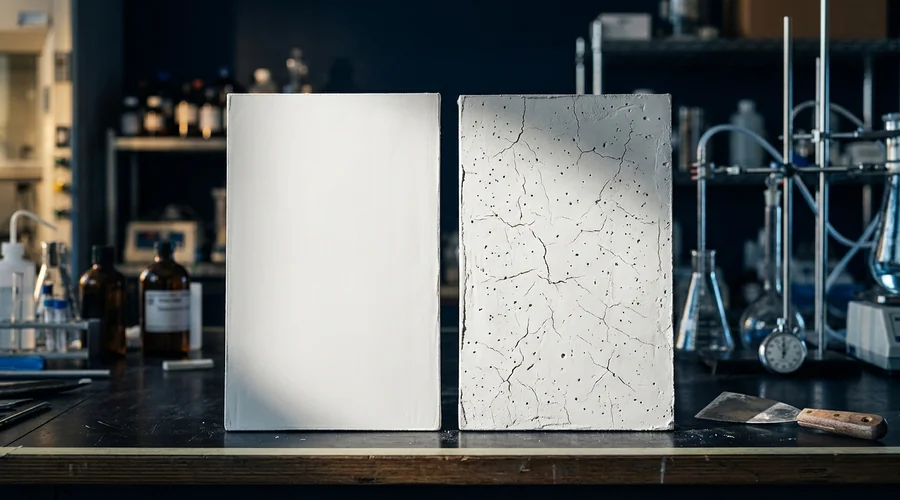
Defects are cheaper to catch in the laboratory than on a customer's wall, which is what a proper test programme is for.
Testing Wall Putty: IS 17545, EN 1015 and Pull-Off Adhesion
A test programme turns a putty that looks right into one that is proven right. IS 17545:2021 lists requirements and test methods for white cement based polymeric putty, including properties such as tensile adhesion strength, water retentivity, setting time, consistency, and whiteness. Mortar methods from the EN 1015 series and the ISO 4624 pull-off method give additional ways to measure the same behaviours. Together they let you compare batches, suppliers, and competing products objectively.
| Property | Method | What It Predicts |
|---|---|---|
| Consistency | EN 1015-3 flow table | Workability and mixing water demand |
| Water retentivity | EN 1015-8 | Resistance to dry-out on absorbent substrates |
| Adhesion | EN 1015-12 or ISO 4624 pull-off | Bond to the substrate and to the coating system |
| Capillary water absorption | EN 1015-18 | Water repellence of the cured layer |
| Setting time and working time | IS 17545 or manufacturer procedure | Usable window on site |
| Whiteness | Colourimeter against a reference | Colour of light topcoats |
| Sanding and cracking | Panel trials to a written protocol | Finish quality at application |
The UK mortar industry testing guide describes how the EN 1015 flow, adhesion, and capillary absorption tests are run. Test on the substrates your customers actually use, because a putty that bonds well to one plaster can behave differently on another. Low-VOC and heavy-metal limits also shape the finished product, and our guide to construction chemical regulatory compliance covers REACH, VOC, and CE frameworks.
Good test results still depend on the wall, so application practice belongs in every technical data sheet.
Substrate Preparation and Application: Where Good Putty Still Fails
Even a well-formulated putty fails on a poorly prepared wall. Data sheets for cement putty set out clear conditions. New plaster is cured for 28 days, the surface is clean, dry, and free from seepage, and mixed material is used within its working time. Temperature, humidity, and film thickness then control how fast water leaves the layer, so the data sheet is part of the product.
- Cured, sound substrate — new plaster is cured before putty goes on, and the cured surface is hard and non-powdery.
- Clean surface — dust, grease, loose paint, and organic growth are removed first.
- Moisture source repaired — seepage and leaks are fixed before any coating is applied.
- Crack treatment — open non-structural cracks are filled first, and structural cracks need an engineer. Our guide to polymer-modified repair mortars covers suitable fillers.
- Working time — cement putty is used within its working time after mixing, because hydration continues in the bucket.
- Controlled conditions — temperature, humidity, and coat thickness stay within the data sheet limits.
- Primer timing — an alkali-tolerant primer goes on over cement putty once it is dry, within the window the manufacturer specifies.
Application guidance only works when the plant delivers consistent batches, which brings the discussion to manufacturing.
Wall Putty Manufacturing and Scale-Up: Dry-Mix Plant and Paste Line
A putty that performs in the laboratory can change character at plant scale. Mixing energy, addition order, moisture pick-up, and minor-ingredient dosing accuracy all shift between a bench blender and a production line. Powder and paste lines carry different risks, so each needs its own control points. Scale-up work exists to find those points before customers do.
- Minor-ingredient dosing (powder) — cellulose ether, polymer powder, and additives are used in small amounts, so dosing accuracy and blend uniformity decide batch consistency.
- Moisture control (powder) — cement reacts with moisture, so dry fillers and sealed, moisture-resistant bags protect shelf life.
- Dust and housekeeping (powder) — fine powders demand dust extraction and worker protection.
- Dispersion and let-down (paste) — fillers are wetted and dispersed first, and binder and additives follow at lower shear.
- Deaeration (paste) — entrained air is removed before filling to prevent pinholes.
- Viscosity and preservation (paste) — viscosity is checked after storage, and the preservative system is verified in the finished paste.
Our guide to construction chemical scale-up from lab batch to plant explains how to structure pilot trials. Our guide to starting a tile adhesive manufacturing business describes a closely related dry-mix plant. The wider construction chemicals range shows where putty sits beside mortars, adhesives, and waterproofing products.
Few manufacturers have every skill in-house, which is where outside formulation support pays off.
Working With a Wall Putty Formulation Consultant
Many established brands already sell wall putty, so a new one wins on consistent finish and fewer complaints, not on novelty. A construction chemicals formulation consultant shortens the path by matching raw materials to the target segment, running the test programme, and preparing the plant for repeatable batches. Construction chemical product development services also cover documentation, such as technical data sheets and quality specifications. A contract formulation scale-up partner can run pilot batches while you finish the plant.
- Define the segment — interior or exterior, cement or acrylic, economy or premium.
- Select raw materials — write specifications for binder, filler, polymer, and cellulose ether.
- Build and screen prototypes — test consistency, water retentivity, adhesion, and sanding on real substrates.
- Stress the formulation — run heat, cold, humidity, and thick-coat trials that mimic site conditions.
- Run pilot batches — confirm batch-to-batch consistency on plant equipment.
- Write the data sheet and quality specification — include substrate preparation, application limits, and test methods.
Our guide to hiring a construction chemicals formulation consultant explains how to judge candidates and scope the work. Global Formulation provides wall putty formulation, raw material selection, scale-up, and technical data sheet development for construction chemical manufacturers.
Frequently Asked Questions
What is the difference between white cement putty and acrylic wall putty?
White cement putty is a powder that hardens by cement hydration, with polymer and cellulose ether added to improve adhesion and water retention. Acrylic wall putty hardens by film formation as water leaves an emulsion binder, so it needs no hydration.
The cement family leaves a strongly alkaline surface, while the acrylic family is set by the polymer and its additives. The right choice depends on the substrate, the finish expected, and the plant available to make it.
Why does wall putty crack after application?
Cracking starts when shrinkage stress exceeds the strength of the drying layer. Three causes are well established: water leaving too fast through an absorbent substrate, a coat applied too thick, and a formulation that is too rigid or poorly packed.
Higher water retention, a suitable polymer, and controlled coat thickness address these causes. Hot or windy conditions make the problem worse, which is why data sheets set temperature and humidity limits for application.
Does waterproof wall putty stop dampness?
No. Water-resistant putty reduces capillary absorption at the surface through hydrophobic additives and a dense layer, but a thin skim coat cannot resist water under pressure. Moisture that arrives from behind the wall, whether from leaks, seepage, or rising damp, will still lift the coating.
The source must be repaired before any putty or paint goes on. Treat water resistance as protection for the paint film, not as waterproofing for the wall.
Why is white cement used in wall putty instead of grey cement?
The colour of ordinary grey Portland cement comes mainly from iron and manganese oxides. White Portland cement is made from raw materials low in those oxides, so it gives a bright, neutral base.
Light paint colours show through a thin coat, and a bright base keeps the finish true. The Indian standard for white Portland cement, IS 8042, includes a test for degree of whiteness.
How long should new plaster cure before wall putty is applied?
Data sheets for cement putty commonly require new plaster to cure for 28 days before application. The cured plaster should be hard, non-powdery, and sound.
Applying putty earlier traps moisture and alkalinity under the coat, which causes adhesion and paint problems later. Always follow the specific data sheet of the product in use.
Can wall putty be applied over a damp wall?
No. A damp wall signals seepage, leakage, or rising damp, and putty cannot cure those problems. Data sheets ask for surfaces to be dry and free from seepage before application, and for excess dampness to be repaired first.
Moisture moving through a wall carries salts that crystallise under the coating and lift it. Repair the moisture source, let the wall dry, and then apply the putty.
Which Indian standard covers wall putty?
IS 17545:2021 prescribes requirements, sampling, and test methods for white cement based polymeric putty used as a finished skim coat on internal or external plastered surfaces. It covers the cement family, so acrylic putty sits outside its scope.
IS 8042 covers the white Portland cement used as the binder. Confirm current BIS certification obligations for your product directly with the Bureau of Indian Standards.
Developing a Wall Putty Product?
Global Formulation supports wall putty formulation, raw material selection, testing, and plant scale-up for cement and acrylic systems.
Talk to Our Formulation Team