3D Printed Concrete: Printable Mortar Rheology Guide
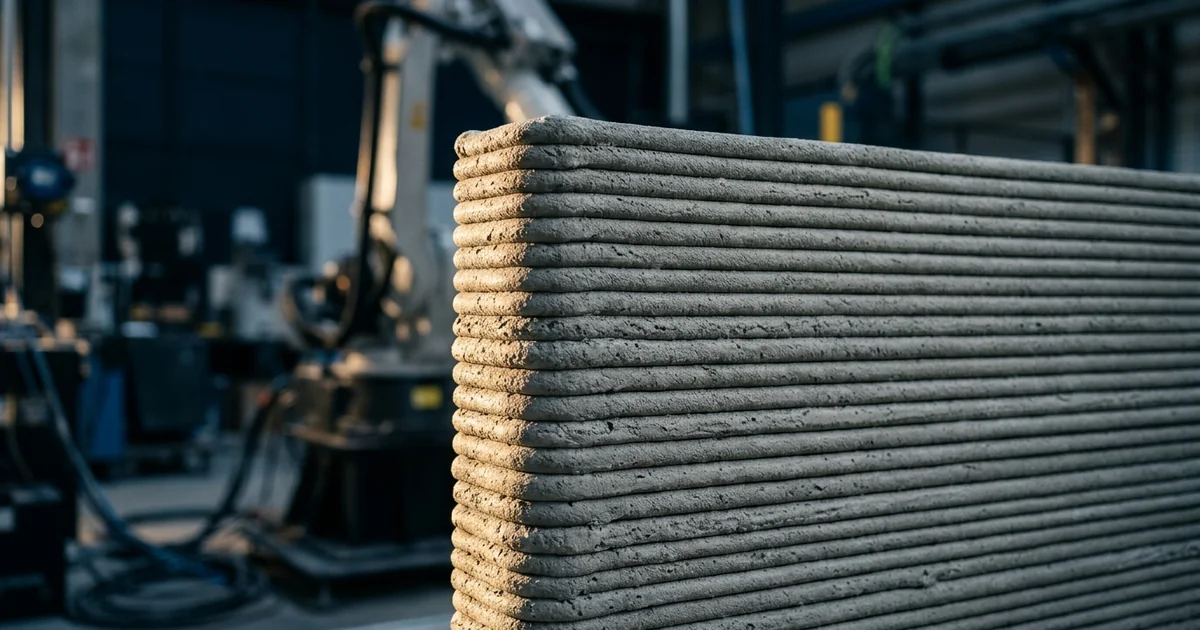
A mortar for 3D printed concrete must flow through a hose, leave the nozzle as a continuous filament and then carry the layers printed above it. Those demands pull in opposite directions, and a mix that suits one stage can block the hose, tear the filament or slump under its own layers. This guide explains 3D printed concrete from the rheology up: what pumpability, extrudability and buildability require, how admixtures shape them, and how interlayer bond and testing complete the picture. It draws on an open-access systematic review in Materials, a review of entrained air in printable concrete, a nano-clay and superplasticizer study and a summary of ISO/ASTM 52939. It also reflects the formulation support Global Formulation gives construction chemical makers.
3D Printed Concrete Rheology: Pumping, Extruding and Building
Printing sends one mortar through three stages, and each stage wants a different rheology. The pump and hose want it fluid, the nozzle wants it cohesive and the finished layers want it stiff. The Materials systematic review states the conflict plainly: high workability is needed during pumping, while low workability and high thixotropy are needed after extrusion. Printing works only when the mix changes character after it leaves the nozzle.
| Stage | What the Mortar Must Do | Governing Property | Failure When Wrong |
|---|---|---|---|
| Pumpability | Travel through a pipe under pressure | Dynamic yield stress and plastic viscosity of the bulk and the lubrication layer | Blockage, or higher pressure to restart after a stop |
| Extrudability | Pass the nozzle without segregation as a continuous filament | Rheological parameters, not simple flow tests | Segregation, blocked pipe, torn filaments and voids |
| Shape retention | Keep the cross-section of the nozzle | Static yield stress and printing speed | Filament width drifts away from the nozzle width |
| Open time | Stay extrudable for the whole print | Growth of yield stress with time | Filaments tear once open time expires |
| Buildability | Carry successive layers without collapse | Static yield stress, thixotropy, structuration rate and geometry | Plastic collapse or elastic buckling |
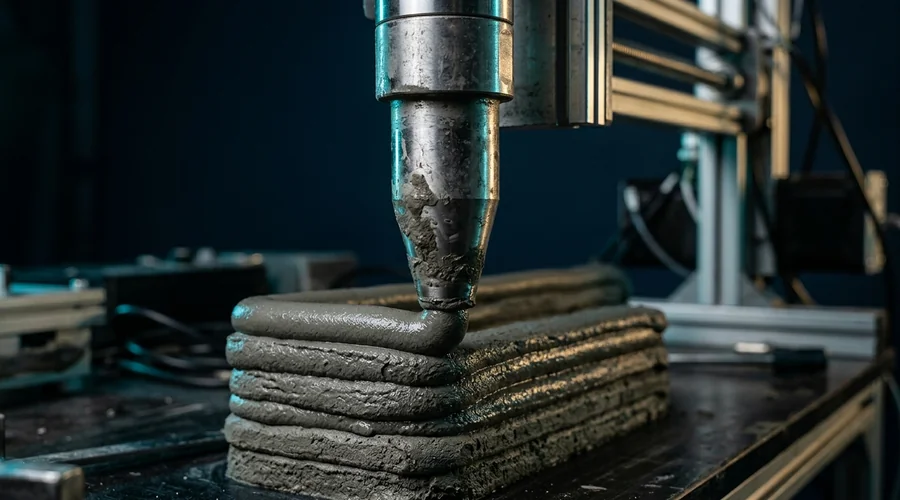
- Pumping detail — pumped mortar divides into a lubrication layer and a bulk layer, and both layers' rheology sets the pumping requirement. If pumping stops briefly, the mortar structures inside the hose and needs more pressure to restart.
- Aggregate effect — in one study the pressure needed for pumping rose each time the aggregate-to-binder ratio increased.
- Extrusion detail — mixes with high sand content segregated during extrusion and blocked the pipe in one study. Stiff mixes rupture as filaments and leave voids.
- Trade-offs — the entrained-air review notes that pumpability and extrudability are interrelated, while pumpability and buildability are opposed.
Our guide to self-leveling underlayment rheology shows the opposite design target, where flow is the goal. Printing needs the vocabulary of yield stress and thixotropy in precise form, which the next section defines.
Printable Mortar Rheology: Yield Stress, Thixotropy and Structuration
Four properties describe most of what a printing operator feels. Static yield stress is the peak stress needed to start flow in resting mortar, and dynamic yield stress is the stress needed to keep it flowing. Plastic viscosity is the resistance to flow once the mortar moves, and thixotropy is the recovery of structure at rest after shearing. The review adds structuration, the rise of static yield stress with time through particle interaction and the start of hydration.
- Pumping and extrusion — dynamic yield stress and plastic viscosity influence these stages.
- Shape and buildability — static yield stress, thixotropy and the structuration rate define shape retention and buildability after extrusion.
- Structuration rate — the rate of increase of static yield stress with time, often written Athix.
- Measurement — a stress growth test with a shear vane gives static yield stress, and a flow curve test after a breakdown period gives dynamic yield stress and plastic viscosity.
- Thixotropy tests — constant shear rate, hysteresis loop and reflocculation tests are all used.
- Contrast with SCC — printable mixes are designed for low viscosity and high yield stress. Self-compacting concrete has low yield stress and high viscosity, and it carries high formwork pressure.
| Property | Stage It Controls | Typical Test |
|---|---|---|
| Dynamic yield stress | Pumping and extrusion | Flow curve test on a concrete rheometer |
| Plastic viscosity | Pumping and extrusion | Flow curve test on a concrete rheometer |
| Static yield stress | Shape retention and buildability | Stress growth test with a shear vane |
| Thixotropy | Recovery after shearing | Hysteresis loop, reflocculation or constant shear rate test |
| Structuration rate | Buildability over time | Stress growth tests repeated at different ages |
Rheology sets what the mortar can do at the nozzle, and the next question is how the printed wall keeps standing as it grows.
Buildability and Structural Build-Up: How Printed Layers Stand
Buildability is a race between the load that new layers add and the strength that lower layers gain. The review defines it as the ability of a mix to be printed to a specific height without significant deformation or collapse. It depends on rheology, printing parameters and the geometry of the structure. No consensus exists on a standard test, so results from different laboratories are hard to compare.
- Green strength — the early-age strength of the mortar comes from interparticle friction and cohesion.
- Two failure modes — a wall can fail by plastic yielding when green strength is inadequate, or by elastic buckling when stiffness is low. Geometry, yield stress, structuration rate and the vertical construction rate decide which comes first.
- Strength evolution — Reiter and co-workers report that strength should evolve linearly with time to avoid failure under self-weight, and with the third power of time to avoid buckling. They propose controlled structuration with retarders and accelerators.
- Analytical models — Perrot and co-workers compare the green strength of the bottom layer with the weight added by upper layers. Their model forecasts the failure time when the critical construction rate is exceeded. Kruger and co-workers model the best print speed and layer height from the rheology evolution and self-weight.
- Measured link — in the nano-clay and superplasticizer study, static yield stress correlated well with green strength. The authors derive a criterion in which the rate of static yield stress growth must exceed a value set by density, printed height and printing time.
The tools that move these rates are admixtures, and each class acts on a different parameter.
Concrete 3D Printing Admixtures: What Each Class Does
Admixtures turn a pumpable mortar into a buildable one. The Materials review notes that a high dosage of chemical admixtures is used in concrete designed for extrusion and buildability. Each class moves a different rheological parameter, so the package has to be designed as a system. The classes below are the ones the reviews document.
| Admixture Class | Reported Effect on Printing Rheology | Watch-Point |
|---|---|---|
| Superplasticisers (PCE, naphthalene sulfonate) | Lower dynamic yield stress and thixotropy; the PCE effect is more prominent | Can erode buildability; a thixotropic type was designed to keep initial stiffness |
| Viscosity-modifying admixtures (cellulose ether, starch derivative) | Raise yield stress, plastic viscosity, green strength and thixotropy; improve shape retention and reduce segregation | Raise extrusion pressure; excess hinders hydration |
| Nano-clays | Raise static yield stress and buildability with little effect on viscosity | Cost; stiffer, more brittle failure than a viscosity modifier in one study |
| Silica fume and nano-silica | Silica fume raises yield stress through packing; nano-silica raises thixotropy | Finer solids at a fixed water amount reduced extrudability in one study |
| Air-entraining agents | Anionic surfactant bubbles raise static yield stress and lower plastic viscosity | Interaction with superplasticisers; high-yield-stress mixes are hard to air-entrain |
| Accelerators | Raise structuration and control setting | Too early stiffening shortens open time |
| Retarders | Extend open time; tartaric acid lowered yield stress and viscosity of a sulfoaluminate cement | Slow structuration can cost buildability |
- Plasticiser and clay pairing — the review reports that naphthalene sulfonate is compatible with viscosity modifiers such as nano-clays, giving a high thixotropy mix with low dynamic yield stress.
- Cellulose ethers — hydroxypropyl methylcellulose has been used as a thickener to increase shape retention after extrusion, prevent segregation and increase thixotropy. Our guide to cellulose ether rheology control covers the polymer side.
- Entrained air — the entrained-air review finds that most authors report higher static yield stress and lower plastic viscosity with air-entraining agents under certain conditions. Cationic surfactants maintain or slightly decrease static yield stress.
- Air and plasticiser conflict — organic superplasticisers can compete with air-entraining agents at the liquid-gas interface, which generates less stable bubble systems. The review recommends testing combinations before use.
- Accelerator families — potassium carbonate, sodium carbonate, calcium nitrate and triethanolamine regulate setting, and calcium sulfoaluminate cement has served as an accelerating component. Our guide to shotcrete accelerator chemistry explains the mechanisms.
For plasticiser fundamentals, see our guide to plasticisers and superplasticisers, and for viscosity modifiers in a related rheology-led system see self-compacting concrete admixtures. Admixtures act inside the mix, but timing can also be controlled at the nozzle.
Controlled Structuration: Accelerators at the Nozzle and Set-on-Demand
The conflict between pumping and building can be split in time. A fluid mix is pumped at low pressure, and a stiffening action is applied at or after the nozzle. Esnault and co-workers used fluid concrete to reduce pumping pressure and added an accelerator at the nozzle to speed structuration so that the layer sustains its own load. Reiter and co-workers proposed controlled structuration with retarders and accelerators used together.
- Nozzle dosing — a fluid mix with an accelerator added at the printhead lowers the extrudability requirement on the pumped material.
- Surface spraying — spraying an alkali-free aluminium sulfate accelerator on the printed filament increased the printable height of a test structure.
- Heating on demand — microwave heating of a geopolymer mortar increased its structuration rate and buildability, and raised interlayer bond strength in the same study.
- Open time — printing open time ends when yield stress grows beyond the extrudable range, and retarders or accelerators regulate it.
- Cost to the bond — faster structuration helps the layer below and can hurt the bond to the layer above, as the interlayer section shows.
Mix ingredients set the baseline on which these tools work, so the binder and aggregate come next.
Binder, Aggregate and Water: Mix Design Levers for Printable Mortar
Before admixtures act, the binder, aggregate and water set the baseline rheology. Printable mixes typically omit coarse aggregate, so the sand-to-binder ratio, particle size and fines content carry most of the load. The high cement content of printing mixes raises a sustainability question, which is why supplementary materials feature heavily in the research. The review summarises the reported effects.
| Ingredient Change | Reported Effect on Fresh Properties |
|---|---|
| Higher sand-to-binder ratio | Yield stress and viscosity rose and thixotropy fell; pumping pressure rose; high sand content segregated |
| Larger aggregate particles | Print quality worsened and void density rose |
| Finer solids at a fixed water amount | Extrudability decreased |
| Silica fume | Finer packing raised yield stress and buildability, and improved surface quality |
| Metakaolin or calcined clay | Workability and setting time fell and extrusion pressure rose; thixotropy improved |
| Limestone | Lowered yield stress in one study; improved shape stability in a geopolymer; reduced pumping pressure in a lightweight mix |
| Lightweight aggregate | Suitable up to a replacement level; beyond it, segregation during extrusion |
Two points follow for a formulator. A premix has to control sand grading and water, because the sand-to-binder ratio alone moved yield stress, viscosity and thixotropy in the studies. Waste-derived binders and aggregates show promise, although the review calls for more comprehensive studies of their effect on the whole printing process. Our overview of construction chemicals places printable mortar among the other premix families. Once a layer is printed, the next problem is how it bonds to the one below.
Interlayer Bond, Shrinkage and Hardened Performance
A printed wall is a stack of interfaces, and the weakest interface decides performance. The review reports that strength at the core of an extruded filament is higher than at the horizontal or vertical interfaces between layers. Printed elements therefore behave anisotropically, with strength depending on the direction of load relative to the direction of printing. Fresh-state design and hardened performance meet in the time gap between layers.
- Time gap — researchers agree that strength falls as the time gap between layers grows. In one study a 30-minute gap reduced tensile strength by 58 percent compared with no gap.
- Mechanism — the lower layer structures and stiffens, so the next layer intermixes less. Exposed surfaces lose water to evaporation, which leaves a dry substrate with reduced hydration and high porosity at the interface, and bleeding water also matters.
- Rapid hardening binders — the effect can be more prominent when rapid hardening cement is used.
- Countermeasures — cement paste applied between layers increased the effective bond area. A special interface mix and a polymer-modified mortar also improved bond in reported studies.
- Anisotropy — most reported compressive strengths along the vertical axis were lower relative to cast concrete than those along the horizontal axes. Fibre-containing mixes did not follow that order.
- Shrinkage — plastic shrinkage is higher in printed concrete because of the absence of formwork, a lower sand-to-binder ratio and more fines. Most shrinkage cracks appear within the first two hours.
- Curing — a shrinkage-reducing admixture lowered strains in one study, while external curing reduced them most but hinders continuous printing.
- Durability — the review calls for more work on durability in aggressive environments, because printed concrete differs in mix design, admixture dosage and layered construction.
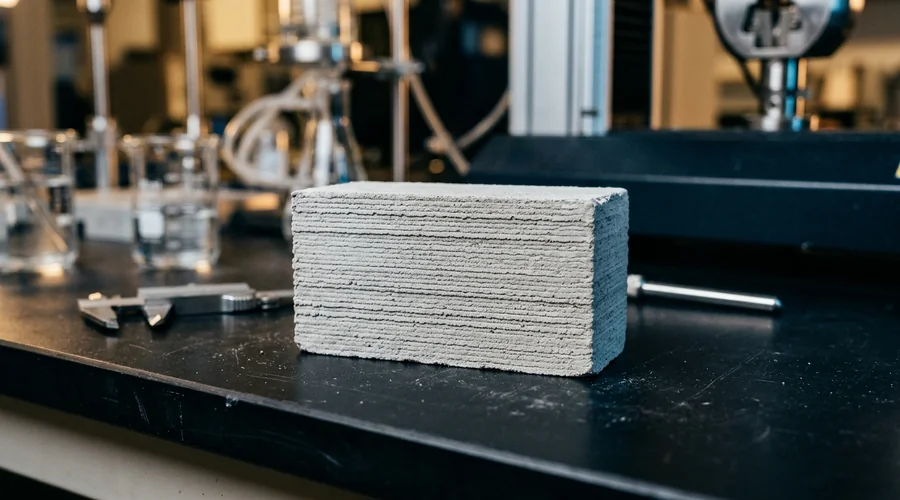
Bond and shrinkage are properties that a lab rheology test does not capture, which is why testing must go beyond the rheometer.
Testing Printable Mortar: From Rheometer to Print Trial
Testing printable mortar means measuring what each stage demands, because slump alone cannot answer it. The Materials review notes that extrudability cannot be quantified from simple flow tests, although rheological parameters indicate it. The entrained-air review adds that slump and rheometry are not the most adequate tools for green strength, and that squeeze flow and unconfined compression tests have been developed instead. A programme combines rheology, green strength and print trials.
| Question | Method in the Literature | Limit |
|---|---|---|
| Pumping and extrusion rheology | Flow curve test on a concrete rheometer | Values vary with rheometer type |
| Static yield stress and structuration | Shear vane stress growth tests at several ages | Needs repeats through the open time |
| Green strength | Squeeze flow or unconfined uniaxial compression | Methods differ between laboratories |
| Extrudability | Printed test filament, ram extruder force and friction, or extrusion energy | Empirical and manual |
| Shape retention | Filament width ratio, or heights of printed layers after one hour | Depends on printing speed |
| Buildability | Layer count, layer settlement, cylinder stability, maximum height of a hollow square | No consensus geometry |
| Open time | Filaments printed at intervals until they tear | Depends on extrusion rate and pre-shear |
| Structural build-up and setting | Vicat penetration resistance and calorimetry | Indirect measures of yield stress growth |
- Standard geometry — the Materials review recommends a standard geometrical model with defined layer width and height, number of layers, curve radius, time gap, nozzle standoff distance and travel speed.
- Pumping research gap — lab printers use small to medium pumps over short distances, and rheology changes over larger pumping distances need detailed investigation.
- Standard for the structure — a trade-press summary says ISO/ASTM 52939:2023, published in December 2023, sets quality-related requirements for printed structural and infrastructure elements. It is independent of material, and the summary says material properties and testing are not covered.
With a test ladder in place, the remaining question is who assembles the whole package.
Working With a Construction Chemicals Formulation Consultant
The printer, the pump and the mortar behave as one system. A premix tuned on one machine can fail on another because pump capacity, hose length and nozzle size differ. A construction chemicals formulation consultant tunes the rheology to the equipment and the schedule before the first full-scale print. Construction chemical product development services then carry the formulation through documentation, scale-up and supply.
- Rheology mapping — static and dynamic yield stress, thixotropy and structuration across the open time of the print schedule.
- Admixture package design — plasticiser, viscosity modifier, clay, air-entraining and accelerator combinations, with compatibility checks between them.
- Equipment matching — pump, hose and nozzle trials that confirm the rheology window on the actual printer.
- Interlayer programme — time-gap studies and interface treatments for the target wall geometry.
- Test record — a protocol that names the printer setup with every result.
- Scale-up and supply — transfer of the dry-mix premix to a contract formulation scale-up partner with defined quality checks.
Our guide to construction chemical scale-up from lab batch to plant covers the manufacturing step in detail. Before the first trial, record the pump type, hose length and diameter, nozzle size and the time each layer needs to print. Those four facts define the rheology window for everything in this article.
Frequently Asked Questions
What is 3D printed concrete?
3D printed concrete is an additive manufacturing method in which a cementitious mortar is pumped to a nozzle and deposited layer by layer from a digital model. It needs no formwork.
The mortar passes through pumping, extrusion and layer deposition, and each stage asks for different fresh-state properties. Printable mixes typically omit coarse aggregate.
What rheology does a printable mortar need?
It needs high workability during pumping and low workability with high thixotropy after extrusion. Dynamic yield stress and plastic viscosity govern pumping and extrusion, while static yield stress, thixotropy and structuration rate govern shape retention and buildability.
Printable mixes are designed for low viscosity and high yield stress. Self-compacting concrete is the opposite case, with low yield stress and high viscosity.
What is the difference between pumpability, extrudability and buildability?
Pumpability is the ability to be transported through a pipe under pressure. Extrudability is the ability to pass the nozzle without segregation as a continuous filament.
Buildability is the ability to be printed to a specific height without significant deformation or collapse. Pumpability and extrudability are interrelated, while pumpability and buildability pull in opposite directions.
Which admixtures are used in 3D printed concrete?
The reviews document superplasticisers, viscosity-modifying admixtures such as hydroxypropyl methylcellulose, nano-clays, silica fume, air-entraining agents, accelerators and retarders. Each one moves a different parameter, such as dynamic yield stress, thixotropy or structuration rate.
Superplasticisers lower dynamic yield stress and thixotropy, while viscosity modifiers and nano-clays raise yield stress and green strength. The package has to be designed as a system, and entrained air and superplasticisers can compete for the air-water interface.
Why are the bonds between printed layers weaker?
Researchers agree that strength falls as the time gap between layers grows. The lower layer structures and stiffens, so successive layers intermix less, and exposed surfaces lose water to evaporation and bleeding.
Countermeasures reported include cement paste between layers, a special interface mix and polymer-modified mortar. Rapid hardening binders can make the problem more pronounced.
How is the buildability of printable mortar tested?
Methods include counting the layers printed before deformation, layer settlement and cylinder stability tests, the maximum height of a printed hollow square and green strength measurements. There is no consensus on a standardised buildability test.
The Materials review recommends a standard geometry with defined layer size, number of layers, curve radius, time gap, nozzle standoff and travel speed so that results can be compared.
Is there a standard for 3D printed construction?
ISO/ASTM 52939:2023, published in December 2023, sets quality-related requirements for 3D printed structural and infrastructure elements in buildings. A trade-press summary says it is independent of material and does not apply to metals.
The same summary says material properties, characterisation and testing are not covered, so mortar test methods remain a matter for the project and the local engineer. Check the standard itself and local rules before relying on this summary.
How can a formulation consultant help with printable mortar?
A consultant maps the rheology window of the mortar to the pump, hose, nozzle and layer time of the printer, then designs the admixture package to hold it. The same team plans compatibility checks between plasticisers, viscosity modifiers, air-entraining agents and accelerators.
The work continues into interlayer bond trials, a test record that names the printer setup and scale-up of the dry-mix premix with a contract manufacturer.
Developing a Printable Mortar or Tuning One to Your Printer?
Global Formulation supports construction chemical manufacturers with printable mortar and admixture formulation, rheology and print-trial programmes, interlayer bond work, product development and contract manufacturing.
Talk to Our Formulation Team