Coagulant Selection in Water Treatment: Alum, Ferric, PAC
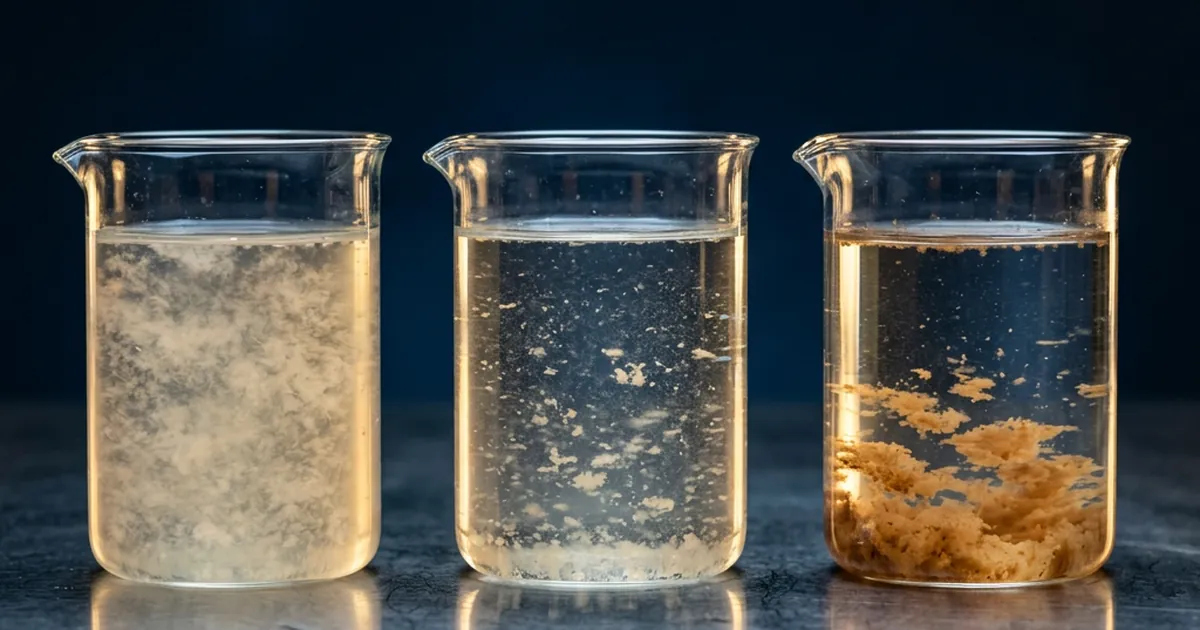
Choosing a coagulant on price per tonne alone ignores four things that decide whether it works: pH window, alkalinity demand, corrosion duty and residual metal limit. A wrong choice shows up as extra pH-correction chemicals, tanks that need new linings, or treated water that breaches a limit. For a chemical manufacturer, the same error means shipping a product that fails in the buyer's raw water. This guide sets out a coagulant selection water treatment framework that compares alum, ferric chloride, ferric sulphate and polyaluminium chloride on the same footing. It draws on EPA and WHO documents, two operating manuals and the Indian, European and American product standards. It also reflects the formulation support Global Formulation gives water treatment chemical manufacturers.
Alum, Ferric Chloride, Ferric Sulphate and PAC: An Inorganic Coagulant Comparison
Four inorganic coagulants cover most of the water treatment market: aluminium sulphate (alum), ferric chloride, ferric sulphate and polyaluminium chloride. The Irish EPA water treatment manual calls aluminium and iron salts the most commonly used coagulant chemicals because they are effective, relatively low cost and easy to handle. All four form an insoluble metal hydroxide in water, but they differ in the metal, the anion and the degree of prehydrolysis. Those three differences drive every trade-off in this guide.
| Coagulant | Metal and Anion | Typical Supply Forms | Handling Note |
|---|---|---|---|
| Alum (aluminium sulphate) | Al3+, sulphate | Solid blocks, granulated or kibbled alum, and liquid | Solution is corrosive to aluminium, steel and concrete, so tanks need protective linings |
| Ferric chloride | Fe3+, chloride | Anhydrous green-black powder, dark-brown syrupy liquid, or FeCl3·6H2O crystal | Solid forms are hygroscopic and unsuitable for dry feed; solution attacks almost all metals and concrete |
| Ferric sulphate | Fe3+, sulphate | Red-brown powder or granules | Mildly hygroscopic and difficult to dissolve; solution is corrosive to aluminium, concrete and most steels |
| Polyaluminium chloride (PAC) | Prehydrolysed Al, chloride (some grades add sulphate) | Liquid and powder | May have advantages over alum in the coagulation of difficult waters, according to the Irish EPA manual |
Ferrous sulphate, also called copperas, is probably the cheapest coagulant salt. The Irish EPA manual notes that its former pairing with chlorine, called chlorinated copperas, has been largely or entirely discontinued in public supply because excess chlorine can form trihalomethanes. Our guide to the polyaluminium chloride coagulant covers basicity and aluminium speciation in depth, so this guide treats PAC as one option among four. To see why one coagulant suits one water and fails in another, follow what happens to the metal after it is dosed.
How Aluminium and Iron Coagulants Hydrolyse in Water
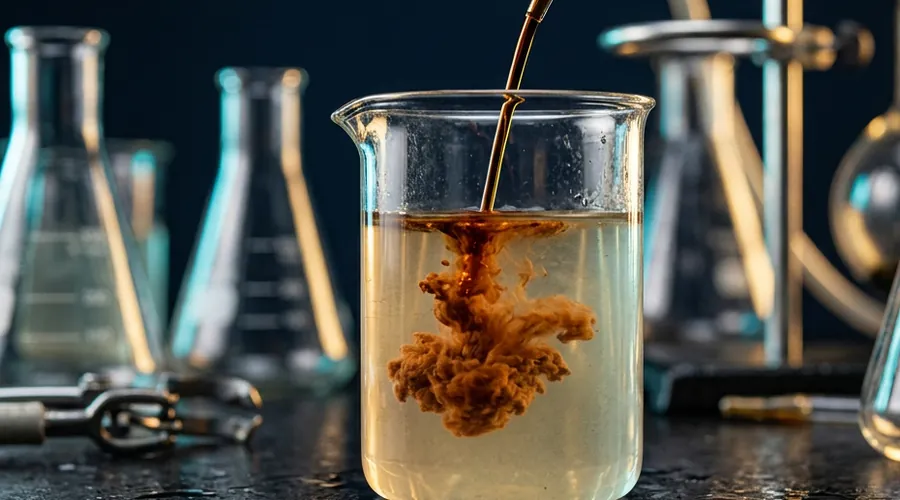
Every metal-salt coagulant works by turning into an insoluble metal hydroxide in the treated water. The Irish EPA manual describes that hydroxide as floc-forming, heavier than water and positively charged, which lets it neutralise the negative charge on colloidal particles. That charge neutralisation is the mechanism behind coagulation in water treatment. The reaction also releases acid, which the alkalinity of the water has to neutralise.
| Coagulant | Reaction With Natural Bicarbonate Alkalinity | Salt Left in the Water |
|---|---|---|
| Alum | Al2(SO4)3 + 3Ca(HCO3)2 → 2Al(OH)3 + 3CaSO4 + 6CO2 | Calcium sulphate |
| Ferric sulphate | Fe2(SO4)3 + 3Ca(HCO3)2 → 2Fe(OH)3 + 3CaSO4 + 6CO2 | Calcium sulphate |
| Ferric chloride | 2FeCl3 + 3Ca(HCO3)2 → 2Fe(OH)3 + 3CaCl2 + 6CO2 | Calcium chloride |
The three reactions share one shape. Each consumes bicarbonate, each leaves a metal hydroxide floc, and each adds sulphate or chloride to the treated water. The Irish EPA manual presents these equations, and four practical consequences follow from them.
- Added alkali — if a water has too little alkalinity, the manual adds hydrated lime, sodium hydroxide or sodium carbonate so the reaction can complete.
- Added anion — the sulphate from alum and ferric sulphate and the chloride from ferric chloride both stay in the treated water. The US secondary standards in 40 CFR 143.3 list each at 250 mg/L.
- pH and species — for alum, lower pH favours the positively charged hydrolysis species that react with negatively charged colloids.
- Prehydrolysed PAC — it brings part of the hydrolysis with it, so fewer protons remain to be released in the water, as our PAC guide explains.
Which of these reactions suits a plant depends on how much alkalinity its water carries and where its pH has to sit, so those two numbers come next.
pH Windows and Alkalinity: Where Alum and Ferric Salts Differ
The working pH range is the first thing that separates alum from ferric salts. Alum has a comparatively narrow window, while ferric salts work over a much wider one. Raw-water alkalinity decides whether a plant can stay inside the window without adding chemicals. A mismatch between the two forces extra alkali or acid into the process.
| Coagulant | pH Range Listed by Hach | Alkalinity Consumed per mg of Product |
|---|---|---|
| Alum | 5.5 to 7.8 in theory; 6.0 to 7.4 typical | 0.49 mg/L as CaCO3 |
| Ferric sulphate | 4.0 to 11.0 | 0.53 mg/L as CaCO3 |
| Ferric chloride | 4.0 to 11.0 | 0.92 mg/L as CaCO3 |
The table comes from a 2010 Hach technical guide on coagulation and clarification. Its jar-test advice adds that alum works well from about pH 5.5, the optimum for colour removal, to the low 7s, while iron salts operate well into the high 8s. As a rule of thumb, it asks for alkalinity of at least half the alum or ferric sulphate dose and nearly the full ferric chloride dose.
The right pH inside each range depends on the water. The Irish EPA manual puts the alum optimum at 6.5 to 7.5 for lowland surface waters and at a lower 5.5 to 6.5 for highly coloured upland waters. For soft coloured waters it says a much narrower band of coagulation pH has to be maintained. At the other extreme, EPA's enhanced coagulation guidance manual says lime softening runs above the workable pH for alum and suggests augmenting with a ferric coagulant.
Once pH and alkalinity are matched, the next question is how to compare doses of different chemicals without fooling yourself.
Comparing Coagulants Fairly: Metal-Equivalent Dosing and the Jar Test
A kilogram of alum and a kilogram of ferric chloride carry different amounts of metal, so comparing them by mass tells you little. EPA's enhanced coagulation guidance solves this by converting every coagulant to a metal-equivalent dose. In its conversion table, anhydrous ferric chloride needs a little over half the mass of regular alum, while ferric sulphate nonahydrate needs nearly the same mass. Cost per tonne therefore says little until it is restated per unit of metal.
- Characterise the raw water — record turbidity, pH, alkalinity and temperature before dosing, plus colour or total organic carbon where organics matter.
- Convert to metal-equivalent doses — use EPA's coagulant dosage equivalents so the alum, ferric chloride and ferric sulphate series line up on contained metal.
- Record the pH of every jar — Hach stresses that pH must be measured when aluminium or iron salts are used.
- Test the temperature extremes — a 2019 study found that coagulation in cold, low-turbidity water is slow and the flocs are small, light and loose.
- Add polymer only after the metal salt — the Irish EPA manual allows one to several minutes for microflocs to form before a polyelectrolyte aid goes in.
- Score more than turbidity — read settled and filtered turbidity, final pH, residual aluminium or iron, floc settling and sludge volume.
- Confirm at plant scale — check the winning series against full-scale settling and filtration, as our guide to scale-down models that predict the plant explains.
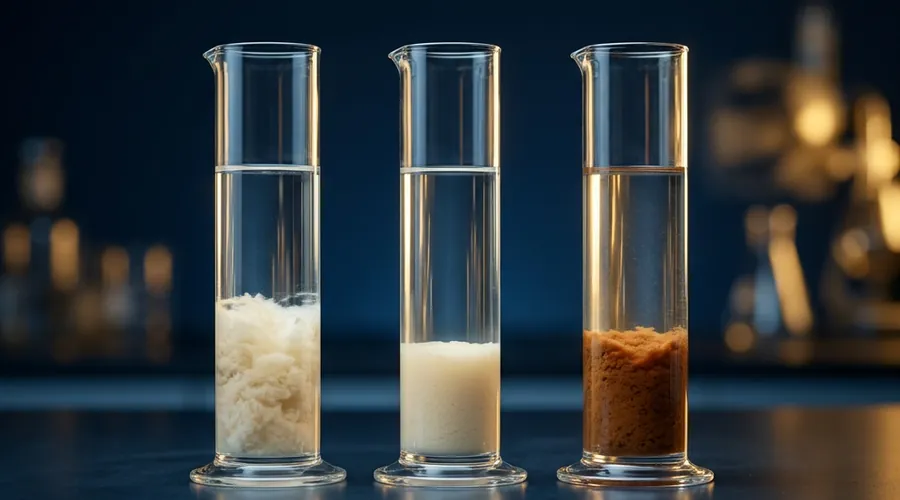
The jar test is standardised by ASTM D2035, and our PAC guide walks through the procedure and the overdosing effect in detail. EPA's own jar-test procedure accepts either alum or an equivalent ferric dose, so neither salt is the default.
A fair test produces data, and the scorecard in the next section turns that data into a shortlist.
Coagulant Selection Water Treatment Scorecard: Matching Chemistry to Raw Water
The right first candidate depends more on the raw water than on the product. This scorecard maps common raw-water situations to the chemistry that deserves the first jar-test series. Each row is a starting point built from published guidance. The jar test, not the table, makes the final decision.
| Raw-Water Situation | What the Published Guidance Says | Where to Start the Jar Test |
|---|---|---|
| Low-alkalinity, soft water | EPA's jar-test procedure notes that below 60 mg/L alkalinity as CaCO3, small metal-salt doses can push pH under 5.5 and base is added | Prehydrolysed PAC, which releases less acid, or alum or ferric with lime or caustic soda |
| High-alkalinity water | In very alkaline waters the optimum dose may not lower pH enough, and a larger dose raises soluble metal (Irish EPA) | Ferric salts for their wider window, or alum with acid trim |
| Coloured soft upland water | Alum needs a typical pH of 5.5 to 6.5 in a narrow band (Irish EPA); iron salts also remove total organic carbon (EPA) | Alum at the low-pH end, with a ferric series for comparison |
| Lime softening or other high-pH treatment | The pH lies outside the workable range for alum (EPA) | Ferric salts |
| Cold, low-turbidity water | Aluminium hydrolysis is slow in the cold and flocs are small and loose (2019 study) | Every candidate at the coldest temperature, plus PAC and a polymer aid |
| Arsenic or phosphate to remove | Ferric coagulants may remove arsenate at low pH (EPA), and iron(III) phosphate is insoluble | Iron salts, with the sludge disposal route in view |
| Tight residual aluminium limit | IS 10500:2012 accepts 0.03 mg/L aluminium | Include iron salts, and measure residual iron against its own 0.3 mg/L limit |
| Staining-sensitive supply | Excess residual iron brings clothes-staining complaints; excess aluminium is less noticeable (Irish EPA) | Alum or PAC with close residual control |
| Unlined concrete or steel dosing tanks | Alum and both ferric solutions attack these materials, the chloride more than the sulphate (Irish EPA) | Budget linings first, since ferric chloride demands the most |
The scorecard narrows the field, and two constraints then decide whether the shortlisted coagulants are usable: the residual metal limit and what each chemical does to the plant.
Residual Iron and Aluminium: Limits That Constrain the Choice
Every metal-salt coagulant leaves some metal in the treated water, so the residual limit is a selection criterion, not an afterthought. Iron and aluminium are regulated differently, and the numbers are not symmetrical. WHO proposes no health-based guideline for iron, yet staining and taste problems appear at low concentrations. In India the aluminium limit is the tighter of the two.
| Reference | Iron | Aluminium |
|---|---|---|
| WHO | No health-based guideline value; staining of laundry and plumbing may occur above 0.3 mg/L | No guideline value; practicable levels of 0.1 mg/L or less in large plants and 0.2 mg/L or less in small plants |
| US 40 CFR 143.3 | 0.3 mg/L | 0.05 to 0.2 mg/L |
| IS 10500:2012 (India) | 0.3 mg/L maximum with no relaxation; iron and manganese together not above 0.3 mg/L | 0.03 mg/L acceptable; 0.2 mg/L permissible where no alternate source exists |
- Iron staining — the Irish EPA manual warns that excess residual iron brings complaints of clothes staining, particularly with automatic washing machines, while a similar aluminium excess is less noticeable.
- Iron plus manganese — IS 10500:2012 caps the two together, so impurities in the coagulant matter as well as the iron it adds.
- Aluminium — our PAC guide sets out the aluminium limits and why the dose must respect them.
Residual limits cap the dose, and handling constraints cap the infrastructure that can deliver it.
Corrosion, Storage and Handling: What Each Coagulant Demands of the Plant
All four coagulants are acidic, and each one attacks common plant materials. They differ in how aggressively they do so and in which materials suffer. Tank, pump and pipework decisions therefore belong in the selection, not after it. The Irish EPA manual places ferric chloride at the demanding end.
- Alum — the solution is corrosive to aluminium, steel and concrete, so tanks of those materials need protective linings.
- Ferric sulphate — the powder is mildly hygroscopic but difficult to dissolve, and the solution is corrosive to aluminium, concrete and most steels.
- Ferric chloride — the manual calls the solution very corrosive, attacking almost all metals and concrete, and the iron(III) chloride entry on Wikipedia also advises protective equipment for concentrated solutions.
- Dosing-line reliability — the foreword to IS 299:2012 says the insoluble matter limit was reduced because alum consumers face choking of dosing lines.
- Representative sampling — the same standard notes that liquid alum spends about 10 to 12 hours or more in a tanker. Insolubles settle during that time, and a spot sample from the bottom can read high, so the tanker contents must be mixed before sampling.
Published guidance on the treated water itself points in different directions. The Irish EPA manual notes that the calcium chloride formed from ferric chloride may increase water corrosivity. It adds that ferric sulphate is usually preferred despite its higher price. Our PAC guide reports research finding that prehydrolysed coagulants intensify the corrosiveness of treated water less than sulphate coagulants. Because both anions can matter, test the treated water against the plant's own distribution materials, and see our guide to scale and corrosion inhibitor manufacturing for the downstream side. A written specification covers the product itself, and the standards in the next section show what it contains.
Beyond Drinking Water: Phosphate, Sulphide and Sludge Duties
Wastewater plants use the same salts for jobs that drinking-water plants rarely face. Phosphate removal and sulphide control are the best documented of these jobs. Drinking-water rankings do not carry over automatically to effluent duties. The selection has to be repeated for each duty.
- Phosphate — iron(III) phosphate is insoluble and precipitates, which is why iron(III) chloride removes soluble phosphate from wastewater, and aluminium sulfate is also used for chemical phosphorus removal.
- Sulphide — the ferric ion oxidises hydrogen sulphide, which Wikipedia describes as a potential advantage of iron(III) chloride in water treatment.
- Arsenic — EPA notes that arsenate not removed by earlier practice may be removed by ferric coagulants at low pH and then ends up in the sludge.
- Sludge — EPA notes that higher coagulant doses raise the share of hydroxide precipitate in the sludge and can change its dewaterability, for ferric and alum alike.
Because the published guidance does not rank the two metals on sludge, measure settled volume and dewaterability for each candidate in the jar test. Our water treatment chemical manufacturing business guide and our overview of water treatment technology and formulations show where these duties sit in a product range. Whatever the duty, the product is bought against a specification, so the standards come next.
Coagulant Standards and Specifications: IS 299, EN 878, EN 888, EN 890 and AWWA
A coagulant grade is bought against a written specification. The specification decides which impurities are limited and how the product is packed, sampled and labelled. India, Europe and the United States publish separate standards for each chemical. The table lists the standards verified for this guide.
| Product | India | Europe | United States |
|---|---|---|---|
| Alum | IS 299:2012 (alumino-ferric, grades 1 to 5) and IS 260:2001 (non-ferric) | EN 878:2016 | AWWA B403, aluminum sulfate in liquid, ground or lump form |
| Ferric chloride | Confirm the current BIS standard | EN 888:2023, solution and hexahydrate | AWWA B407, liquid ferric chloride |
| Ferric sulphate | Confirm the current BIS standard | EN 890:2023, solution | AWWA B406, ferric sulfate |
| PAC | IS 15573:2018 | EN 17034:2018 | AWWA B408, liquid polyaluminum chloride |
IS 299:2012 is titled Alumino-Ferric and describes the material as essentially aluminium sulphate octadecahydrate. It defines five grades: 1 and 2 are solid, 3 is liquid, 4 is solid and 5 is liquid. Grades 4 and 5 are the ones intended for drinking water. Its foreword explains that the 2012 revision lowered the insoluble matter limit and the permissible iron for the drinking-water grades, because higher iron is associated with more impurities. It also added limits on heavy metals and organic impurities based on the WHO drinking-water guidelines.
IS 260:2001 covers aluminium sulphate, non-ferric, which its foreword calls a purer form of aluminium sulphate than alumino-ferric. The foreword lists uses in textile dyeing, paper loading, oil and fat clarification and pharmaceutical preparations, as well as in purifying water injected into oil-bearing formations. Both Indian standards sit beside IS 15573 for PAC, which our PAC guide covers.
Standards fix the grade of each single salt, while formulation decides how grades combine into a finished product.
Blended Coagulants and Coagulant Aids: Where Formulation Adds Value
Single salts are the starting point of coagulant formulation, not its limit. The Irish EPA manual notes that proprietary coagulants combining synthetic polyelectrolyte solutions with metal salts are on the market. Blends and aids let a formulator adjust a coagulant to the water in front of it. This is where formulation, rather than commodity supply, defines a product.
- Alum and ferric blends — a jar-test study reported lower residual aluminium and iron with blended alum and ferric chloride than with either salt alone. It appeared in the International Journal of Water and Wastewater Treatment and compared the salts at optimal pH and dose. As a single laboratory study, it needs confirming in your own water.
- Coagulant aids — the Irish EPA manual says aids improve the settling characteristics of floc from aluminium or iron coagulants. Activated silica can give the best results with alum but demands a high level of technical expertise.
- Sodium aluminate with alum — it is mainly useful in alkaline waters, where the floc is denser and coagulation works at low temperatures over a wide pH range. The two must never be mixed before dosing, and the aluminate goes in 0.5 to 2 minutes before the alum.
- Cationic polymers — EPA notes that polymers have proven valuable in creating settleable floc when high doses of aluminium or iron salts are used.
- Order and timing — the Irish EPA manual calls the timing of coagulants and aids usually critical to effective clarification, which makes dosing-point spacing part of the formulation.
A blend that wins on the bench still has to be made repeatably, which is a question of specification, manufacturing and a partner who can hold both.
Working With a Water Treatment Formulation Consultant
Coagulant selection and coagulant product development meet at the same bench test, run on the buyer's own raw water. A water treatment formulation consultant defines the target water, builds the scorecard and benchmarks candidates against the incumbent product. Water treatment chemical product development services also cover specification writing, pilot batches and storage trials. Industrial water chemicals contract manufacturing then carries the chosen grade into a plant that can hold the specification.
- Define the raw water — turbidity range, temperature extremes, pH, alkalinity and organic load.
- Choose the benchmark — the incumbent alum, ferric or PAC product, compared on contained metal.
- Run the three-way jar series — alum, a ferric salt and PAC at metal-equivalent doses.
- Score the full result — pH, residual metal, floc settling and sludge for every jar.
- Write the specification — set assays and impurity limits against IS 299, EN 878, EN 888, EN 890 or the AWWA standard that applies.
- Run pilot batches and storage trials — test the tanks, lining materials and dosing lines the buyer will use.
- Scale up with a qualified partner — transfer the analytical methods together with the process.
Our water treatment range shows where coagulants sit among the other chemistries. Entrepreneurs planning a plant will also find our guide to starting a coagulant and flocculant manufacturing business useful, and our guide to manufacturing without a factory explains the contract route. Global Formulation provides coagulant selection studies, jar-test benchmarking, specification support and scale-up for water treatment chemical manufacturers.
Frequently Asked Questions
What is the difference between alum, ferric chloride, ferric sulphate and PAC?
Alum is aluminium sulphate, ferric chloride and ferric sulphate are iron(III) salts, and polyaluminium chloride is a partially neutralised aluminium chloride. All four form an insoluble metal hydroxide that removes colloidal particles.
Alum, ferric chloride and ferric sulphate hydrolyse in the treated water and consume alkalinity as they do. PAC arrives already prehydrolysed, so it releases less acid in the water.
The metal, the anion and the working pH range then decide which one suits a given water.
Is ferric chloride a better coagulant than alum?
Neither is better in every water. Ferric salts work over a much wider pH range than alum, and EPA notes that iron salts are effective for removing total organic carbon.
Against that, ferric chloride solution attacks almost all metals and concrete, and excess residual iron stains laundry. Alum solution is also corrosive, but its residual aluminium is less noticeable to consumers.
A three-way jar test on the real raw water, scored on residual metal and sludge as well as turbidity, settles the question.
Which pH range suits alum and ferric coagulants?
A Hach technical guide lists a typical range of 6.0 to 7.4 for alum, with 5.5 to 7.8 in theory. For ferric sulphate and ferric chloride it lists 4.0 to 11.0.
The Irish EPA manual puts the optimum for alum at 6.5 to 7.5 for lowland surface waters and 5.5 to 6.5 for highly coloured upland waters.
The best pH for one water still comes from a jar test, because the raw water changes the shape of the optimum pH curve.
Does ferric chloride use more alkalinity than alum?
Per unit mass of product it does. Hach lists 0.92 for ferric chloride against 0.49 for alum. The two products carry different amounts of metal, so that mass comparison misleads.
On EPA's metal-equivalent basis, the alkalinity demands of alum, ferric chloride and ferric sulphate agree within about 3 percent, because each metal ion releases the same amount of acid.
Check the alkalinity of the raw water before any switch, since every one of these salts consumes it.
What residual iron limits apply in drinking water?
WHO proposes no health-based guideline value for iron. It derives about 2 mg/L from the JECFA tolerable intake and notes that this does not present a hazard to health. Taste and appearance, it adds, are usually affected below that level.
WHO also reports that staining of laundry and plumbing may occur above 0.3 mg/L. The US secondary standard and IS 10500:2012 both set iron at 0.3 mg/L, and the Indian standard allows no relaxation.
IS 10500:2012 also caps iron and manganese together at 0.3 mg/L, so impurities in the coagulant count as well as the iron it adds.
Which standards apply to alum and ferric coagulants?
For alum, India has IS 299:2012 (alumino-ferric, grades 1 to 5, with grades 4 and 5 for drinking water) and IS 260:2001 (non-ferric). Europe has EN 878:2016, and AWWA B403 covers aluminum sulfate in the United States.
For ferric chloride, EN 888:2023 covers the solution and the hexahydrate, and AWWA B407 covers liquid ferric chloride. For ferric sulphate, EN 890:2023 covers the solution, and AWWA B406 covers ferric sulfate.
Confirm the current Indian standard for the iron salts with the Bureau of Indian Standards before writing a specification.
Why is ferric chloride harder to store and dose than alum?
The Irish EPA manual calls ferric chloride solution very corrosive, attacking almost all metals and concrete. Alum solution is corrosive to aluminium, steel and concrete, and its tanks need protective linings.
The solid forms of ferric chloride are hygroscopic and unsuitable for dry feed, so the product cannot simply be fed as a dry powder.
Tanks, pumps and pipework for ferric chloride need materials chosen for the duty from the start, and that cost belongs in the selection, not after it.
Selecting or Developing a Coagulant Product?
Global Formulation supports coagulant benchmarking, grade selection, specification writing and scale-up to a qualified plant.
Talk to Our Formulation Team