Cooling Tower Water Treatment: Scale, Corrosion, Fouling
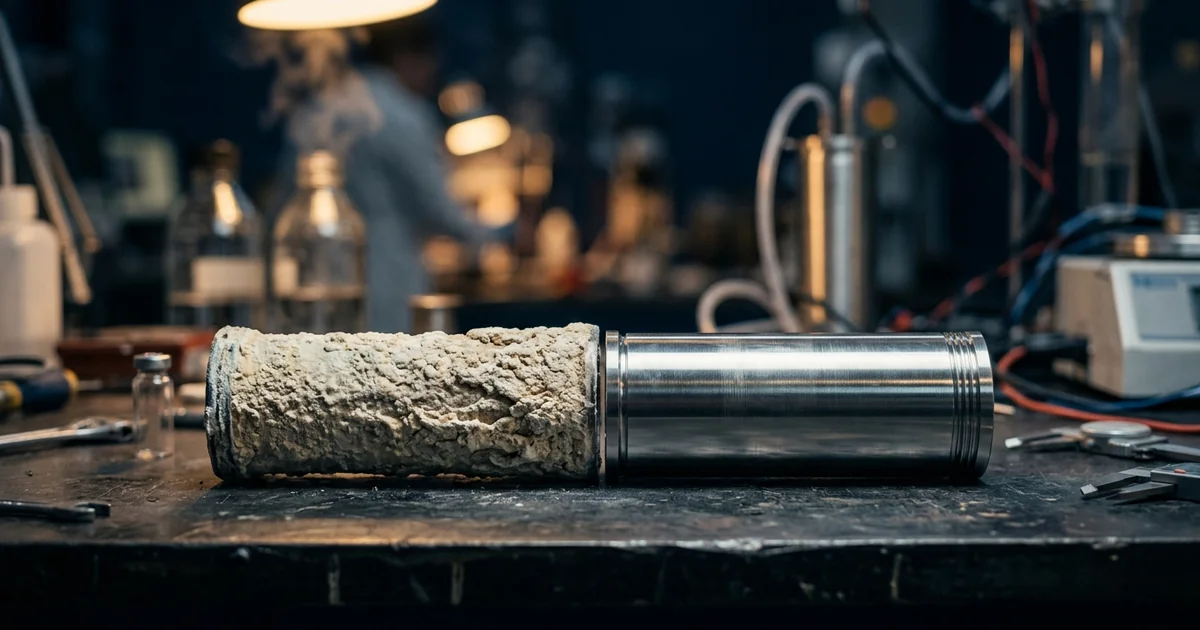
A cooling tower rejects heat by evaporating water, and every litre that evaporates leaves its dissolved minerals behind. Scale builds on hot exchanger tubes, pits form under deposits, and slime grows where the water is warm and well fed. The cost appears as lost heat transfer, tube failures, wasted make-up water and, in the worst case, a Legionella investigation. This guide explains cooling tower water treatment, from cycles of concentration to scale and corrosion chemistry, inhibitors, biocides and monitoring. It draws on US Department of Energy and CDC guidance, an EPRI state-of-knowledge report and a peer-reviewed biofilm review, plus the formulation support Global Formulation gives water treatment chemical makers.
Cooling Tower Water Treatment Basics: Evaporation and Cycles of Concentration
Water leaves a cooling tower by evaporation, drift, blowdown and any leaks, and the make-up water must replace all of it. The US Department of Energy's cooling tower practice states the balance as make-up equals evaporation plus blowdown plus drift. Evaporation removes heat but not dissolved solids, so calcium, magnesium, chloride and silica concentrate in the recirculating water. Blowdown, the removal of concentrated water, is how operators keep that concentration in check.
Cycles of concentration measure how far the water has concentrated. The ratio of dissolved solids in the blowdown to those in the make-up gives the cycles, and the ratio of make-up volume to blowdown volume gives approximately the same number. The guidance notes that many systems run at two to four cycles and that some reach six or more. Raising cycles from three to six cuts make-up water by about 20 percent and blowdown by about 50 percent.
| Term | Meaning | Why It Matters |
|---|---|---|
| Make-up | Fresh water that replaces evaporation, blowdown and drift | Brings in the dissolved solids that the tower then concentrates |
| Blowdown | Concentrated water removed on purpose | The main lever for controlling dissolved solids and the largest water saving opportunity |
| Drift | Small droplets carried out as mist, controlled with baffles and drift eliminators | Small compared with evaporation and blowdown, but relevant to aerosol exposure |
| Cycles of concentration | Ratio of dissolved solids in blowdown to make-up, or approximately make-up volume to blowdown volume | Sets water use and, together with the treatment programme, the scaling and corrosion risk |
| Conductivity | Practical proxy for dissolved solids | Operators compare blowdown and make-up conductivity to confirm the cycles |
The limit on cycles is mostly set by scale, so the next question is which minerals precipitate and where.
Cooling Tower Scale Control: Calcium Carbonate, Sulfate, Phosphate and Silica
Scale forms when a dissolved mineral exceeds its solubility and crystallises on equipment as a hard layer. EPRI's cooling water treatment report names calcium carbonate as the most prevalent scale, followed by calcium sulfate and calcium phosphate, with silica and magnesium silicate also encountered. Scale has low thermal conductivity and insulates the surface, so it impairs heat transfer. Where it forms depends on how each mineral's solubility changes with temperature.
| Scale | Conditions and Origin | Solubility Behaviour and Location | Identification Note |
|---|---|---|---|
| Calcium carbonate | Dissolved calcium and bicarbonate, present in almost all natural waters | Becomes less soluble as temperature rises, so it forms on hot exchanger surfaces | Effervesces in acid |
| Calcium sulfate (gypsum) | Sulfate from the water or from sulfuric acid feed; about 40 times more soluble than calcium carbonate | Less soluble above about 38 °C (100 °F), so it appears at the hot end of tubes; not pH sensitive | Dense, off-white, no effervescence |
| Calcium phosphate | Orthophosphate added as an inhibitor, or generated by reversion of polyphosphates or phosphonates | Less soluble than calcium carbonate; more prevalent as pH and temperature rise | No effervescence; laboratory test needed |
| Silica | Natural waters, or silicate inhibitors | Normal solubility, so it deposits in cooler areas such as the fill; solubility increases with pH | Hard glassy deposit that is very difficult to remove |
| Magnesium silicate | Magnesium and silica together, mainly above pH 8 | Magnesium shows retrograde solubility; the formation mechanism is not well understood | Difficult to remove once formed |
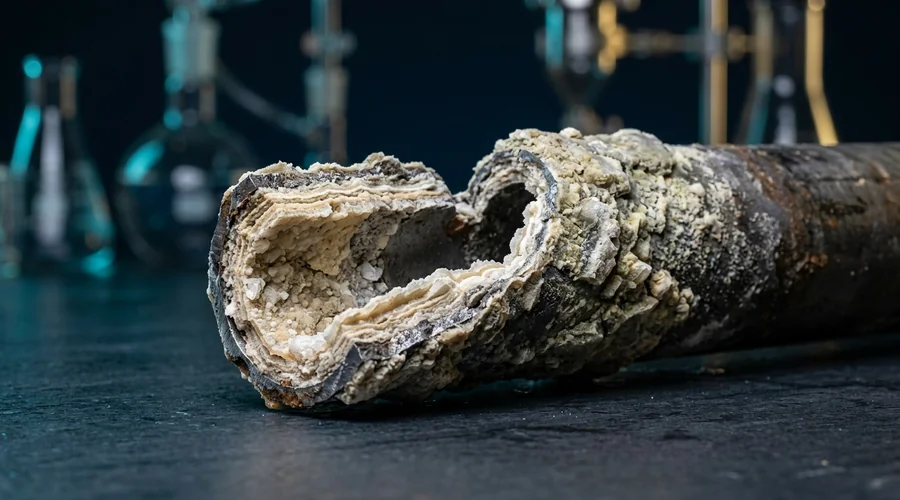
Control follows the chemistry. Acid feed converts part of the bicarbonate and carbonate alkalinity into more soluble forms, which the DOE guidance says allows higher cycles. The same guidance warns that an acid overdose can severely damage a cooling system and asks for timers or continuous pH monitoring. It also lists make-up softening as an option when hardness limits the cycles. Our water treatment technology and formulations guide places scale inhibitors among the other chemistries.
Scale is only half of the balance, because the conditions that stop it can speed corrosion.
Cooling Water Corrosion: Mechanisms, pH and Metallurgy
Corrosion in a cooling system is an electrochemical reaction that returns refined metal to a more stable oxide or salt. EPRI describes an anode where metal is lost and a cathode that completes the circuit, with the water acting as the electrolyte. Corrosion costs material and equipment life, and it also generates metal oxides that act as foulants. The common materials are carbon steel, copper alloys and 300 series stainless steel, and each fails in its own way.
| Mechanism | What Happens |
|---|---|
| General corrosion | Essentially uniform metal loss, because anodic and cathodic sites shift over the surface |
| Pitting | Localised attack on a broadly exposed surface that can penetrate the metal rapidly |
| Crevice corrosion | Attack at a geometric discontinuity where stagnant water separates anodic and cathodic areas |
| Galvanic corrosion | The less noble metal of a connected dissimilar pair becomes the anode and corrodes quickly |
| Stress corrosion cracking | Cracking under tensile stress; more associated with stainless steels in high-chloride water and copper alloys exposed to ammonia |
| Microbiologically influenced corrosion | Sulfate-reducing bacteria convert sulfate to sulfide, which attacks steels, stainless steels and copper alloys; black iron sulfide is a marker |
pH and alkalinity link corrosion to scale. EPRI reports that as pH falls, scale becomes less likely but carbon steel corrosion rises, and as pH rises the corrosion rate falls but scale becomes more likely. Raising cycles often lifts alkalinity and pH, which cuts steel corrosion and adds scale risk, until acid feed replaces carbonate with sulfate. Towers moved from the corrosive chromate-era pH range into a scaling regime, which is why effective antiscalants became essential. The Larson-Skold index, from 1958, relates corrosiveness to the ratio of chloride and sulfate to alkalinity.
Inhibitors have to fit the metals. Orthophosphates and polyphosphates inhibit carbon steel but do not protect copper alloys. EPRI notes that copper alloy inhibitors such as azoles are often needed in addition to a steel inhibitor. Zinc faces discharge restrictions, and polysilicate films are fragile and lost if not replenished.
Chemistry alone does not keep surfaces clean, because living films foul them too.
Cooling Water Fouling Control: Biofilm, Sediment and Biocide Programmes
Fouling is the third problem, and it feeds the other two. A peer-reviewed review reports that cooling towers are the industrial water systems most affected by biofilm, biofouling and biocorrosion. Biofilms accelerate corrosion, raise resistance to heat transfer and increase fluid friction. Warm water, a high nutrient load, neutral pH and continuous aeration make a tower an ideal home for many bacteria.
| Fouling Source | Mechanism | Control | Source |
|---|---|---|---|
| Biofilm | Microbial communities in a self-produced matrix on surfaces | Continuous oxidising biocide plus periodic non-oxidising biocide, surfactants and mechanical cleaning | Biofilm review |
| Legionella | Lives within biofilm communities; sediment and biofilm, temperature, water age and disinfectant residual are the key factors | Automated disinfectant and inhibitor feed, weekly flushing of dead legs, annual offline cleaning | CDC toolkit |
| Suspended solids and silt | Dust and sediment collect in an open tower | Filtration or side-stream filtration; higher molecular weight polymer dispersants | CDC, DOE, EPRI |
| Algae | Sunlight on tower surfaces and open distribution decks | Covers on open distribution decks | DOE |
| Corrosion products | Metal oxides generated by corrosion | Corrosion control | EPRI |
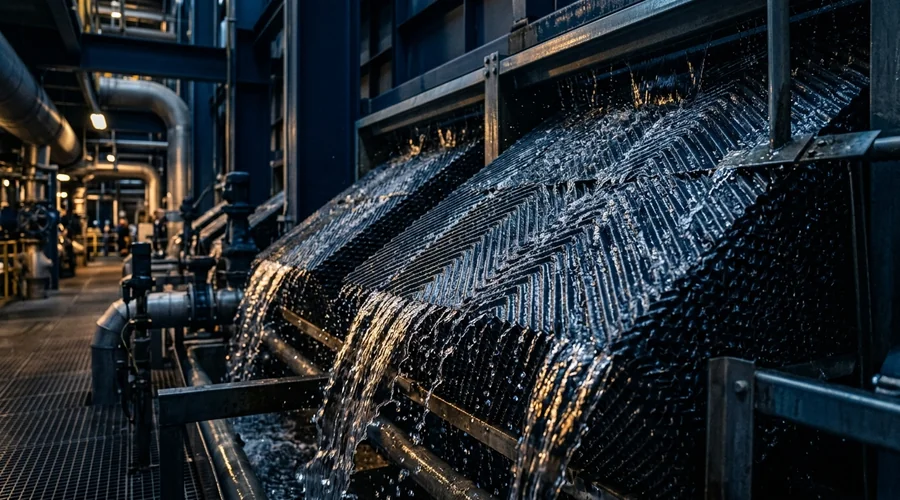
Traditional programmes combine a continuous oxidising biocide with periodic doses of a non-oxidising biocide. The review adds that chemical surfactants enhance biocide effectiveness by acting as wetting agents that help penetrate the biofilm matrix. It also notes that environmental legislation is pushing the industry to cut biocide concentrations, and that biosurfactants have few studies behind them so far. Our guide to starting a scale and corrosion inhibitor manufacturing unit covers the supply side of these products.
Every one of these threats pulls on the formulation, so the inhibitor chemistry deserves a closer look.
Scale and Corrosion Inhibitor Chemistry: Phosphonates, Polymers and Biocide Compatibility
Scale and corrosion programmes are blends of a few well-characterised building blocks. EPRI notes that water treatment service companies mostly do not make the basic materials and polymers, and instead formulate them into end-use blends. Phosphonates and polymers dominate calcium carbonate control, each with strengths and limits. A formulator chooses among them for the water, the metals and the biocide programme.
| Chemistry | Role | Strengths | Limits (EPRI) |
|---|---|---|---|
| HEDP | Non-nitrogen phosphonate for calcium carbonate scale; some steel corrosion protection | Good chlorine stability | Degrades over time with bromine; performance reduced by iron; can precipitate with calcium at high pH and high concentration |
| PBTC | Calcium carbonate control under highly stressed conditions, such as high hardness and high calcite supersaturation | Excellent stability with chlorine and bromine; more tolerant of iron; does not precipitate with calcium at high pH | Usually more expensive than HEDP |
| Amino-phosphonates | Excellent inhibitors for sulfate salts; widely used in reverse osmosis antiscalants | Strong sulfate scale control | Poor chlorine stability, so limited use in cooling systems today |
| Carboxylate polymers | Work best on calcium carbonate and calcium sulfate | Non-phosphorus substitutes for phosphonates under alkaline conditions | Not highly effective on calcium phosphate |
| Sulfonated polymers | Work best on calcium phosphate, iron, manganese and zinc hydroxide | Cover the deposits that carboxylate polymers handle poorly | Carboxylate types perform better on calcium carbonate and calcium sulfate |
Mechanisms explain the combinations. Phosphonates inhibit calcium carbonate mainly by threshold stabilisation, which interferes with nucleation and aggregation of crystals. Polymers, especially polymaleics, work mainly by crystal distortion and are often paired with phosphonates under very high calcite supersaturation. EPRI also gives a molecular weight rule: lower molecular weight is often better for scale control, somewhat higher for silt and higher still for silica.
Regulation shapes the field too. EPRI reports growing limits on phosphorus in cooling water inhibitors, and it names a superior non-phosphorus scale inhibitor for high pH operation as the first challenge for non-phosphorus programmes. Our guide to rust and scale remover chelation chemistry covers the cleaning side of the same deposits.
Even a well-formulated blend only performs as well as the measurement and control around it.
Monitoring and Control: Conductivity, Blowdown and Automated Dosing
A treatment programme is only as good as the control around it. The DOE guidance asks operators to install a conductivity controller that discharges water only when the set point is exceeded, and flow meters on the make-up and blowdown lines. The conductivity ratio and the flow ratio should both match the target cycles. When they do not, the tower has a leak, an unauthorised draw-off or a failing component.
| Check | What It Tells You | Source |
|---|---|---|
| Conductivity ratio, blowdown to make-up | Actual cycles of concentration | DOE |
| Flow ratio, make-up to blowdown | Cycles by water balance; a mismatch with the conductivity ratio points to leaks or unauthorised draw-off | DOE |
| Disinfectant residual and pH | Whether disinfection and corrosion control hold; adjusted by an automated system | CDC |
| Scale and corrosion inhibitor levels | Frequency set by the water quality measurements | CDC |
| Logs of make-up, blowdown, conductivity and cycles | Trends that show deterioration before failures do | DOE, CDC |
Automation closes the loop. The DOE guidance recommends automated chemical feed on larger systems, controlled by make-up water flow or real-time chemical monitoring, to minimise chemical use while controlling scale, corrosion and biological growth. The CDC toolkit asks for automated anti-corrosion, anti-scale and disinfectant addition and monitoring, an offline disinfection and cleaning at least annually, and operation in line with ASHRAE Guideline 12-2020.
Turning these building blocks into a product that works across many sites is the formulator's job.
Working With a Water Treatment Formulation Consultant
Cooling water programmes sit between water chemistry, metallurgy, microbiology and regulation, and a change in one area shifts the others. A water treatment formulation consultant characterises the make-up water and the metals in the loop, then screens scale, corrosion and dispersant chemistries and checks them against the biocide programme. Water treatment chemical product development services extend that into specifications, technical data and service procedures. Industrial water chemicals contract manufacturing then carries the validated blend into production under batch controls.
- Characterise the system — make-up water analysis, metals of construction and operating temperatures.
- Set the cycle target — balance water savings against the scaling and corrosion limits.
- Screen the chemistry — phosphonates, polymers and corrosion inhibitors against the stress of the water.
- Test compatibility — inhibitors with the oxidising and non-oxidising biocides in use.
- Design the control — conductivity, blowdown, feed rates and monitoring points.
- Pilot the programme — run coupon and heat transfer checks before full-scale release.
- Transfer to manufacture — write the specification and quality limits for the contract manufacturing partner.
Our water treatment range shows where cooling water chemistry sits among coagulants, flocculants and biocides. Our jar test guide covers a bench method used in clarification and pretreatment programmes. Global Formulation provides inhibitor and biocide compatibility screening, specification support and contract manufacturing transfer for water treatment chemical makers. Dose rates and blend ratios stay outside this guide by design, because each system sets its own.
Frequently Asked Questions
What is cooling tower water treatment?
Cooling tower water treatment is the control of scale, corrosion, fouling and microbial growth in the recirculating water of a cooling system. The US Department of Energy notes that typical programmes include corrosion and scaling inhibitors along with biological fouling inhibitors.
Evaporation removes heat but leaves dissolved solids behind, so blowdown and chemical treatment keep the concentrated water within safe limits.
The programme is built around the make-up water, the metals in the loop and the number of cycles of concentration the operator wants.
What are cycles of concentration in a cooling tower?
Cycles of concentration compare the dissolved solids in the blowdown water with those in the make-up water. They are also approximately equal to the ratio of make-up volume to blowdown volume.
Many systems run at two to four cycles, and some can run at six or more. The Department of Energy reports that raising cycles from three to six cuts make-up water by about 20 percent and blowdown by about 50 percent.
The achievable number depends on the make-up water quality and the treatment programme, because scale and corrosion potential rise with the cycles.
What types of scale form in cooling towers?
EPRI names calcium carbonate as the most prevalent scale, followed by calcium sulfate and calcium phosphate, with silica and magnesium silicate also encountered. More than one mineral can form in a single deposit.
Calcium carbonate, calcium phosphate and magnesium compounds become less soluble as temperature rises, so they form on hot exchanger surfaces. Silica behaves the other way and tends to deposit in cooler areas such as the fill.
Scale has low thermal conductivity, so it insulates the surface and impairs heat transfer.
Why does cooling water corrode metals and how is it controlled?
Corrosion is an electrochemical reaction in which refined metal returns to a more stable oxide or salt. Metal is lost at an anode, and a cathode completes the circuit. EPRI lists general corrosion, pitting, crevice and galvanic attack, stress corrosion cracking and microbiologically influenced corrosion.
Control combines pH and alkalinity management with inhibitors. Phosphates protect carbon steel but not copper alloys, which usually need an azole inhibitor as well.
Raising pH lowers steel corrosion and raises scaling tendency, so every programme balances the two.
How are biofilm and Legionella controlled in cooling towers?
A peer-reviewed review reports that biofilms in cooling towers are traditionally treated with a continuous oxidising biocide plus periodic doses of a non-oxidising biocide. Surfactants and biodispersants help biocides penetrate the biofilm matrix.
The CDC toolkit lists sediment and biofilm, temperature, water age and disinfectant residual as the key factors for Legionella growth. It recommends automated treatment, weekly flushing of dead legs and an offline clean at least annually.
Legionella lives within biofilm communities, so controlling biofilm is central to controlling the organism.
Do phosphonate scale inhibitors work with oxidising biocides?
It depends on the phosphonate. EPRI reports that HEDP has good chlorine stability but degrades over time with bromine, while PBTC has excellent stability with both. Amino-phosphonates have poor chlorine stability and see limited cooling system use.
A phosphonate that degrades under the biocide programme loses its scale control, and the orthophosphate it releases can form calcium phosphate scale.
Formulators therefore choose the inhibitor and the biocide together and test them as a pair.
How is a cooling tower treatment programme monitored?
The Department of Energy advises a conductivity controller that triggers blowdown at a set point, plus flow meters on the make-up and blowdown lines. The conductivity ratio and the flow ratio should both match the target cycles, and a mismatch points to leaks or unauthorised draw-off.
The CDC toolkit adds automated feed and monitoring of anti-corrosion, anti-scale and disinfectant chemicals, regular pH and disinfectant residual checks, and site logs.
Operators keep a log of make-up, blowdown, conductivity and cycles so that trends show up before failures do.
Developing a Cooling Water Treatment Product?
Global Formulation supports scale and corrosion inhibitor screening, biocide compatibility testing, specification writing and contract manufacturing transfer.
Talk to Our Formulation Team