Jar Test Water Treatment: Optimising Coagulant Dose
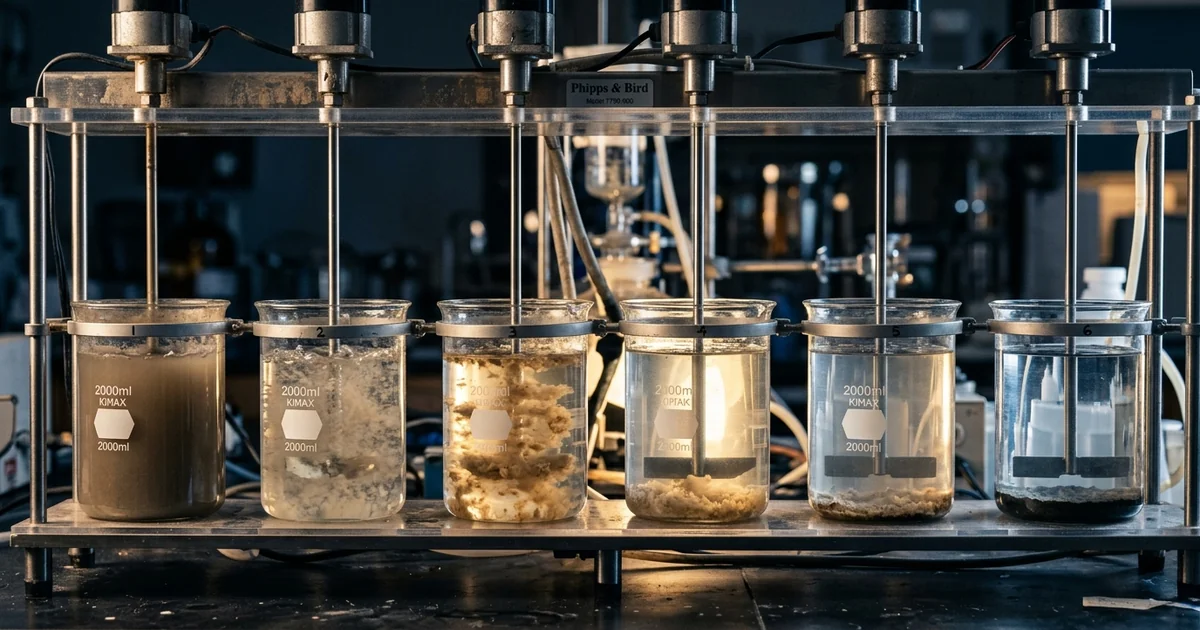
A coagulant dose that worked last month can leave the clarifier cloudy this week. Raw water shifts with rain, temperature and algae, and a plant that doses by habit pays twice, once for wasted chemical and again for floc carried onto the filters. The standard defence is the jar test, a bench experiment that compares doses on the real water before anything changes at full scale. This guide explains the jar test water treatment professionals rely on. It covers apparatus, mixing steps, dose and pH series, result metrics and the limits of scaling bench data to a plant. It draws on ASTM D2035, the US EPA enhanced coagulation manual and the Irish EPA coagulation manual, plus the formulation support Global Formulation gives water treatment chemical makers.
Jar Test Water Treatment: What the Test Decides and What It Does Not
The jar test doses identical samples of one water with different coagulation conditions and compares the results side by side. The Irish EPA coagulation manual calls it probably the most important routine test at a works that uses coagulation and flocculation. ASTM D2035-19 describes it as a way to evaluate coagulants and coagulant aids on the same water under the same experimental conditions. Its value comes from that controlled comparison, not from any claim to copy the plant.
ASTM D2035-19 standardises this flocculation test method for water and wastewater. Its scope covers dissolved, suspended, colloidal and nonsettleable matter removed by coagulation-flocculation followed by gravity settling, with colour, turbidity and hardness reduction as the quantities it can evaluate. It also lets the tester compare coagulant concentration and order of addition.
| Decision | What the Jar Test Shows | Caution From the Manuals |
|---|---|---|
| Choice of coagulant or polymer | Candidates compared on one water under identical conditions (ASTM D2035) | The ranking holds for that water, and the US EPA manual notes that jar tests do not always accurately predict full-scale behaviour |
| Coagulation pH | Final colour and turbidity plotted against pH select the optimum | The raw water changes the shape of the optimum pH curve (Irish EPA) |
| Dose | The dose that gives the best floc and the clearest settled water | Use it for plant control, not necessarily to predict operating rates, final turbidity or total coagulant levels (Irish EPA) |
| Polymer aid | Concentration and order of addition can be evaluated (ASTM D2035) | Higher coagulant doses can give a poorly settling floc, so polymer aids need their own jar tests (US EPA) |
| Is today's dose still right | The current dose runs in one jar, with doses slightly above and below in the neighbouring jars | This confirms the current dose rather than predicting a new one (Irish EPA) |
A fair comparison depends on controlling the equipment and the sample, which is where many jar tests go wrong.
Jar Test Apparatus and Sample Preparation That Keep Results Comparable
A jar test compares waters by eye and by meter, so every uncontrolled variable shows up as noise. The stirrer, jar shape, sample temperature and stock solution age all change how floc forms. The Irish EPA manual stresses that glassware must be clean, because the test rests on comparing the appearance of the water in the jars. Controlling these basics costs far less than repeating a series.
- Multiple stirrer — one motor drives four or more paddles at the same speed. The Irish EPA manual describes racks of reagent vessels so that every jar receives its chemical at the same moment.
- Jar shape — the US EPA manual prefers square jars because they distribute mixing energy more efficiently. Hach's guide notes that round, square and two-litre jars all see use.
- Covers — the US EPA manual recommends inert covers to limit the transfer of carbon dioxide and other gases, because the coagulation pH is a controlled variable.
- Light and heat — Hach says the lamp under a lit base should stay off except when observing floc. It warms the jars enough to create convection currents that disturb settling.
- Sample age and temperature — the US EPA manual asks for freshly collected water at ambient temperature, refrigerated at about 4 °C if it must be stored. Temperature drift during a test can interfere with settling through convection currents or release of dissolved air.
- Stock solutions — the US EPA manual asks for freshly prepared stock no more than seven days old. It warns that a metal coagulant stock rising well above pH 3.0 can precipitate metal hydroxide and lose active coagulant.
- Product strength — Hach notes that the percent active in liquid coagulants and aids can vary between manufacturers and from lot to lot. The concentration must be known before a standard solution is made.
- Instruments — the US EPA manual calls for a pH meter calibrated daily with fresh buffers, using at least two points.
With the equipment and the sample under control, the mixing sequence is the next thing to fix.
Jar Test Procedure: Rapid Mix, Flocculation and Settling
Every jar test runs three stages: rapid mixing disperses the coagulant, slow mixing grows floc, and a still period lets the floc settle. The speeds and times are choices, not constants, and published protocols differ. The US EPA enhanced coagulation manual asks that mixing conditions reflect the plant's own mixing intensities and detention times at maximum daily flow. It offers a fallback only where those are unknown.
| Parameter | US EPA Protocol (1999) | Irish EPA Routine (2002) |
|---|---|---|
| Jar size | 1 or 2 L beakers or square jars | 1 L samples |
| Rapid mix | Coagulant added during rapid mixing for at least 1 min; fallback 100 rpm for 1 min | 200 rpm for 1 min, coagulant added to all jars, then 200 rpm for a further 1 min |
| Flocculation | Fallback 30 rpm for 30 min | 20 rpm for 15 min |
| Settling | 60 min without stirring for the enhanced coagulation protocol; 30 to 60 min recommended in the scale-up chapter | 30 min |
| Sampling | Supernatant about 10 cm below the surface, without disturbing settled floc | Supernatant decanted for colour, turbidity and pH |
| Records | Data sheet with speeds, durations, doses, TOC, pH and alkalinity | Test record with doses, floc formation time, appearance and settling rate |
The two protocols are not interchangeable, and they do not need to be. Irish EPA guidance sets one guiding principle: choose a suitable procedure and do not depart from it unless absolutely necessary. Otherwise results from different times cannot be related. US EPA guidance adds that full-scale flocculation can be simulated well when the jar test reproduces the energy input and detention times accurately.
- Characterise the raw water — mix the bulk sample, then record turbidity, pH, alkalinity and temperature before any dosing.
- Fill the jars — measure equal volumes into clean jars and set the stirrers to the rapid-mix speed.
- Dose all jars together — add the coagulant to every jar at the same moment during rapid mixing, and start the timer once the chemical is in.
- Add the polymer aid second — the Irish EPA routine adds a coagulant aid after the primary coagulant has mixed rapidly for about a minute. Rapid mixing then continues for another minute.
- Flocculate — drop to the slow speed and record when floc first appears and how large it grows, for example against the Irish EPA floc comparator chart.
- Settle — stop the stirrers and watch the settling without disturbing the jars.
- Sample and measure — take supernatant from a fixed depth and read turbidity, pH and colour, then filter a portion for the filterability check.
- Record everything — note doses, times, floc appearance and settled-water results, so that past tests can guide future ones.
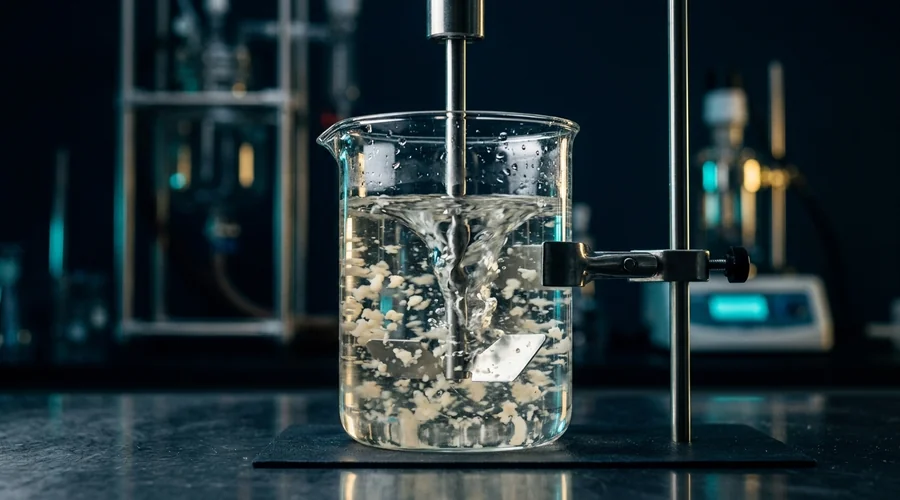
A fixed procedure is what makes the dose and pH series that follow comparable.
Coagulant Dose Optimisation: Dose Curve, pH Series and Refinement
Dose and pH act together, so optimisation runs as a sequence rather than a single series. The Irish EPA manual describes three linked tests for a new source or after a very significant change, such as an algal bloom or a flood. Routine control needs only one series centred on the current dose. Each test holds one variable steady so that the next can isolate the other.
| Test | What Varies | What Is Held | Output |
|---|---|---|---|
| 1. Dose curve | Coagulant dose over a suitable range | Raw-water pH, with no adjustment | Coagulation curve and the coagulant demand |
| 2. pH series | pH in steps of about 0.5, usually between 5.5 and 8.5, set with acid or alkali quantities found by titration | Coagulant dose at the demand from test 1 | Final colour and turbidity against pH; the optimum coagulation pH |
| 3. Dose at optimum pH | Coagulant dose again | pH held at the optimum | Optimum dose at the optimum pH |
| Routine check | Current dose in one jar, doses slightly above and below in neighbouring jars | Plant pH | Confirmation that the current dose remains optimum |
The coagulation curve plots residual turbidity against dose and labels three zones: no coagulation, slow coagulation and rapid coagulation. The Irish EPA manual defines the coagulant demand as the dose at which residual turbidity equals the minimum plus 5 percent of the gap between raw and minimum turbidity. That gives a defined reading point on a curve that flattens gradually.
After a coarse series, the manual repeats the test centred on the best jar, with much narrower spacing between vessels. Where different chemical combinations perform alike, it prefers the one with the lowest polyelectrolyte dose. For low-alkalinity waters, the US EPA protocol adds base to hold the pH between 5.3 and 5.7 and asks for the same alkali that the plant uses at full scale.
Variable waters are the hard case. The Irish EPA manual notes that raw water quality changes the shape of the optimum pH curve. A soft coloured water needs a much narrower band of coagulation pH and tends to give a weaker floc. Our guide to coagulant selection shows how the raw water steers the first candidates into the jars.
Choosing the best jar then depends on what is measured in each one.
Reading Jar Test Results: Turbidity, Floc, Settling and Filterability
A jar test produces observations and measurements, and the best dose is the one that scores well on several of them, not one. Hach advises measuring turbidity at the start, again in the supernatant at the end of settling, and a third time after filtering a portion through medium-speed filter paper. Floc behaviour during stirring and settling tells the operator what the meter cannot. Hach adds that the more measurements are made, the less the interpretation depends on art and the more it depends on data.
| Measurement | What It Reveals | Source |
|---|---|---|
| Settled-water turbidity | How well coagulation, flocculation and settling worked together; low turbidity reduces floc loading on the filters | Irish EPA, Hach |
| Filtered-water turbidity | Whether the floc is tough enough to withstand shear during filtration; Hach calls filtering through medium-speed paper a surprisingly good simulation of plant filters | Hach |
| Floc size and time to form | Floc graded into one of seven size classes, from 0.3 mm to 4.5 mm, on the comparator chart | Irish EPA |
| Settling rate and clarity | The best result is the dose giving the most rapidly settling floc in the shortest time | Irish EPA |
| pH and alkalinity | Metal coagulants consume alkalinity, and the coagulation pH is closely tied to natural organic matter removal | Hach, US EPA |
| TOC, DOC and UV-254 | For SUVA, the settled water is characterised for DOC and UV-254 after filtering through a pre-washed 0.45 µm membrane | US EPA |
| Residual metal | Metal in the filter effluent should be no more than, and preferably less than, the raw-water and filter-influent levels | Hach |
| After-precipitation | Settled water held in clear stoppered bottles on black paper for at least 24 hours shows any later precipitate | Irish EPA |
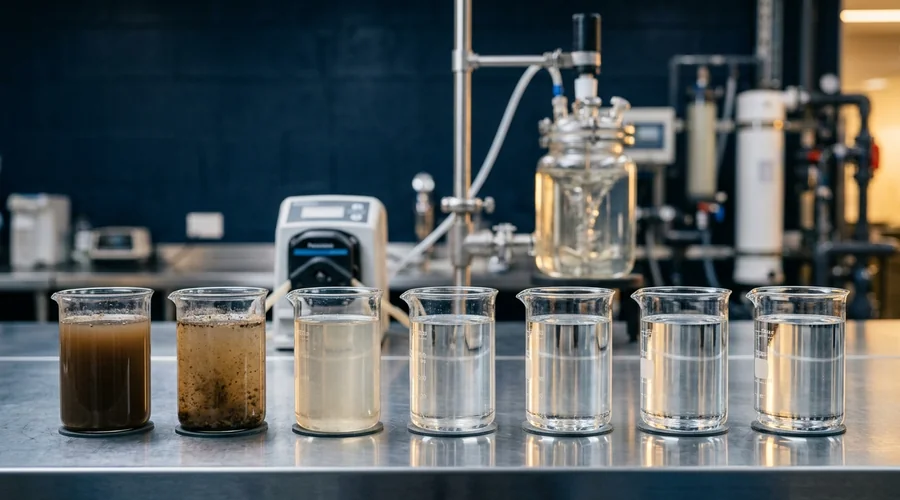
Instruments extend the same logic. A streaming current detector reads zero when particle charge is neutralised, and microscale flocculation tests shrink the jar test to a microplate to cut sample volume. The Wikipedia account of the jar test also notes that jar test results are often only semi-quantitative, which is another reason to read several measurements together.
These results describe a jar, and a jar is not a clarifier.
Scale-Up From Jar to Plant: Why Bench Results Need Confirmation
A jar holds a litre or two of water, stirred horizontally and then left to settle, while a plant treats a continuous flow in basins holding thousands of litres. Hach compares a one or two litre jar with a basin of 67,000 gallons. That mismatch builds systematic biases into bench results, and they do not all point the same way. Knowing the direction of each bias tells you how much margin to keep when moving a result to site.
| Factor | Effect on Jar Results | Source |
|---|---|---|
| Carbon dioxide exchange | A jar exposes more surface per volume, so CO2 exchanges faster and pH changes more; jar tests can overestimate particle removal and underestimate TOC removal, and covers reduce the exchange | US EPA |
| Short-circuiting | None occurs in a jar, so jar flocculation can look better than in a plant where short-circuiting occurs | US EPA |
| Settling time | For a given settling velocity, jar detention is about 1/60 of a conventional plant's, and plants with well-designed mixing usually settle floc better than jars | US EPA |
| Mixing direction | Jar mixing is horizontal, while upflow settling tanks mix vertically, which helps form a stable floc blanket | Irish EPA |
| Temperature drift | A test lasting up to two hours can drift in temperature and disturb settling | US EPA |
| Rotation after the paddles stop | Continued rotation approximates inlet turbulence in a settling basin; stators or square jars reduce it | US EPA |
Both manuals respond the same way: use jar tests for trends and control, build in a margin, and confirm at larger scale. The US EPA manual says an adequate margin of safety should be incorporated when translating jar results to full scale. It also says any full-scale change should be preceded by extensive bench- and pilot-scale testing. For pilot work it asks for steady state, which can take three to four times the theoretical detention time of the flocculation and sedimentation basins.
The Irish EPA manual puts the principal value of jar tests in predicting trends, not exact coagulant concentrations. Our guide to scale-down models that predict the plant explains how to design bench work so that it transfers.
That is why manufacturers who supply the chemistry also need a disciplined way to run these tests.
Jar Testing in Water Treatment Chemical Product Development
For a chemical manufacturer the jar test is also a product-development and quality tool. ASTM D2035 exists to compare coagulants and coagulant aids on the same water under the same conditions, which is exactly what a customer trial does. A water treatment formulation consultant applies that discipline to benchmark a new grade against the incumbent and to define the conditions behind a performance claim. Water treatment chemical product development services carry the same protocol into technical data sheets, batch checks and customer support.
- Define the duty — collect representative raw-water samples, including the worst seasons for temperature and turbidity.
- Fix and document the protocol — record apparatus, jar, mixing, settling and measurements once, then reuse them.
- Prepare stock solutions from known actives — check the percent active of each lot and use fresh solutions.
- Run coarse then fine series — test each candidate on the same water, one variable at a time.
- Score on several measures — read settled turbidity, filtered turbidity, floc, pH and residual metal, and prefer lower polymer use where results tie.
- Confirm at larger scale — run a pilot or plant trial with a safety margin before committing.
- Transfer to manufacture — write the jar-test method into the specification and quality plan for the contract manufacturing partner.
Our water treatment range shows where coagulants and flocculants sit among scale inhibitors and biocides. The water treatment technology and formulations guide covers the wider chemistry. Entrepreneurs planning production will find the practical route in our guide to starting a water treatment chemical manufacturing business. For product choice, see our guides to polyelectrolyte flocculant selection and polyaluminium chloride dosing. Global Formulation provides jar-test programmes, product benchmarking and industrial water chemicals contract manufacturing transfer for water treatment chemical makers. Dose rates and blend ratios stay outside this guide by design, because each water sets its own.
Frequently Asked Questions
What is a jar test in water treatment?
A jar test is a bench method that treats identical samples of one water with different coagulation conditions and compares the results. A multiple stirrer gives every jar the same rapid mixing, slow mixing and still settling period.
ASTM D2035 standardises the practice for the coagulation-flocculation of water and wastewater, and it also covers testing coagulant concentration and order of addition.
The outcome is a ranking of products, doses and pH values for that water on the day of the test.
How do you perform a jar test?
Measure the raw water's turbidity, pH, alkalinity and temperature, then fill clean jars with equal volumes. Add the coagulant to every jar together during rapid mixing, add any polymer aid second, and drop to slow mixing so floc can grow.
Stop the stirrers, let the floc settle, and sample the supernatant from a fixed depth for turbidity, pH and colour.
The Irish EPA routine uses 200 rpm for a minute before dosing and a minute after, then 20 rpm for 15 minutes and a 30 minute settle.
How do you find the optimum coagulant dose from jar test results?
Run a dose series on the raw water and plot settled turbidity against dose to draw a coagulation curve. The Irish EPA manual defines the coagulant demand as the dose where turbidity equals the minimum plus 5 percent of the gap between raw and minimum turbidity.
For a new source it then varies pH at that dose and repeats the dose series at the best pH.
Finally, centre a narrower series on the best jar. Where combinations perform alike, choose the one that uses the least polyelectrolyte.
What mixing speeds and times should a jar test use?
There is no single set of values, and published protocols differ. The US EPA manual says to match the plant's own mixing intensities and detention times at maximum daily flow.
Where those are unknown, it gives a fallback of 100 rpm for one minute and flocculation at 30 rpm for 30 minutes. The Irish EPA routine uses 200 rpm and 20 rpm with a shorter flocculation.
Pick one protocol, write it down and keep it fixed, so that results from different days can be compared.
Why do jar test results differ from plant performance?
A jar and a plant differ in carbon dioxide exchange, flow pattern, detention time and mixing direction. The US EPA manual says jar tests can overestimate particle removal and underestimate TOC removal, because carbon dioxide exchanges faster in small jars.
It also says plants with well-designed mixing and flocculation usually settle floc better than jars do.
The Irish EPA manual puts the principal value of jar tests in predicting trends, so confirm any new dose at plant scale with a margin.
What should you measure after a jar test?
Measure settled-water turbidity, pH and alkalinity, and judge floc size and settling speed during the test. Hach also recommends filtering a portion of the supernatant through medium-speed paper and measuring turbidity again, to see whether the floc survives shear.
Where organics matter, add colour or total organic carbon. Where metal coagulants are used, check residual metal.
The Irish EPA manual adds a 24 hour observation of the settled water to detect after-precipitation.
How often should a plant run jar tests?
Run them whenever raw-water quality changes significantly. The Irish EPA manual lists shifts in turbidity, alkalinity, pH and temperature as triggers. Cold water settles floc more slowly, so seasonal changes call for tests aimed at a heavier, faster-settling floc.
A single series centred on the current dose is enough for routine control when conditions are steady.
Keep records, because past results let operators estimate a starting dose for similar conditions, such as turbidity doubling after heavy rain.
Developing a Water Treatment Chemical Product?
Global Formulation supports jar-test programmes, product benchmarking, specification writing and contract manufacturing transfer.
Talk to Our Formulation Team