Glass-Lined Reactor Care, Inspection and Repair
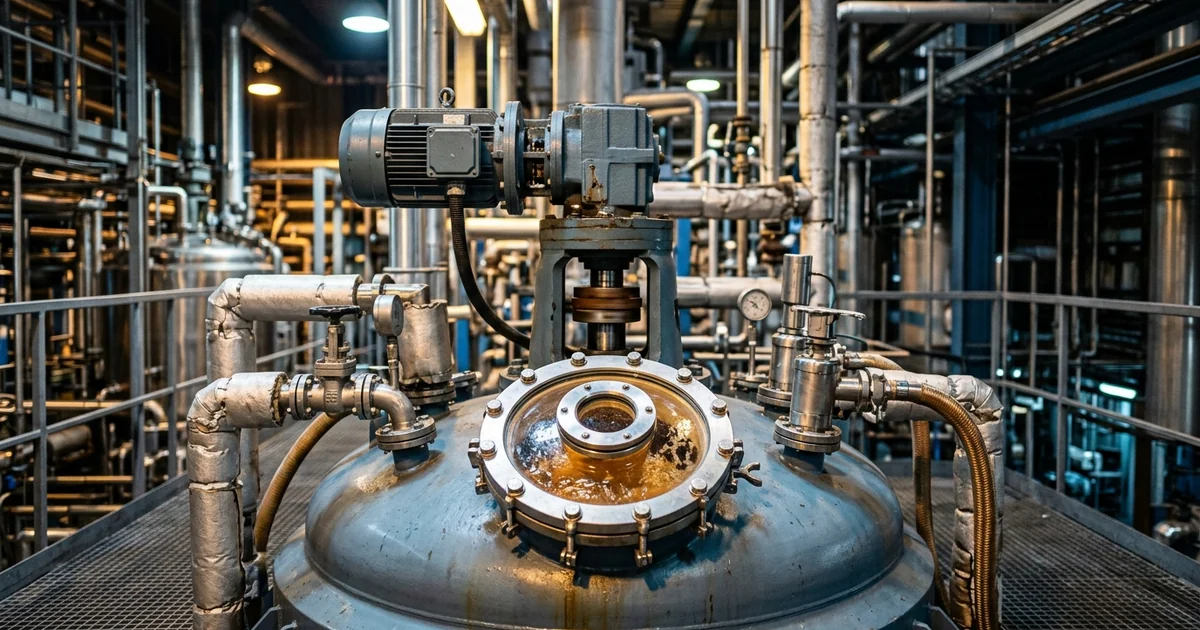
A glass-lined reactor can run for years without trouble and then lose part of its lining in a single careless moment. One dropped tool, a cold charge into a hot vessel or a splash of acid on the outside of the shell is enough to start the damage. Left unrepaired, a small defect lets process liquid reach the steel. A manufacturer's engineer writing in Chemical Engineering warns that this can lead to corrosion of the steel substrate. This guide to glass lined reactor repair explains how linings fail, how inspection finds damage early, and how to choose between a tantalum plug, a patch and reglassing. It draws on that article, the ISO 28721 standards and the plant engineering work Global Formulation supports for plant owners.
How a Glass-Lined Reactor Is Built and Where It Is Weak
A glass-lined reactor is a steel vessel with a layer of glass fused onto every wetted surface, so it behaves as two materials bonded together. The steel supplies strength, while the glass supplies broad chemical resistance and a smooth, anti-stick surface that is easy to clean. Each material fails in its own way, and the bond between them sets the limits on how the vessel is heated, cooled and handled.
The body is typically carbon steel. A first coat of glass, the ground coat, develops the chemical bond with the steel, and chemically resistant glass is then built up in further coats. After firing, the glass is left under residual compressive stress, which greatly strengthens it and makes it resistant to thermal and mechanical shock. The temperature at which the glass is under neither compression nor tension is the null point, and heating the lining towards it removes that protection.
Indian equipment catalogues often list these vessels as GLR or MSGL units, for glass-lined reactor and mild-steel glass-lined. Reactors, storage tanks, columns, dryers and filters are all supplied with glass linings, as are the agitators, baffles and dip pipes inside them.
Chemical resistance is broad but not universal. The source article lists three exceptions to it:
- Fluorides — attack the glass at any temperature or concentration.
- Hot, concentrated phosphoric acid — falls outside the glass's normal resistance.
- Highly alkaline chemicals — attack the glass at elevated temperatures.
Knowing where the lining is weak shows why most failures come from handling and temperature rather than from chemistry.
Why Glass-Lined Reactors Fail: Impact, Thermal Shock and Chemical Attack
The main glass lined reactor damage causes are operational rather than chemical, which makes them avoidable. A manufacturer's engineer writing in Chemical Engineering names mechanical impact as the leading cause of problems and thermal shock as the second. The same article attributes approximately 75% of all failures to mechanical shock, often through human error. The table pairs each failure mode with its mechanism, its appearance and the usual prevention.
| Failure mode | Mechanism | What you see | Prevention |
|---|---|---|---|
| Mechanical impact | Objects falling on or against the inside or outside of the vessel | Crushed glass at the impact point with chunks fractured around it, or glass that pops off | Non-metallic tools, careful handling, and lifting by the designed lugs and never by the nozzles |
| Thermal shock | Abrupt temperature change between the glass and the contents or jacket fluid | Large areas of glass fracturing off the steel | Staying inside the manufacturer's temperature-differential chart |
| Thermal stress | Slower, uneven heating or cooling, such as a jacketed region against an unjacketed one | Damage near the jacket closure rings | Gradual jacket temperature changes and insulation of unjacketed areas |
| Chemical attack | Fluorides, hot concentrated phosphoric acid, or hot strongly alkaline chemicals | Progressive thinning of the lining | Checking process and cleaning chemistry against the known exceptions |
| Abrasion | Abrasive solids in the charge | Loss of fire polish, then a rough, sandpaper-like finish | Thickness mapping and closer monitoring of agitators and baffles |
| External acid | Acid spilled on the shell reacts with the steel and forms hydrogen | Glass spalling as pressure builds behind the lining | Preventing spills, neutralising and washing at once, and shielding the top head |
| Nozzle and agitator stress | Over-tightened bolts or clamps, piping loads, or starting an agitator into a thickened mass | Cracked glass at nozzles or on agitator blades | Manufacturer's torque tables, supported piping, and an inverter or soft-start on the drive |
Thermal shock deserves the closest attention because it damages large areas at once. The glass keeps less of its compressive stress as it gets hotter, so the temperature differential that causes shock shrinks as the glass temperature rises. ISO 28721-3 separates shock on the glass-lined side, produced by charging, from shock on the steel side, produced by heating or cooling. It sets the limits as diagrams for operating temperatures from −25 °C to +230 °C. Four situations trigger shock:
- Cold liquid on hot glass — cooling a hot glass surface with a cold charge.
- Hot liquid on cold glass — heating a cold glass surface with a hot charge.
- Hot jacket fluid on a cold vessel — heating a cold, jacketed vessel by rapidly circulating a very hot fluid.
- Cold jacket fluid on a hot vessel — cooling a hot vessel wall by rapidly circulating a cold fluid.
Every one of the four is a charging or control decision, so thermal shock is prevented in the recipe and the control system rather than at the repair stage.
Glass-Lined Reactor Inspection: Visual, Spark and Thickness Checks
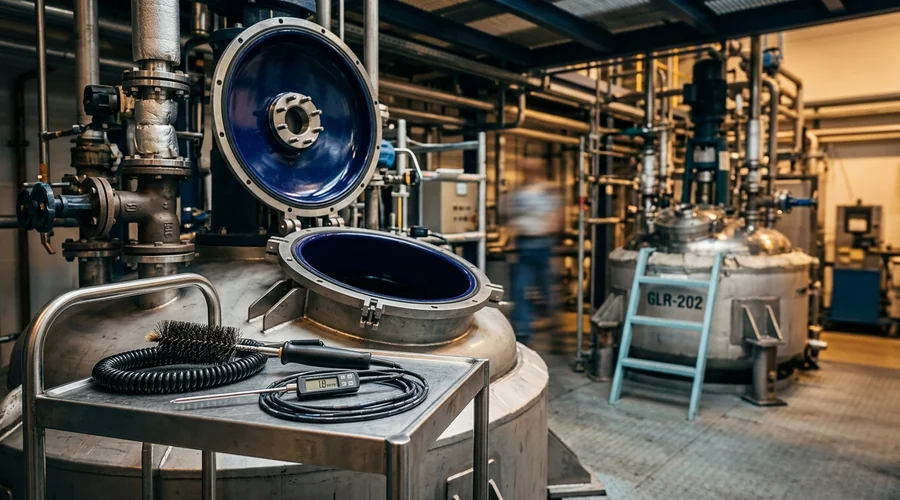
Early detection decides whether a lining defect costs a plug or a reglass. The Chemical Engineering article starts inspection on delivery, to catch transit damage, then continues it at intervals from several times a year to once every two years. Severity of service sets the interval, and more frequent or continuous testing applies when conditions are especially severe or damage is suspected. The methods below show what a competent programme checks and why.
| Method | What it finds | Notes |
|---|---|---|
| Visual inspection | Chips, cracks, loss of fire polish and loose plugs or patches | Entering the vessel is itself a damage risk and a confined-space activity |
| DC spark testing | Pinholes and breaks that reach the steel, shown by current arcing to the shell | Preferred for vessel linings because the shell is grounded |
| AC spark testing | Defects in components fully encapsulated in glass, such as agitator blades | Used where grounding to the steel is not possible |
| Continuous monitoring | A leak in the glass while the vessel is in service | An electrode and the conductive contents complete a circuit that triggers alarms, with no entry needed |
| Glass-thickness gauge | Remaining lining thickness, read with a magnetic-induction or eddy-current probe | Readings are taken on a grid, and agitator blades and baffles wear fastest |
| Logbook | Trends in spark, visual and thickness results | Used to estimate remaining life and plan reglassing |
Spark testing of a glass lined reactor and thickness readings find damage that the eye misses, which is why a programme built on visual checks alone is incomplete. DC vs AC spark testing comes down to grounding, since the grounded vessel shell suits the DC tester and glass-encapsulated components suit the AC tester. Online vs periodic glass integrity monitoring is a trade-off. Continuous systems alarm during service and avoid entry, while a portable probe tests as often as needed but not continuously. Entry for inspection falls under the site's permit-required confined-space procedures, such as OSHA 29 CFR 1910.146 in the United States, and online monitoring reduces how often entry is needed. The manufacturer's own test requirements and defect-repair actions sit in ISO 28721-1:2019, which covers glass-lined steel apparatus for process plants. Together, the logbook and the trend it shows turn inspection from a checklist into an early warning.
Glass Lined Reactor Repair: Plugs, Patches and Reglassing
Tantalum plug vs patch vs reglassing is decided by the size and cause of the damage. Local mechanical damage is repaired with a tantalum plug or patch, while thermal shock tends to damage large areas and often needs reglassing. Reglassing is a factory operation and the remedy of last resort. The table sets the three options side by side.
| Option | Suited to | How it seals | Limits |
|---|---|---|---|
| Tantalum plug | Small local defects | A tantalum stud, nut and disc hold a PTFE gasket over the defect | Small holes only, and a loose plug is replaced, not retightened |
| Tantalum patch | Larger damaged areas | A tantalum sheet with a PTFE gasket is fastened over the damage with tantalum studs and nuts around its edge | Checked at every inspection, and a loose patch is replaced |
| Reglassing at the manufacturer | Widespread damage, a thin lining or thermal-shock failure | The vessel is returned and a new glass lining is applied | The vessel must be cleaned and emptied, and plugs and patches removed, before it ships |
A tantalum plug repair on a glass lined vessel is a metal seal, not restored glass, so every plug and patch becomes a permanent inspection item. Product can become trapped behind a plug or patch, which is why they are removed before a vessel is sent for reglassing. The repair vs reglass decision for a glass lined reactor turns on extent. Repeated local repairs, a lining worn thin or widespread thermal-shock damage all point towards reglassing. If the process chemistry itself is attacking the glass, the better question is the material. A glass lined vs stainless steel reactor comparison, with nickel alloys as the third option, is set out in our reactor materials selection guide.
Operating Practices That Protect the Lining
Glass lined reactor maintenance begins with how the vessel is run, because most protection is built into daily operation. The practices below turn the failure mechanisms into operating rules, and several depend on how well the jacket temperature loop is controlled. An overshooting jacket loop applies a larger temperature step to the glass than the recipe intended. The manufacturer's limits, not general figures, set the numbers.
- Respect the temperature chart — measure or closely approximate the lining temperature and check for local hot spots. Keep charges and jacket changes inside the manufacturer's chart of maximum safe differentials.
- Ramp the jacket — raise and lower jacket temperature gradually to limit thermal gradients, and insulate unjacketed areas. A cascade jacket loop and sensible PID tuning keep the ramp close to what the recipe asks.
- Watch for exotherms — a quick-response temperature sensor in a baffle, the bottom outlet valve or a thermowell warns the operator of a dangerous temperature rise. Reaction calorimetry data show how large that rise can be.
- Protect agitator and nozzles — start the agitator only into a mobile charge, and use an inverter or soft-start on the drive. Tighten nozzle bolts and clamps to the manufacturer's torque tables, and keep piping loads off the nozzles.
- Keep metal off the glass — use non-metallic scrapers or high-pressure water-jet cleaning, and lift the vessel only by its designed lugs.
- Look after the jacket — jacket fouling in a glass lined reactor, from deposits and iron-oxide corrosion, lowers heat-transfer efficiency and lengthens reaction times. Acid-based cleaners are not recommended because the acid attacks the steel.
Operating rules hold only when they are written into the batch recipe and the control system rather than left to memory.
Troubleshooting Glass Lining Damage: Chips, Pinholes and Spalling
Damage shows up in a handful of recognisable patterns, and each points to a different cause and a different response. The patterns below come from the failure modes already covered. Some are visible at once, while others appear only on a spark test or a thickness reading. Sorting the pattern first decides whether the response is a plug, a patch, a change in operation or a reglass.
| Symptom | Probable cause | First response |
|---|---|---|
| Glass lining chipped at an impact point, with fragments around it | Mechanical impact | Inspect immediately and repair before further use |
| Pinhole in a glass lined reactor found by spark test | A local defect in the lining | Repair promptly, because an unrepaired pinhole lets the steel corrode |
| Large areas of glass fractured off with the steel exposed | Thermal shock | Expect reglassing, because plugs and patches are often impractical |
| Glass lining spalling after acid on the outside of the shell | Hydrogen building up behind the lining | Reglass, and neutralise and wash any spill at once |
| Dull, rough surface with loss of fire polish | Abrasion or progressive chemical attack | Map the thickness and increase inspection frequency |
| Longer batch times and reduced jacket heat transfer in a glass lined reactor, with no recipe change | Jacket fouling that reduces heat transfer | Inspect and clean the jacket without acid-based cleaners |
| Loose repair plug or patch | Compromised seal | Replace it and do not retighten it |
| Cracked glass near a nozzle or jacket closure ring | Over-tightened bolts, piping load or thermal stress | Review torque, pipe supports and heating rate |
Pinholes and gradual thinning are found by instruments rather than by eye, which is why a programme built on visual checks alone misses early damage. A loss of heat transfer is also an engineering signal. If batch times drift, the jacket is a candidate before the control loop or the recipe is blamed.
A Care and Repair-or-Reglass Framework for Plant Owners
A glass-lined reactor deserves a written care programme because its failure modes are known and mostly preventable. The framework below follows the vessel from delivery to the end of its lining life. It ends at the point where the right answer is no longer repair but a different material. Plant owners reviewing an ageing fleet can use it as a screening checklist.
- Inspect on delivery — check for transit damage before the vessel is installed.
- Baseline and log — record a spark test, a thickness map and a visual survey, and keep a logbook for each vessel.
- Write the limits into the recipe — build the manufacturer's temperature-differential chart and the ISO 28721-3 limits into recipes and jacket ramp limits.
- Set the interval by severity — inspect more often for aggressive chemistry, abrasive solids and ageing vessels.
- Repair defects promptly — use plugs and patches under the manufacturer's or an approved contractor's method, and replace any that loosen.
- Escalate to reglassing — call the manufacturer when damage is widespread, the lining is thin or repairs are accumulating.
- Revisit the material — if the process attacks glass, as fluorides and hot strong alkali do, return to the materials decision.
Glass-lined equipment serves pharmaceutical, specialty chemical, agricultural and polymer plants, where the glass surface protects both the vessel and the product. Where a fleet is ageing or a new line is being specified, the questions are condition review, equipment selection and whether a lining is the right choice at all. Our process engineering consulting acts as a plant engineering consultant. It covers reactor condition assessment, equipment selection support, a debottlenecking study and contract process engineering for plants in India and the Gulf.
Reactor type shapes these decisions too, as our guide to batch, semi-batch and continuous reactor selection explains. The whole subject sits within chemical reaction engineering, where equipment, control and scale are chosen together.
Frequently Asked Questions
What is a glass lined reactor?
A glass-lined reactor is a steel vessel, usually carbon steel, with chemically resistant glass fused onto every wetted surface. The steel supplies strength, while the glass supplies broad corrosion resistance and a smooth, anti-stick surface that is easy to clean and does not introduce impurities into the product.
Indian equipment catalogues often list these vessels as GLR or MSGL units, for glass-lined reactor and mild-steel glass-lined. Reactors, storage tanks, columns, dryers, filters and the agitators, baffles and dip pipes inside them are all supplied with glass linings.
Why do glass lined reactors fail?
A manufacturer's engineer writing in Chemical Engineering names mechanical impact as the leading cause of problems and thermal shock as the second. The same article attributes roughly 75% of failures to mechanical shock, often through human error.
Chemical attack, abrasion by solids, acid spilled on the outside of the shell, and over-tightened nozzle bolts are the other recognised causes. Most are operational, which means they are avoidable with trained operators and a written care programme.
How do you inspect a glass lined reactor?
A typical programme combines visual inspection, spark testing, glass-thickness readings, and a check of any tantalum plugs and patches, nozzle connections and jacket connections. Spark testing finds pinholes and breaks that reach the steel, and a thickness gauge tracks how much glass remains.
Intervals run from several times a year to once every two years depending on the severity of service. Continuous monitoring systems can watch the lining while the vessel is in service, which avoids sending someone into the vessel.
What chemicals damage a glass lined reactor?
The source article lists fluorides at any temperature or concentration, hot concentrated phosphoric acid, and highly alkaline chemicals at elevated temperatures as the exceptions to glass's broad resistance. Glass is not completely inert, so acids, alkalis and even water attack it slowly at a rate set by temperature, duration and concentration.
Abrasive solids erode the surface, and abrasion combined with acid corrosion accelerates failure. Acid spilled on the outside of the shell causes a different kind of damage, because hydrogen formed in the steel builds up behind the lining and lifts the glass.
Can a glass lined reactor be repaired?
Yes, within limits. Local mechanical damage is repaired with a tantalum plug for small defects or a tantalum patch for larger areas, both sealed with a PTFE gasket.
Thermal shock usually damages the lining over large areas, so plugs and patches are often impractical and the vessel is returned to the manufacturer for reglassing. Repair method belongs to the manufacturer or an approved repair contractor, not to a plant checklist.
When should a glass lined reactor be reglassed?
Reglassing is the remedy of last resort, appropriate when the lining has worn thin through years of service or has been severely damaged. Widespread thermal-shock damage and spalling caused by acid on the outside of the shell usually end in reglassing as well.
A logbook of spark tests, visual inspections and thickness readings shows the trend and tells the plant when to call the manufacturer. The vessel and jacket must be cleaned and emptied before it ships, and any plugs and patches removed, because product can be trapped behind them.
How is thermal shock avoided in a glass lined reactor?
Each vessel has a manufacturer's chart of maximum safe temperature differentials, and temperature limits are stamped on the vessel. Operations stay inside that chart when charging liquids and when heating or cooling the jacket.
ISO 28721-3 distinguishes shock on the glass side, produced by charging, from shock on the steel side, produced by heating or cooling the jacket. Gradual jacket changes, insulation of unjacketed areas and a quick-response temperature sensor for exothermic reactions all reduce the risk.
Reviewing, Specifying or Replacing Reactors at Your Plant?
Global Formulation provides plant engineering, equipment selection, utilities design and debottlenecking support for reactor-based manufacturing, from material choice to lining condition review.
Talk to Our Process Team