Gypsum Plaster Formulation: Retarders, Additives and Tests

Gypsum plaster sets in minutes, and the additives that buy working time can cost strength. A formulator therefore balances setting time, water retention, density and strength in one dry blend. This guide explains gypsum plaster formulation from hemihydrate setting chemistry through retarders, cellulose ethers, lightweight aggregates, manufacturing and the IS 2547 and EN 13279 tests. It reads the Indian standards, the European test-method standard and open-access research at source. It also reflects the formulation support Global Formulation gives construction chemical manufacturers.
Gypsum Plaster Formulation: Hemihydrate Chemistry and Setting
Gypsum plaster is built around calcium sulfate hemihydrate, the compound known as plaster of Paris and often abbreviated POP in India. Mixed with water at ambient temperature, the hemihydrate quickly reverts to the dihydrate, gypsum, while setting into a rigid and relatively strong crystal lattice. That single reaction explains why unretarded plaster sets in minutes and why strength depends on the crystals that form. A formulator therefore controls a crystallisation, not just a mixture.
| Phase | Formula | Role in Plaster |
|---|---|---|
| Dihydrate (gypsum) | CaSO4·2H2O | The raw mineral and the set product; sparingly soluble, at 2.63 g/L in water at 25 °C |
| Hemihydrate (bassanite, plaster of Paris) | CaSO4·½H2O | The binder; its α and β forms differ in porosity, which the dehydration conditions control |
| Anhydrite | CaSO4 | The basis of anhydrous gypsum plasters and Keene's plaster, which IS 2547 recommends for finishing only |
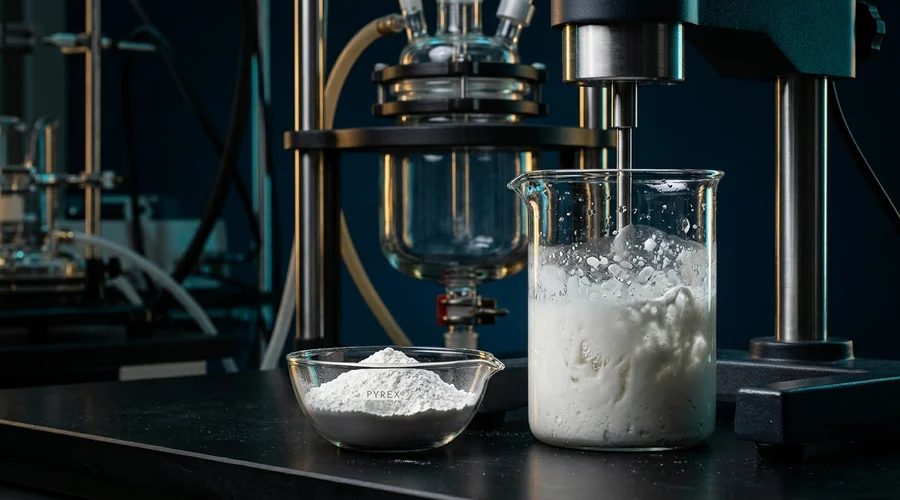
Research on hemihydrate hydration divides the process into four stages: dissolution, induction, acceleration and deceleration. The same study used electron microscopy to show the crystal morphology changing from long to short columns or blocks when retarders or impurities were present. Impurities in by-product gypsum, such as soluble phosphorus, affect the same hydration process, so raw-material quality belongs in the formulation.
Before choosing additives, the binder must be matched to the plaster class, so the next step is to see how standards divide the product.
Gypsum Plaster Types: IS 2547 and EN 13279 Classes
Standards classify gypsum plasters by how they are used as well as by composition. India's IS 2547 (Part 1) divides gypsum building plaster into plaster of Paris, retarded hemihydrate plaster, anhydrous plaster and Keene's plaster. Retarded hemihydrate plaster is split again into undercoat types, browning and metal lathing, and final-coat types, finish and board finish. Part 2 covers premixed lightweight plaster, which combines retarded hemihydrate plaster with lightweight aggregate.
| Class | What It Is | Setting Time (Part 1, 1976 Text) |
|---|---|---|
| Plaster of Paris | Hemihydrate plaster, listed separately from the retarded grade | Neat: 20 to 40 minutes; plaster and sand mixture: 120 to 900 minutes |
| Retarded hemihydrate gypsum plaster | Undercoat (browning, metal lathing) and final coat (finish, board finish) | Neat: 60 to 180 minutes; plaster and sand mixture: 120 to 900 minutes |
| Anhydrous gypsum plaster | Anhydrous type, for finishing only | Neat: 20 to 360 minutes |
| Keene's plaster | Anhydrous type with a higher purity and hardness than other anhydrous plaster; finishing only | Neat: 20 to 360 minutes |
| Premixed lightweight plaster (Part 2) | Retarded hemihydrate plaster with suitable lightweight aggregates; undercoat types (browning, metal lathing, bonding) and a final-coat finish type | Not tabulated in Part 2, which limits density, strength and surface resistance instead |
These figures come from the 1976 text. BIS lists both parts as active, reaffirmed in 2022, with three amendments to Part 1 and one to Part 2, so confirm the current amended wording before writing a specification. In Europe, EN 13279-1 gives definitions and requirements for gypsum binders and gypsum plasters, and EN 13279-2:2014 gives the test methods. Manufacturer datasheets declare designations such as B4/20/2 or B4/50/2, whose elements the standard itself defines.
Within these classes, the retarded grades are where formulation skill shows most clearly.
Gypsum Plaster Retarder Chemistry: Working Time vs Strength
Hemihydrate reacts so quickly that plaster without a retarder is difficult to apply. One open-access study notes that, since the hydration of calcined gypsum is too fast, retarders such as alkaline phosphates, organic acids and proteins are commonly used in gypsum-based materials. IS 2547 allows additives that control setting, naming sodium citrate, break-down products of keratin, potassium sulphate, alum and zinc sulphate. The retarder you choose sets the working time and also leaves a mark on strength.
| Retarder Class | Examples | What the Literature Reports |
|---|---|---|
| Organic acids | Citric acid, sodium citrate | Citric acid was the most efficient of eight retarders in one study; it changed dihydrate crystals from column to block, which went with a sharp strength decline |
| Proteins | Keratin break-down products, bone glue | Described as highly effective with minimal strength reduction; bone glue adsorbs on newly formed nuclei and coarsens the crystal morphology |
| Alkaline phosphates | Soluble phosphates | High effect at low dosage; insoluble calcium phosphate deposits on hemihydrate surfaces, preventing further dissolution and reducing supersaturation |
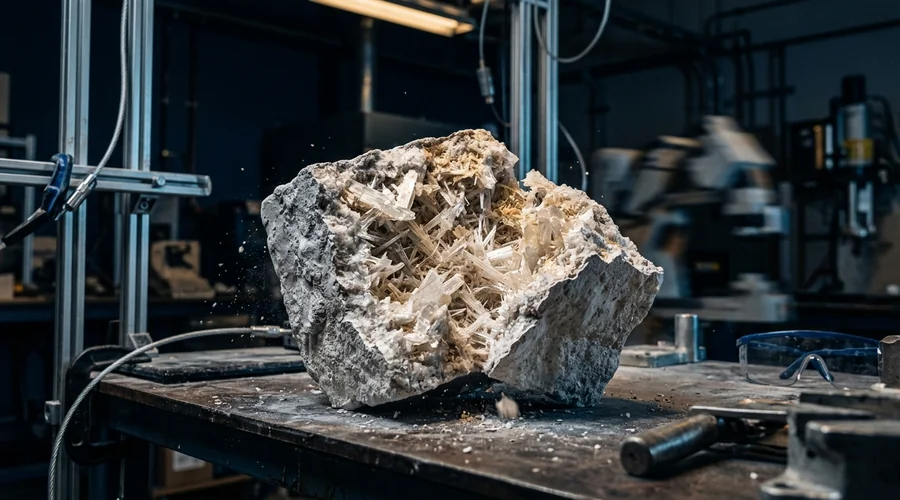
The same paper explains why dose control matters. It states that longer setting time leads to severe loss of strength, and that faster hydration forms more needle-shaped crystals that overlap more and give higher strength. It also identifies soluble phosphorus, a common impurity in phosphogypsum, as a cause of extended setting time and reduced strength. Phosphogypsum therefore brings its own retardation, which has to be counted when it is used as a raw material.
- Set the working time — define the target for hand or machine application.
- Measure setting time — use a standard method, such as the knife or Vicat cone method of EN 13279-2.
- Test strength at each level — measure flexural and compressive strength after every retarder change.
- Compare retarder classes — weigh the strength cost of organic acids against proteins.
- Check raw-material impurities — soluble phosphorus and similar contaminants shift setting.
- Confirm batch consistency — test setting time on individual packages, as IS 2547 does.
Retarders control the reaction, and the next group of additives controls the water.
Cellulose Ethers, Fillers and Lightweight Aggregates
A retarded binder still needs water retention, workability and often a lower density before it works on a wall. Cellulose ethers manage the water, while fillers and lightweight aggregates manage bulk and density. IS 2547 Part 1 limits additions to materials that control setting, improve working characteristics or give anti-corrosion or fungicidal properties. Each addition shifts water demand and setting behaviour, so the additives must be designed together.
A patent on cellulose ether derivatives calls water-soluble cellulose ethers indispensable aids for building materials, from masonry and plaster systems to gypsum plaster, cement plaster and joint fillers. The ethers used to improve the processibility of plaster are mainly non-ionic, with methyl celluloses or their hydroxyalkyl mixed ethers in particular. The patent adds that control of the water balance is of overriding importance, because it influences processibility, plasticity, setting behaviour, adhesiveness, open time, air void content and non-sag properties.
| Additive Class | Function | What to Monitor |
|---|---|---|
| Retarder | Extends working time | Strength and crystal morphology |
| Cellulose ether | Controls the water balance, which affects workability, open time, adhesion and sag resistance | Water demand and setting behaviour |
| Lightweight aggregate | Gives low density, thermal insulation and sound absorption in premixed lightweight plaster | Dry bulk density, dry set density and compressive strength under IS 2547 Part 2 |
| Working-characteristic, anti-corrosion or fungicidal additives | Permitted by IS 2547 Part 1 for these purposes | Compliance with the chemical and physical requirement tables |
IS 2547 Part 2 describes premixed lightweight plasters as consisting of gypsum plaster and lightweight aggregate, characterised by low density, high thermal insulation and sound absorption. Our guides to wall putty formulation and dry mix mortar manufacturing show how cellulose ethers and fillers appear in neighbouring dry-mix products.
The additives only work if the binder underneath is consistent, which is a manufacturing question.
Gypsum Plaster Manufacturing: Calcination, Blending and Control
Gypsum plaster manufacturing starts with gypsum rock or by-product gypsum and ends with a dry, homogeneous blend. Calcination drives off part of the water in the crystal structure. Wikipedia gives 100 to 150 °C as the range required, with industrial calcination at temperatures as high as 170 °C, where γ-anhydrite begins to form. Changing the dehydration conditions adjusts the porosity of the hemihydrate, which gives the α and β forms.
Calcium sulfate comes from natural gypsum and anhydrite and also as a by-product. Flue-gas desulfurization produces it when exhaust gases are scrubbed with finely ground limestone. Phosphogypsum, from phosphoric acid production, is often contaminated with impurities. Each source needs its own incoming-quality checks.
| Control Point | Why It Matters | Check |
|---|---|---|
| Raw gypsum purity | Impurities such as soluble phosphorus extend setting time and reduce strength | Sulphur trioxide content (EN 13279-2); soluble sodium and magnesium salts (IS 2547) |
| Calcination | Temperature and conditions decide the phase and the porosity of the hemihydrate | Loss on ignition (IS 2547) and setting time |
| Fineness | Coarse residue affects finish and consistency | Sieve analysis (EN 13279-2); residue on the 1.18 mm IS sieve (IS 2547) |
| Blending | Retarder and ether are added in small amounts and must be uniform | Setting time and strength on individual packages |
| Packing | Plaster must stay dry | IS 2547: dry, free from lumps, in watertight bags or containers |
IS 2547 Part 1 also fixes chemical limits. They include a minimum sulphur trioxide content, a minimum CaO content related to it, maximum soluble magnesium and sodium salts, and loss-on-ignition limits for each class. Our guide to construction chemical scale-up from lab to plant explains how to carry a validated dry-mix recipe into production.
A controlled binder still has to be proved against standard tests, which is how a specification is built.
Testing Gypsum Plaster: Setting Time, Strength and Water Demand
Two test systems cover gypsum plaster, one Indian and one European. IS 2547 Part 1 states its requirements and refers to IS 2542 for the test methods. EN 13279-2:2014 is the European test-method standard for gypsum binders and gypsum plasters. The table compares them side by side.
| Property | EN 13279-2:2014 | IS 2547 Part 1 (1976 Text) |
|---|---|---|
| Fineness | Sieve analysis | Residue on the 1.18 mm IS sieve, with a maximum |
| Composition | Sulphur trioxide content and equivalent calcium sulfate | SO3, CaO, soluble salts, loss on ignition and free lime where applicable |
| Water demand | Water/plaster ratio by sprinkling, dispersal or flow table | Plaster-sand mixture and neat plaster tested for setting time |
| Setting time | Knife method and Vicat cone method | Neat plaster and plaster-sand ranges by class |
| Strength and hardness | Hardness, flexural and compressive strength | Transverse strength, and mechanical resistance of set neat plaster |
| Adhesion | Determination of adhesion | Not a Part 1 requirement |
| Soundness | Not in the contents list | Set plaster pats must show no disintegration, popping or pitting |
The IS sampling clause adds a quality-control lesson. IS 2547 requires setting time, transverse strength and sieve residue to be tested on each sampled package individually, while the remaining requirements are tested on a composite sample. Conformity is judged from the average and range of the individual results. Testing packages individually shows bag-to-bag variation that a composite would average away.
With the tests defined, field complaints can be traced to a property and then to a lever.
Troubleshooting Gypsum Plaster Defects
Most plaster complaints reduce to setting, water, density or strength. Tracing a complaint to the test that measures it turns a vague report into a targeted formulation change. The table pairs common symptoms with the property to check and the lever to examine first. The levers follow from the retarder, cellulose ether and manufacturing evidence above.
| Symptom | Property to Check | Lever to Examine |
|---|---|---|
| Sets too fast to apply | Setting time (knife or Vicat cone) | Retarder system and water demand |
| Soft plaster that loses strength after setting | Setting time and strength together | Over-retardation; retarder class and impurities such as soluble phosphorus |
| Sags or slumps in thick coats | Water/plaster ratio and water retention | Cellulose ether type and level |
| Weak adhesion to the substrate | Adhesion and water retention | Water balance through the cellulose ether |
| Pitting or popping in set pats | Soundness (IS 2547) | Composition against the IS 2547 chemical table and calcination control |
| Setting time varies between bags | Setting time on individual packages | Raw gypsum purity, calcination control and blending uniformity |
| Plaster too heavy for the application | Dry bulk density (IS 2547 Part 2) | Lightweight aggregate choice and level |
| Scuffed or soft finish coat | Hardness or mechanical resistance | Binder class for finishing, such as anhydrous or Keene's plaster |
Every row connects a symptom to a measurable property, so a laboratory that already runs the standard tests can locate the cause. The same logic applies at the design stage, where a target for each property is set before the first trial batch.
Working With a Construction Chemicals Formulation Consultant
Gypsum plaster development sits between mineral chemistry, additive science and standards compliance, and each region writes the specification differently. A construction chemicals formulation consultant characterises the binder, screens retarders and ethers, and builds the test programme. Construction chemical product development services extend that work to pilot batches, packaging and specification writing. A contract formulation and scale-up partner then moves the validated blend into a plant that can reproduce it.
- Define the application — hand or machine, undercoat or finish, standard or lightweight.
- Characterise the binder — phase content, purity and impurities of the gypsum source.
- Screen retarders — compare working time and strength across classes.
- Select the water-retention system — choose the cellulose ether against water demand and sag behaviour.
- Write the specification — align with IS 2547 or EN 13279 as the market requires.
- Run the test programme — setting time, strength, soundness and sieve residue on individual packages.
- Scale up and transfer — move the validated process to a qualified plant.
Our construction chemicals range shows where plasters sit among the other dry-mix and building products. The construction chemicals technology guide covers the wider chemistry. A guide to hiring a construction chemicals formulation consultant explains how to pick a partner. Global Formulation provides binder selection, additive screening, specification writing and scale-up for construction chemical manufacturers. Retarder levels and blend ratios stay outside this guide by design.
Frequently Asked Questions
What is gypsum plaster formulation?
Gypsum plaster formulation is the design of a dry blend around calcium sulfate hemihydrate, with retarders, water-retention additives, fillers and sometimes lightweight aggregates. The aim is to balance setting time, workability, density and strength for a specific application.
The binder reacts with water to form gypsum, so every additive is judged by what it does to that reaction and to the crystals it produces.
How does gypsum plaster set?
Gypsum plaster is based on calcium sulfate hemihydrate. When it is mixed with water at ambient temperature, it quickly reverts chemically to the dihydrate, gypsum, while physically setting into a rigid and relatively strong crystal lattice.
Research divides the hydration of the hemihydrate into four stages: dissolution, induction, acceleration and deceleration.
The reaction is fast, which is why practical plasters contain retarders.
What does a gypsum plaster retarder do, and which types exist?
A retarder slows the hydration of the hemihydrate so the plaster stays workable long enough to apply. The literature names alkaline phosphates, organic acids such as citric acid, and proteins such as keratin break-down products and bone glue.
IS 2547 allows additives that control setting, including sodium citrate and break-down products of keratin.
Retarders change crystal growth, so each one has a different effect on strength.
Why are cellulose ethers used in gypsum plaster?
Cellulose ethers control the water balance of the plaster. A patent on cellulose ether derivatives says this balance influences processibility, plasticity, setting behaviour, adhesiveness, open time, air void content and non-sag properties.
The ethers used to improve the processibility of plaster systems are mainly non-ionic, in particular methyl celluloses and their hydroxyalkyl mixed ethers.
Because they change how much water the plaster holds, a change of ether should be followed by a water demand and setting-time check.
Which standards apply to gypsum plaster?
In India, IS 2547 Part 1 covers gypsum building plaster excluding premixed lightweight plasters, and Part 2 covers premixed lightweight plaster. BIS lists both parts as active, reaffirmed in 2022.
In Europe, EN 13279-1 gives definitions and requirements for gypsum binders and gypsum plasters, and EN 13279-2:2014 gives the test methods.
Check the current amended text of each standard before writing a specification.
How is gypsum plaster tested?
EN 13279-2:2014 includes sieve analysis, sulphur trioxide content, water/plaster ratio by sprinkling, dispersal or flow table methods, and setting time by the knife or Vicat cone method. It also covers hardness, flexural strength, compressive strength and adhesion.
IS 2547 Part 1 specifies setting time, transverse strength, soundness, mechanical resistance and sieve residue, with test methods in IS 2542.
IS 2547 tests setting time, strength and sieve residue on each sampled package individually.
Why does retarding gypsum plaster reduce its strength?
A review of the literature states that longer setting time leads to severe loss of strength, and that faster hydration forms more needle-shaped crystals with more overlaps and higher strength.
Citric acid changed dihydrate crystals from column to block in one study, which went with a sharp decline in strength. Protein retarders are reported as effective with minimal strength reduction.
The practical rule is to delay setting only as much as the application needs and to test strength after every retarder change.
Developing a Gypsum Plaster or Dry-Mix Product?
Global Formulation supports binder selection, retarder and additive screening, specification writing and scale-up to a qualified plant.
Talk to Our Formulation Team