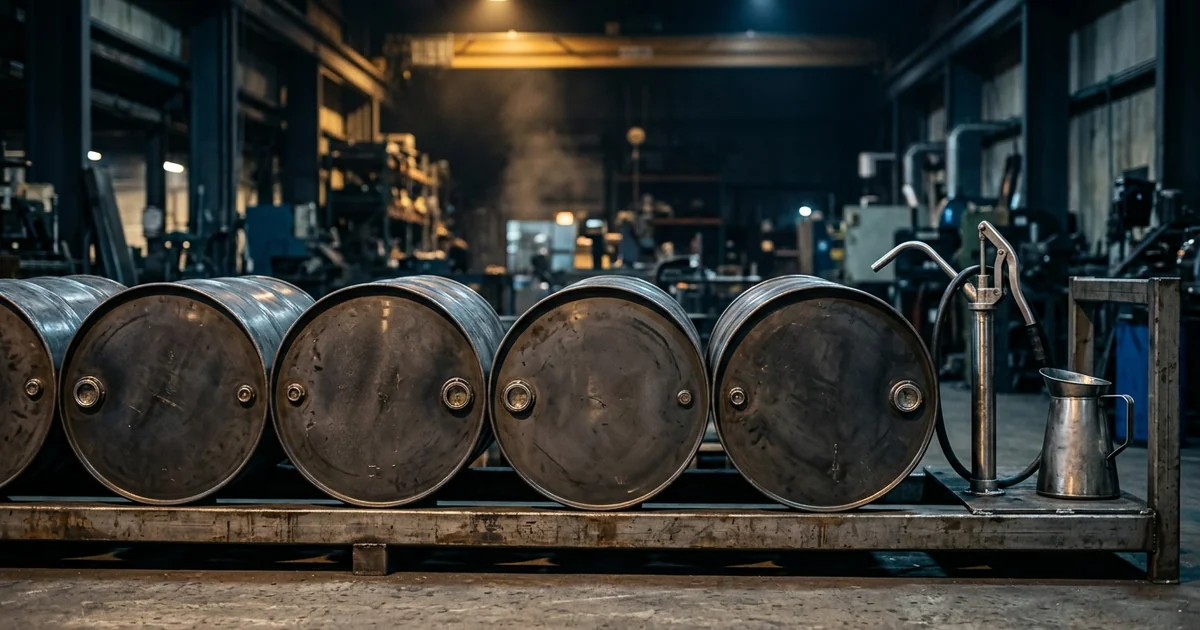
A lubricant can leave the blending plant on specification and still fail months later in a customer's machine. The cause can sit entirely outside the formulation. Water enters through a drum bung, dust enters through a dirty pump, or additives settle during a long winter in a warehouse. Lubricant packaging shelf life therefore decides whether the oil that reaches the bearing matches the oil that passed the test. This article explains what storage does to oil and grease and what suppliers actually state for shelf life. Next, it compares drums, pails, and IBCs, shows how moisture and particles get in, and explains how to read an ISO 4406 code. It draws on supplier technical bulletins, published standards, and trade research, so a new lubricant brand or a maintenance team can set storage rules with confidence.
Lubricant Packaging Shelf Life Starts With What Storage Does to Oil
Lubricants age in storage for different reasons than they age in service. A packaged product sits motionless for long periods while temperature cycles, vibration continues, and the container slowly exchanges air with its surroundings. Those conditions can affect the formulation's components or let contaminants in. ExxonMobil therefore separates shelf life, the period a stored product stays usable without quality-control checks, from service life, which depends on the machine and on oil analysis.
A Chevron technical bulletin lists acceptable storage between 0 and 110 °F (about −18 to 43 °C) and an ideal range of 32 to 77 °F (0 to 25 °C). Each stress in the table below attacks the oil in a different way.
| Storage stress | What it does | Control |
|---|---|---|
| Heat | Speeds oil oxidation | Keep stock cool and away from heaters and steam lines |
| Extreme cold | Wax and sediment can form | Avoid stores that fall below the acceptable range |
| Temperature cycling | Makes drums breathe, drawing in moist air | Store indoors, where swings are smaller |
| Water | Reacts with some additives and promotes microbial growth at the oil–water interface | Dry location, sealed closures, bung position |
| Airborne particles | Contaminate partly used containers | Keep containers closed, store in a low-dust area |
| Oxygen and carbon dioxide | React with the lubricant and affect viscosity and consistency | Keep containers sealed until needed |
| Light | Changes colour and appearance | Keep product in its original opaque container |
Mobil adds a practical summary of the common causes of contamination, deterioration, and waste. They are damaged containers, moisture condensation, dirty dispensing equipment, dust, poor outdoor storage, mixed brands, and exceeded shelf life. The next question is how long a sealed container can sit before those effects matter.
How Long Does Lubricant Last? Stated Shelf Life by Product Type
Suppliers publish shelf-life estimates, and the numbers differ by supplier and by product family. ExxonMobil states that the recommended shelf life for oils and greases is typically five years in original sealed containers stored properly. Chevron gives up to five years for finished lubricants other than grease and three years for greases. Exceptions run shorter, and the date stamped on the container label is the official figure.
| Product family | Stated shelf life | Notes |
|---|---|---|
| Mineral and most synthetic oils | Typically 5 years (ExxonMobil); up to 5 years (Chevron) | Original sealed container, proper storage |
| Greases | Typically 5 years (ExxonMobil); 3 years (Chevron) | Some open gear greases are listed at 1 year |
| Some synthetic gear and hydraulic oils | 2 to 4 years in Chevron's exception list | Formulation sets the figure, not the base oil alone |
| Soluble oils and oils containing fats | 1 to 2 years in Chevron's exception list | Moisture-sensitive or high-additive products |
| Water-based lubricants | Short, with a use-by date on the label (ExxonMobil) | Metalworking coolants, fire-resistant hydraulic fluids |
Shelf life ends with a test, not a guess. ExxonMobil describes the warning signs in oils as a cloudy appearance or strong odour, and engine oils kept in unsealed containers absorb moisture and can turn hazy. Slight sediment can form in some oils over time without hurting performance, but significant sediment is a defect. For greases the signs are excessive oil separation, a consistency change of more than 25 percent by worked or unworked penetration, and a marked change in colour, odour, or texture.
Product past its date is not automatically scrap. Both suppliers advise testing against the original specification, and Chevron adds that the container must be mixed thoroughly so the sample is representative. If it passes, Chevron suggests consuming it within a year or earmarking it for reclamation, and checking that equipment designs have not moved on. Before any of that matters, the container itself has to keep contaminants out, and formats differ in how well they do it.
Drums, Pails, and IBCs: Choosing Lubricant Packaging Formats
Packaging is the first defence against contamination, and it also sets how the product is handled for the rest of its life. The 55-gallon drum, nominally 208 litres, is the most common lubricant container in industry, with pails, grease kegs, and cartoned cans below it and IBCs and bulk tanks above it. Each format trades handling convenience against exposure every time it is opened. A full drum weighs about 450 pounds, so handling damage is a real route to leaks and dirt.
| Format | Typical size and build | Contamination watch-point |
|---|---|---|
| Steel tight-head drum | Nominal 208 L (55 US gal); 200 L international standard. Welded seam, fixed top, two threaded bung openings of about 2 inch and 0.75 inch | Metal particles left by grinding and welding in manufacture; bung seals; dents and seam damage in handling |
| Plastic drum | Blow-moulded HDPE | Stacking is not recommended above about 32 °C (90 °F); closure and compatibility checks |
| Pails and grease kegs | 5-gallon pails and 35-lb kegs, shipped on pallets; small cans in cartons | Lids and rims collect dirt and must be wiped before opening |
| Composite IBC | About 1,000 L; HDPE liner in a steel cage on a pallet; top inlet and bottom ball valve | Residue from earlier contents in reconditioned units; open inlets and valves |
| Bulk tank | Delivered by tank truck or railcar into storage tanks or bins | Tank vents and filler openings breathe moisture into the oil |
Reuse deserves attention. Steel drums are commonly reconditioned through inspection, cleaning, repair, and relabelling, and IBCs are sold as new, rebottled with a new liner in a washed cage, or reconditioned. For lubricants, the cleaning route and the previous contents decide whether residue rides along, so brand owners should specify container history in their purchasing terms.
Particle contamination starts at manufacture. A trade article in Machinery Lubrication explains that drum manufacturing involves grinding and welding that can leave metal particles in the container, and that many users therefore request lined drums. Our overview of lubricant formulations and technology and our wider lubricants practice cover the oils these containers protect. The next risk arrives silently, because water gets in even when nobody opens the container.
Lubricant Moisture Ingress: How a Sealed Drum Still Takes On Water
Water is the most common storage contaminant, and it enters even when nobody touches the container. Drums breathe as the day warms and cools: air inside expands and contracts, and anything sitting on the bungs can be pulled in on the inhale. Mobil's handling bulletin notes this happens even to drums that have never been opened. Water that gets in settles to the bottom and can rust the drum from the inside.
The mechanism gets worse outdoors. Machinery Lubrication reports summer drum temperatures reaching upward of 150 °F (about 66 °C), which intensifies the breathing cycle. It notes that accumulated water can raise the fluid level, deform the drum, and push oil out through the bungs. Position is the control.
| Storage position | What happens at the bung | Verdict |
|---|---|---|
| Upright, bung on top, outdoors | Rain and condensate collect in the chime and are drawn down through the bung | Poor practice |
| On its side, bungs horizontal, under cover | The underside of each bung is submerged, so the drum cannot breathe in moisture | Recommended |
| On end, bung down, on a well-drained surface | The bung is wetted by the contents rather than by air | Maximum protection (Mobil) |
| Upright, tilted on blocks, bungs at 3 and 9 o'clock | Water runs off instead of pooling at the openings | Fallback when bung-up is unavoidable |
Water does real damage once inside. Chevron states that it reacts with some additives and promotes microbial growth at the oil–water interface, while refrigeration and transformer oils are highly sensitive and must not be stored outside. Our guide to compressor oils explains why polyol ester refrigeration fluids demand strict moisture exclusion, and the article on lubricant oxidation warning signs covers desiccant breathers at fill points. Laboratories measure water in lubricating oils by coulometric Karl Fischer titration, covered by ASTM D6304, which spans 10 to 25,000 mg/kg. Water is only half the story, because particles enter by other routes.

Oil Cleanliness and ISO 4406: Why New Oil Is Not Clean Oil
New oil is not automatically clean oil. Every transfer from refinery to blender to drum to dispensing pump is another chance to add dust and moisture. A Machinery Lubrication analysis of new hydraulic oil lists contaminated drums, cross-contaminated bulk loads, mislabelling, and dirty additives as common causes. Even a refinery that keeps particle ingress near zero cannot protect the oil from later handling. Cleanliness therefore needs its own specification, and for lubricants that is usually an ISO 4406 code.
The code expresses particle contamination in one millilitre of liquid as three numbers. They count particles at 4, 6, and 14 micrometres and larger, as a filter-maker's ISO cleanliness bulletin explains. Each range number covers about twice the particle count of the one below it, so a single step is a large change. Counters that produce the numbers are calibrated under ISO 11171.
| Range number | Particles per mL, more than | Up to and including |
|---|---|---|
| 13 | 40 | 80 |
| 14 | 80 | 160 |
| 15 | 160 | 320 |
| 16 | 320 | 640 |
| 17 | 640 | 1,300 |
| 18 | 1,300 | 2,500 |
| 19 | 2,500 | 5,000 |
A code of 19/16/13 therefore means 2,500 to 5,000 particles per millilitre at 4 micrometres and larger. It also means 320 to 640 at 6 micrometres and larger, and 40 to 80 at 14 micrometres and larger. The target comes from the equipment maker, not from the oil supplier, and our guide to hydraulic oil manufacturing shows how blenders meet such targets at the plant. The consequence of missing it appears in our analysis of bearing failure from contamination.
- Test on arrival — particle-count new oil before it enters a machine, especially hydraulic oil.
- Filter on transfer — offline filter carts clean drum or bulk oil before it reaches tanks and equipment.
- Let counting set the time — filtering time depends on starting cleanliness, the filter's beta ratio, and pump flow, so measure rather than guess.
- Specify at purchase — some buyers write cleanliness requirements into supply agreements, weighing the price premium against filtration and downtime costs.
The same reliability author estimates that delivered oils are often several cleanliness codes dirtier than machines need, and argues that oils should rarely enter service unfiltered. Greases and special fluids need different checks, because their failures look different.
Grease, Additive Settling, and Water-Based Fluids in Storage
Not every lubricant ages the same way, and the failures differ by type. Greases lose oil to the surface, oils with suspended solids can settle, and water-based fluids can destabilise outright. Each type has its own warning signs, and each needs storage rules beyond keeping the lid on. Knowing the pattern separates stock that needs a test from stock that needs scrapping.
- Grease oil separation — oil naturally separates from most greases, and Chevron notes that temperatures above 110 °F (43 °C) accelerate it. Some bleed is normal and required for lubrication, so excess separation is the warning sign.
- Grease handling — Chevron advises storing greases upright and smoothing the surface after grease is removed from a drum or pail, so oil does not collect in the cavity. Condensate that collects on top of grease in a bin should be siphoned off.
- Additive settling — Chevron notes that a gear oil carrying suspended solid borate particles can show a white, hazy layer at the bottom after two years in a stationary container. It remains acceptable if the container is vigorously agitated before use. Our guide to gear oil formulation covers the wider additive systems in gear oils.
- Water-based fluids — metalworking coolants and fire-resistant hydraulic fluids gradually change and eventually become unusable, and they destabilise if frozen. Signs include a change in texture, a pungent odour, oil–water separation, discoloration, and bulging drums.
- Soluble oils — moisture-sensitive, high-additive products show a hazy appearance, phase separation, or heavy sediment.
A consistency change of more than 25 percent matters. As Mobil notes, consistency controls how easily grease is applied, how it performs at low temperature, and how well it stays put. Our guide to NLGI grease grades explains the grade scale. Storage rules prevent these failures only if the store itself is organised to enforce them.

Oil Drum Storage Best Practice: Layout, Containment, and Dispensing
A good lubricant store is a designated indoor room with racks, a hoist, and a stock-rotation rule. Mobil recommends one designated area, because lubricants scattered around a plant make accounting and inventory control difficult. Racks and shelving should protect every container, and nothing should sit near steam lines or heaters. Dispensing practice then decides whether clean oil stays clean.
- Store indoors — a cool, dry area with few airborne particles protects the oil and the labels. Chevron's ideal range is 32 to 77 °F (0 to 25 °C).
- Rotate first in, first out — read the fill date and use the oldest container first, so no stock drifts past its shelf life.
- Wipe before opening — clean tops and edges of containers before they are opened, and keep them tightly closed afterwards.
- Use clean tools — dedicate pumps, funnels, and transfer jugs to one product family, and label them, because mixing brands or types is a listed cause of contamination.
- Protect bulk tanks — fit desiccant breathers, drain condensate from the bottom, and keep tanks out of heat and hot–cold cycling.
- Avoid zinc-bearing metal — Mobil warns against galvanized tanks and piping for lubricants whose additives react with zinc to form a soap-like sludge.
Spills matter as well as contamination. In the United States, the EPA SPCC rule counts containers of 55 US gallons or more, including drums and totes. The threshold is more than 1,320 US gallons of aboveground oil storage, where a discharge to navigable waters is reasonably expected. Oil-filled equipment such as lubricating and hydraulic systems can also count. Covered facilities provide sized secondary containment for bulk containers, holding the full capacity plus possible rainfall. They also provide general containment, such as drip pans, sorbents, or curbing, where oil is transferred. Other countries set their own limits, so check local rules before designing the store.
If outdoor storage cannot be avoided, shelter the drums, raise them on blocks or racks several inches above the ground, and follow the bung positions covered earlier. A store that enforces these rules protects the product, but a brand owner also has to design the pack itself.
Packaging a Lubricant Brand: Shelf-Life and Cleanliness Checklist
A new lubricant brand inherits every storage risk the moment product leaves the filling line. The brand owner controls the pack, the label, and the instructions, and those three items decide how the product behaves in a customer's store. A short specification written at launch turns those storage risks into controlled decisions. The checklist below turns the supplier guidance in this article into packaging decisions.
- Set the shelf-life claim from evidence — test the filled pack through temperature cycling and long storage, keep retention samples, and print a batch code and date on every container.
- Match the format to the user — pails and drums for workshops, IBCs and bulk for large plants, and dispensing equipment that fits the container.
- Specify container cleanliness — consider lined drums for particle-sensitive fluids, and control the cleaning history of any reconditioned container.
- Set a cleanliness target at fill — verify filled product by particle count to ISO 4406, using counters calibrated to ISO 11171.
- Seal and protect — use tight closures, and crimped metal cap-seals on drum bungs to deter tampering.
- Write the storage instructions — state indoor storage, the temperature range, container orientation, first-in first-out use, and what to do after the date: test and recertify.
- Flag the exceptions — give water-based and moisture-sensitive lines a use-by date, and mark refrigeration and transformer oils as indoor-only.
| Customer type | Suitable format | Key control |
|---|---|---|
| Workshops and small plants | Pails, grease kegs, small drums | Closed containers, wiped rims, clean dispensing |
| Mid-size industrial users | 208 L drums on racks | Bung position, first in first out, filtered transfer |
| Large plants | IBCs and bulk tanks | Desiccant breathers, condensate drains, particle counting |
Treat the pack as part of the formulation. A lubricant is only as good as the condition in which it reaches the machine, and the checklist above makes that condition a design decision instead of an accident.
Frequently Asked Questions
How long does lubricant last in storage?
What is the shelf life of synthetic oil?
Can I still use lubricant that has passed its shelf life?
How should oil drums be stored?
What ISO 4406 cleanliness code should new oil meet?
Does grease go bad in storage?
Do drums and IBCs need secondary containment?
Need Expert Formulation Support?
Our team provides end-to-end technical consultancy — from lubricant and grease formulation to packaging selection, storage-stability programmes, cleanliness specifications, and plant setup for new lubricant brands.
Get a Free Consultation