A customer wants lower free fatty alcohol and a higher cloud point at the same nominal ethoxylation degree, and the plant's potassium hydroxide grade cannot deliver either. On paper the two products look identical, because both carry the same average number of ethylene oxide units. A narrow range ethoxylate and a broad range ethoxylate share that average and differ in almost everything around it. The gap costs rework, formulation changes and a delayed launch, and closing it usually means a catalyst change with its own hazard basis. This guide explains why ethoxylation produces a distribution, how conventional and narrow-range catalysts shape it, what real comparison data show and how to choose. It builds on our guide to ethoxylation reactor design and ethylene oxide safety and reflects the route-selection work in our chemical reaction engineering practice.
Why Ethoxylation Gives a Distribution, Not a Single Molecule
Ethylene oxide (EO) adds to a fatty alcohol one unit at a time, so a batch never contains molecules of a single length. The label's average degree of ethoxylation (navg, the mean number of EO units added per alcohol molecule) hides a spread of adducts that starts at unreacted alcohol. The shape of that spread sets free alcohol, cloud point and viscosity, so two products with the same average are not interchangeable. A 2021 open-access study describes alcohol ethoxylates as alcohol–ether mixtures with a molecular weight distribution, and states that the distribution directly affects performance.
The same study names three factors that set the distribution:
- Catalyst — the choice this article compares.
- Initiator structure — the starting alcohol and its structure.
- Reactor mass transfer — how quickly EO dissolves and reaches the reacting species.
When the reactor and the alcohol are fixed, the catalyst is the one factor left to change. Reactor types and heat removal are covered in our guide to ethoxylation reactor design, so this article stays with the catalyst.
Poisson, Weibull–Nycander and Natta–Mantica: Which Model Fits Which Catalyst
Three named models cover what a process chemist meets in practice. Flory (1940) showed that when every hydroxyl group adds EO at the same rate, the adducts follow a Poisson distribution. Weibull and Nycander (1954) treated EO reacting with water, ethanol and glycols, where the starting compound reacts at a different rate from its products. Natta and Mantica (1952) analysed consecutive competitive reactions in general, and their equation fits systems where reactivity changes with each added unit.
- Poisson (Flory) — equal reactivity at every step. The calcined magnesium–aluminium (Mg–Al) catalyst in the cited study gave a distribution near this model.
- Weibull–Nycander — the starting alcohol reacts at a different rate from its adducts. The study calls it typical for classical basic catalysts such as sodium hydroxide (NaOH) and potassium hydroxide (KOH).
- Natta–Mantica — reactivity depends on how many units have been added. The study used it for a phosphotungstic acid catalyst and for a calcium-based catalyst.
A short calculation shows why the first step matters. The figure below is an illustration built for this article, not measured data. Every ethoxylated species adds EO at the same rate constant (kp), and the starting alcohol adds it at one quarter of that rate (k1). Both curves stop at the same average of 3.0 EO units per molecule. The one-quarter ratio is an assumption, because real ratios depend on the alcohol, the catalyst and its counter-ion.
At equal reactivity, 5.0 mol % of molecules remain as unreacted alcohol. With the slow first step, 27.4 mol % remain. The tail is heavier as well: chains of seven or more EO units make up 3.4 mol % of the first product and 11.2 mol % of the second. Converted to weight for the 192 g/mol C12–C14 alcohol of the cited study, the free alcohol is about 2.9 % against 16.2 % at the same average. Free alcohol is the visible symptom of a catalyst that favours chain growth over chain starts.
Quote the distribution, not just the average, whenever a specification or a transfer depends on the product. The next section shows where the slow first step comes from in the hydroxide-catalysed reaction.
How KOH and NaOH Make a Broad Range Ethoxylate
Potassium and sodium hydroxide dominate the ethoxylation of fatty alcohols because they are cheap, well understood and start without an induction period. The hydroxide forms alkoxide during a preheat in which water or methanol is removed under vacuum, and the cited study confirms that these classical catalysts show no induction period. The catch is selectivity between species. A standard reference summary notes that ethoxylated alcohols can be more prone to ethoxylation than the starting alcohol, so chains that have started keep growing while unreacted alcohol waits.
Three consequences follow, each visible in the study's comparison of a C12–C14 alcohol ethoxylated to an average near 3 EO units:
- Free alcohol — the study measured 13.7 % by weight with KOH and 16.3 % with NaOH. Unreacted alcohol lowers the ethoxylate content of every drum.
- Cation effect — KOH left less free alcohol than NaOH, and potassium methylate left less than sodium methylate (10.2 % against 15.4 %). The authors attribute this to the way the cation shifts the hydrogen-transfer equilibrium between alcohol and ethoxylate. Swapping one hydroxide or methylate for another therefore changes the product even when nothing else moves.
- Polyethylene glycol (PEG) — the study found 3.8 % with KOH and 1.5 % with NaOH. PEG forms from traces of water or methanol in the substrate and by degradation of ethoxylate chains, so drying the substrate before the EO feed protects product quality.
Broad range is not a defect. It is what a cheap, selective, induction-free catalyst gives when the starting alcohol reacts more slowly than its adducts. Narrow range catalysts exist because some specifications need more, and the next section sets out what each family costs.
Narrow Range Ethoxylate Catalysts: Alkaline Earth, Mg–Al and Acid Systems
A narrow range alcohol ethoxylate comes from a catalyst that changes how the first additions compete with later ones. Three families of narrow range alcohol ethoxylate catalyst do it: alkaline earth compounds, calcined magnesium–aluminium solids and acids. Each buys narrowness at a different price, paid in by-products, induction behaviour or a solid to remove. The subsections below take them in turn and then place double metal cyanide catalysts in context.
Calcium, Strontium and Barium Catalysts
Alkaline earth catalysts have the longest record in the patent literature. A 1980 strontium patent states that base-catalysed adduct distributions are "undesirably broad" and makes a sharp distribution in the desired mole adduct range, usually 5 to 10, the goal. A calcium patent defines narrow range as at least one alkoxylation species at about 20 % by weight or more, with only a minor portion above the peak. Henkel later patented calcium, strontium and barium salts of polycarboxylic acid monoesters, noting that they give short reaction times and are soluble in the reaction system.
The cited study includes one such system, NAE-03, a calcium-based catalyst containing calcium salts of low molecular weight carboxylic acids and a strong mineral acid. It is supplied as a homogeneous liquid suspension, it showed a long induction period followed by a strong increase in rate, and the product was filtered before testing. A review of fed-batch ethoxylation reactors also records narrow-range ethoxylation obtained with barium catalysts. Two consequences reach the plant: a catalyst residue to filter out, and an induction period that changes how the EO feed is started.
Heterogeneous Mg–Al Composite Oxide Catalysts
A calcined magnesium–aluminium solid takes a different route to narrowness. The study's MCT-09 is a laboratory-prepared Mg–Al composite catalyst of the type Hama and co-workers used for direct ethoxylation of fatty acid methyl esters. The authors propose a bifunctional mechanism, with a base site from magnesium oxide and an acid site from aluminium. Because the catalyst is a solid, it leaves the product by filtration, and the product is transparent.
In the study MCT-09 gave 7.1 % free alcohol against 13.7 % for KOH, with a distribution near the Flory model. It trades the neutralisation step a hydroxide needs for a filtration step. Solid-catalyst recovery, residue and lot-to-lot behaviour are the trade-offs set out in our guide to homogeneous versus heterogeneous catalysis.
Lewis and Brønsted Acids: Narrower, With More By-Products
Acids narrow the distribution and pay for it in by-products. The study lists boron trifluoride among such catalysts, and it tested tin tetrachloride, magnesium perchlorate and phosphotungstic acid. Tin tetrachloride and magnesium perchlorate failed to reach the target average EO number, and phosphotungstic acid gave 7.7 % PEG against 3.8 % for KOH.
The strontium patent adds that acid catalysts produce "some harmful side products such as dioxanes which must be separated and removed prior to use". According to the calcium patent, acid catalysts are "not in wide use commercially". A purification burden and a by-product specification follow, and hydroxide plants carry neither. The comparison table later in this article sets the calcium and Mg–Al catalysts against the hydroxides on the same alcohol.
Where Double Metal Cyanide Catalysts Fit
Double metal cyanide (DMC) complexes have been known as alkoxylation catalysts since the 1960s. Ethylene oxide is a harder feed for most of them. A 2017 Evonik patent application states that EO poisons the majority of DMC catalysts known from the literature, blocking them so that activity drops severely or stops. The same document describes DMC catalysts modified with polyether siloxanes that show short induction periods and keep their activity with high proportions of EO or pure EO.
The narrow distribution promised by DMC in EO-rich ethoxylates therefore depends on the specific catalyst design. It must be proven for the alcohol and the EO number in question. A stalled catalyst under continuing EO feed is also an accumulation scenario, which the safety section below returns to.
Every narrow range route trades something: PEG, by-products, start-up behaviour or a solid to remove. The comparison in the next section puts the trades side by side.
Narrow Range vs Broad Range Ethoxylates: Head-to-Head Comparison
Catalyst comparisons usually stop at "narrow is better". One laboratory study tested every catalyst on the same C12–C14 alcohol at the same target average, which makes for a fairer picture. Its figures are for a low degree of ethoxylation, one alcohol and one reactor, so read them as direction and relative size, not as plant values. Even so, they expose trade-offs that a catalyst brochure omits.
| Catalyst (class) | Average EO (hydroxyl value) | Free alcohol (% by weight) | PEG (% by weight) | Viscosity at 25 °C (mPa·s) | Cloud point (°C) |
|---|---|---|---|---|---|
| KOH (conventional base) | 2.8 | 13.7 | 3.8 | 25 | 42 |
| NaOH (conventional base) | 2.9 | 16.3 | 1.5 | 20 | 42 |
| MCT-09 (heterogeneous Mg–Al) | 2.7 | 7.1 | 4.4 | 11.7 | 54 |
| NAE-03 (calcium-based, acidic) | 2.8 | 10.0 | 6.2 | 10.0 | 54 |
Source: Li et al., ACS Omega 2021, 6, 29774–29780. C12–C14 primary alcohol, target average 3.0 EO units; NAE-03 and MCT-09 products filtered before testing. The authors class NAE-03 as acidic: it is a pH 4 suspension of calcium salts and a strong mineral acid.
Three readings stand out. Both narrow range catalysts cut free alcohol, cut viscosity to less than half and raised cloud point by 12 °C against KOH. Both also made more PEG, not less. The average EO reached was similar across the four runs (2.7 to 2.9), so the differences are mainly a distribution effect and not a change of ethoxylation degree.
| Attribute | Broad range (KOH, NaOH) | Narrow range (calcium, Mg–Al) | Plant consequence |
|---|---|---|---|
| Distribution model | Weibull–Nycander type | MCT-09 near Flory; NAE-03 narrower than Weibull–Nycander | What the specification can hold |
| Free alcohol | Higher in the study | Lower in the study | Ethoxylate content per drum |
| PEG | Lower in the study | Higher in the study | PEG limit and the ISO 2268 result |
| Induction period | None for the hydroxides | Long for NAE-03 in the study | EO feed start and accumulation review |
| Catalyst removal | Neutralise, usually filter the salt | Filter the solid or the calcium residue | Filter duty and waste stream |
| Benefits claimed in patents | — | Low pour point, high smoke point, fewer EO moles for water solubility, fewer hydrotropes, less pluming in spray drying | Formulation and drying performance |
Last row: benefits listed in the Henkel alkaline earth catalyst patent; the other rows summarise the cited study.
Performance is not one-way. In the study, the narrow range ethoxylates wet a paraffin film better. The KOH product lowered dynamic surface tension faster at the test concentration, and the narrow range products had a slightly higher critical micelle concentration. Static surface tension reduction and water permeation were similar across catalysts. Narrow range fits where wetting, viscosity or cloud point drive the application, and it is not an upgrade in every respect.
How to Measure What the Catalyst Made
A distribution claim is only as good as the method behind it. Four measurements separate the products, and each answers a different question. Together they describe a grade far better than the label does. Specify the method beside each number so that supplier and customer read the same result.
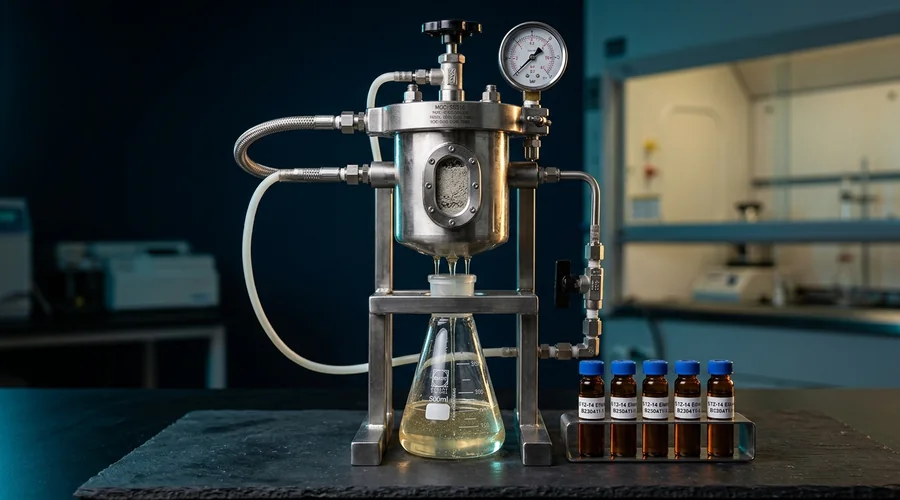
- Average EO — from hydroxyl value by the acetic anhydride method in ISO 4326. The cited study calculated actual average EO this way.
- PEG and ethoxylate content — the Weibull method in ISO 2268, which separates PEG from the nonionic adducts by extraction with ethyl acetate and salt solution.
- Free alcohol and oligomer distribution — gas chromatography with flame ionisation detection, as used in the study.
- Cloud point — ASTM D2024, which notes that a measurable cloud point exists only within a window of ethoxylation level.
Ask for all four before accepting a narrow range grade, because the average alone cannot tell the products apart. The same four measurements are also the fastest way to diagnose a problem, which is the subject of the next section.
Troubleshooting Ethoxylate Distribution: Free Alcohol, PEG and Catalyst Residue
Distribution problems surface as specification failures long after the reactor has been emptied. Free alcohol, PEG and cloud point are measured on the drum, yet the catalyst and the water present during the feed set them. The patterns are consistent enough to read backwards from the symptom, provided batch data are kept. The list below pairs each symptom with its usual cause and its consequence.
- High free alcohol — the catalyst adds EO to the starting alcohol more slowly than to its adducts, or the cation is wrong (NaOH left more than KOH). Consequence: a failed free-alcohol limit and lower ethoxylate content, and a narrower catalyst is a process change to assess, not a quick fix.
- High PEG — water or methanol in the alcohol or catalyst solution, and, per the study, more PEG with the calcium and Mg–Al systems than with either hydroxide. Consequence: a failed PEG limit, confirmed by the ISO 2268 method.
- Broad distribution on a narrow range catalyst — check the study's three factors in order: catalyst lot and activation, starting alcohol quality, and mass transfer in the reactor. Consequence: a grade that meets the average and misses cloud point and viscosity.
- Cloud point below specification — a broader distribution than planned, as the KOH product's 42 °C against 54 °C shows. Check the average EO by hydroxyl value first, because the average moves cloud point as well as the distribution does.
- Solids or catalyst residue in the product — heterogeneous and calcium catalysts must be filtered, and the study filtered both narrow range products before testing. Consequence: filter duty and residue handling become design items.
- Long or variable start-up delay — an induction period, seen in the study with a carboxylate catalyst and, strongly, with NAE-03. Consequence: EO fed before the reaction starts is unreacted inventory, which the next section treats as a safety matter.
Read a distribution problem as three questions in order. What did the catalyst do to the first addition? Which water or methanol entered the reactor? How did mass transfer behave during the feed? Answering them from batch records usually locates the cause before any experiment is needed.
Basis of Safety When the Catalyst Changes
A catalyst change is a change to the hazard basis of an EO plant, even when nothing on the pipework moves. The reaction is strongly exothermic, with a heat of reaction (ΔHr) of about −92 kJ per mole of EO reacted according to a standard reference summary. If cooling is lost, that heat raises the batch by the adiabatic temperature rise (ΔTad), the rise reached with no heat removal. A catalyst with an induction period lets EO accumulate unreacted before onset, and that inventory is what a sudden onset turns into a heat-release event.
Three things change with the catalyst. The general EO hazard basis, inerting and relief philosophy sit in our ethoxylation reactor article, so this list covers only what the catalyst adds:
- Onset behaviour — the hydroxides in the study showed no induction period, while the carboxylate and NAE-03 systems did, NAE-03 for a long time before a strong rise in rate. A feed-start philosophy that suits one does not suit the other.
- Rate response — a different catalyst changes how fast EO reacts at a given temperature, so accumulation and cooling demand change with it. Measuring that response is the job of reaction calorimetry. Our guide to adiabatic temperature rise and the maximum temperature of the synthesis reaction explains what the result means.
- Stall scenarios — where EO can poison the catalyst, as it does for most DMC systems, a stalled reaction under continuing feed accumulates EO. The basis of safety has to cover that case for the chosen catalyst.
Thermal hazard evaluation, relief sizing and the basis of safety for an ethoxylation process are site- and recipe-specific. They require measured calorimetric data for the actual alcohol, catalyst and feed system, and must be performed by qualified process safety engineers against the applicable regulatory regime. Recognised authorities include OSHA Process Safety Management, the EPA Risk Management Program and the NIOSH pocket guide entry for ethylene oxide.
With the hazard basis in view, the choice between grades can be made as a sequence of constraints.
Choosing a Grade: A Five-Question Framework
The choice between grades is a sequence of constraints, and working it in order stops a cheap catalyst being ruled out for a reason that does not apply. It also stops an expensive one being adopted for a benefit nobody needs. The output of the sequence is most of what a route-selection file contains. The answers settle catalyst selection: stay with hydroxides, pilot a narrow range catalyst or source the grade externally.
- What does the specification limit? — free alcohol, PEG, cloud point, viscosity or pour point at your average EO. If none is at risk, a hydroxide grade is the economical answer.
- Where does the average EO sit? — the strontium patent frames the target as a sharp distribution in the desired mole adduct range, usually 5 to 10. Build the benefit case at the EO numbers you sell, not at 3.
- Can the product carry more PEG? — the study's narrow range products made more PEG than KOH, so check the PEG limit and the ISO 2268 result before switching.
- Can the plant remove the catalyst? — a solid or calcium catalyst needs a filtration step where a hydroxide needs neutralisation. Size the filter duty and the residue handling.
- Has onset behaviour been measured? — induction and rate response come from calorimetry, and the results must feed the safety review before any EO reaches a new catalyst.
If questions 1 and 2 point to a narrow range grade, run a pilot comparison on your own alcohol. The study's numbers came from one alcohol, one low EO number and one reactor. Record distribution, PEG, free alcohol and onset behaviour side by side. That record gives a defensible decision and the core of a technology transfer package.
The value of a reaction engineering consultant sits in the pilot comparison and the hazard review, not in the catalyst name. For producers in India and the Gulf adding nonionic capacity, the decision usually comes before equipment is ordered. Our process development consulting covers route selection and contract process development for nonionic surfactant producers. Our scale-up support works as a scale-up partner through pilot plant support, and our lab-to-market service carries the chosen route through technology transfer, including R&D outsourcing for catalyst screening. The downstream side sits in our household and industrial cleaners resources, our surfactant selection guide and the surfactants hub.
Frequently Asked Questions
What is a narrow range ethoxylate?
A narrow range ethoxylate is an alcohol ethoxylate whose adducts are concentrated around the average degree of ethoxylation instead of spread widely around it. It is made with catalysts that change how the first ethylene oxide additions compete with later ones, such as alkaline earth compounds or calcined magnesium–aluminium solids.
One calcium patent defines the term as a composition with an adduct at about 20 % by weight or more and only a minor portion above the peak. In a published comparison study, the narrow range ethoxylates held less free alcohol than the potassium hydroxide product at the same average.
What is the difference between narrow range and broad range ethoxylates?
The average degree of ethoxylation is the same and the spread around it is different. A broad range ethoxylate, made with sodium or potassium hydroxide, contains more unreacted alcohol and a longer tail of high adducts. A narrow range ethoxylate concentrates the product nearer the average.
In a 2021 study of a C12–C14 alcohol at an average near 3 EO units, the narrow range ethoxylates had less free alcohol than the KOH product. They also had less than half its viscosity and a cloud point 12 °C higher. They contained more PEG, so the difference is a trade and not a pure gain.
Why does KOH ethoxylation leave so much unreacted alcohol?
Ethoxylated alcohols are more prone to ethoxylation than the starting alcohol. Once a molecule has picked up one EO unit, it competes for more EO faster than an untouched alcohol does. The result is a Weibull–Nycander type distribution, which the cited study describes as typical of classical basic catalysts, with unreacted alcohol and a tail of long chains.
The cation matters as well. In the study KOH left 13.7 % free alcohol and NaOH left 16.3 %, which the authors link to the hydrogen-transfer equilibrium between alcohol and ethoxylate. A plant that must cut free alcohol therefore looks at the catalyst before it looks at the reactor.
Which catalysts make narrow range ethoxylates?
Three families appear in the literature. Alkaline earth systems based on calcium, strontium and barium are the oldest in the patent record. Calcined magnesium–aluminium composite oxides are heterogeneous solids that leave the product by filtration. Acid catalysts such as boron trifluoride narrow the distribution but form more by-products and are not in wide commercial use.
Double metal cyanide catalysts are a further route, although ethylene oxide poisons most of those described in the literature. Each family changes catalyst removal, PEG level or start-up behaviour, so the choice is a process decision and not only a purchasing one.
Is a narrow range ethoxylate better than a conventional one?
Not in every respect. In the cited study the narrow range ethoxylates wet a paraffin film better, and they had lower viscosity and a higher cloud point. They also contained more PEG than the KOH product.
The KOH product reduced dynamic surface tension faster at the test concentration, while static surface tension reduction and water permeation were similar across catalysts. Choose on the property that drives your application and on your specification limits, not on the label narrow range.
How is PEG formed during ethoxylation and how is it measured?
PEG forms when EO reacts with traces of water or methanol instead of the alcohol, and by degradation of ethoxylate chains. That is why the substrate is dried before the EO feed, and why methylate catalysts, which arrive dissolved in methanol, bring methanol into the reactor.
The Weibull method in ISO 2268 separates PEG from the nonionic adducts by solvent extraction. In the cited study, both narrow range catalysts made more PEG than KOH, and NaOH made the least of the four.
Do DMC catalysts make narrow range ethoxylates?
Double metal cyanide complexes have been known as alkoxylation catalysts since the 1960s, but ethylene oxide is a harder feed for most of them. A 2017 Evonik patent application states that EO acts as a catalyst poison in the majority of DMC catalysts described in the literature, so activity drops severely or stops.
The same document describes DMC catalysts modified with polyether siloxanes that keep their activity with high proportions of EO. A narrow range ethoxylate from DMC therefore depends on the specific catalyst and has to be proven for the alcohol and the EO number.
Can a plant switch from KOH to a narrow range catalyst without other changes?
No, treat the switch as a process change. The catalyst changes the distribution, the PEG level, the way the reaction starts and the way the catalyst leaves the product. A catalyst with an induction period changes how the EO feed is started and how accumulation is assessed. The hazard basis must be reviewed on measured calorimetric data for the new system.
Run a pilot comparison on your own alcohol, check filtration and PEG limits, and complete the process safety review before the first commercial batch. Our process development consulting team plans this work as part of route selection and technology transfer.
Choosing or Changing an Ethoxylation Catalyst?
Global Formulation provides route selection, process development and scale-up partnership for nonionic surfactant producers, from catalyst screening and pilot comparison to the hazard review, technology transfer and R&D outsourcing.
Talk to Our Process Team