Oil Dispersion Formulation Agrochemical: OD and EW Guide
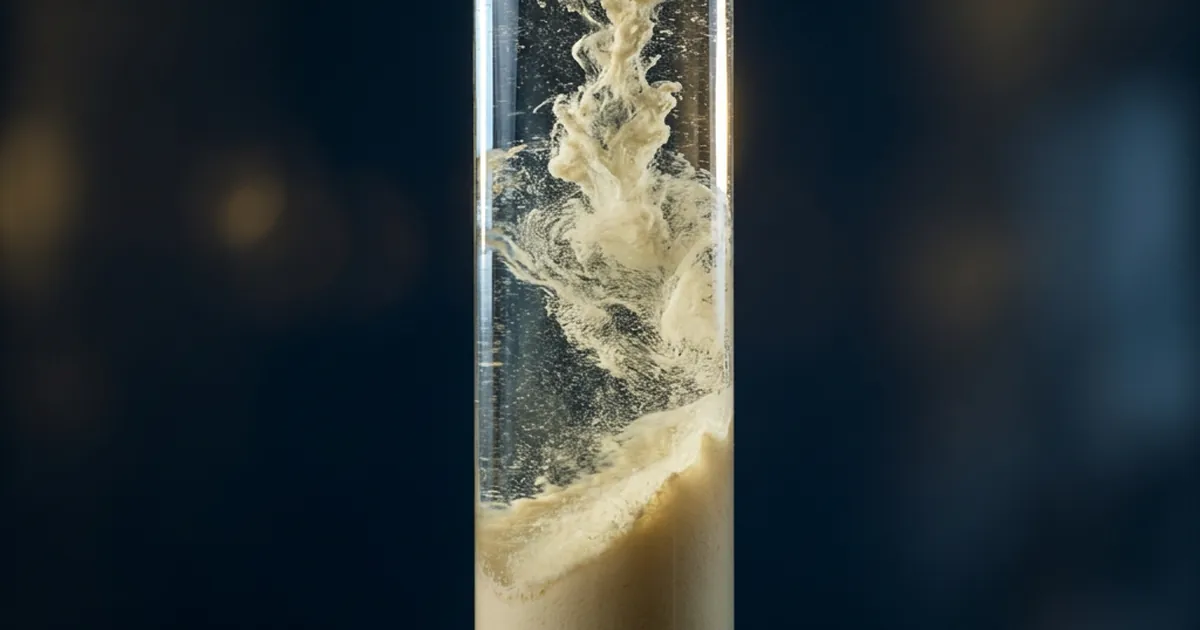
Some actives degrade in water, and others are solids that dissolve in no practical solvent. Two routes follow: suspend the solid in oil as an oil dispersion, or dissolve the active in a solvent and emulsify it in water as an EW. Each route solves one problem and creates another, from sediment cakes and crystal growth to creaming and droplet ripening. This guide explains oil dispersion formulation agrochemical design for OD and EW products, from carrier oils and dispersants to rheology, stability clauses and failure modes. It draws on the FAO/WHO specifications manual, the CropLife technical monograph and open peer-reviewed studies, plus the formulation support Global Formulation gives agrochemical manufacturers.
Oil Dispersion Formulation Agrochemical Basics: What OD and EW Are
OD and EW look like neighbouring products, yet they sit on opposite sides of the oil-water divide. An oil dispersion carries solid active particles in an oil, while an emulsion in water carries oil droplets in an aqueous phase. That single difference decides which actives fit, how the product behaves on dilution and which failures to expect. The specifications manual and the CropLife monograph define both precisely.
The FAO/WHO specifications manual defines an oil dispersion as a stable suspension of active ingredients in an organic fluid, intended for dilution with water before use. It defines an emulsion, oil in water, as a stable emulsion of active ingredients in an aqueous phase. In an EW the active is normally a liquid forming the dispersed oil phase, or a solid or liquid dissolved in a water-immiscible solvent. The EW guideline applies to aqueous macro-emulsions only, not to suspo-emulsions, water-in-oil emulsions or micro-emulsions.
| Type | What It Is | Active in the Pack | Behaviour on Dilution |
|---|---|---|---|
| OD, oil dispersion | Suspension of fine particles in a non-aqueous fluid | Solid, suspended in oil | Does not disperse as spontaneously as an EC, so the spray tank needs stirring |
| EW, emulsion oil in water | Aqueous macro-emulsion of oil globules | Liquid, or dissolved in a water-immiscible solvent | Dilutes into water as an emulsion; checked by emulsion stability and re-emulsification |
| SC, suspension concentrate | Suspension with water as the fluid | Solid, suspended in water | Dilutes as a suspension; see our SC formulation guide |
| EC, emulsifiable concentrate | Homogeneous solution of the active in solvent plus emulsifiers | Dissolved | Emulsifies spontaneously on dilution; see our EC formulation guide |
With the definitions fixed, the next question is how an oil dispersion is built.
Designing an Oil Dispersion: Carrier Oil, Dispersant, Rheology Modifier and Emulsifier
An oil dispersion has five jobs to do: carry the particles, keep them apart, stop them settling, emulsify on dilution and stay homogeneous through storage. Each job maps to a class of ingredient, and the classes interact. A supplier technical page states that choosing the right oil and surfactant system, including a non-aqueous dispersant, is the key to a good result. A formulator therefore designs the oil, the dispersant and the thickener as one system.
| Component | Role | Examples Reported |
|---|---|---|
| Carrier oil | Continuous phase that carries the solid | Paraffinic or aromatic solvents, vegetable oils and methylated seed oils; methyl oleate; rapeseed methyl esters |
| Non-aqueous dispersant | Wets the particles and keeps them apart in oil | Ethylene oxide and propylene oxide copolymer in one supplier example |
| Rheology modifier | Builds structure in the oil so particles do not sediment | Organic bentonite; hydrophobic fumed silica |
| Emulsifier | Lets the concentrate emulsify when poured into water | Calcium dodecylbenzene sulfonate with non-ionic ethoxylates; anionic and non-ionic blends |
| Wetting agent | Low-foaming wetting during milling and dilution | Low-foaming wetting agent in one supplier example |
| Aqueous dispersant, optional | Improves suspension stability in the spray tank after dilution | Polymeric aqueous dispersants |
The process follows the same logic as a suspension concentrate. One supplier formulation guide mixes the dispersant into the oil, adds the active, disperses it under high shear and wet-grinds the premix until finely dispersed. The remaining ingredients go in afterwards. An open-access study of a botanical oil dispersion milled its premix in a bead mill with zirconium beads until the median particle size was 5 micrometres or less. Our guide to wet milling for suspension concentrates covers the milling principles that carry over.
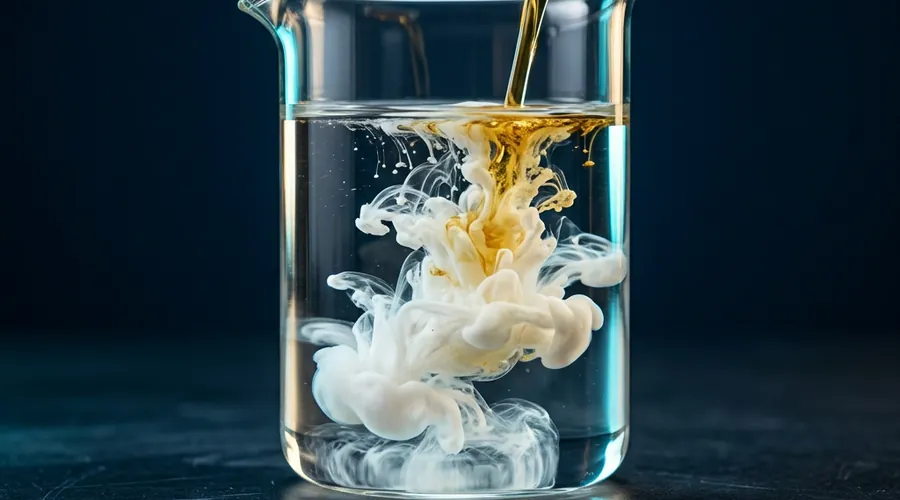
Oil dispersions have clear advantages and clear limits. A supplier page reports that they suit hydrolytically unstable actives such as sulfonylureas. The oil phase acts as a built-in adjuvant, and no preservative is needed because the product contains no water. It also lists more sedimentation than water-based systems and difficult formulation as limitations. The botanical study's authors conclude, against a soluble concentrate reported in earlier work, that the oil dispersion improved spray uniformity and leaf coverage.
An emulsion in water is a different balancing act, because the dispersed phase is liquid.
Emulsion in Water (EW) Design: Solvent, Emulsifier Pair and Droplet Stability
An EW packs the oil phase as droplets in water, so the formulator controls droplet size, the interfacial film and the solvent together. The active is dissolved in a water-immiscible solvent, and an emulsifier system holds the droplets apart. Because the pack already contains an emulsion, stability must last through storage, not only through dilution. The design choices are the solvent, the emulsifier balance and the continuous phase additives.
The supplier guide shows the structure with a fungicide example. It combines an emulsifier made of anionic and non-ionic surfactants, a water-immiscible solvent for the active, propylene glycol as an antifreeze and water as the aqueous phase. The order of addition is simple: mix emulsifier and solvent, then add the active, the glycol and the water and homogenise. An open-access review of pesticide emulsions reports that surfactants with a hydrophilic-lipophilic balance of about 10 to 16 give good oil-in-water agricultural formulations.
| Instability Route | What Happens | Design Response |
|---|---|---|
| Creaming | Droplets separate as a concentrated layer; the template checks re-emulsification | Smaller droplets and a stable interfacial film |
| Coalescence | Droplets merge and free oil appears | Strong interfacial film from the emulsifier pair at the right balance |
| Ostwald ripening | Oil moves from small droplets to large ones through the water phase | Solvent with very low water solubility |
| Cold-storage separation | Solid or liquid separates after storage at 0 °C | Antifreeze additive; low-temperature storage test |
The review defines Ostwald ripening as the net transport of oil from smaller droplets to larger ones through the continuous phase. It adds that an oil that is insoluble in the continuous phase gives a kinetic barrier to ripening. Solvent choice is therefore a stability decision as well as a solubility decision. Our guides to emulsion science and to creaming, sedimentation and coalescence explain these mechanisms in depth.
Whichever type you choose, the specification clauses decide whether the product passes.
Stability Testing for OD and EW: Dispersion, Emulsion and Storage Clauses
The FAO/WHO manual gives a template specification for each type, and the templates share a skeleton. They cover pourability, behaviour on dilution, foam and two storage tests. They differ in what happens after dilution: an oil dispersion is checked for cream, free oil and sediment, while an emulsion is checked for cream and free oil. Knowing the clauses early lets a formulator design to the test, not discover it at registration.
| Clause | OD | EW |
|---|---|---|
| Pourability | MT 148.1, maximum residue | MT 148.1, maximum residue |
| Behaviour on dilution | Dispersion stability, MT 180: cream, free oil and sediment after 0.5 h and again after re-dispersion | Emulsion stability and re-emulsification, MT 36.3: cream and free oil at set times |
| Oversize particles | Wet sieve, MT 185, to detect coarse particles, crystals or agglomerates that block nozzles | Not in the template |
| Persistent foam | MT 47.3 | MT 47.3 |
| Water content | MT 30.6, if required | Not applicable |
| Storage at 0 °C | MT 39.3, then dispersion stability and wet sieve must still pass | MT 39.3, volume of separated solid or liquid limited |
| Storage at 54 °C for 14 days | MT 46.4: active content retention, then pourability, dispersion stability and wet sieve | MT 46.4: active content retention, then emulsion stability |
The manual explains the logic for oil dispersions. Pourability confirms the product leaves its container, dispersion stability, wet sieve and foam confirm sprayability, and storage at elevated temperature confirms the absence of crystal growth. The manual also says laser diffraction particle size is not an ideal criterion for liquid formulations. Wet sieve plus suspensibility or dispersion stability should be used instead. The 0 °C test is not normally an essential clause for an oil dispersion.
Development studies add measurements beyond the template. The botanical oil dispersion study followed stability by multiple light scattering and measured suspensibility after hot storage. It judged wetting by static surface tension and dynamic contact angle, and spray deposition by droplet density and leaf coverage. Those tests tie the bench formulation to field behaviour, but they supplement the specification clauses rather than replace them.
The tests exist because particular failures keep recurring.
OD and EW Failure Modes: Sedimentation, Crystal Growth, Free Oil and Foam
Most failures of these two systems trace back to the physical state of the dispersed phase. Solid particles in oil settle, grow or clump, while liquid droplets in water cream, merge or ripen. Each failure has a signature the test clauses are designed to catch. Reading the signature points to the fix.
| Failure | System | Signature | Likely Fix |
|---|---|---|---|
| Sedimentation and cake | OD | Clear oil on top, sticky non-dispersed layer on the bottom | Rheology structure, finer milling, dispersant review |
| Crystal growth | OD | Oversize crystals retained on the wet sieve after hot storage | Check active solubility in the oil; adjust oil or dispersant |
| Poor dispersion in the tank | OD | Cream, free oil or sediment in the dilution test | Rebalance the emulsifier; consider an aqueous dispersant |
| Water ingress | OD | Water above the specified limit; degradation of a water-sensitive active | Dry raw materials; control the packing line |
| Creaming and free oil | EW | Cream layer or oil film on dilution or in storage | Emulsifier balance; droplet size; solvent water solubility |
| Cold-storage separation | EW | Separation after 0 °C storage | Antifreeze; low-temperature trials |
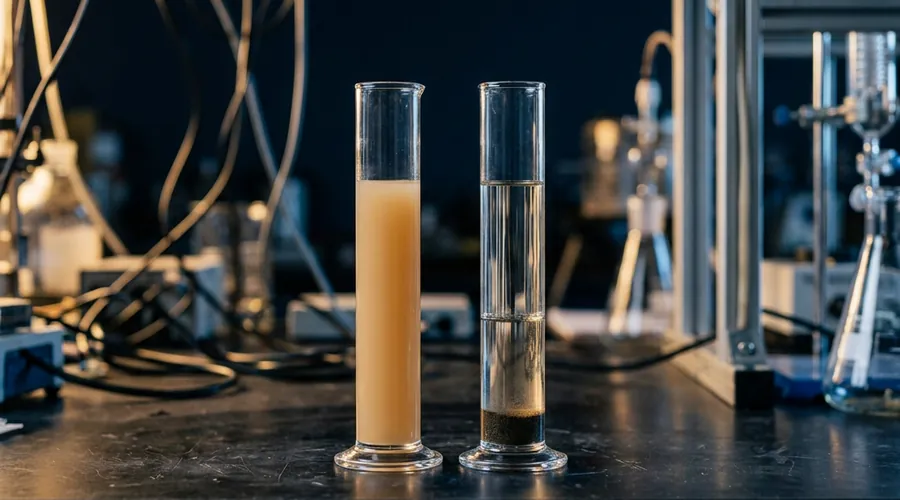
Crystal growth deserves special attention in oil dispersions. The manual states that elevated-temperature storage exists to ensure the absence of crystal growth upon storage, and the wet sieve then detects the crystals that formed. Solubility of the active in the carrier oil is therefore a measurement to make early, not an assumption. Our agrochemical technology and formulations guide places OD and EW among the other formulation types.
Knowing the failure modes makes the choice between formulation types more concrete.
Choosing Between OD, EW, SC and EC: Active Chemistry and Regulatory Fit
Formulation type follows the active, not the other way round. The active's state, its sensitivity to water and its solubility in practical solvents narrow the choice quickly. Commercial factors then decide among the remaining options, including solvent regulation, packaging and the registration route. A short decision framework prevents a long development detour.
- Liquid active or one that dissolves well in a safe solvent — EC or EW; the EW holds the solution as droplets in water.
- Solid, stable in water — SC or a water-dispersible granule, with water as the fluid.
- Solid, hydrolytically unstable — OD, because the oil phase excludes water and needs no preservative.
- Solid that must be loaded with other oil-soluble actives — OD, since the definition allows other dissolved actives in the oil.
- Active that needs better leaf contact — OD, where the oil phase acts as a built-in adjuvant according to supplier literature.
- Solvent load is a concern — EW rather than EC, because water carries part of the volume.
Registration then follows the formulation. In India, the CIB&RC publishes a list of pesticide formulations registered under the Insecticides Act, 1968. That list is the first place to check whether a given active and formulation type is already registered. Specification templates from FAO and WHO then give the physical clauses buyers expect. Dose rates, loadings and use claims are outside this guide by design, because registration and field data set them for each product.
The botanical oil dispersion study also reminds formulators that the application method matters. That study designed its product for unmanned aerial spraying and screened wetting and deposition accordingly. A consultant brings these constraints into the brief at the start.
Turning that choice into a robust product is the work of a formulation partner.
Working With an Agrochemical Formulation Consultant
OD and EW development combines colloid science, solvent and oil selection, milling or emulsification engineering and regulatory knowledge. An agrochemical formulation consultant measures the active's solubility and water stability, screens oils and surfactant systems, and designs the test plan around the FAO/WHO clauses. Agrochemical product development services extend that into pilot batches, stability data packages and technical documents for registration. A contract formulation agrochemical manufacturer then runs the validated process at scale.
- Characterise the active — physical form, solubility in oils and solvents, and stability in water.
- Pick the formulation type — OD, EW, SC or EC, using the decision framework above.
- Screen the carrier and surfactants — oil, dispersant, emulsifier and rheology modifier as one system.
- Mill or emulsify — set the particle size or droplet size target and the equipment.
- Run the specification tests — dispersion or emulsion stability, wet sieve, foam and both storage tests.
- Pilot and scale — confirm repeatability across batches.
- Transfer to manufacture — write the process, quality limits and release tests for the contract partner.
Our agro chemicals range shows where formulation expertise supports crop protection products. Global Formulation provides formulation screening, stability programme design, specification support and contract manufacturing transfer for agrochemical manufacturers. Active loadings and surfactant ratios stay outside this guide by design, because they belong to each client's product.
Frequently Asked Questions
What is an oil dispersion (OD) formulation in agrochemicals?
An oil dispersion is a stable suspension of solid active ingredients in a water-immiscible fluid, intended for dilution with water before use, according to the FAO/WHO specifications manual. The oil may also carry other dissolved actives.
It suits actives that degrade in water, because the oil phase excludes water. Supplier literature also credits the oil with acting as a built-in adjuvant.
Oil dispersions are metastable, so they need re-homogenising after storage and a spray tank that is stirred.
What is an emulsion in water (EW) formulation?
An EW is a stable emulsion of active ingredients in an aqueous phase, intended for dilution with water before use. The active is normally a liquid forming the dispersed oil phase, or a solid or liquid dissolved in a water-immiscible solvent.
The FAO/WHO guideline covers aqueous macro-emulsions only, not suspo-emulsions, water-in-oil emulsions or micro-emulsions.
Because the pack is already an emulsion, it must stay stable in storage and also after dilution in standard waters.
How do OD and SC formulations differ?
Both suspend a solid active, but an SC uses water as the fluid while an OD uses a water-immiscible oil. That choice decides which actives fit, because water-sensitive actives degrade in an SC but survive in an OD.
An OD also relies on oil-compatible dispersants, rheology modifiers and an emulsifier so that it disperses when diluted. An SC relies on aqueous dispersants and wetting agents.
Both are milled to a fine particle size, and both are metastable systems that need a structure to stop settling.
What tests does an oil dispersion need to pass?
The FAO/WHO template includes pourability (MT 148.1) and dispersion stability (MT 180) with cream, free oil and sediment limits. It adds wet sieve (MT 185), persistent foam (MT 47.3) and, if required, water content (MT 30.6).
Storage tests follow: 0 degrees C for 7 days (MT 39.3) and 54 degrees C for 14 days (MT 46.4). After storage, active content, pourability, dispersion stability and wet sieve must still comply.
The manual says laser diffraction particle size is not an ideal criterion for liquid formulations, so wet sieve and dispersion stability carry that role.
Why do oil dispersions develop crystals or sediment?
Sediment forms because solid particles are denser than the oil, and a clear liquid layer on top with a sticky cake at the bottom is the usual signature. Rheology structure, finer milling and a suitable dispersant control it.
Crystal growth occurs when the active dissolves slightly in the oil and re-crystallises on storage. The FAO/WHO manual includes elevated-temperature storage specifically to ensure the absence of crystal growth, and the wet sieve then detects oversize crystals.
Measuring the active's solubility in the carrier oil early prevents surprises.
How is an EW different from an EC?
An EC is a homogeneous solution of the active in solvent with emulsifiers that forms an emulsion spontaneously on dilution. An EW is already an emulsion of that solution in water before dilution.
Water therefore carries part of the volume, which lowers the solvent load per litre compared with an EC. The trade-off is that an EW must stay stable as an emulsion in storage, which brings creaming, coalescence and Ostwald ripening into play.
An open-access review notes that an oil insoluble in the continuous phase gives a kinetic barrier to ripening, so the solvent choice matters.
Does an oil dispersion or EW need registration, and where is it checked?
Yes. Agrochemical products are registered as specific formulations. In India, the CIB&RC publishes a list of pesticide formulations registered under the Insecticides Act, 1968, which is the first place to check an active and formulation type.
The FAO/WHO specification templates then supply the physical clauses buyers and regulators expect, such as dispersion stability and storage tests.
Registration pathways differ by country, so formulators confirm the route and data requirements before committing to a development plan.
Developing an OD or EW Formulation?
Global Formulation supports carrier and surfactant screening, stability programme design, specification writing and contract manufacturing transfer for agrochemical makers.
Talk to Our Formulation Team