Pharmaceutical Granulation Technology: Wet vs Dry Methods
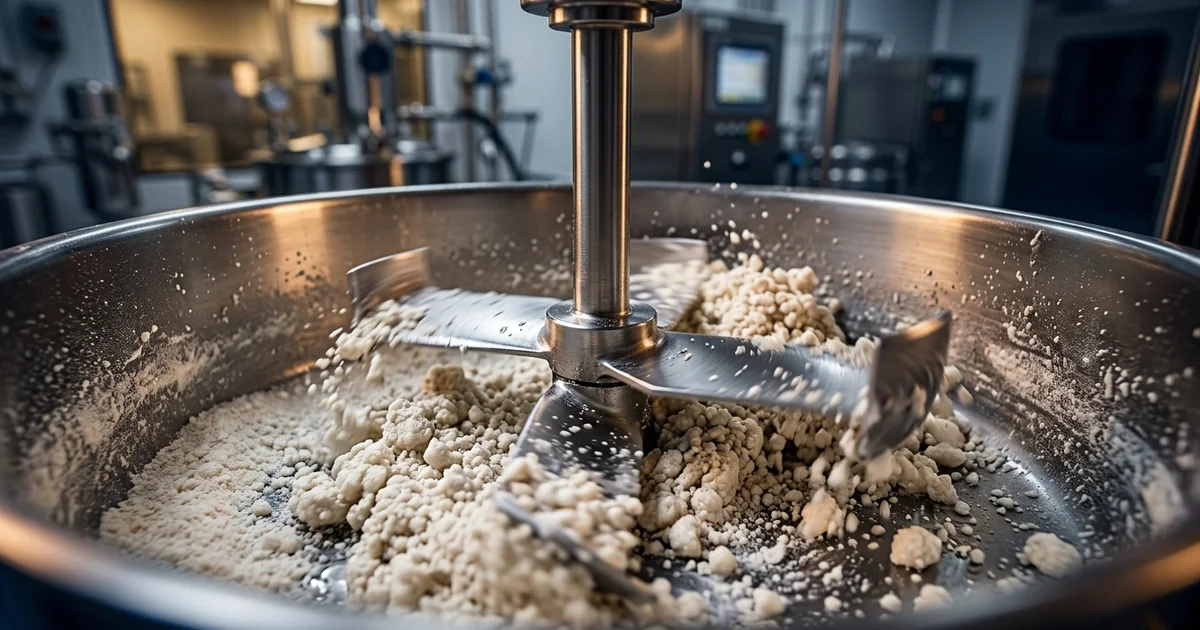
A powder blend can flow perfectly in a small bench trial and still jam a production hopper once volumes scale up. It can bridge in a chute or feed unevenly into a tablet press, and poor flow shows up as tablet weight variation, capping, and lost batches. At commercial scale, a single stalled hopper can idle an entire line for a shift. Pharmaceutical granulation technology exists to solve exactly this problem: it converts a fine, cohesive, unpredictable powder into free-flowing granules that meter accurately and compress cleanly. This guide compares wet granulation, dry granulation by roller compaction, and direct compression, and it explains how powder flow is actually measured. It also works through the process variables and failure modes that decide whether a formula survives the move from lab to plant. That reflects how Global Formulation approaches solid oral dosage development for pharmaceutical manufacturers and start-ups.
Why Pharmaceutical Granulation Technology Decides Whether a Formula Scales
Every solid oral dosage project eventually meets the same test: can this powder move, meter, and compress at production speed? A formula that looks perfect in a mortar and pestle often turns cohesive, sticky, or bridge-forming once handled by hoppers, feed frames, and rotary presses. Pharmaceutical granulation technology exists because most active ingredients and fine excipients do not flow well enough on their own to survive that transition. Getting the powder-handling decision right early prevents the two most common causes of late-stage tablet failure: weight variation and capping.
- Weight variation — uneven die fill produces tablets outside the acceptable weight range, which risks a content uniformity failure at release testing.
- Capping and lamination — trapped air and poor granule bonding split tablets during or shortly after compression.
- Segregation — differences in particle size or density let ingredients separate during transfer, hopper storage, or vibration in transit.
- Line downtime — bridging or rat-holing in a hopper stops production until the blend is manually broken up and re-fed.
Each of these failures traces back to how well the powder flows, which is why the next question is how flow is actually measured, not guessed at from experience alone.
Measuring Powder Flow: Carr's Index, Hausner Ratio, and Angle of Repose
Deciding whether a blend needs granulation, or whether direct compression will do, starts with a number, not a guess. Powder flow is characterized using bulk and tapped density, angle of repose, and particle size and shape, and pharmaceutical quality systems formalize these into standard indices. USP General Chapter <1174>, Powder Flow, sets out the two indices used almost universally in tableting: Carr's Compressibility Index and the Hausner ratio. Both are derived from the same two density measurements, so a formulation team can generate both from a single test.
- Bulk density — the mass of powder per unit volume in its loosely settled state, measured before tapping.
- Tapped density — the mass per unit volume after a fixed number of mechanical taps consolidate the powder bed.
- Carr's Compressibility Index — (tapped density − bulk density) ÷ tapped density × 100; a higher value indicates a more cohesive, harder-flowing powder.
- Hausner ratio — tapped density ÷ bulk density; values approaching 1.0 indicate a genuinely free-flowing powder.
- Angle of repose — the angle a powder pile forms when released from a fixed height through a funnel; steeper piles indicate poorer flow.
| Flow Character | Carr's Index | Hausner Ratio | Angle of Repose |
|---|---|---|---|
| Excellent | ≤10% | 1.00–1.11 | 25–30° |
| Good | 11–15% | 1.12–1.18 | 31–35° |
| Fair | 16–20% | 1.19–1.25 | 36–40° |
| Passable | 21–25% | 1.26–1.34 | 41–45° |
| Poor | 26–31% | 1.35–1.45 | 46–55° |
| Very poor | 32–37% | 1.46–1.59 | 56–65° |
| Very, very poor | >38% | >1.60 | >66° |
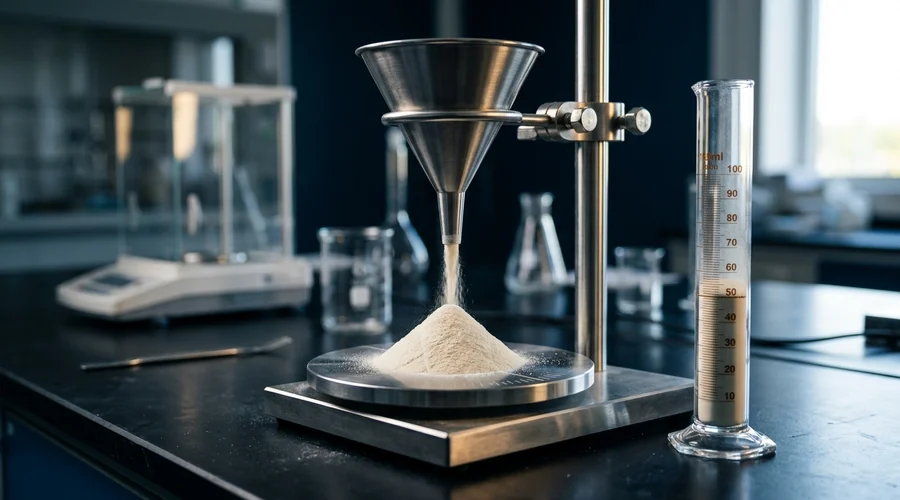
A powder blend that classifies as poor or worse under Carr's Index, as described in Wikipedia's overview of angle of repose and bulk-material flowability, rarely survives direct compression untreated. The next two sections cover the two established ways to fix it: adding a liquid binder, or compacting the powder dry.
Wet Granulation: Mechanism, Equipment, and Process Variables
Wet granulation is the oldest and still the most widely used route to flowable pharmaceutical granules. A granulating liquid, usually water or a hydro-alcoholic solvent carrying a dissolved or dispersed binder, wets the powder bed and creates liquid bridges between particles. Mechanical agitation from an impeller, a fluidizing air stream, or a rotating screw consolidates those bridges into granules. A drying step then removes the liquid, leaving a permanent solid bridge behind. Wikipedia's overview of granulation notes that binding agents such as povidone are added specifically to reinforce these bonds once the liquid evaporates.
| Equipment | Wetting Mechanism | Typical Granule Character | Key Process Variables |
|---|---|---|---|
| High-shear granulator | Impeller and chopper blades mechanically work liquid through the powder bed | Dense, relatively spherical granules | Impeller speed, binder-liquid addition rate, wet massing time |
| Fluid bed granulator | Top-spray liquid onto a fluidized, air-suspended powder bed | Porous, lower-density granules | Inlet air temperature and volume, spray rate, atomization air pressure |
| Twin-screw granulator | Continuous mechanical shear as powder and liquid move through a screw barrel | Narrow size distribution, tunable density | Screw speed, liquid-to-solid ratio, screw element configuration |
Within any of these platforms, four variables decide whether the batch turns out right. Each one interacts with the others, so a change to one usually forces a re-check of the rest rather than an isolated fix.
- Binder concentration and solvent choice — sets bridge strength once dry and determines how long the drying step will take.
- Liquid addition rate and total volume — under-wetting leaves ungranulated fines behind; over-wetting creates dense, over-massed granules that resist disintegration later.
- Wet massing time or spray rate — extends particle growth, and stopping too early or too late shifts the final granule size distribution away from target.
- Drying endpoint — residual moisture that is too high risks sticking at the press and microbial growth in storage. Drying too aggressively can instead degrade heat-sensitive binders and generate excess fines on milling.
Wet granulation solves flow and segregation problems for most formulations. Its liquid and heat, however, make it unsuitable for moisture- or heat-labile actives — the exact problem dry granulation was developed to solve.
Dry Granulation: Roller Compaction and Slugging
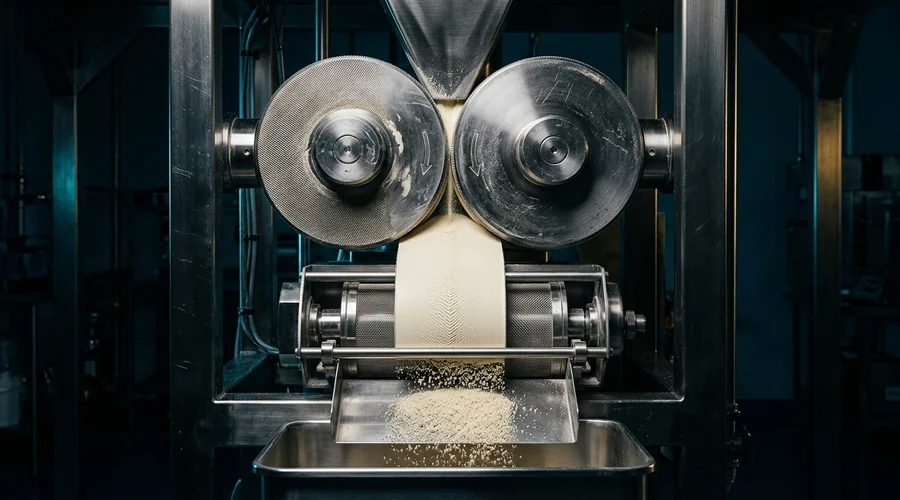
Dry granulation densifies a powder blend without adding liquid or heat, which makes it the default route for moisture-sensitive or heat-labile active ingredients. Roller compaction has effectively replaced the older slugging method in modern manufacturing, though slugging still appears where a roller compactor is unavailable. Roller compaction feeds powder between two counter-rotating rollers under high mechanical pressure, forming a dense ribbon that is then milled into granules of the target size. The same Wikipedia granulation overview describes this compacting and densifying step as the defining feature of dry granulation.
| Method | Mechanism | Typical Use | Key Variables |
|---|---|---|---|
| Roller compaction | Powder compacted into a ribbon between two counter-rotating rollers, then milled into granules | Standard route for moisture- or heat-sensitive APIs | Roll force/pressure, roll speed, roll gap, ribbon density |
| Slugging | Powder compressed into large slugs on a tablet press, then milled into granules | Used where roller compaction is unavailable; less common in current practice | Compression force, slug hardness |
- Roll force and pressure — higher pressure increases ribbon density and granule strength, but excessive pressure can over-compact the material and hurt its downstream compressibility.
- Roll speed and feed-screw speed — must be matched so the feed screw keeps the roll gap fully fed; a starved feed produces a weak, porous ribbon.
- Roll gap — sets ribbon thickness directly and interacts with roll force to determine the final ribbon density.
- Ribbon density — the single best predictor of downstream granule strength and flow, more reliable than reading roll pressure off the machine alone.
Roller compaction protects the API from moisture and heat, but it trades away some of wet granulation's flow and compressibility benefits. That trade-off is one a formulation team has to weigh directly, which is the subject of the next section.
Choosing Between Wet Granulation, Dry Granulation, and Direct Compression
No granulation route is universally correct. The choice comes down to five recurring factors: API sensitivity, dose and potency, blend flow and segregation risk, cost and equipment access, and development timeline. Teams that weigh these factors against the actual blend, rather than defaulting to whichever route the plant already runs, avoid the most common source of late-stage reformulation. The table below lines up the three main routes against the factors that usually decide between them.
| Factor | Wet Granulation | Dry Granulation (Roller Compaction) | Direct Compression |
|---|---|---|---|
| Moisture/heat sensitivity of API | Unfavorable for moisture- or heat-labile actives | Favorable — no liquid or heat involved | Favorable — no processing stress at all |
| Powder flow of the base blend | Improves flow substantially | Improves flow moderately | Requires an inherently good-flowing blend or added glidant |
| Content uniformity risk (low-dose, potent API) | Low risk — liquid binder helps distribute the API evenly | Moderate risk — needs careful pre-blend uniformity | Higher risk of segregation without engineered excipients |
| Capital and operating cost | Higher — adds a drying step and more equipment | Moderate | Lowest |
| Development timeline | Longer — more unit operations to optimize | Moderate | Shortest, when it works |
- Low-dose, potent API — favor wet granulation or roller compaction over direct compression to control segregation risk.
- Heat- or moisture-labile API — favor roller compaction, and avoid an aqueous wet granulation step entirely.
- Inherently free-flowing blend — direct compression is worth testing first, provided content uniformity data support it.
- Tight capital budget or fixed equipment — match the route to equipment already validated on site rather than to the theoretical ideal.
Once a route is chosen and process parameters are set, the formulation still has to prove itself through granule- and tablet-level testing, which is where the next section picks up.
Granule Characterization and In-Process Controls
A granulation process is only as good as the granules it produces, so in-process and finished-granule testing runs alongside every batch, not only at final release. Particle size distribution, bulk and tapped density, flow, moisture content, and friability each answer a different question about how the granules will behave at the tablet press. Skipping any one of them lets a defect travel downstream, where it becomes far more expensive to trace and fix. Our guide to excipient selection for oral solid dosage forms covers how binder and filler choice feeds into these same tests.
- Particle size distribution — measured by sieve analysis or laser diffraction, it governs die-fill uniformity and downstream tablet weight variation.
- Bulk and tapped density — feeds directly into the Carr's Index and Hausner ratio calculations covered earlier, now measured on the finished granule rather than the starting powder.
- Moisture content — checked by loss-on-drying or Karl Fischer titration, it verifies the drying endpoint and predicts sticking, picking, or microbial risk.
- Friability — indicates whether granules will survive transfer, storage, and feeding into the press without generating excessive fines.
These tests catch a drifting process before it reaches the press, but understanding why a process drifts in the first place is what actually prevents the same failure from recurring.
Common Granulation Failure Modes and Their Root Causes
Most granulation failures repeat a small number of root causes, and recognizing the pattern is faster than troubleshooting from first principles every time. Wet and dry granulation fail in different ways, because the underlying physics of bonding differs between them. Both routes still converge on the same downstream symptom: a tablet press that caps, sticks, or produces out-of-specification weights.
| Failure Mode | Process | Root Cause | Consequence |
|---|---|---|---|
| Over-wetting / over-massing | Wet granulation | Excess binder solution or extended massing time | Hard, dense granules; poor disintegration; capping risk at the press |
| Under-drying | Wet granulation | Insufficient drying time or temperature | Sticking to punches, microbial growth risk, poor downstream flow |
| Ribbon lamination or splitting | Roller compaction | Trapped air, low roll pressure, or poor initial ribbon density | Weak granules, excess fines, poor tablet hardness |
| Capping or lamination at the press | Any route | Air entrapment, over-lubrication, or excessive compression speed | Tablet defect and batch rejection at inspection |
| Segregation during transfer | Any route, especially direct compression | Particle size or density mismatch, poor blend uniformity | Content uniformity failure at release testing |
Diagnosing a failure by its symptom at the press separates a quick fix from a batch that has to be reworked from scratch. The key is tracing that symptom back to its root cause, not just its source unit operation. Some of these failure modes are also exactly what continuous processing and in-line sensing were built to catch before an entire lot is affected.
Continuous Granulation and Process Analytical Technology
Traditional granulation runs as a batch: mix, wet or compact, dry if applicable, mill, then test the finished granule before moving on. Continuous granulation keeps material moving through the same unit operations without stopping between steps, most commonly as continuous twin-screw wet granulation or continuous roller compaction. It pairs naturally with real-time sensing. Process analytical technology relies on near-infrared and Raman probes mounted directly on the ribbon or granule stream. These probes let a plant adjust roll pressure or liquid addition rate before an entire lot drifts out of specification. Our guide to continuous manufacturing in pharmaceutical production covers the broader regulatory and operational shift toward these methods.
Continuous processing changes how a drift is caught. The regulatory framework a process must satisfy, whether batch or continuous, stays the same — and that framework is the subject of the next section.
Regulatory Expectations: Process Validation and Quality by Design
Granulation process changes fall squarely inside process validation, and regulators expect the process to be understood well enough that its outputs are predictable, not merely repeatable after the fact. The FDA's guidance on process validation asks manufacturers to demonstrate this understanding across three stages. ICH's Quality by Design framework, formalized across the Q8 through Q14 guideline series, pushes that understanding further upstream, into development itself.
- Process design — establishing which granulation variables, such as binder amount, roll pressure, or spray rate, are critical to the quality attributes that matter.
- Process qualification — confirming the process performs consistently at commercial scale, on the actual equipment and batch size used in production.
- Continued process verification — ongoing monitoring during routine manufacturing to confirm the validated state is maintained batch after batch.
- Design space — under Quality by Design, a defined multidimensional combination of granulation variables demonstrated to assure quality, movement within which does not require a new regulatory filing.
A granulation process documented this way survives scale-up and technology transfer with far fewer surprises than one defended only by historical batch records. Translating that documentation into an actual scale-up program, and choosing who executes it, is the final piece.
Building a Granulation Program and Choosing a Manufacturing Partner
A granulation process that works on a two-kilogram bench batch does not automatically work at two hundred kilograms, because heat transfer, shear history, and residence time all change with scale. A structured development program treats each of these as a gate to clear rather than an assumption to carry forward. The sequence below reflects how Global Formulation structures granulation and powder-flow work for pharmaceutical manufacturers and start-ups.
- Powder characterization — measure bulk and tapped density, angle of repose, and particle size on the actual API and excipient lot before choosing a route.
- Route selection and bench trials — test wet granulation, roller compaction, and direct compression against the decision factors above, rather than defaulting to habit.
- Process parameter mapping — identify which variables, such as binder level, roll pressure, or spray rate, are critical to the final quality attributes, in line with process validation expectations.
- Pilot-scale confirmation — verify granule and tablet properties hold at an intermediate scale before committing to full production equipment.
- Technology transfer and validation — document the process design space and execute the three-stage validation program at commercial scale.
Choosing who executes this program matters as much as the science behind it. A contract manufacturer or consultant needs proven experience with the specific unit operation the formula requires, whether that is high-shear wet granulation, fluid bed processing, or roller compaction. It also needs the analytical capability to run particle size, density, and moisture testing in-house. Our guide to choosing a pharmaceutical formulation consultant and our guide to pharmaceutical process validation from R&D to commercial scale expand on these criteria. Our pharmaceutical regulatory pathway guide covers the filing implications of a design-space change.
- Equipment match — does the partner run the exact granulation platform the formula is designed around, at the batch size the project needs?
- Analytical capability — can it perform particle size distribution, density, moisture, and friability testing on-site, without shipping samples out for basic release tests?
- Process validation support — has it executed the three-stage process validation framework for a comparable product, and can it document a design space under Quality by Design?
- Technology transfer history — can it show a track record of scaling a partner's bench process onto its own commercial equipment successfully?
A pharmaceutical and healthcare partner that answers all four questions with documents rather than assurances can carry a project from bench characterization to a validated commercial process. Global Formulation provides pharmaceutical granulation technology consulting, powder flow optimization, and granulation process contract-manufacturing support, from bench characterization through validated commercial scale-up.
Frequently Asked Questions
What is the real difference between wet granulation and dry granulation?
Wet granulation binds powder particles together with a liquid, usually water or a solvent carrying a dissolved binder. Drying then removes that liquid, leaving a solid bridge between particles. Dry granulation, most often performed by roller compaction, densifies the same powder mechanically between two rollers under high pressure, with no liquid or heat involved at any stage.
The practical consequence is that wet granulation suits actives that tolerate moisture and drying heat, while dry granulation protects actives that degrade under either condition. Wet granulation also tends to produce denser, more compressible granules, while roller-compacted granules are generally less compressible and need careful control of ribbon density to compress well.
How do I know if my powder blend flows well enough for direct compression?
Measure bulk density, tapped density, and angle of repose, then calculate Carr's Compressibility Index and the Hausner ratio from the density values. USP General Chapter <1174> classifies flow from excellent, with a Carr's Index around 10 or below, down to very, very poor above 38. A blend needs to land in the good-to-fair range, tested on the actual production equipment, before direct compression is a safe bet.
A single good result is not enough on its own. Confirm the result holds across multiple raw-material lots, because supplier-to-supplier variation in particle size or moisture content can shift flow from acceptable to unacceptable. This can happen without any change to the formula itself.
Which is more reliable, Carr's Index or the Hausner ratio?
Both are calculated from the same bulk and tapped density measurements, so they move together and rarely disagree about whether a powder flows well or poorly. Carr's Index is more sensitive at the boundaries between flow categories, which makes it more common in formal specifications. The Hausner ratio, in contrast, is quicker to calculate and easier to communicate informally on the bench.
Neither number should be trusted in isolation. Angle of repose and a direct flow-through-a-hopper or feed-frame trial on the real equipment catch problems that density-based indices sometimes miss, particularly for cohesive or electrostatically charged powders.
When should a formulation move from wet granulation to roller compaction?
Move to roller compaction whenever the active ingredient is sensitive to moisture, to the heat used in drying, or to both. Hydrolysis-prone actives and other moisture- or heat-labile compounds fall into this category, and wet granulation's aqueous or hydro-alcoholic environment risks degrading them before the tablet is even made.
Roller compaction is also worth considering when a plant wants to cut process time and energy cost, since it removes the drying step entirely. The trade-off is that roller-compacted granules are typically less compressible than wet-granulated ones, so the final tablet formula may need adjustment to compensate.
What causes ribbon lamination or splitting in roller compaction, and how is it fixed?
Lamination happens when air trapped in the powder cannot escape fast enough as the rollers compress it, so the ribbon splits along internal planes instead of forming a solid sheet. Low roll pressure, an underfed roll gap, or a powder blend with poor initial bulk density all make the problem worse.
Fixing it usually starts with the feed system: increasing feed-screw speed or applying vacuum deaeration gives trapped air more time and a clearer path to escape before compression. Adjusting roll speed relative to feed rate, and confirming ribbon density directly rather than relying on the roll-pressure readout, resolves most remaining cases.
Can a tablet formula skip granulation entirely and go straight to direct compression?
Yes, if the blend of API and excipients is inherently free-flowing and compressible without any pretreatment. Content uniformity testing must also confirm the API stays evenly distributed through blending, transfer, and compression. Many modern excipients, including specially engineered co-processed fillers, are designed specifically to make direct compression possible for formulas that would once have required granulation.
Low-dose or highly potent actives are the main exception, because a fine, low-concentration API is more prone to segregating from the bulk excipients during handling. For those formulas, wet granulation or roller compaction usually stays the safer default, since the granulation step itself helps lock the API into a uniform matrix.
What should I prepare before bringing a granulation process to a scale-up partner or contract manufacturer?
Bring the powder characterization data already gathered on the actual API and excipient lots: bulk and tapped density, angle of repose, particle size distribution, and any bench-scale granulation trial results. Also specify the target batch size and the equipment platform the process was developed on. State clearly whether the API has any known moisture or heat sensitivity that ruled out one granulation route.
Beyond the technical data, clarify who will own the process documentation and design space once development is complete. Ask the partner directly about its experience validating a comparable granulation process at commercial scale. A partner that answers with prior batch records and validation reports, rather than general assurances, is the one that can actually execute the scale-up.
Scaling Up a Granulation Process?
Global Formulation provides pharmaceutical granulation technology consulting, powder flow optimization, and wet or dry granulation process development from bench trial through validated commercial scale-up.
Talk to Our Formulation Team