Sulfate Attack Concrete: Mechanisms and Resistant Design
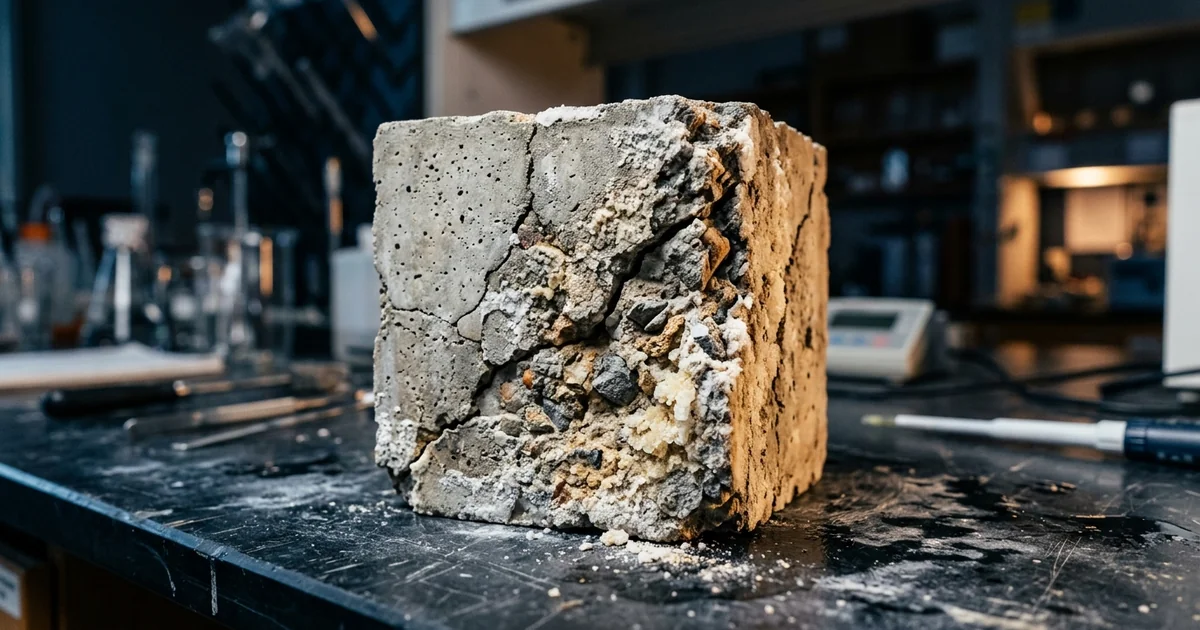
A foundation poured in sulfate-bearing soil can look sound for years and then crack, soften or scale. The cause is not a single reaction, and the fix is not always a different cement. Field damage comes from several mechanisms that need different conditions, so a design that stops one can leave another open. This guide explains the main sulfate attack concrete mechanisms: ettringite, gypsum, magnesium sulfate, thaumasite and physical salt attack. It then shows how binder choice, permeability, protective systems and testing fit together. It draws on open reviews, the Mineral Products Association, Indian and ASTM standards and the formulation support Global Formulation gives construction chemical manufacturers.
Sulfate Attack Concrete: Four Mechanisms, Not One
Sulfate attack is a family of chemical and physical processes, not a single reaction. Whittaker and Black define it as a series of interactions between hardened cement paste and sulfates. Each process needs different conditions, so the same sulfate-rich soil can ruin one concrete and spare another. The table below lists the four external mechanisms that matter for design.
| Mechanism | What It Needs | How Damage Shows | Main Control |
|---|---|---|---|
| Ettringite and gypsum formation | Sulfate ingress, aluminate hydrates and calcium | Expansion, cracking and spalling, with softening and strength loss also possible | Low permeability, low-aluminate or blended binders |
| Magnesium sulfate attack | Magnesium together with sulfate | Brucite and gypsum layers, then decalcified C-S-H and magnesium silicate hydrate | Dense paste, and care with silica fume blends |
| Thaumasite sulfate attack | Sulfate, carbonate, temperature below about 15 °C and very wet ground | Paste converted to a soft mush | Specific guidance such as BRE Special Digest 1 |
| Physical sulfate attack | Sulfate salt solution, evaporation, and swings in temperature and humidity | Scaling and spalling, with no reaction in the hydrates | Low water-cementitious ratio, curing, air entrainment |
All four need sulfate to move into the paste, so exposure classification starts with the sulfate level. ACI 318 uses classes S0 to S3, with water boundaries at 150, 1,500 and 10,000 mg/L sulfate in Hooton's summary. EN 206 uses XA1 to XA3 for groundwater from 200 to 6,000 mg/L. Its classes also cover aggressive carbon dioxide, ammonium, magnesium and pH. IS 456 uses five classes defined by sulphate in soil and groundwater.
This article covers external sulfate sources, and delayed ettringite formation from internal sulfate is a separate subject. Sulfate attack is also distinct from reinforcement corrosion, which our guide to concrete corrosion inhibitors covers. The wider category sits under construction chemicals.
The most familiar mechanism, ettringite expansion, is also the best understood, so it comes first.
Ettringite Expansion in Concrete: The Chemical Pathways
Ettringite expansion in concrete begins when sulfate ions reach aluminate hydrates in the cement paste. Whittaker and Black explain that aluminium sits in unreacted material and several hydrates, most commonly AFm phases, and that ingressing sulfate converts AFm to ettringite. The conversion needs extra calcium, which comes from calcium hydroxide. Knowing which phases supply aluminium and calcium explains why binder choice changes sulfate resistance.
- Ettringite — its precipitation from monosulfate roughly doubles the solid volume, from 312.7 to 714.9 mL/mol.
- Gypsum — it forms from calcium hydroxide with a rise in solid volume from 33.2 to 74.2 mL/mol. Its formation depends on sulfate concentration and pH, and strong laboratory test solutions favour it.
- Confinement — volume increase alone does not explain damage. Modelling showed that the added solids did not exceed the capillary porosity, so ettringite must grow in confined spaces to cause damage.
- Magnesium sulfate — it first reacts with calcium hydroxide to give brucite and gypsum. Brucite's low solubility holds the pore solution near pH 10.5, too low to stabilise C-S-H and ettringite, so decalcification follows.
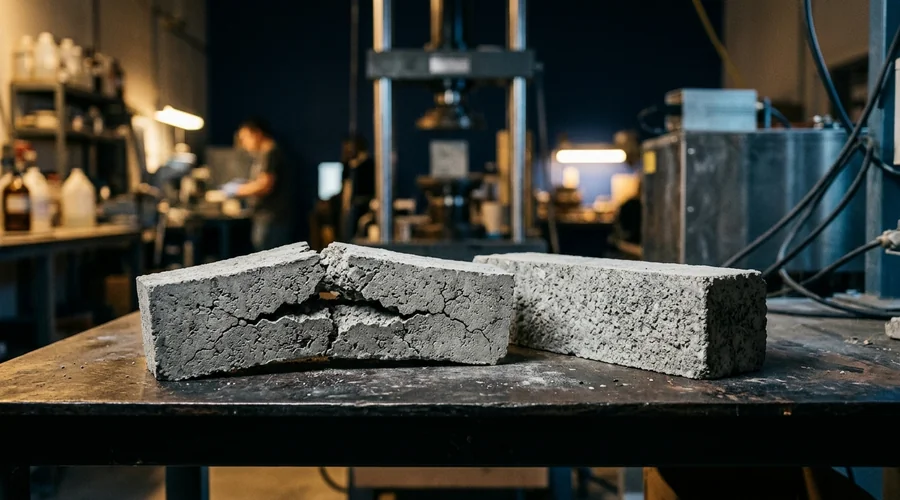
Cement chemistry offers a direct lever. A lower tricalcium aluminate content reduces the aluminate available to form ettringite, and several studies show improved resistance. That is the basis of sulfate-resisting cements, including Type V in ASTM C150 and the CEM I-SR series in EN 197-1. The ASTM C150 scope describes Type V as the cement for high sulfate resistance and Type II as the option for moderate sulfate resistance.
Ettringite is not the only way sulfate destroys paste, and in cold, wet ground a different mineral takes over.
Thaumasite Sulfate Attack in Cold, Wet Ground
Thaumasite sulfate attack, or TSA, destroys the binding phase of the paste instead of simply cracking it. The MPA Cement fact sheet states that TSA needs carbonate in the concrete as well as sulfate in the groundwater. It occurs below 15 °C and does significant damage only in very wet ground with mobile water. The thaumasite mineral gradually replaces the cement paste matrix, so the surface softens and disintegrates out of sight below ground.
- Cement type — TSA can attack concretes made with cements that resist the conventional form of sulfate attack. Whittaker and Black report that cements low in aluminate remain susceptible.
- Limestone and portlandite — limestone cements have been shown to be less resistant, and calcium hydroxide worsens resistance. Blended systems improved it.
- Structure — thaumasite resembles ettringite with silicate in place of alumina, and ettringite acts as a precursor.
- Scale — the MPA fact sheet, last revised in 2013, reports only about 60 instances, mainly in Lower Lias or Kimmeridge clays and against pyrite-bearing colliery waste. Structural failure is unlikely and would follow warning signs such as cracking and deflection.
The government's Thaumasite Expert Group produced guidance on risk analysis, diagnosis, remedial work and new construction. BRE Special Digest 1, Concrete in aggressive ground, still forms the basis of UK recommendations. MPA Cement adds that in most cases carbonate-containing aggregates can still be used with appropriate cement types.
Both chemical routes need wet, buried concrete, whereas the next mechanism works on concrete that is drying out.
Physical Sulfate Attack Above the Ground Line
Physical sulfate attack damages concrete without any reaction between sulfate and the hydrates. Salt solution rises through the pores by capillary action, evaporates at the surface and crystallises. In Hooton's account, swings in temperature and humidity make sodium sulfate cycle between thenardite and mirabilite, and under field conditions these cycles occur several times a day. The repeated cycles cause deterioration similar to freeze-thaw damage.
- Where it occurs — arid regions, tidal zones and half-buried structures, where evaporation concentrates salts at the drying front.
- PCA evidence — in a 16-year exposure study, low water-cementitious ratio gave the greatest resistance and cement composition mattered less. The authors judged salt crystallisation a major cause of distress compared with chemical reaction.
- Water-cement ratio — in earlier PCA cylinders, all concretes with a ratio above 0.45 were damaged. Hooton adds that evaporative transport falls rapidly below 0.45 and damage falls further near 0.40.
- Air entrainment — air-entrained mixes performed better than non-air-entrained mixes at the same ratio, and salts precipitated in the air voids.
- Test gap — Whittaker and Black note that no standardised test exists for this exposure.
Supplementary cementitious materials need care here. Hooton reports evidence that low-ratio fly ash and slag concretes resist sodium sulfate physical attack less well than portland cement concretes, and the cause is still unresolved. Whittaker and Black note that a refined pore structure can raise capillary action and worsen the damage. Our guides to air-entraining admixtures and efflorescence in cementitious products cover the void system and the salt transport involved.
Both families of attack lead to the same first line of defence, which is limiting how much sulfate enters.
Sulphate Resistant Cement, SCMs and Low Permeability
Design for sulfate exposure works in layers: limit ingress first, then limit what the sulfate can react with. Lower permeability slows ingress for every mechanism, which is why water-cementitious ratio and curing come before cement type in both the PCA data and the code logic. Cement chemistry then removes reactive aluminate, and supplementary cementitious materials dilute and bind what remains. Each layer helps against some mechanisms and not others.
| Measure | Helps Against | Limit |
|---|---|---|
| Low water-cementitious ratio, compaction and curing | All mechanisms, because ingress and evaporative transport both fall | Must be achieved in the structure, not only in the mix |
| Sulfate-resisting cement (low aluminate) | Ettringite formation | Does not stop thaumasite or physical attack |
| Slag, fly ash, pozzolan or silica fume blends | Ettringite and gypsum formation, and in some cases thaumasite | Can worsen physical attack, and silica fume blends perform poorly in magnesium sulfate |
| Air entrainment | Physical attack, by providing space for salts | Does not stop chemical reaction |
| Linings and surface coatings | Very severe exposure | Must resist substrate moisture and cracking |
Blends aid sulfate resistance in three ways, according to Whittaker and Black. They dilute the clinker aluminate and calcium hydroxide, pozzolans consume more calcium hydroxide, and the finer pore structure lowers permeability. Composition still matters. Calcium-rich fly ash can perform poorly, silica fume blends resist sodium sulfate well but perform poorly in magnesium sulfate, and slag blends behave adequately at high slag levels.
Indian practice follows IS 456:2000. Its clause 8.2.2.4 and Table 4 give five sulphate classes and set the cement type, minimum cement content and maximum free water-cement ratio for each. Sulphate resisting Portland cement to IS 12330 is one of the cements the code lists. A note adds that Portland slag cement with more than 50 percent slag shows better sulphate resisting properties. For the most severe class the code adds a lining of polyethylene or polychloroprene sheet, or a coating based on asphalt, chlorinated rubber, epoxy or polyurethane. Check the current edition and amendments before specifying.
Sulfates are only one of the aggressive agents concrete meets, and acids need their own measures.
Chemical Resistance Concrete Design: Acids, Sewers and Protective Systems
Portland cement paste is alkaline, which makes concrete durable in most environments and vulnerable to acids. Acids dissolve calcium hydroxide and decalcify C-S-H, so the paste loses both its alkalinity and its binder. Sewer headspaces show the process at its most severe, because bacteria convert hydrogen sulfide into sulfuric acid on the concrete surface. Chemical resistance concrete design therefore adds protection layers to the sulfate measures above.
The University of Colorado study of microbially induced concrete corrosion describes three stages.
- Abiotic neutralisation — acidic gases in the headspace lower the surface pH of fresh concrete from about 13 to about 9, usually within 1 to 8 weeks and without microorganisms.
- Colonisation — neutrophilic sulfur-oxidising microorganisms settle on the moist pipe crown and lower the pH further until acidophilic populations take over.
- Sustained corrosion — acidophilic bacteria oxidise hydrogen sulfide to sulfuric acid at pH below 3, and that acid solubilises the paste.
Gypsum and ettringite form in the corroding layer, and flowing sewage can wash them away, which accelerates the loss. In a 227-day laboratory test, the same study measured 0.08 mm per year for concrete with a lower water-cement ratio. Higher-ratio concrete corroded at 0.208 mm per year. Calcium aluminate cement follows a different route. The Wikipedia article on biogenic sulfide corrosion summarises it. It reports about 40 percent more acid neutralising capacity per gram than portland cement, plus a protective alumina gel layer that is stable down to about pH 4. The same article describes structural epoxy coatings for rehabilitating manholes and wet wells.
| Exposure | Attacking Agent | Design Response |
|---|---|---|
| Sulfate-bearing soil or groundwater | Sulfate ions, with ettringite and gypsum formation | Low ratio, sulfate-resisting or blended binder, curing |
| Cold, wet, carbonate-rich ground | Sulfate plus carbonate, forming thaumasite | Follow dedicated guidance such as BRE Special Digest 1 |
| Arid or tidal sites | Sodium sulfate crystallising in the pores | Low ratio, curing, air entrainment |
| Sewer headspace and wet wells | Biogenic sulfuric acid | Dense paste, calcium aluminate binders, linings and acid-resistant coatings |
| Groundwater with aggressive carbon dioxide, ammonium, magnesium or low pH | Acid dissolution and decalcification | Classify under EN 206 XA classes, then protect or line as the class demands |
Protective systems such as repair mortars and coatings extend the life of a structure that already shows damage, and our guide to concrete repair mortars covers that side.
Whatever the design, its claims need testing, and the test method shapes the answer.
Testing Sulfate Resistance: What ASTM C1012 Does and Does Not Show
ASTM C1012 is the most widely used test for chemical sulfate resistance, and it measures one thing: length change. Its scope covers mortar bars cured to a set compressive strength and then immersed in a sulfate solution. Whittaker and Black describe a 5 percent sodium sulfate solution, renewed at set intervals, with a solution volume four times that of the sample. Understanding the design of the test explains both its value and its blind spots.
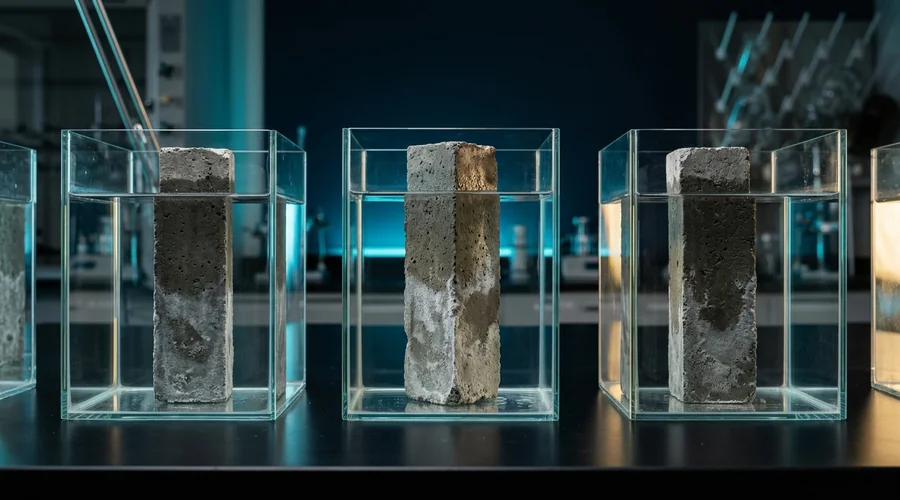
- Leaching — the bars soon leach calcium and hydroxide ions, which raises the pH of the bath to about 12.5.
- Concentration — the solution is far stronger than natural conditions, and it favours gypsum, which is typically not observed in the field.
- Single cation — the test uses one salt, whereas field waters carry several cations.
- One measurement — it assesses expansion only, although strength, dynamic modulus and mass changes also show damage.
- No physical attack — immersion does not reproduce drying and salt crystallisation.
The test still has a formal role. Hooton's summary of the ACI 318 table shows that alternative binders can be qualified using ASTM C1012 performance limits. Whittaker and Black note that recent studies change the pH, renewal and concentration to mimic field conditions better. A formulator who relies on a single immersion test is therefore measuring one mechanism under favourable conditions.
With the mechanisms, design measures and test limits in view, the practical question is who assembles and validates the programme.
Working With a Construction Chemicals Formulation Consultant
Sulfate and chemical resistance is a systems problem, because binder, admixtures, curing, coatings and test method all interact. A construction chemicals formulation consultant maps the exposure first and then builds the product and test plan around it. Independent construction chemical product development services also keep supplier claims separate from measured performance data. A contract formulation partner then turns the specification into repeatable batches.
- Exposure review — classify the site under EN 206, ACI 318 or IS 456 and identify which mechanism governs.
- Binder and admixture strategy — choose cement type, SCM blend and water-reducing and air-entraining admixtures to meet the permeability target.
- Protective system selection — match coatings, linings and repair mortars to the substrate and the chemical.
- Test design — pair ASTM C1012 with exposure tests that reproduce magnesium, thaumasite or physical attack.
- Scale-up — transfer the formulation to a contract manufacturing partner with raw material specifications and batch checks.
Our overview of construction chemicals technology and formulations shows where protective products and admixtures fit in the range. Before committing to a product or specification, run a short decision check. Classify the exposure and name the governing mechanism, then set the permeability target before choosing the cement. Add protection only for the agents the binder cannot resist, and test under the mechanism that governs the site. A system chosen this way answers to the exposure, not to a data sheet.
Frequently Asked Questions
What is sulfate attack on concrete?
Sulfate attack is a series of chemical and physical interactions between hardened cement paste and sulfates from an external source such as groundwater or soil. Chemical attack forms ettringite, gypsum, thaumasite or magnesium-bearing products that expand or soften the paste.
Physical attack is different. Salt solution rises through the pores, evaporates and crystallises, which scales and spalls the surface without reacting with the hydrates. Damage develops slowly and can take years to appear.
What causes ettringite expansion in concrete?
Sulfate ions react with aluminate hydrates, mostly AFm phases, to precipitate ettringite, with calcium supplied by calcium hydroxide. The solid volume roughly doubles when ettringite forms from monosulfate.
Expansion depends on where the crystals grow, because modelling showed that the added solids do not exceed the capillary porosity. Ettringite must therefore grow in confined spaces to cause damage, and the amount formed is not a reliable predictor of expansion.
Does sulfate-resisting cement stop all sulfate attack?
No. Sulfate-resisting cements such as ASTM C150 Type V and the CEM I-SR series reduce tricalcium aluminate, which limits ettringite formation. They do not address thaumasite attack or physical salt attack.
MPA Cement states that thaumasite attack can affect concretes made with cements that resist conventional sulfate attack. Hooton adds that physical attack often acts faster than chemical attack, so sulfate-resisting cement alone is not adequate.
What is thaumasite sulfate attack and where does it occur?
Thaumasite attack needs carbonate in the concrete, sulfate in the groundwater, temperatures below 15 °C and very wet ground with mobile water. The thaumasite mineral gradually replaces the cement paste matrix, which softens and disintegrates the concrete.
MPA Cement reports only about 60 UK instances, mainly in Lower Lias or Kimmeridge clays and against pyrite-bearing colliery waste. BRE Special Digest 1 remains the basis of UK guidance on avoiding it.
Do fly ash and slag improve sulfate resistance?
For chemical attack, blends usually help. They dilute clinker aluminate and calcium hydroxide, pozzolans consume more calcium hydroxide, and the finer pore structure lowers permeability. Composition still matters, because calcium-rich fly ash can perform poorly and silica fume blends perform poorly in magnesium sulfate.
For physical attack the picture differs. Hooton reports evidence that low-ratio fly ash and slag concretes resist sodium sulfate physical attack less well than portland cement concretes. Whittaker and Black note that a refined pore structure can raise capillary action.
How is sulfate resistance tested?
ASTM C1012 immerses mortar bars in a sulfate solution, usually 5 percent sodium sulfate, and measures length change. It is the most widely used test for chemical sulfate resistance, and the ACI 318 table accepts it for qualifying alternative binders.
Its limits are real. The strong solution favours gypsum that is rarely seen in the field, the bath uses one cation, and only expansion is measured. No standardised test exists for physical sulfate attack, so that mechanism needs separate exposure tests.
How does acid attack differ from sulfate attack?
Acids dissolve calcium hydroxide and decalcify C-S-H, so the paste loses its alkalinity and its binder. Sulfate attack instead forms expansive or weak products from the reaction of sulfate with the paste.
Sewer concrete shows both. Bacteria convert hydrogen sulfide into sulfuric acid, which attacks the paste and forms gypsum and ettringite in the corroding layer. A laboratory study found concrete with a lower water-cement ratio corroded at about 0.08 mm per year, against 0.208 mm per year for higher-ratio concrete.
What can a formulation consultant do for a construction chemicals manufacturer on sulfate resistance?
A consultant classifies the exposure, identifies which mechanism governs and designs the binder, admixture and protective system around it. The work covers cement and SCM selection, water-reducing and air-entraining admixture strategy, coating and repair mortar selection, and test design beyond ASTM C1012.
Consultants also support scale-up and technology transfer to a contract manufacturer, with raw material specifications and batch checks for the finished product.
Specifying Concrete or Protective Products for Aggressive Ground?
Global Formulation supports construction chemical manufacturers with exposure review, binder and admixture strategy, protective coating and repair mortar development, test programme design, product development and scale-up to contract manufacturing.
Talk to Our Formulation Team