Waterstop Construction Joint Guide: PVC and Hydrophilic
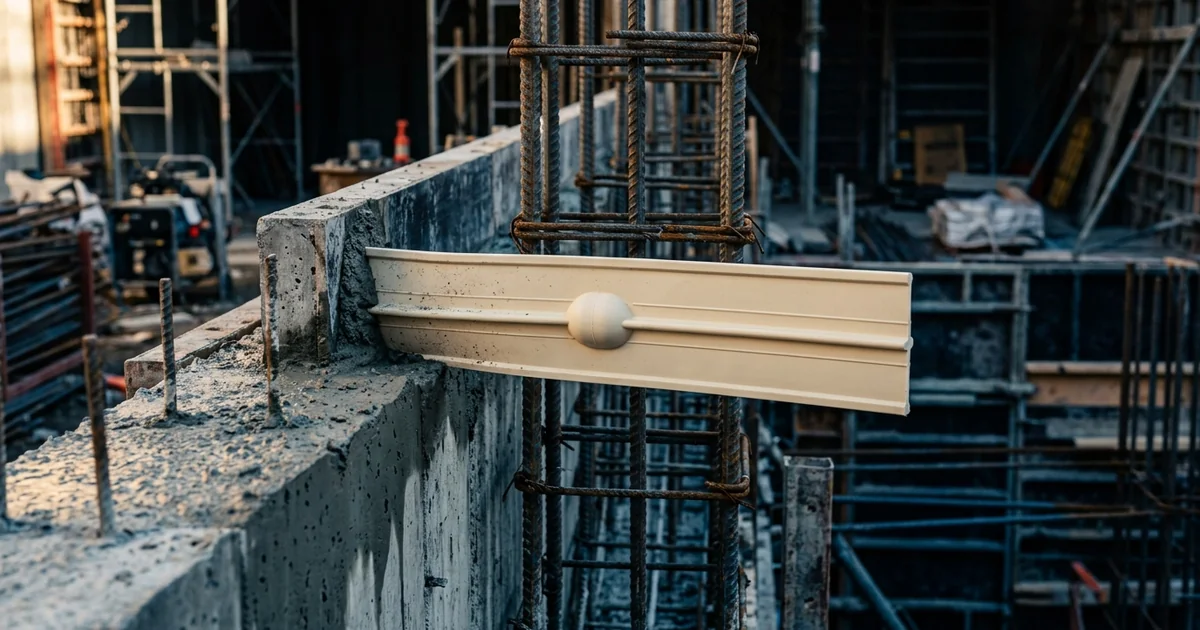
A basement wall or water tank can be cast from dense, low-permeability concrete and still leak at the joint between two pours. A waterstop construction joint detail exists to close that path, and the choice of waterstop decides whether it does. The US Army Corps of Engineers calls waterstops a primary line of defence against the passage of water through concrete joints. This guide compares PVC, rubber, metal, hydrophilic and mastic waterstops and explains the PVC compound tests in CRD-C 572. It also covers the chemistry of swelling strips and the installation faults that cause leaks. Sources are the Corps manual, the CRD-C 572 specification, open laboratory data on swelling polymers and a trade review of site faults, with formulation support from Global Formulation.
Why a Waterstop Construction Joint Leaks: Joint Types and Movement
Concrete changes in length, shape and volume with temperature, moisture, carbonation and load. Designers accommodate that movement with joints instead of leaving the concrete to crack where it chooses. Each joint is also an opening that can pass liquids, gases and solids into or through the structure. The Corps of Engineers manual EM 1110-2-2102 treats the waterstop as the primary barrier across that opening.
- Contraction joints — also called control joints, they divide an element into smaller elements by a complete separation, which regulates cracking from contraction.
- Expansion joints — also called isolation joints, they protect concrete from crushing, distortion and buckling. They run the full depth and are wide enough to keep abutting elements from touching.
- Construction joints — these form wherever a placement stops. They can be unbonded where they coincide with movement joints, or fully bonded in monolithic placements.
- Cracks — the manual calls them self-made joints. A trade review adds that waterstops cannot stop water entering through cracks that open later from settlement or deflection.
The manual defines a waterstop as a thin sheet of metal, rubber, plastic or other material inserted across a joint to obstruct the seeping of water. Unlike most joint sealants, it goes into the formwork before the concrete. It also cannot stop water vapour or capillary moisture moving through a slab, which other products handle.
| Joint | Movement After Casting | Waterstop Implication |
|---|---|---|
| Construction (cold) joint | Little or none once bonded | Flat or labyrinth PVC, hydrophilic strip, mastic strip or injection hose |
| Contraction joint | Small | Flat or dumbbell PVC where movement is very small to small |
| Expansion joint | Significant | Centerbulb PVC or rubber; most hydrophilic strips and mastic strips are not intended for these joints |
Our guide to sealant joint design and movement capability covers the surface-applied side of the joint, and expansion joint fillers cover the gap itself. Joint movement sets the waterstop profile, and the profile in turn limits the material.
Waterstop Types Compared: PVC, Rubber, Metal, Hydrophilic and Mastic
Waterstops differ in how they seal. Some lock into the concrete through ribs or bulbs and form a mechanical interlock. Others swell or stick to close the joint. The type has to match the joint movement, the water head and the fluid.
| Type | How It Seals | Typical Use | Main Limits |
|---|---|---|---|
| PVC (thermoplastic) | Mechanical interlock; heat-welded splices | Construction, contraction and expansion joints, by profile | Less elastic and slower to recover than rubber; more susceptible to oils and some chemicals |
| Rubber (natural, butyl, neoprene, SBR, NBR) | Mechanical interlock | Movement joints | Thermoset rubber cannot be heat-welded, so field fabrication is harder |
| Metal (stainless steel, copper, steel, lead, bronze) | Adhesive bond to concrete | Low-movement joints; severe chemical or high-temperature service | Rigid; described as probably the most difficult to install |
| Hydrophilic strip (bentonite, rubber, polyurethane) | Swells on contact with water | Construction joints and penetrations | Must not be wetted early; needs concrete cover; mostly not for expansion joints |
| Mastic strip (butyl or asphaltic) | Adhesion to primed concrete | Construction joints only | Hydrostatic resistance very limited; lowest-performing type |
| Injection hose | Perforated hose, resin injected later | Construction joints | Re-injection is frequently not possible |
The manual names four common nonmetallic shapes. Flat waterstops carry rows of ribs for better interlock. Dumbbell shapes have solid bulbs along both edges, and centerbulb shapes add a hollow bulb that accommodates transverse, lateral and shear movement. Labyrinth shapes lie within non-moving joints, and the manual allows them only under very little hydrostatic pressure.
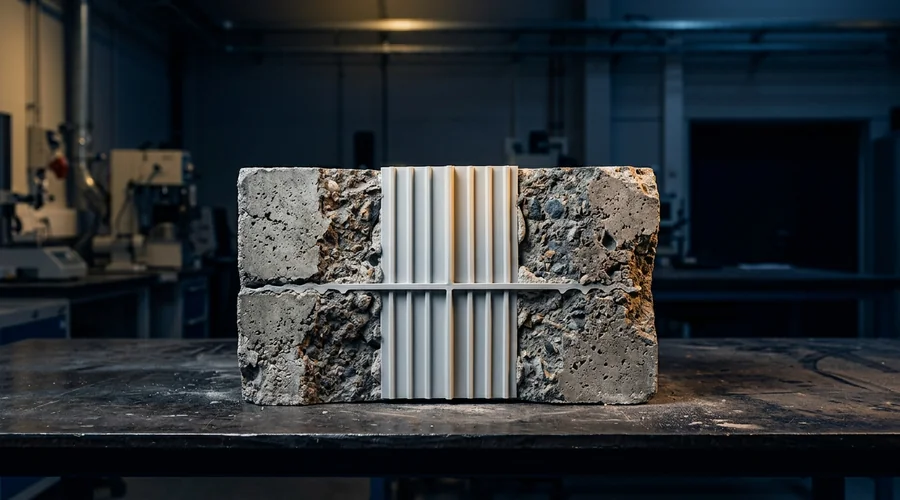
A 2015 Construction Specifier review adds a point from ACI 504R. The dumbbell seal is ineffective at small joint movements and puts the waterstop under considerable tension at wide movements, which is why ribbed profiles followed. Split-flange versions avoid split formwork but are hard to splice at intersections.
The next section looks at the compound specification for PVC, the most prevalent nonmetallic type.
PVC Waterstop Compound and the CRD-C 572 Tests
PVC is the most prevalent nonmetallic waterstop, and being thermoplastic it splices easily on site. The Corps specification CRD-C 572 fixes no recipe. It requires a dense, homogeneous extrusion whose basic resin is polyvinyl chloride, plus whatever additional resins, plasticisers, stabilisers or other materials the compound needs to meet the performance limits. The compounder therefore designs against a test list, and the list below is from the 1974 revision.
| Property | Test Method | Requirement in CRD-C 572-74 |
|---|---|---|
| Tensile strength | CRD-C 573 | Not less than 1,750 psi (12.17 MPa) |
| Ultimate elongation | CRD-C 573 | Not less than 300 percent |
| Low-temperature brittleness | CRD-C 570 | No cracking or chipping at −35 °F (−37.2 °C) |
| Stiffness in flexure | CRD-C 571 | Not less than 600 psi (4.13 MPa) |
| After accelerated extraction: elongation | Clause 7.1 | Not less than 280 percent |
| After accelerated extraction: tensile strength | Clause 7.1 | Not less than 1,500 psi (10.3 MPa) |
| Effect of alkalies: weight change after 7 days | Clause 7.2 | Between −0.10 and +0.25 percent |
| Effect of alkalies: hardness change (Shore A) | Clause 7.2 | Not more than ±5 |
| Job-made and factory splices: tensile strength | CRD-C 573 | Not less than 1,000 psi (6.89 MPa) |
The accelerated extraction test immerses tensile specimens in a hot sodium and potassium hydroxide solution for at least 14 days. The solution is renewed daily, and the specimens are weighed until their weight is constant. Only then are tensile strength and elongation re-tested. The effect-of-alkalies test uses a similar solution at room temperature for seven days. Both ask whether the compound keeps its mass, hardness and strength under alkaline conditions of the kind found in concrete.
The manual adds that PVC is less elastic than rubber, slower to recover and more susceptible to oils and some chemicals. A compound that passes the table can still be the wrong choice for a joint exposed to oils or some chemicals. Swelling strips take a different route, and the Corps manual does not cover them.
Hydrophilic Swelling Waterstop Chemistry: Bentonite, Rubber and Polyurethane
Hydrophilic waterstops work differently from PVC. Instead of passively blocking water, they react with it and swell to form a seal. Bentonite-based strips use clay as the swelling agent. Water-swelling rubber blends a water-absorbent resin with a carrier rubber and vulcanises it, while water-swelling polyurethane is made by chemical polymerisation.
- Fixing — the strip is bonded to the cured first pour with an adhesive or primer, or covered with steel mesh nailed at about 300 mm centres. Fasteners alone are not enough.
- Cover — manufacturers typically require 50 to 75 mm of concrete cover, depending on profile and material, to avoid spalling.
- Timing — the strip must not be wetted early, so the second pour follows promptly. The free water in a concrete mix is not enough to swell it, and without an outside water source it stays dormant.
- Limits — the review says bentonite and rubber strips cannot swell in fluids other than water, and most are not intended for expansion joints.
Open laboratory data show how large the fluid effect is. The studies come from Shanghai Jiao Tong University and tested swelling polymers made for shield tunnel gaskets, not construction-joint strips, but the polymers belong to the same families. The free swelling ratio measures how far an unconstrained specimen swells on immersion, and saline fluids reduced it without stopping it.
| Material | Peak in Distilled Water (%) | Peak in Artificial Seawater (%) | Peak in Concentrated Seawater (%) |
|---|---|---|---|
| Water-swelling rubber | 226 | 54 | 53 |
| Water-swelling polyurethane | 130 | 119 | 104 |
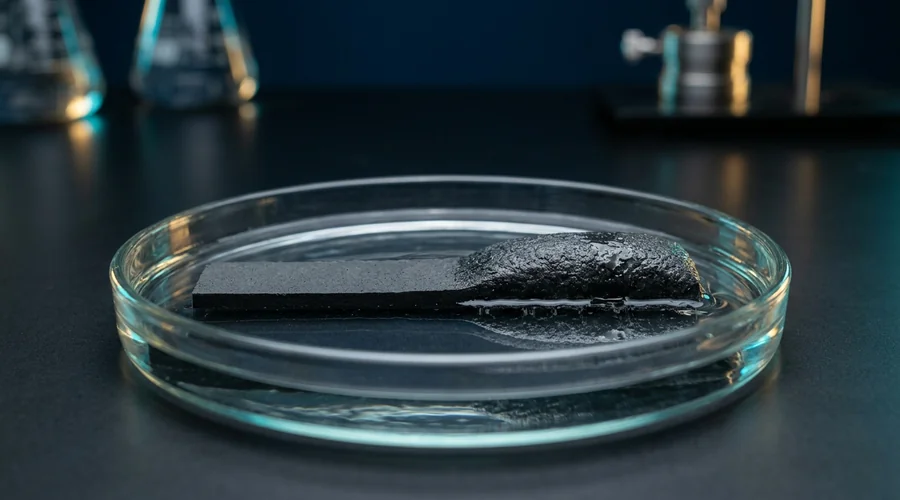
The values come from the Tan and co-workers data set and are rounded. After their peaks the swelling ratios fall, and the rubber in distilled water dropped from 226 to 183 percent by 888 hours. A second data set on polyurethane shows swelling after 21 hours falling from about 460 percent in distilled water to about 334 percent in an 80 g/L solution. Across pH 2 to 12 the polyurethane swelling changed by only a few percent.
Swelling chemistry decides how a strip behaves once wet, and the selection steps decide whether it is the right strip in the first place.
Construction Joint Waterproofing: Selecting a Waterstop
No waterstop suits every joint. Selection starts with movement, then moves to water head, the fluid and the way the concrete is placed. Skipping any of the four leaves a gap in the specification. Manufacturers can recommend size, type and embedment depth once the design conditions are available.
- Movement — flat profiles suit joints with very little lateral movement, dumbbell profiles small movement and centerbulb profiles significant lateral and transverse movement. Hydrophilic and mastic strips belong in construction joints.
- Water head — the review gives the rule of thumb that a wider waterstop resists more pressure, with thickness and ribbing also playing a part. Hydrophilic strips are described as effective under high and intermittent hydrostatic conditions.
- Fluid — rubber resists most chemicals better than PVC. Metallic waterstops serve severe chemical and high-temperature environments, and stainless steel suits ozone contactors.
- Placement — split-flange profiles avoid split formwork. In shotcrete walls a hydrophilic strip is preferred to a PVC dumbbell because spraying and consolidating behind a wide flange is difficult.
- Reinforcement and cover — a profile installed too close to steel is a recorded fault, and swelling strips need their minimum cover.
Joint-level choices connect to the wider system. Our article on polymer-modified cementitious waterproofing covers the coating layer that often sits beside the waterstop. Our guide to polyurethane injection resin for active leaks covers the repair route when a joint fails. A well-chosen waterstop still fails if it is installed badly, which is the next section.
PVC Waterstop Installation and Hydrophilic Strip Faults
A waterstop is a passive component, so its performance is decided during installation. The trade review says the problem with waterstops is their susceptibility to improper installation or damage during concrete placement. Handling rules in the Corps manual prevent many of these faults. Faults listed below come from the review and the manual.
- Handling — store the roll protected from dirt, oils, chemicals and damage, and uncoil it about 24 hours before installing or splicing. Damaged lengths are removed from service.
- Splices — typical faults are overlapped roll ends that are not welded, splices glued with sealant, welds made across the edge only and overheated or charred welds. The manual says to inspect splices for bubbles, cracks, voids, misalignment and burned material.
- Position — faults include a waterstop too close to reinforcement, one that is not centred, and one not tied in, which then shifts during the pour. Cutting holes or narrowing the flange to clear rebar is also recorded.
- Concrete — poor consolidation beside the waterstop and cured concrete left on the flange both weaken the joint. The manual says to clean off laitance, form oil, dirt and excess concrete before the second placement.
- Hydrophilic strips — overlapped instead of butted ends, a void under the strip and fixing by nails alone are the common faults.
Faults like these are visible only if someone looks for them, so inspection and sampling are part of the specification, as the next section shows.
Quality Control, Sampling and Evidence for Swelling Strips
Acceptance of waterstop is by lot. The Corps manual defines a lot as material produced under the same conditions, meaning one batch of raw materials, one production line, one method, one shift and one curing period. PVC and rubber waterstops are tested against CRD-C 572 and CRD-C 513, and a failing lot is rejected in its entirety. The manual does not address hydrophilic strips, so a swelling product needs its own evidence.
- PVC lots — CRD-C 572 takes a sample of at least 12 inches from each 200 feet of finished waterstop, with at least four lineal feet per lot.
- Free swelling — report swelling against time in distilled water and in a fluid that represents the joint, using the swelling-ratio method of the open data sets.
- Confined swelling — the tunnel studies applied compression loads of 1 to 4 MPa to rubber and 1 to 2 MPa to polyurethane, because a strip in service is confined.
- Long-term behaviour — swelling ratios peak and then fall, so reports should cover hundreds of hours.
- Storage and fixing — document protection against early wetting, the minimum cover and the adhesive or primer system.
This evidence file is what lets a buyer compare two strips honestly, and it is the part of the work where formulation skill shows.
Working With a Construction Chemicals Formulation Consultant
Waterstop performance starts in the compound and ends on the site. A failed alkali test, a strip that over-swells in storage or a primer that does not hold a strip all trace back to formulation decisions. A construction chemicals formulation consultant tests those decisions against the specification before launch. Construction chemical product development services then carry the work through documentation, scale-up and supply.
- Compound design — PVC resin, plasticiser and stabiliser systems matched to the CRD-C 572 test list and to the target climate.
- Swelling systems — selection of a bentonite, rubber or polyurethane route, and the carrier polymer, for the target fluids.
- Fixing systems — adhesive and primer packages that hold strips in place through vibration.
- Test programme — mechanical, alkali, free-swell and confined-swell tests planned with a partner laboratory.
- Documentation — technical sheets and installation guides that state cover, wetting limits and joint suitability.
- Scale-up and supply — transfer to a contract formulation scale-up partner with lot-level quality checks.
The full range of services sits under construction chemicals. Anyone planning a product range can also review our guide to starting a waterproofing chemical manufacturing unit. Before committing to a product, collect the joint types, the water head and the fluids of the target projects. Those three inputs shape every decision in this article.
Frequently Asked Questions
What is a waterstop in a construction joint?
A waterstop is a thin sheet or strip of metal, rubber, plastic or other material inserted across a joint to obstruct the seeping of water. It is embedded in the concrete before the second pour, unlike most joint sealants, which are installed afterwards.
The US Army Corps of Engineers calls waterstops a primary line of defence against water passing through concrete joints. They protect basements, tanks, tunnels, dams and similar structures.
What is the difference between PVC and hydrophilic waterstops?
A PVC waterstop is a ribbed or bulbed extrusion that blocks water passively through mechanical interlock with the concrete. Its splices are heat-welded on site, and the profile can accommodate joint movement.
A hydrophilic waterstop is a strip that reacts with water and swells to seal the joint. It is usually fixed to the first pour, is used mainly in construction joints and most types are not intended for expansion joints.
How much concrete cover does a hydrophilic waterstop need?
A 2015 Construction Specifier review states that manufacturers typically require 50 to 75 mm of concrete cover, depending on the profile size and material type. The cover prevents spalling when the strip swells.
The exact figure comes from the manufacturer's installation guide for the product in use, so it should be written into the project specification.
Can a hydrophilic waterstop swell in the concrete mix?
The same review states that the free water in a concrete mix is not enough to swell the strip. After the concrete has cured, an outside source of water has to reach the strip, and without one it stays dormant.
Early wetting is the real risk. If rain reaches the strip before the second pour, it can swell too soon, which is why the second placement should follow promptly after installation.
Why do PVC waterstop joints leak?
Most leaks trace to installation. Common faults include overlapped ends that are not welded, splices glued with sealant and overheated welds. A waterstop that is off-centre or too close to the reinforcement, and poorly consolidated concrete beside it, also cause leaks.
The Corps manual also says to clean off laitance, form oil and excess concrete before the second placement and to inspect splices for bubbles, cracks, voids, misalignment and burned material.
What tests does a PVC waterstop have to pass?
The 1974 Corps specification CRD-C 572 sets minimum tensile strength and elongation, a low-temperature brittleness test at minus 35 degrees Fahrenheit and a minimum stiffness in flexure. It also sets an accelerated extraction test and an effect-of-alkalies test.
Splices are tested too, with a lower minimum tensile strength than the material. Project specifications can cite a later revision, so the current requirement should always be checked.
Does a hydrophilic waterstop work in seawater or saline groundwater?
Swelling continues in salt solutions but at a reduced level. In open laboratory data on tunnel gasket polymers, water-swelling rubber peaked at about 226 percent in distilled water and about 54 percent in artificial seawater. Polyurethane peaked at about 130 and 119 percent in the same fluids.
The construction review also says these strips cannot swell in fluids other than water. A product intended for saline conditions should therefore come with swelling data measured in a representative solution.
How can a construction chemicals formulation consultant help with waterstops?
A consultant designs the PVC compound against the specification tests and selects the swelling system and carrier polymer for the target fluids. The same team plans mechanical, alkali, free-swell and confined-swell tests with a partner laboratory.
The work also covers fixing adhesives and primers, installation guides and technology transfer to a contract formulation scale-up partner with lot-level quality checks.
Developing a Waterstop or Joint Waterproofing Product?
Global Formulation supports construction chemical makers with compound and swelling-system development, test programme planning, technical documentation, scale-up and technology transfer to a contract manufacturing partner.
Talk to Our Formulation Team