Two fence posts cut from the same pine log can have very different service lives, and the difference is rarely the timber. It is wood preservative chemistry: which biocide entered the wood, how deep it went, and whether it stayed there. Decay fungi and termites destroy fence posts, decks, utility poles, railway sleepers and building frames. Every failed member is a replacement cost and, in structural work, a safety risk. This guide explains how CCA, borate, copper azole and micronized copper systems actually work, why the industry moved away from arsenic, and where non-biocidal modified wood fits. It applies the standards-led approach we bring to protective-finish projects across our paints and coatings practice. It also pairs with our guide to wood coatings, stains and UV-cure finishes, which covers the protective layer that sits on top of treatment.
Wood Preservative Chemistry: What Attacks Timber and How Preservatives Respond
Timber is food. Cellulose and hemicellulose feed decay fungi, and the wood structure shelters insects, so wood preservation works by making that food supply toxic or inaccessible. Decay needs four things at the same time: moisture, oxygen, a workable temperature and wood itself. Remove any one and decay stops, which is why dry interior roof timbers survive for centuries while the same species rots quickly in wet ground contact.
Different organisms call for different chemistry, so the hazard defines the preservative. Five groups of organisms matter most to preservative design:
- Brown-rot fungi — break down cellulose and hemicellulose, leaving brittle, cracked brown wood; the leading structural hazard for softwoods
- White-rot fungi — degrade lignin along with the carbohydrates and are more common in hardwoods
- Soft-rot fungi — colonise very wet timber and tolerate several metal-based preservatives
- Termites and wood-boring beetles — insects that feed on the wood itself, so they need an insecticidal active
- Marine borers — shipworms and gribbles that destroy timber in seawater and demand the heaviest protection
Preservatives then divide into three carrier families, each with a characteristic trade-off:
- Oil-borne systems — creosote, pentachlorophenol and copper naphthenate in a heavy oil carrier; water-repellent and durable for railway sleepers, utility poles and marine piling, but oily, odorous and increasingly restricted
- Waterborne systems — CCA, alkaline copper, copper azole, micronized copper and borates; clean and paintable once fixed, and dominant in construction and landscaping
- Light organic solvent preservatives (LOSP) — azole or similar organic fungicides in a solvent carrier; little swelling, so favoured for joinery and window frames, though solvent carriers bring VOC obligations
Regulation shapes this choice as much as performance does: pentachlorophenol is listed under Annex A of the Stockholm Convention, with an exemption for utility poles and cross-arms. Waterborne systems dominate residential and construction lumber, and their story divides into the years before and after CCA.
CCA Wood Preservative: Fixation Chemistry and Why It Was Restricted
Chromated copper arsenate set the benchmark for wood preservative chemistry because one solution delivered broad biocidal action and strong fixation together. The US Environmental Protection Agency records chromated arsenicals in use as wood preservatives since the 1940s. Each of the three elements has a distinct job, and the same properties that made the system effective also created the regulatory problem. Understanding that division of labour explains every replacement that followed.
- Copper — the primary fungicide, active against most decay fungi
- Arsenic — an insecticide, and a fungicide against the copper-tolerant fungi that survive copper alone
- Chromium — the fixing agent: hexavalent chromium reacts with wood components and is reduced to trivalent chromium, which forms insoluble compounds with copper and arsenate inside the cell wall
That fixation reaction continues after the timber leaves the treatment cylinder, and warm conditions speed it up. Once fixed, the biocides resist leaching, so protection lasts through decades of ground contact. Every later system is measured against this benchmark, as the CCA reference entry summarises.
The concern is arsenic and chromium. According to the EPA, chromated arsenicals pose cancer and non-cancer health risks to workers in treatment facilities. They also pose risks to aquatic invertebrates and plants, although the agency did not find health risks of concern for the general public. In December 2003, manufacturers voluntarily stopped making CCA-treated wood for homeowner uses in the United States. Industrial uses such as poles, pilings and foundation beams remain permitted under approved labelling. Europe restricts arsenic compounds in wood preservation under REACH Annex XVII, with narrow industrial derogations.
Removing arsenic and chromium left two gaps: a co-biocide for copper-tolerant fungi and an answer for insects. Borates approached the problem from the opposite direction, by giving up fixation altogether.
Borate Wood Preservative: Chemistry, Diffusion Treatment and Limits
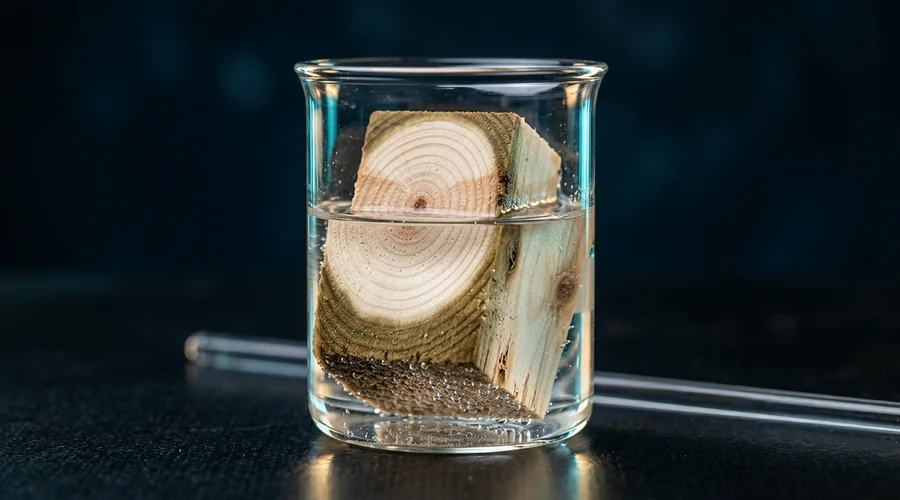
Borates work almost opposite to CCA. Instead of locking into the wood, they stay dissolved in its moisture and move through it, so borate treatment can reach the core of timber that resists pressure impregnation. The common sources are disodium octaborate tetrahydrate, borax and boric acid, all of which release borate species in water. Borate interferes with essential metabolic processes in fungi and in insects that ingest it, so one active covers decay fungi, termites and wood-boring beetles.
Four application routes cover most borate wood treatment:
- Diffusion treatment — freshly sawn green lumber is dipped or sprayed with concentrated borate solution, then stacked and wrapped so the borate diffuses inward along the moisture gradient
- Pressure impregnation — borate solution driven into seasoned timber in a treatment cylinder for interior and protected uses
- Glycol-borate and spray or brush-on products — a glycol carrier improves penetration for on-site protection and remedial treatment of existing structures
- Fused borate rods — solid rods inserted into drilled holes dissolve in the wood's own moisture and protect from the inside, a common remedial method for window joinery and poles
Borates also contribute fire-retardant behaviour to cellulosic materials, an effect we cover in our guide to fire-retardant wood coatings. Their acute toxicity to mammals is low, which is why they dominate interior framing and remedial work. Toxicity has a second side, though: boric acid and several borates carry a reproductive toxicity classification in the European Union, which brings labelling duties for products above set thresholds.
That leachability caps borate at protected above-ground service. Where timber meets rain, soil or standing water, fixed copper systems take over, and they are the subject of the next section.
Copper Azole Treatment, ACQ and Micronized Copper: The Post-CCA Systems
After 2003, alkaline copper and copper azole systems became the standard waterborne treatments for residential timber in North America. They keep copper as the main fungicide and add a second, organic biocide to cover fungi that tolerate copper. The families differ in how copper reaches the wood and which co-biocide guards against tolerance. None has chromium's fixation, so copper retention and metal corrosion need deliberate attention.
- ACQ (alkaline copper quaternary) — copper oxide solubilised with ammonia or ethanolamine and paired with a quaternary ammonium compound; the ACQ reference entry covers the variants
- Copper azole (CA) — copper solubilised with ethanolamine and paired with a triazole fungicide such as tebuconazole, which inhibits ergosterol synthesis in fungal membranes
- Micronized copper azole (MCA) — basic copper carbonate ground to sub-micron particles and dispersed rather than dissolved. The particles lodge in the wood structure and dissolve slowly in its own acidity. An azole co-biocide covers copper-tolerant fungi
Copper azole treatment and its relatives share two practical drawbacks. Alkaline copper systems release more copper than CCA-treated timber, most noticeably early in service. Wood treated with copper-based waterborne preservatives is also more corrosive to steel and zinc coatings than CCA-treated wood. Hot-dip galvanised hardware to ASTM A153 or stainless steel is the usual specification, and the wider discipline of anti-corrosion coatings explains the galvanic and barrier mechanisms that protect steel.
| System | Active components | How the biocide is held | Typical service | Main limitation |
|---|---|---|---|---|
| CCA | Copper, arsenic, chromium | Chromium fixation makes the biocides largely insoluble in the wood | Poles, pilings, foundation beams and other industrial uses | Arsenic and chromium; residential use discontinued in the US |
| ACQ | Copper, quaternary ammonium compound | Copper binds to wood after the alkaline carrier is lost; less robust than chromium fixation | Residential and landscaping timber, ground contact | Corrodes steel and zinc; copper release |
| Copper azole | Copper, triazole fungicide | Copper binds to wood after the ethanolamine carrier is lost | Residential and landscaping timber, ground contact | Corrodes steel and zinc; copper release |
| Micronized copper azole | Copper carbonate particles, triazole fungicide | Particles lodge in the wood structure and dissolve slowly | Residential and landscaping timber, ground contact | Corrodes steel and zinc; copper release |
| Borates | Boric acid and borate salts | Not fixed; mobile in wood moisture | Interior framing, protected above-ground timber, remedial treatment | Leach out when wetted |
| Creosote | Coal-tar distillate | Oil carrier stays in the wood and repels water | Railway sleepers, utility poles, marine piling | Odour, oily surface, regulatory restrictions |
| LOSP azole systems | Organic fungicides in a solvent carrier | Solvent evaporates, leaving the fungicide in the wood | Joinery and window frames | Suited to above-ground use; VOC obligations |
No single system wins everywhere, because each one trades toxicity, fixation, corrosion and regulation differently. What decides whether the chosen chemistry performs is the process that puts it into the timber, which is the next topic.
Pressure Treated Wood Chemistry: How Preservatives Get In and Lock In
Wood preservative chemistry is only half of pressure treatment. The other half is process engineering: driving a liquid deep into a dense cellular material, then giving it time to react. A treatment plant controls this second half directly, and it decides whether a well-chosen formulation performs as designed. The sequence below is the full-cell process used for most waterborne systems.
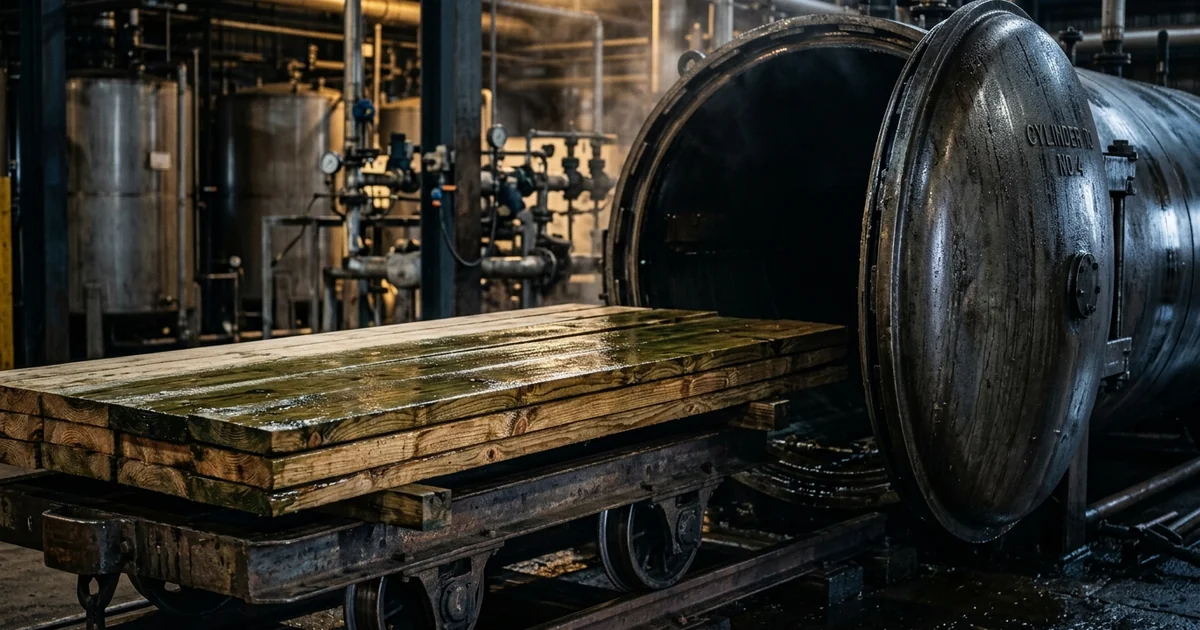
- Load and seal — timber is loaded onto trams, rolled into the treatment cylinder and the door is sealed
- Initial vacuum — air is drawn out of the wood cells so the solution can take its place
- Flood — the cylinder fills with preservative solution while the vacuum holds
- Pressure — pressure is raised to force the solution into the wood structure
- Release and final vacuum — pressure is relieved and a final vacuum pulls surplus solution from the surface
- Fixation and drip — the timber is held so the preservative reacts with the wood and free liquid drains before dispatch
Oil-borne and solvent systems often use empty-cell variants such as the Lowry and Rueping processes. These leave the cell walls coated but drive out much of the excess preservative, which reduces bleeding and preservative consumption.
Wood structure limits everything. Sapwood accepts preservative readily, while the heartwood of many species resists penetration, so species selection, incising and moisture control decide how deep the treatment goes. Penetration and retention are verified by chemical assay of increment cores taken from the treated charge.
Process control protects against fungi and general decay. Termites and the newer non-biocidal options need their own treatment logic, which the next section covers.
Termite-Resistant Wood Treatment and Non-Biocidal Alternatives
Termites change the design problem. Fungi need sustained moisture, but subterranean termites travel from the soil through protected galleries into building frames, so termite-resistant wood treatment needs an insecticidal active, a physical barrier, or both. Treated timber is one layer in a system that also includes soil treatment and barrier detailing. Choosing the timber-side chemistry starts with what each option actually protects against.
- Borates — fungal and insect protection from one active; widely used for framing in termite-prone regions and for remedial work
- Copper-based systems — copper is primarily a fungicide, so termite performance depends on the whole formulation and is demonstrated by standard termite tests, not assumed
- Metal-free organic systems — azole fungicides paired with a dedicated insecticide such as a pyrethroid or neonicotinoid
- Modified wood — chemical or thermal treatment that changes the wood itself and leaves no added biocide
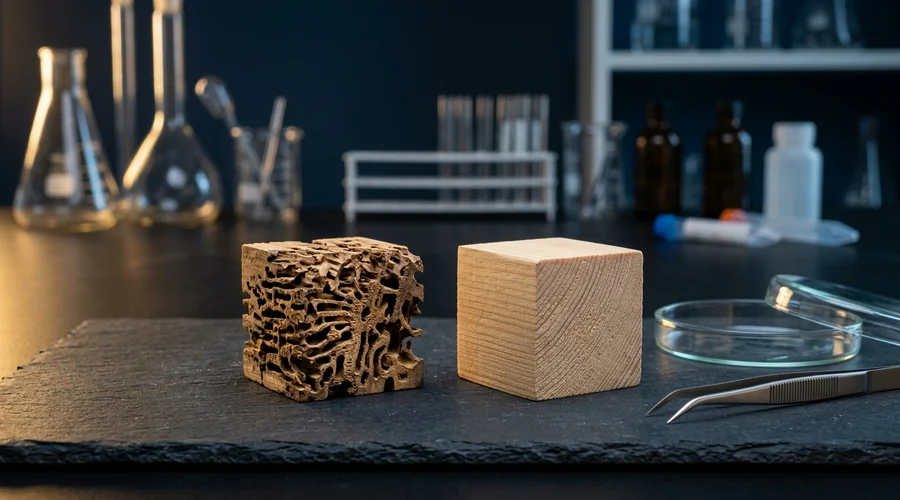
Modified wood deserves a closer look because it removes the biocide question entirely. Acetylated wood is the best-known example, and three routes are established commercially:
- Acetylation — acetic anhydride reacts with hydroxyl groups in the wood polymers to form acetate esters, so the wood takes up less moisture and swells less
- Furfurylation — furfuryl alcohol is impregnated and polymerised inside the cell wall, bulking it and lowering moisture uptake
- Thermal modification — controlled high-temperature heating in a low-oxygen atmosphere alters the hemicelluloses and reduces hygroscopicity
Termite resistance varies by process. Verify it against termite test data (ASTM D3345 or EN 117) rather than assuming decay-resistance results carry over. Whichever route you choose, a protection claim is only as good as the standard behind it.
Standards, Use Categories and Testing for Treated Timber
Wood preservation is standards-driven because failure takes years to appear. Standards turn a service environment into a use category, and they turn a preservative into a tested performance claim in that category. A treatment business without this framework cannot prove its product performs, and specifiers and regulators ask for that proof. Knowing which standard answers which question keeps the testing programme focused. The American Wood Protection Association publishes the North American set.
| Standard or regulation | What it governs |
|---|---|
| AWPA U1 | Use Category System, from UC1 (interior dry) to UC5 (marine); links each use to accepted preservatives and retentions |
| AWPA T1 | Processing and treatment requirements for treated timber |
| EN 335 | Use classes 1 to 5, defining the biological hazard for each service environment |
| EN 350 | Testing and classification of the natural durability of wood species |
| EN 351-1 | Classification of preservative penetration and retention in treated solid wood |
| EN 599-1 | Efficacy specification for preventive preservatives by use class |
| EN 113 and EN 117 | Laboratory tests against wood-destroying basidiomycete fungi and against termites |
| ASTM D1413 | Laboratory soil-block culture test of preservative efficacy against decay |
| ASTM D3345 | Laboratory evaluation of resistance to termites |
| ASTM D1758 | Field stake tests that check laboratory results under real exposure |
| IS 401 | Indian code of practice for preservation of timber |
| EU Biocidal Products Regulation | Wood preservatives fall under product type 8; active substances need approval |
| US EPA under FIFRA | Wood preservatives are registered as pesticides |
Regulatory status matters as much as efficacy data. Our guide to the Biocidal Products Regulation for coatings and preservatives explains the approval route for the European market. In regulated markets the treatment plant itself operates as a regulated pesticide-application and waste-generating facility, so effluent control and drip-pad containment belong in the business plan from day one.
With the framework in place, the practical question is how to select a system for a specific product, market and plant.
Choosing a Wood Preservative System: A Decision Framework
Selecting a system is a sequence of narrowing decisions, not a single comparison of biocides. Each step removes options until one or two systems remain viable for the product, market and plant. Working through the sequence in order prevents the most expensive error: committing to equipment and a registration route for a chemistry that cannot meet the use category.
- Define the use category — interior dry, exterior above ground, ground contact or marine, using AWPA U1 or EN 335
- Identify the hazard organisms — decay fungi alone, or termites and marine borers as well; this decides whether an insecticidal active is required
- Check regulatory status by market — confirm active-ingredient approval and product registration in every country you plan to sell in before investing in equipment
- Match treatability to species — permeable sapwood species suit pressure treatment, while refractory species need incising or a diffusion route
- Specify hardware and finishes — copper systems need corrosion-resistant fasteners, and borate timber needs a water-managed detail or a coating. Our complete guide to wood coatings, stains and varnishes covers the finishing side
- Plan the plant — choose between a pressure cylinder, dip-diffusion line or spray line, and budget for effluent control and drip-pad containment
- Validate with test data — collect soil-block, termite and field-stake evidence to the standards your buyers reference
If you are building a timber-finishing venture alongside treatment, our guide to starting a wood varnish and stain manufacturing unit covers the coatings side of the business.
The right system is the one whose wood preservative chemistry matches the hazard, whose fixation matches the exposure and whose regulatory status survives in the market you serve. CCA showed how much fixation matters, borates showed the value of mobility, and copper systems showed that the co-biocide carries as much weight as the metal. Use those three lessons as a screening test before you commit to trials.
Frequently Asked Questions
What is the difference between CCA, ACQ and copper azole wood preservatives?
Is borate wood preservative effective for outdoor use?
Why did the industry stop using CCA for residential wood?
What is micronized copper azole and how does it differ from older copper systems?
How does wood treatment protect against termites?
Why does treated wood corrode fasteners, and what should I use?
Are acetylated and thermally modified woods a real substitute for preservative-treated timber?
Need Expert Formulation Support?
Our team provides end-to-end technical consultancy — from chemistry development and scale-up to plant design and regulatory strategy for coatings and protective-chemical ventures.
Get a Free Consultation