Boiler Water Treatment: Internal vs External Programs
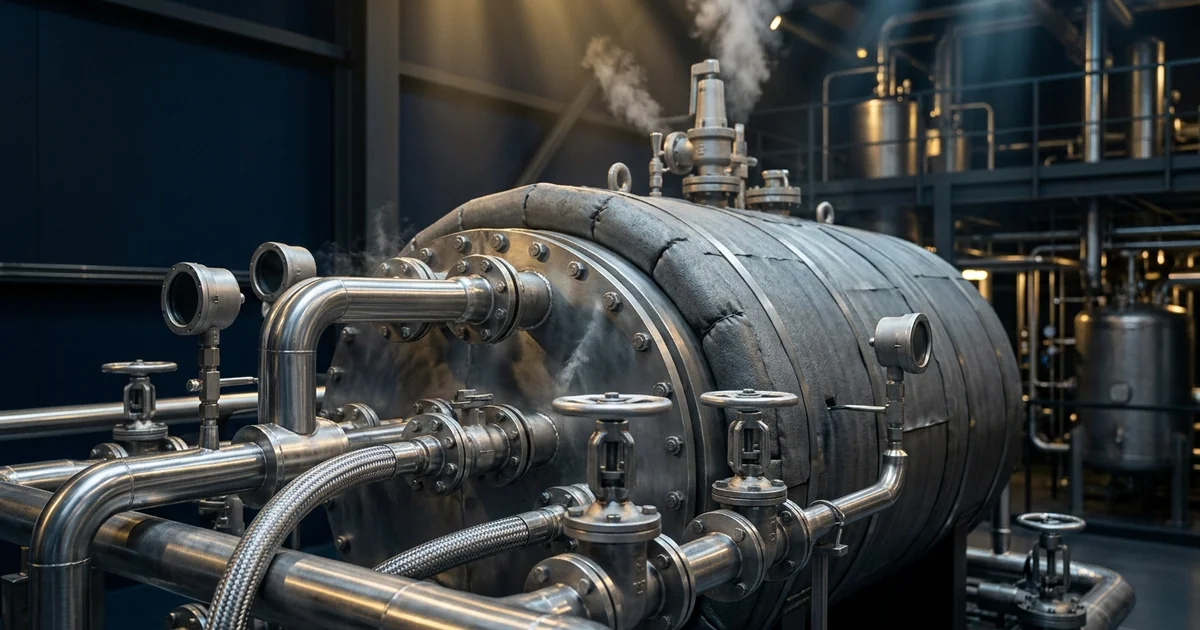
A boiler fed with softened water can still foul its tubes, pit its economiser and carry solids into the steam header. No single cause explains those failures, because scale, oxygen attack, caustic concentration and carryover each need a different control. Boiler tubes tolerate very little deposit at high heat flux, so a small lapse becomes overheating, unplanned downtime and tube replacement. This guide explains boiler water treatment as two layers, external treatment of the feedwater and internal treatment of the boiler water, and shows how blowdown ties them together. It draws on the Veolia Water Handbook, Spirax Sarco's boiler house guides and IAPWS guidance. It also reflects the formulation support Global Formulation gives water treatment chemical makers.
Boiler Water Treatment Basics: External and Internal Layers
Boiler water treatment works in two layers because no single step removes every impurity that reaches a boiler. External treatment cleans the make-up water before it enters the feedwater system, and internal treatment conditions whatever remains once the water is inside the boiler. The Spirax Sarco boiler house guide states that, where possible, the principal feedwater treatment on steam boilers should be external. The table below compares the layers and shows why neither replaces the other.
| Layer | Where It Acts | Typical Tools | Limit of the Layer |
|---|---|---|---|
| External treatment | Make-up water and feedwater before the boiler | Softening, dealkalisation, demineralisation, reverse osmosis, mechanical deaeration | Leaves traces of hardness, iron, silica and oxygen, and cannot treat contamination that arrives later in condensate |
| Internal treatment | Feedwater line, boiler drum and condensate system | Deposit control chemicals, oxygen scavengers, pH adjustment, antifoam | Conditions residual impurities only, so chemical demand and blowdown rise with feedwater contamination |
| Blowdown | Boiler water at the surface and the lowest drum | Continuous take-off and intermittent manual blow | Removes solids by discharge, which also discharges heat, water and treatment chemicals |
Veolia's handbook notes that feedwater pretreatment has advanced to the point of supplying ultrapure water. It adds that the capital cost of such trains is often not justified against the capability of internal treatment. Even softened or demineralised water does not give deposit-free operation, so a good internal programme stays necessary. Our overview of water treatment technology and formulations shows how the chemicals are built, and the wider category sits under water treatment.
The first layer, feedwater chemistry, decides how heavy the second layer must be.
Boiler Feedwater Chemistry and External Treatment: Softening, Demineralisation, Deaeration
Feedwater chemistry sets the workload for every internal chemical that follows. Spirax Sarco lists reverse osmosis, lime and lime-soda softening, and ion exchange as the main external processes. It calls ion exchange by far the most widely used method for shell boilers producing saturated steam. Each process removes a different fraction of hardness, alkalinity and dissolved solids, and mechanical deaeration then handles dissolved gas.
- Reverse osmosis — forces water through a semi-permeable membrane and rejects a concentrated solution of impurities to waste.
- Lime and lime-soda softening — lime reacts with calcium and magnesium bicarbonates to form a removable sludge, and soda ash reduces non-alkaline hardness.
- Ion exchange — covers base exchange, dealkalisation and demineralisation using resin beads in a packed bed.
- Deaeration — heats the feedwater with steam to cut oxygen solubility, then scrubs the water to strip the last traces.
Deaeration follows Henry's law. The solubility of a gas in water is proportional to its partial pressure above the liquid and falls as the temperature rises. In a pressure deaerator, feedwater is sprayed into a steam atmosphere that heats it to within a few degrees of saturation temperature. Veolia reports that 97 to 98 percent of the incoming oxygen is released to the steam and vented at that stage. Vigorous steam scrubbing then removes all but the last traces, and the handbook concludes that industrial oxygen and metal oxide standards need efficient mechanical deaeration plus a controlled chemical scavenger.
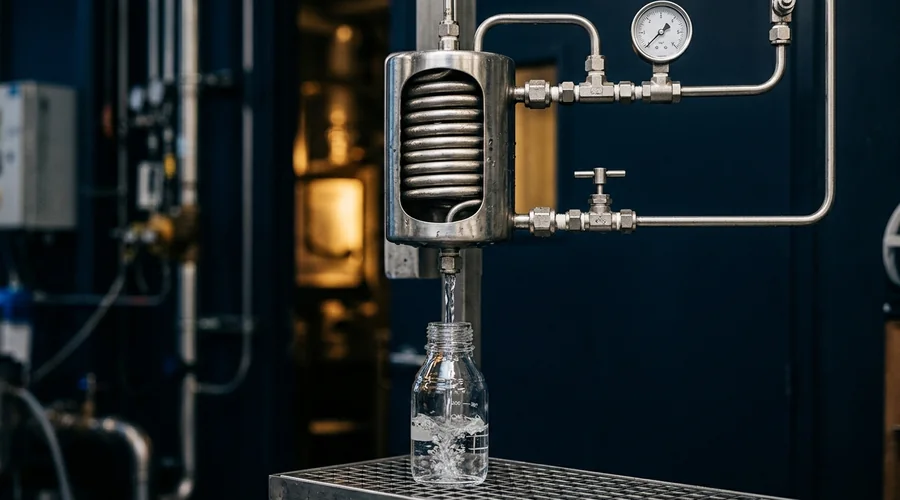
Water leaving the deaerator is nearly oxygen-free, yet it still carries traces of hardness, iron and silica, so the internal programme starts with deposit control.
Internal Boiler Treatment Programme for Scale: Phosphate, Chelant and Polymer
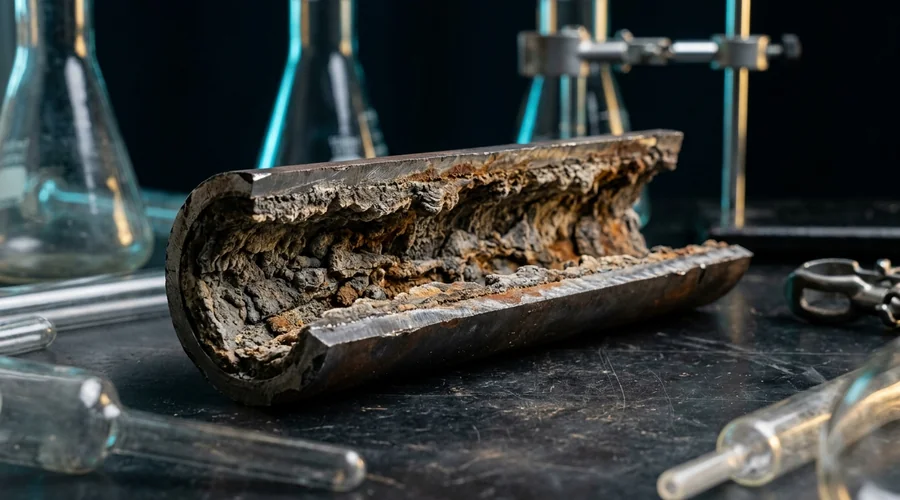
Deposits form because heat transfer concentrates dissolved salts at the tube wall faster than the circulating water can dilute them. Veolia's chapter on boiler deposits separates them into scale, which crystallises directly on tube surfaces, and sludge, which precipitates in the bulk water and is carried to the metal. A modern internal boiler treatment programme either precipitates hardness away from the heating surface or holds it in solution. The right choice depends on feedwater hardness, iron load and boiler pressure.
| Programme | How It Works | Strength | Watch-Out |
|---|---|---|---|
| Phosphate with polymer (precipitating) | Calcium precipitates as calcium phosphate in the bulk water, and polymer disperses the particles | Hardness leaves as sludge that blowdown discharges | Low alkalinity lets magnesium form an adherent phosphate |
| Chelant with polymer (solubilising) | Chelant holds calcium, magnesium, iron and copper in soluble complexes, and polymer disperses leftover iron oxide | Clean waterside surfaces, and forgiving of occasional upsets | Overfeed attacks protective magnetite, so feed control matters |
| Phosphate, chelant and polymer | Mixed programme for low- to medium-pressure boilers | Cleaner than phosphate alone, with an easy test for phosphate | More components to monitor and balance |
| Polymer only | Polymer acts as a weak chelant and dispersant | Simple programme | Works best when feedwater hardness is consistently very low |
The phosphate route rests on a simple solubility fact. Veolia states that calcium phosphate is virtually insoluble in boiler water, and that in sufficiently alkaline water it forms a particle with a relatively nonadherent surface charge. Magnesium precipitates preferentially as magnesium silicate, or as magnesium hydroxide when silica is absent. If alkalinity is too low, magnesium combines with phosphate instead, and that adherent solid collects other particles.
Chelants take the opposite route. They are weak organic acids fed as neutralised sodium salts, and water hydrolyses them to an anion that wraps around a metal ion. EDTA has six coordination sites and forms a stable complex with iron, while NTA has four and forms a weaker one. The handbook lists log stability constants of 10.59 for calcium-EDTA against 6.41 for calcium-NTA.
Polymers complete most programmes. Synthetic polymers replaced the lignins, tannins and starches used as early conditioners, and they are usually low in molecular weight with numerous active sites. Boiler polymers work mainly as dispersants, a different job from the threshold inhibition covered in our guide to phosphonate and polymer scale inhibitors. Some target hardness salts, some target iron, and some cover a broad range of ions.
Deposit control protects heat transfer, but corrosion control decides how long the tube metal survives.
Oxygen Scavengers, pH Control and Condensate Protection
Dissolved oxygen causes localised pitting in feedwater heaters, economisers and the steam drum, and the damage is severe because it is concentrated in small areas. Veolia's corrosion chapter names dissolved gases, under-deposit attack, low pH and mechanical stress as the main causes of boiler system corrosion. A chemical oxygen scavenger finishes the work that the deaerator starts. Selection depends on pressure, temperature, residence time and the end use of the steam.
| Scavenger | Reaction Products | Where It Fits | Limits |
|---|---|---|---|
| Sodium sulfite (plain or catalysed) | Sodium sulfate, which adds dissolved solids | Boilers below about 1,000 psig (69 bar), where cost and ease of testing matter | Decomposes at high pressure to sulfur dioxide and hydrogen sulfide, and is fed away from attemperation water |
| Hydrazine | Water and nitrogen, with no added solids | High-pressure systems where sulfite cannot be used | Toxic and slow at low temperature, and its ammonia decomposition product attacks copper alloys when oxygen is present |
| Organic scavengers (hydroquinone, ascorbate) | Organic oxidation products, with no added solids | Higher pressure systems, start-ups and boiler storage | Reaction rate still depends on temperature, pH and catalysts |
Reaction speed decides where the scavenger must be fed. For sulfite, every 18 °F (10 °C) rise in temperature doubles the reaction speed, and the reaction runs fastest between pH 8.5 and 10. Heavy metals such as cobalt and copper catalyse it. In Veolia's example, catalysed sulfite removed oxygen completely after 25 seconds, while uncatalysed sulfite removed less than half. Short residence time, economisers and incomplete deaeration all call for the catalysed grade.
pH control protects the metal in the same way. Corrosion of carbon steel at feedwater temperatures approaches a minimum between pH 9.2 and 9.6, and the best range for copper alloys is lower. Mixed-metal systems therefore often hold condensate and feedwater between pH 8.8 and 9.2. Neutralising amines such as morpholine and cyclohexylamine raise pH and form protective films on copper oxide, whereas ammonia accelerates copper alloy corrosion in the presence of oxygen.
Hot water loops and electric boilers follow a related logic. Veolia describes sodium sulfite, pH adjustment and a polymer dispersant for high-temperature hot water boilers. Closed heating systems use an inhibitor such as molybdate or nitrite, and our guide to cooling water corrosion inhibitors explains how those anodic inhibitors work.
Scale control and corrosion control meet at high pressure, where deposits and caustic work together.
Caustic Attack and Coordinated Phosphate Control in High-Pressure Boilers
High heat flux turns porous iron oxide deposits into miniature boilers. Water is drawn into the deposit, evaporates, and leaves a caustic solution far stronger than the bulk water. In Veolia's example the concentration under the deposit reaches at least ten thousand times the bulk level. Boilers fed with demineralised water and high condensate return therefore need a different internal programme from boilers fed with softened water.
- Caustic gouging — concentrated sodium hydroxide dissolves the protective magnetite layer, and the tube loses base metal in irregular gouges.
- Coordinated phosphate/pH control — disodium phosphate neutralises free caustic to trisodium phosphate, so high caustic cannot develop beneath deposits.
- Phosphate hideout — phosphate precipitates at hot tube surfaces when load rises and reappears when load falls.
- Acid phosphate corrosion — IAPWS defines it as under-deposit corrosion in which mono- and disodium phosphates concentrate beneath deposits.
The IAPWS guidance on phosphate and NaOH treatments is written for drum boilers in power plants and excludes industrial steam raising plants. Read its limits as a reference for the chemistry, not as a design basis for an industrial unit. It states that phosphate and caustic treatments tolerate more boiler water impurity than all-volatile treatment, and that phosphate is sometimes difficult to control. Hideout appears in boilers above about 10.4 MPa (1,500 psi) and can begin as low as 10.0 MPa. Veolia adds that supercritical once-through units tolerate no solids at all, so they use all-volatile treatment.
Every one of these chemicals adds solids or alters alkalinity, so the boiler needs an exit path, and that path is blowdown.
Boiler Blowdown Control: Solids, Foaming and Heat Recovery
Impurities that do not boil off with the steam concentrate in the boiler water. Blowdown removes concentrated water and replaces it with feedwater, which holds scale, corrosion, carryover and sludge within limits. Where chloride is the tracer, percent blowdown equals feedwater chloride divided by boiler water chloride, multiplied by 100. Veolia's blowdown chapter reports a range from under 1 percent with very high-quality feedwater to over 20 percent in a critical system with poor-quality feedwater.
- Continuous blowdown — removes water from the zone of highest dissolved solids and allows heat recovery through a flash tank and heat exchanger.
- Intermittent bottom blowdown — takes settled sludge from the lowest drum, and frequent short blows are preferred to infrequent long ones.
- Automatic control — a conductivity sensor, controller and modulating valve hold the set point, and Veolia reports an average saving of about 20 percent of blowdown against manual adjustment.
- Foaming limit — as dissolved solids rise, steam bubbles stabilise and foam carries boiler water into the steam main. Spirax Sarco names high dissolved solids as the most common cause of carryover once other factors are controlled.
Conductivity is the usual control signal because it indirectly measures dissolved solids. Feedwater and boiler water conductivity cannot be compared directly, so the handbook advises establishing a correlation factor for each system. Sampling needs care as well. Spirax Sarco advises taking samples from the TDS blowdown connection, never a gauge glass, because hot water flashes to steam as pressure drops and concentrates the sample. A sample cooler removes that error and encourages more frequent testing.
With the technical pieces in place, the remaining question is how to match them to a specific boiler.
Choosing a Boiler Water Treatment Programme by Boiler Type
No single programme suits every boiler, because pressure, heat flux, feedwater source and steam use change which risks dominate. Low-pressure boilers on softened water meet scale and oxygen problems first. High-pressure boilers on demineralised water and condensate return meet iron oxide and caustic problems first. A short decision sequence turns those differences into a shortlist.
| Boiler Duty | Dominant Risk | Internal Approach |
|---|---|---|
| Low- to medium-pressure steam boiler on softened make-up | Residual hardness scale, oxygen pitting, carryover | Phosphate with polymer, or phosphate with chelant and polymer, plus a sulfite scavenger and controlled blowdown |
| Boiler on demineralised water with high condensate return | Iron oxide deposits and caustic attack | Chelant with polymer, or coordinated phosphate/pH control with an iron-dispersing polymer |
| Hot water and closed heating loops | Dissolved oxygen, low pH, iron deposition | Oxygen scavenger or inhibitor, pH adjustment and a polymer dispersant |
| Electric resistance boiler | Very high heat transfer at the heating coil | Polymer for deposit control, because Veolia advises against treatments that precipitate hardness |
- Fix the feedwater first — measure hardness, iron, silica, alkalinity and the condensate return fraction before choosing chemistry.
- Match deposit control to feedwater quality — chelant programmes suit low-hardness feedwater with iron, while polymer-only programmes need consistently very low hardness.
- Match the scavenger to pressure and steam use — sulfite adds solids, so attemperation water and high-pressure units need a solids-free scavenger.
- Set the pH range for the metals present — copper alloys need a lower range than carbon steel.
- Size blowdown to the limiting parameter — total dissolved solids, alkalinity, silica or suspended solids can each set the rate.
- Confirm at inspection — deposit analysis and tube condition at the next outage show whether the programme works.
Veolia makes the last point explicitly. Steam purity testing verifies the effect of water on steam quality, whereas the effect on internal surfaces can be judged only from conditions found at turnaround. A programme chosen this way rests on inspection evidence rather than a supplier default.
Working With a Water Treatment Formulation Consultant
Boiler chemical blends combine deposit control, oxygen control and alkalinity functions in one product, and each function can fail separately. A water treatment formulation consultant tests the blend against the feedwater it will meet instead of against a catalogue claim. Independent water treatment chemical product development services also keep the programme matched to boiler pressure, metallurgy and steam use. The sequence of work matters more than any single test.
- Feedwater audit — hardness, iron, silica, alkalinity and condensate return fraction for each target market.
- Component selection — polymer, phosphate or chelant class, scavenger and amine chosen for pressure and metallurgy.
- Stability and compatibility — blend stability in storage and compatibility with feed pumps and make-up chemistry.
- Monitoring plan — test kits, conductivity control and inspection feedback that let the customer verify the programme.
- Scale-up — transfer to industrial water chemicals contract manufacturing with specifications that hold from batch to batch.
Manufacturers entering the category can start with our water treatment chemical manufacturing business guide, which covers the commercial side. Before committing to a blend, run a short decision check. Confirm the feedwater analysis, match the deposit and scavenger classes to boiler pressure, and set a blowdown strategy tied to a measured limit. Then verify the result at the first inspection, because a boiler treatment product is judged on the tube surface, not the data sheet.
Frequently Asked Questions
What is the difference between internal and external boiler water treatment?
External treatment cleans the make-up water before it reaches the boiler, using softening, dealkalisation, demineralisation, reverse osmosis and mechanical deaeration. Internal treatment adds chemicals to the feedwater or boiler water to control the impurities that remain, such as residual hardness, iron, dissolved oxygen and alkalinity.
Spirax Sarco states that, where possible, the principal feedwater treatment on steam boilers should be external. Internal treatment is still needed, because Veolia notes that even softened or demineralised water does not give deposit-free operation.
Can internal treatment replace a softener or demineralisation plant?
Rarely. Veolia notes that the capital cost of ultrapure pretreatment trains is often not justified against the capability of internal treatment, so the balance differs between plants. Spirax Sarco still recommends external treatment as the principal step where possible.
Internal chemicals only condition what arrives. Blowdown rate depends on the feedwater contaminant level, so poorer feedwater raises both chemical use and discharge losses. Heat flux in modern boilers has also risen, which lowers the tolerance for deposit.
How do phosphate and chelant programmes differ?
A phosphate programme precipitates hardness. Calcium forms calcium phosphate in the bulk water as a non-adherent sludge that blowdown discharges, and polymer disperses the particles. Alkalinity must stay high enough that magnesium precipitates as silicate or hydroxide rather than as an adherent phosphate.
A chelant programme solubilises hardness instead. The chelant, usually EDTA or NTA, wraps calcium, magnesium, iron and copper in soluble complexes that do not deposit. It gives clean surfaces but needs careful feed control, because excess chelant also attacks protective magnetite.
Which oxygen scavenger should a boiler use?
The choice depends on pressure, temperature, residence time and steam use. Below about 1,000 psig, sodium sulfite and catalysed bisulfite are the most common choices because they are cheap and easy to test. At 1,000 psig and above, hydrazine or organic scavengers replace sulfite, because sulfite adds dissolved solids and decomposes to sulfur dioxide and hydrogen sulfide.
Hydrazine adds no solids but is toxic, and the Veolia handbook calls it a suspected carcinogen. Organic scavengers such as hydroquinone and ascorbate are less toxic, and hydroquinone reacts quickly even at ambient temperature, which helps during start-up and storage.
What does boiler blowdown do and how is it controlled?
Blowdown removes concentrated boiler water and replaces it with feedwater, which limits dissolved solids, alkalinity, silica and suspended solids. Continuous blowdown takes water from the zone of highest dissolved solids, and intermittent bottom blowdown removes settled sludge from the lowest drum.
Conductivity is the usual control signal. Automatic control keeps the boiler near its set point, and Veolia reports that the average plant saves about 20 percent of blowdown against manually adjusted continuous blowdown. Flash tanks and heat exchangers then recover heat from the discharge.
What are phosphate hideout and caustic gouging?
Phosphate hideout is the precipitation of phosphate at hot tube surfaces or under deposits when boiler load rises, with the phosphate reappearing when load falls. IAPWS notes that it appears in higher pressure drum boilers above about 10.4 MPa and can begin as low as 10.0 MPa.
Caustic gouging is a different failure. Sodium hydroxide concentrates beneath porous deposits or under steam blanketing, dissolves the protective magnetite layer and removes base metal in irregular gouges. Coordinated phosphate/pH control and clean tube surfaces are the main defences.
Why must a boiler water sample be cooled before testing?
Hot boiler water flashes to steam when its pressure drops, and the flash steam leaves the sample more concentrated than the water in the boiler. The analysis is then wrong, and drawing an uncooled sample is also dangerous for the operator.
A sample cooler is a small heat exchanger that uses cold mains water to cool the blowdown sample. Spirax Sarco adds that it saves time and encourages more frequent testing. Samples should come from the TDS blowdown connection, not from gauge glasses or from close to the feedwater inlet.
What can a water treatment formulation consultant do for a boiler chemical manufacturer?
A consultant checks that the blend suits the boiler pressure, metallurgy and feedwater it will meet. The work covers feedwater audits, selection of deposit control and scavenger classes, stability and compatibility testing of the blend, and a monitoring plan the customer can use to verify performance.
Consultants also support scale-up and technology transfer to a contract manufacturer. This lets a water treatment company bring a boiler product range to market with documented specifications and batch-to-batch control.
Building a Boiler Treatment Range or Auditing a Programme?
Global Formulation supports water treatment chemical makers with feedwater audits, deposit and scavenger programme design, blend stability and compatibility testing, product development and scale-up to contract manufacturing.
Talk to Our Formulation Team