Scale Inhibitor Water Treatment: Phosphonates vs Polymers
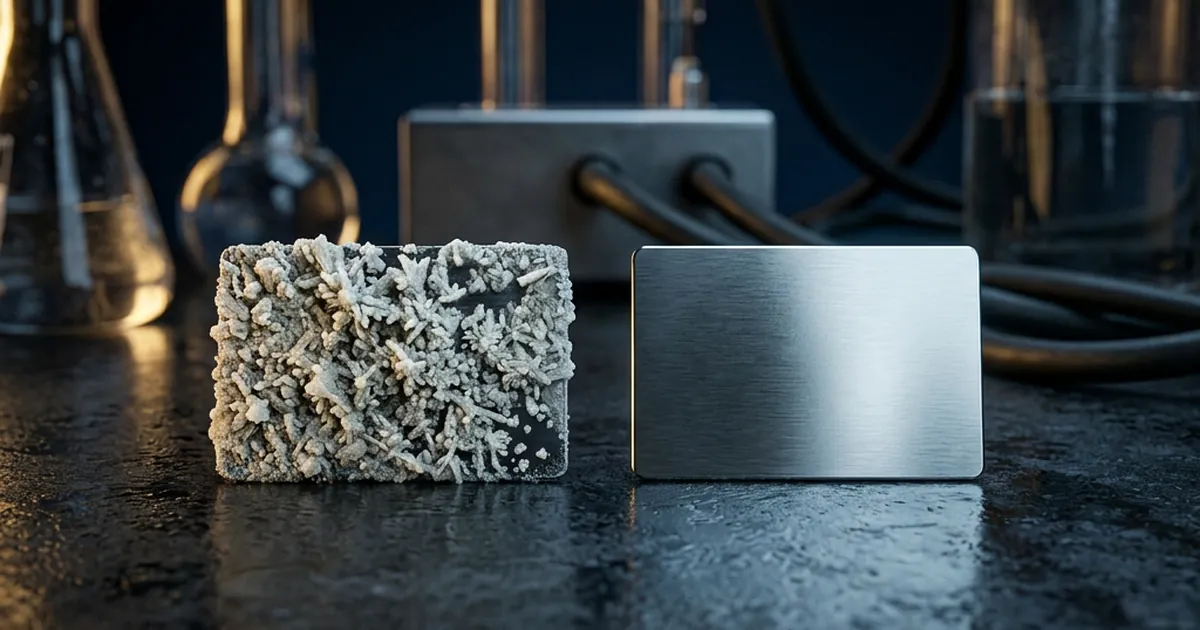
A cooling loop, boiler or RO train can carry water that is already supersaturated with hardness salts and still stay clean for years. A small dose of the right inhibitor does that work, and a poor choice turns into a deposit of its own. Scale costs heat transfer, energy, membrane life and unplanned downtime, and the wrong chemistry adds a second fouling problem on top. This guide explains scale inhibitor water treatment, from threshold inhibition and crystal growth to phosphonate and polyacrylate chemistry, application limits and screening. It draws on an EPRI state-of-knowledge report, the DuPont FilmTec technical manual and open peer-reviewed studies, plus the formulation support Global Formulation gives water treatment chemical makers.
Scale Inhibitor Water Treatment Basics: Threshold Inhibition, Crystal Growth and Dispersion
Scale forms when a dissolved salt exceeds its solubility, nucleates and grows into a hard crystalline layer. Inhibitors do not remove the hardness from the water. They interfere with the steps that turn dissolved ions into a deposit, which is why a very small amount of the right molecule has such a large effect. Three mechanisms do the work, and most commercial products combine more than one.
Threshold inhibition is the classic mechanism. The inhibitor acts at a dose far below the stoichiometric amount needed to bind the hardness, which separates it from simple chelation. EPRI's cooling water treatment report states that phosphonates inhibit calcium carbonate deposition primarily by threshold stabilisation that interferes with the nucleation and aggregation of crystals.
Crystal growth inhibition is the second mechanism. An open-access laboratory study of four non-phosphorus inhibitors split the effect in two. One part is preventing the formation of calcium carbonate by keeping calcium in solution. The other is slowing the growth of the crystals that do form. All four adsorbed on the main growth surface of calcite and destroyed the regular crystal shape. Dispersion is the third mechanism, and it keeps small particles apart so they do not agglomerate and settle.
| Mechanism | What Happens | Typical Chemistry | Source |
|---|---|---|---|
| Threshold inhibition | Interferes with nucleation and aggregation, so supersaturated water stays in solution | Phosphonates such as HEDP and PBTC | EPRI |
| Crystal growth inhibition and distortion | Adsorbs on growth surfaces, so crystals grow malformed and less stable | Polymers, especially polymaleics; polyacrylic, polyaspartic and polyepoxysuccinic acids | EPRI; open-access calcite study |
| Dispersion | Keeps small particles and precipitates suspended and moving | Polyacrylates, higher molecular weight polymers, sulfonated copolymers | EPRI; DuPont FilmTec manual |
| Chelation | Binds metal ions in stoichiometric proportion | Amino-phosphonates such as ATMP, an "excellent chelant" | EPRI |
These mechanisms map onto two families of chemistry, and the phosphonates come first.
Phosphonate Scale Inhibitor Chemistry: HEDP, PBTC and Amino-Phosphonates
Phosphonates are the workhorse threshold inhibitors because they deliver strong calcium carbonate control at very low usage rates. EPRI divides them into non-nitrogen phosphonates, mainly HEDP and PBTC, and amino-phosphonates. The split matters because the nitrogen linkage decides how the molecule survives chlorine. A formulator picks among them for the oxidiser, the hardness and the discharge limit.
| Phosphonate | Class | Strengths | Limits (EPRI) |
|---|---|---|---|
| HEDP | Non-nitrogen | Excellent calcium carbonate inhibition at low dosage; good chlorine stability | Degrades over time with bromine; performance reduced by iron; can precipitate with calcium at high pH and high concentration; aggressive to galvanising at high concentrations |
| PBTC | Non-nitrogen, with phosphonic and carboxylic groups | Effective under high hardness, high calcite supersaturation and high temperature; excellent chlorine and bromine stability; tolerant of iron | Usually more expensive and needs a higher dosage than HEDP |
| ATMP (AMP) | Amino-phosphonate | Excellent chelant and calcium sulfate inhibitor; lower cost than HEDP | Less effective than HEDP on calcium carbonate; amine linkage very susceptible to chlorine |
| PAPEMP | Polyether amino-phosphonate | Calcium carbonate and carbon steel corrosion inhibitor; used where high calcium tolerance and high pH are required | Poor chlorine stability; occasional use with bromine chemistry |
Sulfate scales shift the picture. EPRI notes that amino-phosphonates are generally excellent inhibitors for sulfate salts and are widely used in reverse osmosis scale inhibitors, even though chlorine limits them in cooling towers. A formulator therefore matches the phosphonate to the dominant scale, not only to the system type. Our cooling tower water treatment guide shows how HEDP and PBTC fit a full programme.
Phosphonates also carry a built-in failure route. EPRI lists orthophosphate that is generated in situ by the reversion of polyphosphates or phosphonates among the sources of calcium phosphate scale. A phosphonate that degrades under its oxidiser therefore loses scale control and adds a new deposit. Calcium itself is the other trap, because many classic phosphonates show poor tolerance of high calcium and precipitate as insoluble calcium-inhibitor complexes, as an open-access phosphonate study reports.
Phosphonates handle nucleation well, but polymers cover the gaps they leave.
Polyacrylate Antiscalant and Polymer Chemistry: Carboxylates, Sulfonates and Green Options
Polymers add dispersion and crystal distortion that small phosphonate molecules cannot supply. EPRI notes that water treatment polymers are made by free radical polymerisation, and that molecular weight, monomer ratio, branching and end groups can all be controlled. Those design variables give a formulator a wide range of products from a handful of monomers. The functional group on the chain tells you which scale a polymer suits.
| Polymer | Best Suited To | Notes (EPRI) |
|---|---|---|
| Polyacrylate (PAA, sodium polyacrylate) | Calcium carbonate and calcium sulfate scale; suspended solids, especially swelling clays | Not highly effective on calcium phosphate, iron, manganese or zinc hydroxide; water treatment grades are below 10,000 molecular weight |
| Polymethacrylate | Scale and suspended solids control similar to polyacrylate | Not commonly used in water treatment but found in boiler applications; better iron oxide dispersion |
| Polymaleic acid (PMA) | Calcium carbonate under stress from high calcium, alkalinity and temperature; some silica use | Functions mainly by crystal distortion |
| Polyaspartic acid (PASA) | Non-phosphorus control of calcium carbonate, calcium sulfate and barium sulfate | Less effective than PAA or PMA but more readily biodegradable |
| Sulfonated copolymers (AA/AMPS, SS/MA) | Calcium phosphate, iron, manganese and zinc hydroxide | Sulfonic acid stays charged at low pH; sulfonated styrene cost limits use |
Molecular weight is the main tuning knob. EPRI reports that polyacrylates of around 2,000 molecular weight are typically most effective as scale inhibitors, while 5,000 to 10,000 suits suspended solids dispersion. EPRI's general rule for polymers is lower molecular weight for scale control, somewhat higher for silt and higher still for silica. A polyacrylate antiscalant is therefore a family of grades, not a single product.
Literature rankings need care. In the open-access calcite study, polyepoxysuccinic acid ranked first of four inhibitors for both formation and crystal growth, and polyacrylic acid ranked last at both. EPRI, by contrast, places polyaspartic acid below polyacrylate and polymaleic acid on scale inhibition. The study measured one synthetic water at 51 °C, while EPRI gives a general industry assessment. A ranking from one set of conditions does not transfer automatically to another.
Chemistry only matters in a system, and each system adds its own constraints.
Scale Inhibitors by Application: Cooling Water, Boilers and RO Antiscalants
The same chemistry behaves differently in different systems because temperature, oxidiser and contaminants differ. A cooling tower sees halogen biocides, iron and rising pH. An RO membrane sees no heat but very high concentration, and any precipitate lands on a surface that cannot be scrubbed. A formulator designs for the system before choosing the molecule.
| System | Typical Chemistry | Main Constraint | Source |
|---|---|---|---|
| Open cooling water | HEDP, PBTC and polymer blends | Halogen stability, iron, calcium tolerance and rising limits on phosphorus | EPRI |
| Boilers | Polymers; polymethacrylates find some application | Scale on heat transfer surfaces | EPRI |
| RO and nanofiltration | Organophosphonates and polyacrylates; SHMP is generally not recommended | Cationic polymers, iron and aluminium, overdosing, microbial growth in the dosing tank | DuPont FilmTec manual |
| Oil and gas production | Phosphonates (ATMP, DTPMP) and polymers (PAA, polyvinyl sulfonate) | Brine calcium tolerance, adsorption on rock, biodegradability | Open-access phosphonate study |
Reverse osmosis shows the threshold effect most clearly. The DuPont FilmTec manual says a scale inhibitor added to the feed permits operation above the solubility product, when adequate inhibitor is used according to the manufacturer's instructions. It names three types: sodium hexametaphosphate, organophosphonates and polyacrylates. Sodium hexametaphosphate is cheap but unstable, and hydrolysis in the dosing tank lowers efficiency and creates a calcium phosphate scaling risk, so the manual does not generally recommend it.
The same manual explains why organophosphonates dominate. They are more effective and stable than hexametaphosphate, and they act as antifoulants that keep insoluble aluminium and iron in solution. High molecular weight polyacrylates reduce silica scale through a dispersion mechanism. Our guides to coagulant selection and polyelectrolyte flocculant selection cover the pretreatment chemicals that meet antiscalants downstream.
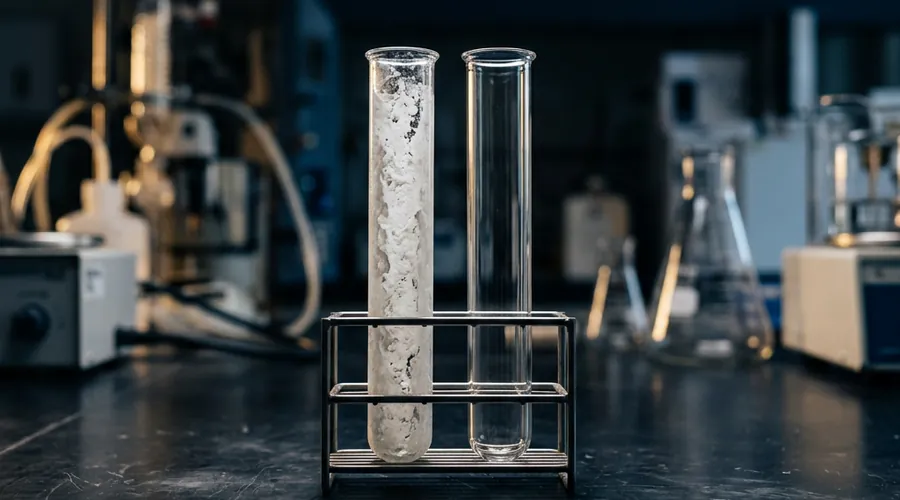
Charge is the hidden hazard. FilmTec reports that nearly all antiscalants are negatively charged and react with cationic coagulants or flocculants. Membranes in several RO plants have been heavily fouled by a gel formed between cationic polyelectrolytes and antiscalants. Polymers based on acrylic acid are also sensitive to iron and aluminium, which deactivate, or poison, the inhibitor. The manual adds that antiscalant fouling can feed microorganisms and lead to biofouling.
With the system constraints clear, the remaining question is how to select and prove a product.
Selecting and Testing a Scale Inhibitor: Compatibility, Environment and Screening
Selection starts with the water and the failure mode, not with a favourite molecule. A product that wins in a clean beaker can fail on iron, on a halogen or at the discharge permit. Testing therefore has to cover performance, compatibility and environmental fate together. Each test answers a different question.
| Test or Check | Question It Answers | Source |
|---|---|---|
| Static precipitation test | How much calcium stays in solution after a fixed time at temperature, with and without inhibitor | Open-access calcite study |
| Crystal characterisation (XRD, particle size) | Whether crystals that do form are smaller, distorted or changed in structure | Open-access calcite study |
| Dynamic tube-blocking rig | The minimum inhibitor concentration that prevents blockage, found by stepping the dose down until pressure rises | Open-access phosphonate study |
| Oxidiser, iron and calcium compatibility | Whether the molecule survives chlorine or bromine and avoids precipitating | EPRI; open-access phosphonate study |
| Microbial growth and 1,000-hour membrane test | Whether a diluted antiscalant grows microbes and whether it harms an RO membrane over time | DuPont FilmTec manual |
| Seawater biodegradation (OECD 306) | How far the molecule is consumed by microorganisms in 28 days | Open-access phosphonate study |
Environmental fate shapes selection as much as performance. EPRI reports increasing restrictions on phosphorus in cooling water corrosion and mineral scale inhibitors. The HERA assessment of ATMP, HEDP and DTPMP found that phosphonates do not significantly degrade in wastewater treatment plants but are removed from the water by adsorption to sludge. The open-access phosphonate study adds that many classes of scale inhibitor are poorly biodegraded, especially in seawater, which limits their use where regulation is strict.
Green chemistry is the response. Polyaspartic acid is more readily biodegradable than polyacrylate or polymaleic acid, at some cost in efficiency. The open-access study reports a phosphonated iminodisuccinate that gave good calcite inhibition with good calcium compatibility and over 70 percent biodegradation in the OECD 306 seawater test. Such results show where inhibitor development is heading, and our green chemistry perspective covers the wider trend.
Turning a tested molecule into a product that behaves across many sites is the formulator's job.
Working With a Water Treatment Formulation Consultant
Scale inhibitor programmes sit between water chemistry, polymer science, metallurgy and regulation, and a change in one area shifts the others. A water treatment formulation consultant characterises the make-up water and the system, then screens phosphonates, polymers and blends against the scale that matters. Water treatment chemical product development services extend that into compatibility testing, specifications and technical data. Industrial water chemicals contract manufacturing then carries the validated blend into production under batch controls.
- Define the scale — water analysis, temperature, pH and the minerals most likely to precipitate.
- Map the constraints — oxidiser programme, metals, pretreatment chemicals and discharge limits.
- Screen the chemistry — phosphonates, polymers and combinations in static and dynamic tests.
- Test compatibility — calcium, iron, halogens and cationic polymers at worst-case conditions.
- Check stability and hygiene — storage stability and microbial growth in diluted product.
- Pilot the blend — confirm performance on the real system before full release.
- Transfer to manufacture — write the specification and quality limits for the contract manufacturing partner.
Our water treatment range shows where scale inhibitors sit among coagulants, flocculants and biocides. Our guide to starting a scale and corrosion inhibitor manufacturing unit covers the supply side, and the rust and scale remover guide covers removing deposits that have already formed. Global Formulation provides scale inhibitor screening, compatibility testing, specification support and contract manufacturing transfer for water treatment chemical makers. Dose rates and blend ratios stay outside this guide by design, because each system sets its own.
Frequently Asked Questions
What is a scale inhibitor in water treatment?
A scale inhibitor is a chemical that keeps hardness salts such as calcium carbonate and calcium sulfate from forming hard deposits on pipes, heat exchangers and membranes. It does not soften the water. It interferes with nucleation and crystal growth so that supersaturated water stays in solution.
The main families are phosphonates such as HEDP and PBTC and polymers such as polyacrylates and polymaleic acid, often blended together.
Choosing among them depends on the scale, the temperature, the oxidiser and the discharge limits.
What is threshold inhibition?
Threshold inhibition is scale control at a dose far below the stoichiometric amount needed to bind the hardness. EPRI reports that phosphonates inhibit calcium carbonate deposition primarily by threshold stabilisation that interferes with the nucleation and aggregation of crystals.
It differs from chelation, where the additive binds metal ions in proportion to their amount. A chelant such as ATMP does both jobs, which is why phosphonates are described as chelating agents and scale inhibitors.
Threshold inhibitors have a ceiling, and under very high supersaturation they are usually combined with a polymer that distorts crystal growth.
How do phosphonates differ from polyacrylates as scale inhibitors?
Phosphonates are small molecules that act mainly as threshold inhibitors of nucleation, with strong calcium carbonate control at low dosage. Polyacrylates are polymers that distort crystal growth and disperse small particles.
Polyacrylates work well on calcium carbonate and calcium sulfate and as dispersants for suspended solids. EPRI reports they are not highly effective on calcium phosphate, iron, manganese or zinc hydroxide.
Phosphonates add phosphorus to the discharge, while polyacrylates do not, which is one reason formulators blend the two.
What is the difference between HEDP and PBTC?
Both are non-nitrogen phosphonates used mainly in cooling water. EPRI reports that HEDP has good chlorine stability but degrades over time with bromine, is hurt by iron, and can precipitate with calcium at high pH and high concentration.
PBTC has excellent stability with chlorine and bromine, is much more tolerant of iron, and does not precipitate with calcium under high pH and high calcium conditions.
PBTC is usually more expensive and needs a higher dosage, but it is more robust and contributes less phosphate, so many programmes blend the two.
Can antiscalants be used in RO systems, and what goes wrong?
Yes, antiscalants are routine in reverse osmosis. The DuPont FilmTec manual names sodium hexametaphosphate, organophosphonates and polyacrylates, and says a scale inhibitor lets the system operate above the solubility product when used according to the manufacturer.
The common failures are charge reactions and metal poisoning. Nearly all antiscalants are negatively charged and form a gel with cationic polyelectrolytes, and acrylic acid polymers are deactivated by iron and aluminium.
Overdosing should be avoided, and a diluted antiscalant must be tested because microorganisms can grow in it.
Why do scale inhibitors sometimes form deposits or stop working?
The usual causes are calcium tolerance, oxidiser attack and contamination. Many classic phosphonates precipitate as insoluble calcium-inhibitor complexes at high calcium, and EPRI notes HEDP can do this at high pH and concentration.
A phosphonate that degrades under chlorine or bromine loses scale control, and the orthophosphate released can form calcium phosphate scale. In RO plants, cationic polymers and metals carried over from pretreatment can foul the membrane with a gum-like product.
Testing the blend at worst-case calcium, pH, oxidiser and carry-over conditions finds these failures before they reach a customer.
Are scale inhibitors biodegradable and environmentally safe?
It depends on the chemistry. The HERA assessment reports that phosphonates do not significantly degrade in wastewater treatment plants but are removed by adsorption to sludge. EPRI reports increasing restrictions on phosphorus in cooling water scale inhibitors.
Polyaspartic acid is more readily biodegradable than polyacrylate or polymaleic acid, although less effective. Researchers have also reported a phosphonated iminodisuccinate that gave good calcite inhibition and over 70 percent biodegradation in a 28-day OECD 306 seawater test.
Regulators set the limits, so formulators check discharge rules in the target market before choosing the chemistry.
Developing a Scale Inhibitor Product?
Global Formulation supports scale inhibitor screening, compatibility testing, specification writing and contract manufacturing transfer.
Talk to Our Formulation Team