Cooling Water Corrosion Inhibitors: Molybdate, Zinc, Azoles
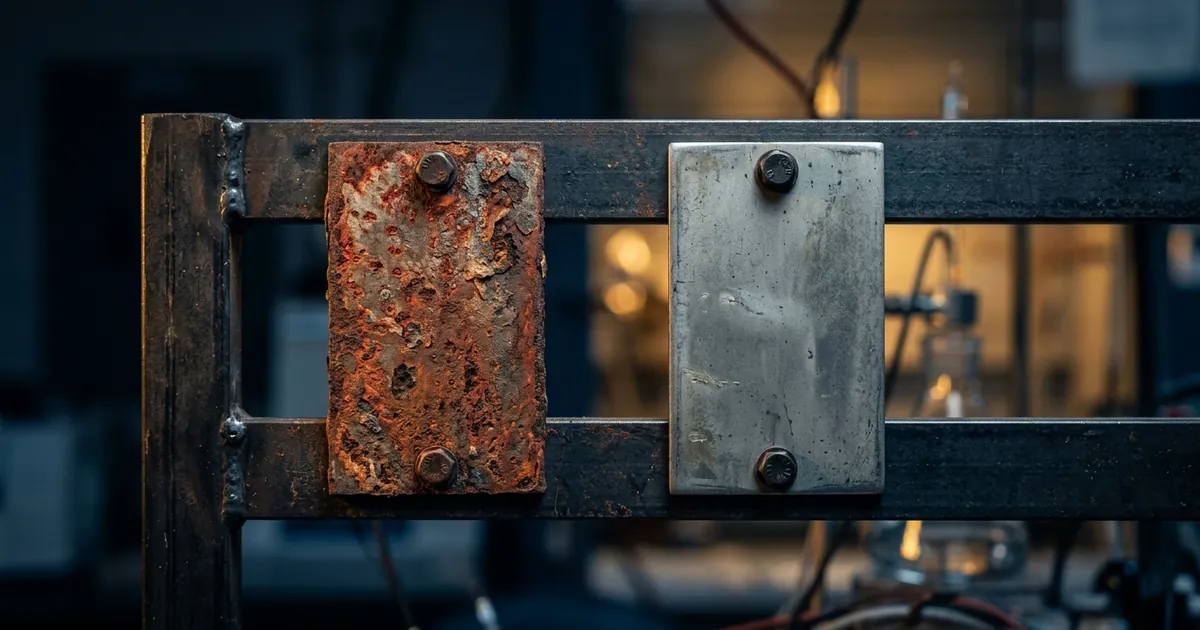
A cooling water loop can corrode from the inside while the treatment programme still reads on target. Steel pits where an anodic inhibitor is underfed, copper tubes lose their protective film under halogen biocides, and the zinc that protects the steel can breach a discharge permit. Each failure ends in leaks and lost heat transfer. This guide explains how a cooling water corrosion inhibitor programme is built from molybdate, zinc and azole chemistry, and how to test whether it works. It draws on the EPRI cooling water guideline, 40 CFR 423.13, ASTM D2688 and open peer-reviewed studies, plus the formulation support Global Formulation gives water treatment manufacturers.
Cooling Water Corrosion Inhibitor Basics: Anodic, Cathodic and Film-Forming Types
A cooling water loop often mixes carbon steel, copper alloys, galvanised steel and stainless steel, and no single film protects them all. EPRI describes corrosion as an electrochemical reaction in which metal is lost at an anode while a cathode completes the circuit. Inhibitors work by suppressing one or both of those reactions, so they are grouped as anodic, cathodic or adsorption types. The type decides how a programme fails when the dose drifts.
| Inhibitor | Type | Metals Protected | Main Limit |
|---|---|---|---|
| Molybdate | Anodic | Steel; not considered a copper alloy inhibitor | High cost; discharge regulated; usually combined with zinc or phosphate |
| Zinc | Cathodic | Typically used with orthophosphate or polyphosphate | Zinc hydroxide fouling at high pH; discharge restricted |
| Orthophosphate | Anodic | Carbon steel; does not protect copper alloys | Algal nutrient; calcium phosphate and iron phosphate foulants |
| Polyphosphate | Cathodic | Carbon steel; does not protect copper or aluminium | Reverts to orthophosphate; aggressive to copper and aluminium if overfed |
| Polysilicate | Adsorption | Carbon steel, copper, aluminium and cast iron | Fragile film, lost if not replenished |
| Tolyltriazole and benzotriazole | Film-forming | Copper alloys | Film breakdown under oxidising halogens |
Chromate once covered steel and copper together. EPRI's cooling water guideline records that chromate-based programmes were eliminated for environmental reasons and mostly replaced by phosphorus programmes. Its removal pushed systems to higher pH and alkalinity, where phosphate, zinc and azole programmes can work. Higher pH and alkalinity cut steel corrosion but raise scaling tendency, which is why every inhibitor choice also constrains scale control. Our guide to cooling tower water treatment covers the scale side of that trade-off.
Molybdate is the anodic option that most resembles chromate, so it comes first.
Molybdate Corrosion Inhibitor Chemistry: Anodic Protection and Its Limits
Molybdate is an anodic inhibitor for steel, and EPRI places it in the same chemical group as chromate. It is not considered a copper alloy corrosion inhibitor, so copper tubes need a second inhibitor. In open cooling systems it is rarely used alone, because cost and discharge rules weigh against it. Knowing where it earns its place decides whether it belongs in a blend.
- Role in a blend — EPRI says molybdate is usually combined with zinc or phosphate. It is not widely used stand-alone in open systems because of cost.
- Film evidence — In a laboratory chloride solution, carbon steel formed a passive film containing Fe2(MoO4)3 alongside iron oxides and hydroxides. The open-access study was electrochemical, not a cooling tower trial.
- Synergy with tungstate — The same study found that molybdate plus tungstate gave a more positive pitting potential and a more resistant film than either anion alone.
- Patent design — US 5,320,779 pairs a water-soluble molybdenum salt with zinc or nickel, two phosphonates and a stabilising agent. One patent shows one design, so treat it as an example and not a rule.
- Evidence gap — EPRI calls the corrosion control abilities of molybdate not well documented and its cost typically high.
- Discharge — Many public treatment works limit molybdate sent to sewer to control its concentration in sludge for land application. EPRI notes heavy regulation in Western Europe.
Zinc covers the cathodic side of the same circuit, with constraints of its own.
Zinc Corrosion Inhibitor for Cooling Water: Cathodic Action and Discharge Limits
Zinc is a cathodic inhibitor that reacts with hydroxyl ion at the locally high-pH cathodic surface. EPRI notes that underfeeding a cathodic inhibitor raises general corrosion but not pitting. Zinc is typically combined with orthophosphate and polyphosphate instead of being used alone. Its drawbacks are zinc hydroxide fouling at elevated pH and tight discharge restrictions.
| Consideration | What the Source Says | Source |
|---|---|---|
| Mechanism | Cathodic; reacts with hydroxyl ion at the cathodic surface | EPRI 3002001276 |
| Underfeed | General corrosion, not pitting | EPRI 3002001276 |
| Fouling | Zinc hydroxide forms at elevated pH unless polymeric dispersants stabilise it | EPRI 3002001276 |
| Feed practice | Typically base fed on flow, because much of the zinc is insoluble and precipitates onto surfaces | EPRI 3002001276 |
| US steam electric limit | Cooling tower blowdown: total zinc 1.0 mg/L maximum and 30-day average; total chromium 0.2 mg/L; other priority pollutants in maintenance chemicals not detectable | 40 CFR 423.13(d)(1) |
| Site limits | Allowable discharge can fall below 0.1 ppm, which removes zinc as a candidate | EPRI 3002001276 |
The federal limit in 40 CFR 423.13 applies to steam electric power plants, and other sites follow their own permits. A zinc programme therefore starts from the discharge limit and works backwards. EPRI says sulfonated polymer functionality tends to be best for stabilising zinc hydroxide, among other deposits. Our guide to scale inhibitors and dispersant polymers covers that polymer chemistry.
Copper alloys need their own protection, which brings in the azoles.
Tolyltriazole Copper Inhibitor and Azole Chemistry: Protecting Yellow Metals
Steel inhibitors leave copper alloys exposed, so cooling programmes add an azole. Benzotriazole and tolyltriazole are the azoles used most often in industrial cooling water, and tolyltriazole is generally preferred for its lower cost. Both are film-forming materials that cover metal or metal oxide surfaces. Their main weakness is the oxidising halogens that are the most common biocides in cooling water.
- Film formation — Laboratory work shows benzotriazole chemisorbing onto copper through Cu–N bonds to build a polymeric [Cu(I)BTA]n film. The study used a chloride electrolyte, not cooling water.
- Copper ion control — Azoles also precipitate soluble divalent copper ions. That stops copper reaching ferrous surfaces, where a galvanic reaction leads to pitting of the steel.
- Dissolved copper limit — EPRI advises avoiding free dissolved copper at or above 200 ppb for aluminium and galvanised steel.
- Halogen attack — When azole-protected copper or iron alloys meet an oxidising halogen, protection breaks down. After breakdown, new films are hard to form, especially under continuous halogenation.
- Overdosing — The patent background says very high tolyltriazole dosages are frequently applied after breakdown, often with limited success.
- Halogen-resistant azoles — The same background cites halo-benzotriazoles as effective in the presence of chlorine.
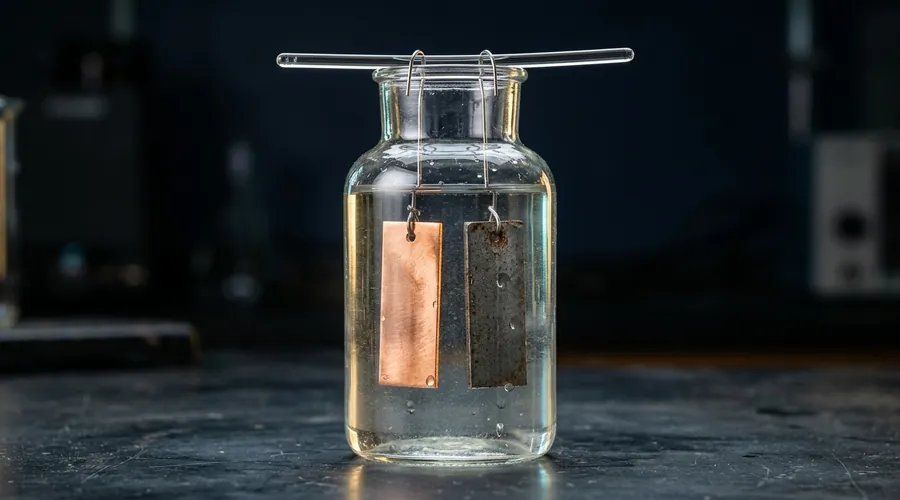
Each inhibitor works only inside a blend that fits every metal and the scale chemistry.
Corrosion Inhibitor Blend Design: Metallurgy, Scale Control and Biocide Compatibility
Corrosion and scale are linked, because conditions that lower steel corrosion tend to raise scaling tendency. EPRI gives the example of higher pH and more cycles of concentration, which reduce carbon steel corrosion and increase scaling. A corrosion blend therefore travels with a scale inhibitor and a dispersant polymer. The metals in the loop then decide which inhibitors the blend carries.
| Metal | Inhibitor Routes | Watch-Out |
|---|---|---|
| Carbon steel | Orthophosphate, polyphosphate, molybdate, zinc, polysilicate | Anodic underfeed pits; phosphate and zinc foul at high pH without a dispersant |
| Copper alloys | Azoles; polysilicate | Not protected by orthophosphate, polyphosphate or molybdate; pitting rises sharply with as little as 0.2 mg/L sulfide |
| Galvanised steel | Application specific | pH and ORP sensitive; HEDP can be aggressive at high concentrations |
| Aluminium | Polysilicate | Polyphosphates can be aggressive if overfed; pH sensitive |
| Stainless steel | Not an inhibitor choice | Allowable halide level depends on alloy molybdenum content, temperature and pH |
Blend architecture follows from that table. A stabilised phosphate programme shows the pattern: an inhibitor, a dispersant polymer and a scale inhibitor working together, with an azole added for copper. EPRI notes that HEDP degrades over time in the presence of bromine, so the biocide choice feeds back into the scale chemistry. Our guide to water treatment technology and formulations shows where inhibitor blends sit in the wider product range.
Waters rich in chloride and sulfate need a further check. The Larson-Skold index, developed in 1958, relates corrosiveness to the ratio of those ions to alkalinity. EPRI recommends evaluating it when organic corrosion inhibitors replace inorganic ones. Ratios and doses stay with each formulation by design, because they belong to each client's product.
Whether a blend works is a measurement question, and the method choice shapes the answer.
Testing a Cooling Water Corrosion Inhibitor: Coupons, LPR and Corrosivity Indices
Test kit residuals show that an inhibitor is present, but only metal loss shows that it is working. ASTM D2688 determines corrosion rate in a water system by measuring the weight loss of metal coupons and evaluating pitting. Its significance section notes that such tests are useful for evaluating the effects of corrosion inhibitors added to the water. Real-time probes add speed, and their limits matter as much as their speed.
| Method | What It Gives | Limit |
|---|---|---|
| Coupon weight loss (ASTM D2688-23) | Average corrosion rate from weight loss, plus pitting evaluation, on flat coupons in a side stream rack | Measured in the absence of heat transfer; the rate is judged in relative terms |
| Linear polarization resistance probe | Real-time corrosion rate | One synthetic brackish water study found readings from 57 percent lower to 385 percent higher than immersion results |
| Larson-Skold index | Corrosiveness from chloride and sulfate relative to alkalinity | A water chemistry screen, not a measure of metal loss |
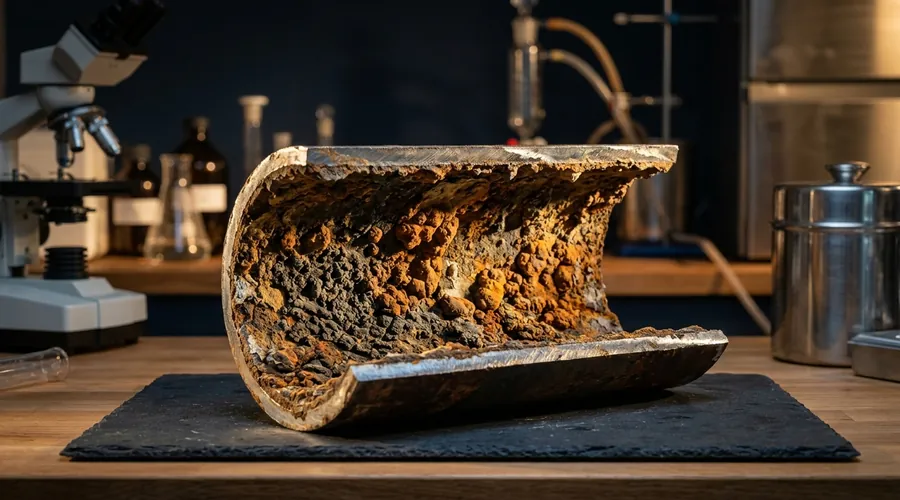
The probe comparison used coupon mass loss as the reference and tested at 35 and 45 °C. Half of the probe results were at least 50 percent higher than the immersion results. The authors conclude that LPR results should be used with caution in industrial applications. Use probes for trends between coupon pulls, and coupons for the audit value.
A development partner ties these choices into one programme.
Working With a Water Treatment Formulation Consultant
Corrosion inhibitor development joins metallurgy, scale chemistry, biocide compatibility and discharge rules, and a change in one shifts the others. A water treatment formulation consultant defines the metals, water chemistry and discharge limits first, then screens inhibitor combinations against them. Water treatment chemical product development services extend that into coupon programmes and specification writing. Industrial water chemicals contract manufacturing then carries the validated blend into repeatable production.
- Define the loop — list every metal, the make-up water, the cycles of concentration and the biocide programme.
- Set the discharge limits — confirm zinc, molybdate and phosphorus limits before choosing chemistry.
- Choose the steel package — pick anodic and cathodic partners and the dispersant that stabilises them.
- Choose the copper package — select the azole and prove it under the actual biocide programme.
- Pair the scale control — match phosphonate and polymer chemistry to the pH and halogen exposure.
- Run the coupon programme — blank and treated coupons per ASTM D2688, with probes for trends.
- Transfer to manufacture — blending, stability checks and release testing for the contract manufacturer.
Our water treatment range shows where inhibitor programmes sit among the other treatment products. Manufacturers entering this category can start with our scale and corrosion inhibitor manufacturing guide. Global Formulation provides inhibitor screening, coupon test design and manufacturing transfer for water treatment manufacturers.
Frequently Asked Questions
What is a cooling water corrosion inhibitor?
A cooling water corrosion inhibitor is a chemical that slows the electrochemical reactions that remove metal in a cooling loop. Anodic inhibitors such as molybdate and orthophosphate suppress the metal-loss reaction, while cathodic inhibitors such as zinc and polyphosphate suppress the reaction that completes the circuit.
Azoles such as tolyltriazole protect copper alloys with a surface film. Most programmes combine several of these with a scale inhibitor and a dispersant polymer.
Why is molybdate usually blended with other inhibitors?
EPRI says molybdate is an anodic inhibitor for steel and is usually combined with another inhibitor such as zinc or phosphate. It is not widely used stand-alone in open cooling systems because of cost.
Molybdate is also not considered a copper alloy inhibitor, so a loop with copper tubes needs an azole as well. Discharge regulation adds a further reason to keep the molybdate level in a blend as low as the programme allows.
Why is zinc restricted in cooling water programmes?
Zinc affects aquatic life at low levels, so its discharge is often restricted. For US steam electric plants, 40 CFR 423.13 sets a limit of 1.0 mg/L total zinc in cooling tower blowdown, and EPRI notes that site limits can be far lower.
Zinc also forms zinc hydroxide fouling at elevated pH unless polymeric dispersants stabilise it. Together these facts explain why many programmes have moved away from zinc.
Why do azole corrosion inhibitors fail after chlorination?
Oxidising halogens such as chlorine, bromine and their hypohalous acids are the most common biocides in cooling water. They break down the protective azole film on copper and iron alloys. After breakdown it is difficult to form new films, particularly under continuous halogenation.
Raising the tolyltriazole dosage is a common response, but a patent background describes it as often having limited success. The same patent background cites halogenated benzotriazoles as effective in the presence of chlorine.
What happens if an anodic or cathodic inhibitor is underfed?
Underfeeding an anodic inhibitor such as molybdate or orthophosphate leaves some metal areas unprotected, and the corrosion driving force concentrates there, which leads to pitting. Underfeeding a cathodic inhibitor such as zinc or polyphosphate raises general corrosion but not pitting.
Pitting is the more serious outcome because it can penetrate the metal rapidly. Control of anodic inhibitor feed therefore deserves close attention.
How do you test whether a corrosion inhibitor programme works?
The reference method is coupon weight loss under ASTM D2688, which determines the average corrosion rate and evaluates pitting on coupons mounted in a side stream rack. A blank and a treated coupon in the same water give the relative comparison the standard is built on.
Linear polarization resistance probes give real-time readings, but one comparison in synthetic brackish cooling water found them from 57 percent lower to 385 percent higher than immersion results. Use probes for trends and coupons for the audit value.
Can one inhibitor protect every metal in a cooling loop?
No single inhibitor in this guide covers every metal. Orthophosphate, polyphosphate and molybdate protect carbon steel but not copper alloys, and polyphosphates can be aggressive toward copper and aluminium if overfed.
Polysilicates can protect carbon steel, copper, aluminium and cast iron, but the film is fragile and lost if not replenished. Most loops therefore need a steel inhibitor, a copper inhibitor and a scale control package designed together.
Developing a Cooling Water Corrosion Inhibitor Product?
Global Formulation supports inhibitor combination screening, coupon test design, discharge-aware blend architecture and contract manufacturing transfer for water treatment chemical manufacturers.
Talk to Our Formulation Team