Epoxy Tile Grout vs Cementitious Grout: Selection Guide
Choosing between epoxy tile grout and cementitious grout looks like a price decision until the first stain, crack or chemical spill. The two families harden by different chemistry, fall under different standards and fail in different ways. This guide compares them on ISO 13007 and ANSI A118 classes, performance limits, stain and chemical resistance, working time and cost. It draws on the ISO 13007-3 text, Tile Council of North America (TCNA) technical writing and a trade-press review of grout chemistry. It also reflects the formulation support Global Formulation gives construction chemical manufacturers.
Epoxy Tile Grout and Cementitious Grout: Two Families With Different Standards
ISO 13007-3 splits ceramic tile grouts into two types: cementitious grout, coded CG, and reaction resin grout, coded RG. The standard defines a cementitious grout as a mixture of hydraulic binding agents, aggregates, and inorganic and organic additives. It defines a reaction resin grout as a single or multi-component mixture of synthetic resin, aggregates and additives in which hardening occurs by chemical reaction. TCNA's technical writing treats reaction resin grouts and epoxy grouts as the same group.
| ISO 13007-3 Designation | Meaning |
|---|---|
| CG1 | Normal cementitious grout |
| CG2 with W, A or WA | Improved cementitious grout with reduced water absorption (W), high abrasion resistance (A) or both |
| F (added to a CG code) | Fast-setting grout |
| RG | Reaction resin grout, with a single designation |
The United States uses a different system. According to TCNA's ANSI standards list, five A118 standards cover grouts, and a sixth, A108.10, covers installation of grout in tilework.
| ANSI Standard | Title | Edition Listed by TCNA |
|---|---|---|
| A118.6 | Standard Cement Grouts for Tile Installation | 2019 |
| A118.7 | High Performance Cement Grouts for Tile Installation | 2019 |
| A118.3 | Chemical Resistant, Water Cleanable Tile-Setting and -Grouting Epoxy and Water Cleanable Tile-Setting Epoxy Adhesive | 2021, reaffirmed 2025 |
| A118.8 | Modified Epoxy Emulsion Mortar/Grout | 1999, reaffirmed 2025 |
| A118.5 | Chemical Resistant Furan Mortars and Grouts for Tile Installation | 1999, reaffirmed 2025 |
In Europe, EN 13888-1:2022 now carries the requirements and classification for ceramic tile grouts, and the 2009 edition is listed as withdrawn. The standards define the families, but to see why they behave so differently you have to look at how each one hardens.
How Each Grout Hardens: Hydration, Polymer Modification and Resin Cure
A cementitious grout hardens as its hydraulic binder reacts with water, so it depends on moisture and time to develop its properties. An epoxy grout hardens by a chemical reaction between its components, so mixing, temperature and batch size control how long it stays workable. These two routes explain most of the practical differences in colour, cleaning and service life. The points below follow the ISO definitions and published technical writing.
- Uniform hydration — a review by Steve Taylor in Construction Specifier notes that cement grout that is not uniformly hydrated shows shading, with light and dark areas.
- Polymer modification — ISO 13007-3 defines a liquid admix as a special aqueous polymer dispersion mixed with a cementitious grout on site. The same review says high-performance cement grouts are generally polymer-modified to cut water absorption.
- Exothermic cure — epoxy curing is an exothermic reaction, and large quantities of mix generate more heat, which speeds the reaction and shortens the pot life.
- Pot life — ISO 13007-3 defines pot life as the maximum time during which the grout can be used after mixing. Our guide to epoxy pot life and induction time explains the chemistry behind it.
- Colour control — the review reports that factory pigmenting of epoxy gives a more consistent batch-to-batch appearance, and that the cure does not change the colour.
Both families must also meet measurable limits, which the next section sets out.
ISO 13007-3 Performance Limits: What CG1, CG2 and RG Must Achieve
ISO 13007-3 gives each grout class numerical limits for strength, shrinkage, abrasion and water absorption. A cementitious grout must meet the fundamental characteristics to be CG1, and CG2 adds the improved characteristics for abrasion and water absorption. A reaction resin grout has its own, tighter table. The comparison shows how wide the gap is between the families.
| Characteristic | CG1 (Fundamental) | CG2 Additional Characteristic | RG |
|---|---|---|---|
| Abrasion resistance | 2,000 mm3 or less | A: 1,000 mm3 or less | 250 mm3 or less |
| Flexural strength, standard conditions | 2.5 N/mm2 or more | — | 30 N/mm2 or more |
| Compressive strength, standard conditions | 15 N/mm2 or more | — | 45 N/mm2 or more |
| Strength after freeze-thaw cycles | Same limits as standard conditions | — | Not listed |
| Shrinkage | 3 mm/m or less | — | 1.5 mm/m or less |
| Water absorption after 30 minutes | 5 g or less | W: 2 g or less | Not listed |
| Water absorption after 240 minutes | 10 g or less | W: 5 g or less | 0.1 g or less |
These figures come from the ISO 13007-3:2004 preview text, the edition available as a free preview. The current edition is ISO 13007-3:2010, so confirm every limit against it before writing a specification. Fast-setting grouts must meet the same table, except that the compressive strength requirement has to be met within 24 hours or less. The standard also defines transverse deformation and chemical resistance as grout characteristics, although the table sets no limit for transverse deformation.
Numbers on a data sheet become real in the field, and the difference shows first as staining.
Stain and Chemical Resistance: Where Epoxy Tile Grout Earns Its Cost
Water absorption decides whether a spill becomes a stain. TCNA's article explains that reduced water absorption matters when staining can occur, because liquid left on a grout can permeate the installation. It adds that epoxy grouts outperform cement-based grouts for an added cost, and that spills over a resin grout are virtually not absorbed. Chemical exposure follows the same logic.
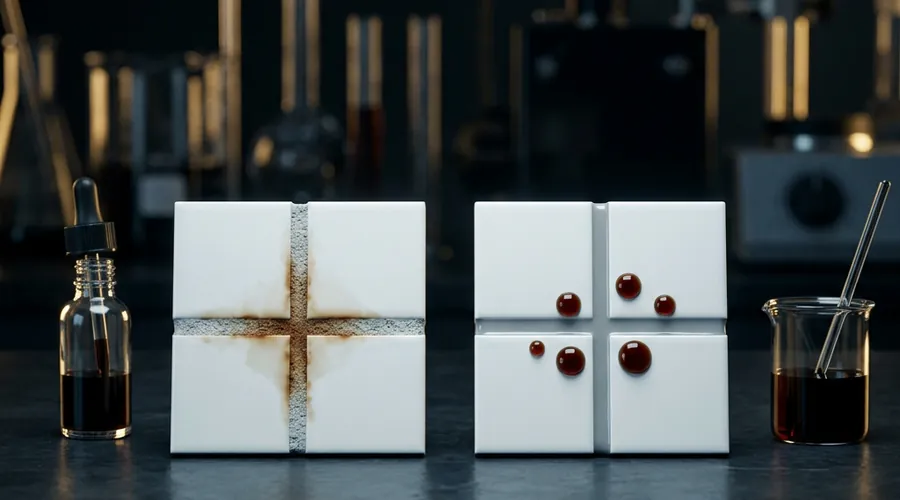
- Acid attack on cement grout — the Construction Specifier review says acids from contaminants and cleaning agents break down the portland cement component of poorly maintained and cleaned grout. They weaken its internal structure.
- Sealing and maintenance — the same review says properly sealed and maintained cement grout installations can last the life of the tile installation.
- Epoxy chemical resistance — the review reports that epoxy resists many chemicals, such as solvents and strong acids, which is why chemical-resistant grouts were first based on epoxy.
- Furan grouts — ANSI A118.5 covers furan mortars and grouts, a less common type developed for industrial applications that need even more chemical and heat resistance.
- Stain and colour tests — TCNA noted in 2010 that ANSI and ISO grout standards did not reference stain resistance or colour consistency. Claims could not be compared in advance, so a job-specific warranty deserves consideration.
Resistance is only half of the decision, because the grout also has to be installed and cleaned by people.
Installation, Working Time and Cleaning: The Practical Difference
Epoxy grout turns the installer's job into a race against its pot life. ISO 13007-3 defines four times that matter: pot life, grouting time, cleaning time and service time. A manufacturer states them for each product. The history of epoxy grout shows why they matter.
- Pot life — the maximum time during which the grout can be used after mixing.
- Grouting time — the minimum interval after tile installation before the grout can be applied.
- Cleaning time — the interval between filling the joints and starting to clean.
- Service time — the minimum time before the finished installation can be put into service.
The Construction Specifier review explains that replacing the portland cement binder with epoxy resin made the original ANSI A118.3 epoxy grouts hard to install and spread across the tile face. Installers found them difficult to clean, which added labour cost and gave less acceptable installations. Later chemistry advances produced 100 percent solids epoxy grouts that are easier to spread and water cleanable, and ANSI A118.3 now carries "water cleanable" in its title. ANSI A108.10 covers installation of grout in tilework, and our guide to sealant joint design and movement capability covers the joints that should not be grouted at all.
- Check the tile and joint — confirm the joint width and depth the grout is designed for, and the tile surface texture.
- Mix the full unit — mix cement grout with the liquid the manufacturer specifies, and mix epoxy grout as complete component units.
- Place inside the pot life — fill the joints within the stated pot life, because a large mix shortens it.
- Clean at the right time — start cleaning inside the cleaning time stated for the product.
- Protect until service time — keep the installation out of service until the stated service time has passed.
With the practical differences clear, the question becomes which grout suits which job.
Epoxy Tile Grout Selection Scorecard: Matching Grout to the Job
The right grout depends on what the joint will meet, not on the tile. This scorecard maps common conditions to the grout family that deserves the first test. Each row is a starting point built from the standards and technical writing cited in this guide. A field trial or a job-specific warranty makes the final call.
| Condition | What the Sources Say | Where to Start |
|---|---|---|
| Low exposure, large area, tight budget | Epoxy outperforms cement-based grout for an added cost (TCNA) | Standard or high-performance cement grout |
| Staining risk from food, drink or dirt | Reduced absorption matters when staining can occur (TCNA) | CG2W or a resin grout |
| Heavy foot traffic or abrasion | ISO abrasion loss limits: CG1 2,000 mm3, CG2A 1,000, RG 250 | CG2A or a resin grout |
| Acids, solvents or aggressive cleaning | Acids attack the portland cement component; epoxy resists many solvents and strong acids | Epoxy grout, and furan only for the harshest industrial duty |
| Uniform colour across a large installation | Factory-pigmented epoxy gives consistent colour; high-performance cement grouts add reduced shading | Epoxy, or a high-performance cement grout |
| Quick return to service | ISO fast-setting grouts reach their compressive strength requirement in 24 hours or less | A cementitious grout with the F designation |
| Upgrading a cement grout | ANSI A118.8 modified epoxy emulsion grout is available for addition to standard cement grout | A118.8 modifier on a cement base |
The scorecard assumes a product exists with the claimed properties, which is where the manufacturer's formulation work begins.
What the Manufacturer Has to Get Right: Formulating Cementitious and Epoxy Grouts
A grout manufacturer sells a property set, and the two families reach it by different routes. A cementitious formulation balances binder, aggregates and additives against water demand, workability and colour. An epoxy formulation balances resin, hardener and filler against pot life, cleaning time and cure exotherm. Both are judged against the same measurable characteristics in the standards.
- Cementitious levers — hydraulic binder, aggregate, additives and an optional liquid admix, with water retention controlled by cellulose ethers as our guide to grout and tile adhesive rheology control explains.
- Epoxy levers — resin and hardener system, fillers and pigments, with pot life and cleaning time as the application properties to hit.
- Strength and shrinkage — flexural strength, compressive strength and shrinkage are tested for both families, and cementitious grouts are also tested after freeze-thaw cycles.
- Absorption and abrasion — water absorption by capillary action and abrasion loss decide the W and A classes and the RG designation.
- Colour — factory pigmenting gives epoxy its batch consistency, while cement grout colour depends on uniform hydration and mixing.
- Packaging — a reaction resin grout can be a single or multi-component product, while cement grout is a powder mixed on site with water or a liquid admix.
Our guides to tile adhesive formulation and tile adhesive classification cover the matching bedding materials, and our tile adhesive and grout manufacturing business guide covers the plant side. Many brands meet capacity needs through contract partners, and scaling construction chemicals from lab to plant explains how bench results carry over. A specialist partner shortens the path from bench formulation to qualified product.
Working With a Construction Chemicals Formulation Consultant
Grout development sits between cement chemistry, polymer chemistry and standards testing, and the tests that matter run on the finished product. A construction chemicals formulation consultant defines the target class, builds the formulation and benchmarks it against competing products. Construction chemical product development services also cover specification writing, pilot batches and shelf-life studies. A contract formulation scale-up partner then carries the product into a plant that can hold the specification.
- Define the target class — choose the ISO designation or ANSI category that your market buys.
- Benchmark the incumbent — test competing products on the characteristics in the standard.
- Build the formulation — select binders or resins, additives, fillers and pigments for the target properties.
- Test beyond the standard — add stain panels, colour consistency checks and chemical exposure tests relevant to the market.
- Write the specification — set limits against ISO 13007-3, EN 13888-1 or the ANSI standard that applies.
- Run pilot batches — check pot life, cleaning time, colour and shelf life at pilot scale.
- Scale up with a qualified partner — transfer the methods together with the process.
Our construction chemicals range shows where grouts sit among the other chemistries. Global Formulation provides grout formulation, standards testing programmes, specification support and scale-up for construction chemical manufacturers.
Frequently Asked Questions
What is the difference between epoxy tile grout and cementitious grout?
ISO 13007-3 defines a cementitious grout (CG) as a mixture of hydraulic binding agents, aggregates, and inorganic and organic additives. It defines a reaction resin grout (RG) as a single or multi-component mixture of synthetic resin, aggregates and additives that hardens by chemical reaction.
Epoxy tile grout belongs to the resin family. TCNA writes that epoxy grouts outperform cement-based grouts for an added cost, and that spills over a resin grout are virtually not absorbed.
The two families are classified and tested separately, and each has its own standards in Europe and the United States.
What do CG1, CG2, W and A mean on a tile grout?
CG1 is a normal cementitious grout, and CG2 is an improved cementitious grout. CG2 always carries the letter W for reduced water absorption, the letter A for high abrasion resistance, or both.
The letter F can be added to a cementitious designation for a fast-setting grout. A reaction resin grout has the single designation RG.
The ISO limits behind the letters are numerical. For example, the A characteristic needs an abrasion loss of 1,000 mm3 or less, and W needs a 240-minute water absorption of 5 g or less.
Is epoxy tile grout stain proof?
Epoxy tile grout absorbs far less than cement grout. ISO 13007-3 limits the 240-minute water absorption of a reaction resin grout to 0.1 g, against 10 g for a normal cementitious grout.
TCNA reports that a spill over a resin grout is virtually not absorbed. The same article noted in 2010 that stain resistance had no ANSI or ISO test, so a claim of stain resistance cannot be compared in advance.
Run a stain panel with the substances the installation will meet before relying on the claim.
Which standards apply to epoxy tile grout?
In the ISO system, ISO 13007-3 sets the terms and specifications for reaction resin grouts, and ISO 13007-4 holds the test methods. In Europe, EN 13888-1:2022 covers requirements, classification, designation, marking and labelling for ceramic tile grouts.
In the United States, ANSI A118.3 covers chemical resistant, water cleanable tile-setting and grouting epoxy, and TCNA lists the 2021 edition as reaffirmed in 2025.
ANSI A108.10 covers installation of grout in tilework.
Why was epoxy grout hard to install, and is that still true?
A Construction Specifier review explains that replacing the portland cement binder with epoxy resin made the original ANSI A118.3 grouts hard to spread and difficult to clean. That added labour cost and gave less acceptable installations.
Later advances produced 100 percent solids epoxy grouts that are easier to spread and water cleanable.
Pot life and cleaning time still matter, because epoxy cure is exothermic and large mixes shorten the working time.
Can a cement grout be upgraded with epoxy?
ANSI A118.8 covers modified epoxy emulsion mortar and grout, and the Construction Specifier review says it is available for addition to standard cement grout. TCNA lists the 1999 edition as reaffirmed in 2025.
This is a modified cement grout, not a reaction resin grout, so it is not the same product as an epoxy grout under A118.3.
Check the performance of the mixed system against the standard you are targeting before specifying it.
Do the ISO and ANSI grout classes match?
No. A TCNA article states that the ISO and ANSI grout standards are not intended to correlate. The same is true of their thin-set mortar specifications.
The tests differ. ANSI weighs samples before and after total immersion in water, while ISO partly immerses samples and weighs the capillary absorption. Fast set is judged by penetration under ANSI and by early compressive strength under ISO.
Specify the classification system your market uses and test products to it.
Developing a Tile Grout Product?
Global Formulation supports grout formulation, standards testing programmes, specification writing and scale-up to a qualified plant.
Talk to Our Formulation Team