Condensate Corrosion Control Amines: Neutralising, Filming
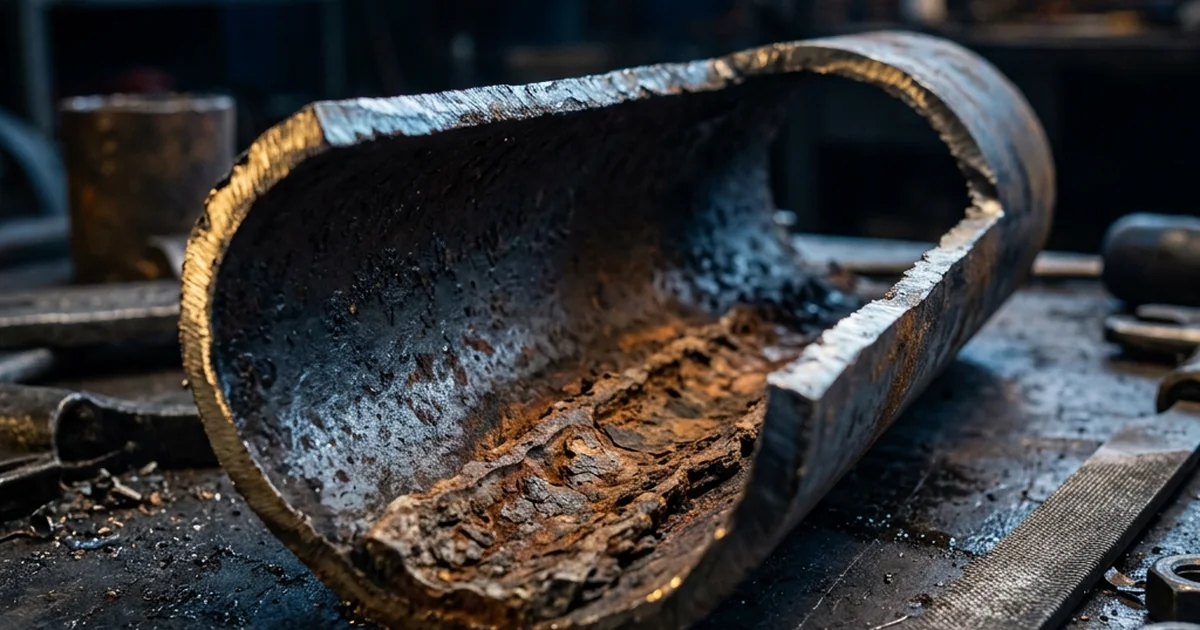
Condensate lines fail quietly. Pipe walls thin from the inside until a threaded joint leaks, a steam trap clogs with iron oxide, or iron-laden condensate returns to the boiler and seeds new deposits. Most of the damage traces to two causes: carbon dioxide that turns condensate acidic, and oxygen that enters through open receivers and leaking joints. This guide to condensate corrosion control amines explains how neutralising amines raise pH, how filming amines build a barrier, and how blends, scavengers and monitoring fit around them. It draws on the Veolia Water Handbook, the IAPWS guidance on film forming substances and the US food-contact rule for boiler additives. It also reflects the formulation support Global Formulation gives water treatment manufacturers.
Carbonic Acid Condensate Corrosion: Why Condensate Lines Fail
Condensate is among the purest water in a steam plant, which is exactly why it corrodes so readily. It holds almost no dissolved salts to buffer its pH, so a trace of acid gas shifts it quickly. The Veolia Water Handbook condensate chapter names carbon dioxide as the primary cause of low condensate pH and direct absorption of air as the usual route for oxygen. The two attack in different ways, and the right treatment depends on which one dominates.
- Carbon dioxide source — feedwater alkalinity breaks down in the boiler and leaves with the steam. Bicarbonate decomposes completely, while carbonate reacts only about 80 percent, so bicarbonate alkalinity releases more than twice as much carbon dioxide per unit as carbonate alkalinity.
- Acid attack — as steam condenses, carbon dioxide dissolves to form carbonic acid, which supplies the hydrogen ions that dissolve iron. The loss is general and not local, and Veolia notes that walls thin most at the bottom of the pipe and fail at threaded sections.
- Oxygen attack — oxygen replaces hydrogen ions in the corrosion reaction and drives pitting that can end in perforation within a short time. Pits start at weak points or damaged sites in the oxide film.
- Copper alloys — copper oxide layers are porous and leaky, so water, oxygen and copper ions move through them, and the outer layers slough off as particles.
- Dissolving contaminants — chloride, sulphide, acetate and, for copper, ammonia can dissolve part or all of the oxide layer even when the pH is correct.
| Corrosion Driver | Damage Pattern | Where It Shows | Lead Control |
|---|---|---|---|
| Carbon dioxide | General thinning, heaviest at the pipe bottom | Return lines and threaded joints | Neutralising amine, lower feedwater alkalinity, venting |
| Oxygen | Localised pitting | Open receivers, returns from intermittent equipment, complex branched systems | Deaeration, covered receivers, scavenger, filming amine |
| Ammonia on copper alloys | Oxide dissolution | Copper-bearing exchangers and fittings | Controlled alkalising feed, amine blends |
| Chloride, sulphide, acetate | Oxide dissolution | Returns carrying process contamination | Find and remove the contaminant source |
Veolia adds that mechanical deaeration and chemical scavenging remove all but a trace of oxygen from boiler feedwater, so air contact after condensation is usually the larger source. Its handbook describes a receiver designed with a cover and a steam heating coil, which cut air contact and lower oxygen solubility. Condensate from warm-up steam for intermittently used equipment should not be saved, because its oxygen attacks the system up to the deaerating heater. Our guide to internal and external boiler water treatment programmes covers the alkalinity reduction that lowers carbon dioxide at its source.
Raising pH is the first lever, and neutralising amines are the chemistry built for it.
Condensate Corrosion Control Amines: Neutralising Amine Chemistry and Selection
Neutralising amines work because they are volatile bases that travel with the steam and dissolve into the condensate when the steam condenses. Once dissolved, they react with carbonic acid and lift the pH of every condensate drop they reach. Veolia treats five properties as decisive for a neutralising amine condensate programme: neutralising capacity, recycle and recovery ratio, basicity, distribution ratio and thermal stability. The sections below take them in the order that decides a blend.
The chemistry is simple. An amine hydrolyses in water to form hydroxide ions, which then neutralise carbonic acid and leave the amine bicarbonate in solution. Veolia states that neutralisation is complete when condensate pH is above 8.3 in every part of the system. It gives 8.8 to 9.2 as an example control range for a mixed copper-iron condensate system. The plant sets its own range to protect its most critical components.
- Neutralising capacity — inversely proportional to molecular weight and directly proportional to the number of amine groups, so a lighter amine neutralises more acid per unit mass.
- Recycle and recovery — some amine returns with the condensate, so the total amine in the system exceeds the amount fed.
- Basicity — the pH an amine can sustain after all acid is consumed, measured by its dissociation constant Kb, which changes with temperature.
- Distribution ratio — the amine concentration in the vapour divided by that in the liquid. A ratio above 1 favours the steam phase, and the ratio depends on pressure and pH, so it is not a true constant.
- Thermal stability — organic chemicals in hot alkaline water eventually degrade to some degree, mostly to carbon dioxide or acetic acid and ammonia. Morpholine and cyclohexylamine are the most stable of those in common use and stay substantially intact at pressures up to 2,500 psig.
| Amine | Amine Mass per Part CO₂ (Theoretical) | Kb × 10⁶ at 22 / 148 / 170 °C | Behaviour Noted in the Handbook |
|---|---|---|---|
| Cyclohexylamine | 2.3 | 489 / 61 / 32 | Favours the steam phase; strongest base at ambient temperature but weakens steeply when hot |
| Morpholine | 2.0 | 3.4 / 4.9 / 3.8 | Favours the liquid phase; weak base whose strength barely changes with temperature |
| Diethylaminoethanol | 2.6 | 68 / 11.3 / 9.2 | Needs the most amine mass per part of carbon dioxide of the four |
| Dimethylisopropanolamine | 2.3 | 20.6 / 6.9 / 4.6 | Basicity falls steadily with temperature |
The mass column is a stoichiometric property and not a feed rate, because real feed depends on recycle, recovery and the acid load at each condensation point. The basicity column shows why a single number never describes an amine: cyclohexylamine looks strongest at ambient temperature and falls to a fraction of that value in hot condensate. Distribution decides where the amine does its work, and Veolia explains it with two contrasting systems.
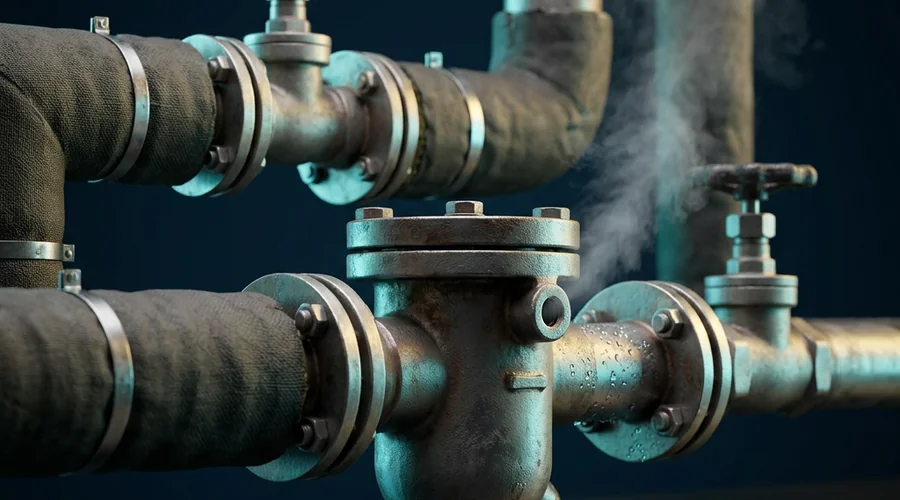
In the first system, carbon dioxide-laden steam passes through three consecutive condensation sites. Morpholine distributes mainly into the liquid, so the first site receives a high concentration and a high pH. By the last site little morpholine is left while most of the carbon dioxide remains, and the pH there falls and attacks the oxide layer. Cyclohexylamine, which favours the steam, is the better choice for that layout.
The second system reverses the problem. Acetic acid goes largely into the first condensate. Most of the cyclohexylamine stays in the steam, so the first site runs at low pH while the last site runs high. A morpholine and cyclohexylamine blend suits that layout, and Veolia concludes that the best protection comes from blends of amines with differing steam and liquid distributions. It also notes that estimating distribution across several sites is difficult without computer modelling packages built for the purpose.
Ammonia is the other alkalising option, and it carries a copper penalty. Veolia calls ammonia the most common condensate contaminant, usually from breakdown of nitrogenous organics, hydrazine or amine treatment chemicals. Where ammonia is fed deliberately, its rate must be tightly controlled to limit attack on copper-bearing alloys. IAPWS adds that film forming products containing alkalising amines, applied instead of ammonia, can significantly reduce the risk of ammonia grooving by cupro-ammonium complexes in low-oxygen conditions. Neutralising amines address the acid, but they do not remove oxygen or build a barrier, which is the job of the next chemistry.
Filming Amine Boiler Treatment: Barrier Chemistry and Limits
Filming amines protect the metal surface and not the water, which makes them a different tool from pH control. Their long hydrocarbon chain forms a hydrophobic barrier, and the amine group adsorbs on the metal and oxide surface. IAPWS defines the family by two features: one or more primary or secondary amine groups and a saturated or unsaturated carbon chain of 10 to 22 atoms. The practical questions are how complete the film becomes and what the amine leaves behind when it breaks down.
- Named substances — IAPWS lists octadecylamine (ODA), oleylamine (OLA) and oleyl propylenediamine (OLDA). Commercial products also carry alkalising amines, emulsifiers, reducing agents and dispersants such as polycarboxylates.
- Physical form — the amines are solid or paste-like and sparingly soluble, so they are supplied as solutions, emulsions or suspensions. They are steam volatile, and monoamines are less volatile than diamines.
- Film build-up — IAPWS reports studies showing a rapid monomolecular layer followed by a slower multilayer, and the amount adsorbed depends on molecular structure, temperature and surface composition.
- Cleaning action — the surfactant character lifts loose oxide. Veolia warns that a heavy first dose on an old system can slough large amounts of iron oxide into traps and return lines, so treatment must rise gradually.
- Deposit risk — Veolia notes that filming amines form deposits with multivalent ions such as sulphate, hardness and iron, and that overfeed and oxygen contamination add to the problem. IAPWS describes gel-like clumps forming under sustained overdosing.
- Breakdown products — thermal degradation yields low molecular weight organic acids and carbon dioxide, which raise cation conductivity and can mask chloride or sulphate contamination.
| Feature | Neutralising Amine | Filming Amine |
|---|---|---|
| Mechanism | Neutralises carbonic acid and raises pH | Adsorbs on metal oxide and forms a hydrophobic barrier |
| Protects against | Acid corrosion from carbon dioxide and other acids | Oxygen and carbon dioxide corrosion, per Veolia |
| Effect on pH | Direct and intended | Negligible next to alkalising agents, per IAPWS |
| Where it acts | Where its distribution puts it in the condensate | On surfaces the volatile amine reaches |
| Main risk | Depletion at condensation points it does not reach | Overdose deposits, oxide sloughing, masked contamination |
| Control measurement | pH at each condensation point, iron and copper trends | Free amine residual by spectrophotometry |
IAPWS also states what the treatment cannot do. A filming amine cannot prevent hard scales such as calcium carbonate or silicates that poor water purity causes. IAPWS says it is not clear that such scales can be removed by the treatment alone. The film's durability across all operating conditions is not completely understood, although practical experience shows a filmed system is protected through a shutdown of several weeks in wet storage. Where to inject the product is the next decision, and the sources do not fully agree.
Few plants run one chemistry alone, so most commercial products blend functions.
Blended Condensate Treatment: Amines, Scavengers and Passivators
Real condensate systems rarely have a single problem, so one chemistry seldom covers every case. Acid gas, oxygen ingress and mixed metallurgy often coexist in the same network. Veolia reports that combination products, with filming and neutralising amines plus dispersant aids, give a better film bond, fewer deposit problems and better system coverage than a straight filming amine. Straight octadecylamine is effective, yet it often fails to cover the whole system and can foul.
- Neutralising amine plus scavenger — Veolia says the pairing helps twice. The pH rises, so the condensate becomes less corrosive, and most scavengers react faster under the mildly alkaline conditions the amine maintains.
- Scavenger volatility — ascorbic acid and hydrazine have very low volatility, so they must be fed near the problem area. An example is hydrazine at a turbine exhaust to protect the condenser. Hydroquinone is relatively volatile and can be fed well upstream.
- Scavenger reactivity — Veolia names reactivity with oxygen at the system temperature and pH as one important selection factor, and it reports hydroquinone as particularly effective for most systems.
- Filming plus neutralising amine — emulsifiers and small amounts of neutralising amine improve film distribution and cut fouling.
- Non-volatile ingredients — IAPWS states that products containing non-volatile components such as polycarboxylates, sodium hydroxide or phosphate must not be dosed into feedwater that supplies attemperation water.
The sulphite and DEHA options for oxygen control are compared in our guide to oxygen scavengers for boiler feedwater. Condensate treatment is the steam-side half of the same programme, and the wider framework sits in water treatment technology and formulations. Hydrazine illustrates why regulation shapes a blend, because 21 CFR 173.310 sets its limit at zero in steam that contacts food.
A blend is only proven when the plant measures its effect, which is the subject of the next section.
Monitoring Condensate Corrosion and Checking the Film
A condensate programme is only as good as the evidence that it works. IAPWS states that without baseline iron and copper data a plant cannot quantitatively validate any benefit from a film forming product. The same logic applies to neutralising amines, because a pH reading alone does not show how much metal is being lost. Establish a baseline first, then compare after treatment using the same sample points and conditions.
- Corrosion products — total iron, and copper in mixed-metal systems, at fixed sample points. IAPWS suggests at least a month of baseline sampling before a film forming product and at least three months after. Samples need full digestion so the film does not bias the oxide measurement.
- Direct corrosion evidence — Veolia lists coupons in bypass racks, corrosion product analyses, corrosion rate meters and submicron corrosion product filtration.
- Amine residual — two spectrophotometric methods dominate: methyl orange extraction, which uses an organic solvent, and xanthene dye reaction with eosin Y or rose bengal, which does not. IAPWS asks for a detection limit preferably below 0.1 mg/kg and no interference from short-chain amines or ammonia.
- Sampling — filming amines coat sample lines and adsorb on plastics and glass. IAPWS recommends PTFE storage with acetic acid to adjust the pH and warns that detergents interfere with the colourimetric methods.
- Instruments — in laboratory tests of three products, oxidation-reduction potential probes lost sensitivity and some conductivity probes were coated, while glass pH, sodium and Clark-type oxygen probes were unaffected.
- Film check — water-repellent metal shows a film, but a rough porous oxide can hide it, and IAPWS notes that non-hydrophobic does not necessarily mean unprotected.
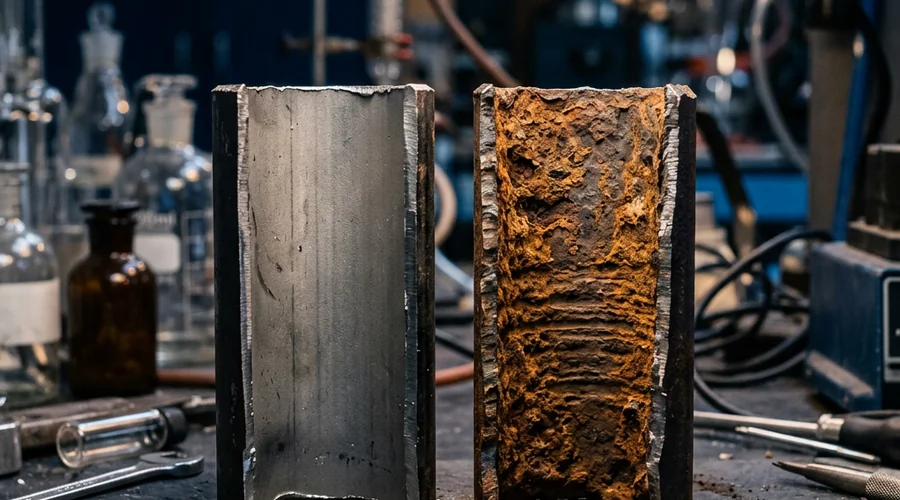
Inspection closes the loop. IAPWS recommends recording the appearance of internal surfaces, the amount of sludge in drums, headers, deaerators and hotwells, and the history of tube failures before treatment starts. Cut pipe sections taken at an outage show the surface condition that the iron trend summarises. Sample lines also deserve inspection after an extended treatment period for organic or oxide fouling.
Where the steam goes after the condensate system decides which chemistries are allowed at all.
Steam End Use: Food Contact and Sensitive Processes
Steam that touches food, people or product turns a corrosion question into a compliance question. Components of the treatment chemistry can end up in food, on catalyst surfaces or in manufactured goods. IAPWS states that legislation varies considerably with application and region and that the product supplier must supply the information needed to judge compliance. The rule most often cited is 21 CFR 173.310 on boiler water additives.
Under that rule, an additive must not exceed the amount needed for its function. The amines appear in a list of substances used alone or in combination with the other listed additives, each with a limit for steam concentration. The list covers cyclohexylamine, diethylaminoethanol, morpholine and octadecylamine, and each carries an exclusion for steam that contacts milk and milk products. Of the three film forming amines IAPWS describes, octadecylamine is the only one on the list, and the rule names no oleylamine or oleyl propylenediamine.
| Steam End Use | Why It Is Sensitive | What to Verify |
|---|---|---|
| Direct food contact, such as cooking or sugar processing | Treatment components can be incorporated into food | Listing and limits under 21 CFR 173.310 or the local equivalent |
| Milk and dairy | Chemical use in the steam system is generally very restricted | The exclusion for milk contact, and whether only naturally present substances are allowed |
| Paper for food packaging | Indirect contact still reaches the food | Compliance of the product and the paper grade |
| Sterilisers, hospitals, laundries | Humans can be exposed by inhalation, skin contact or swallowing | Supplier compliance information for the specific use |
| Catalysts and manufactured goods | Adsorption can change surface function or product properties | Compatibility evidence from the supplier |
The IAPWS industrial guidance reports film forming amine products in sugar plants. It also reports use in a refinery and an ammonia plant where the steam touched a catalyst, with no observed effect on catalytic efficiency. Those are reports from specific plants and not a general clearance. This article does not cover Indian food-contact rules, so confirm local requirements with the regulator or the supplier before specifying a product. With the end use settled, the remaining task is selection.
Choosing a Condensate Treatment by Metallurgy and Steam Use
No single chemistry suits every condensate system, because the answer depends on metallurgy, feedwater alkalinity, oxygen ingress and what the steam touches. The table pairs common situations with the approach the sources support and the main watch-out. The numbered sequence after it gives a decision order that avoids the usual mistakes.
| Situation | Lead Approach | Watch-Out |
|---|---|---|
| High-alkalinity feedwater, all-ferrous condensate | Neutralising amine blend chosen for distribution and basicity, plus lower alkalinity at source | Depletion at the last condensation sites if the amine favours the liquid |
| Mixed copper and iron condensate | pH held in a range that protects both metals | Ammonia attack on copper-bearing alloys |
| Oxygen ingress in complex branched systems | Steam-volatile filming amine, or neutralising amine with a scavenger | Scavenger volatility and the feed location |
| Old condensate lines with heavy oxide | Filming amine started low and raised gradually | Sloughed oxide plugging traps and returns |
| Steam contacting food or milk | Only additives and limits the local rules allow | Milk-contact exclusions and hydrazine at zero in steam |
- Map the metallurgy — all-ferrous or copper-bearing, since ammonia and pH limits depend on it.
- Measure the acid load — feedwater alkalinity, carbon dioxide in the steam and any process acids such as acetic acid.
- Check for oxygen ingress — open receivers, intermittent equipment and branched lines.
- Confirm the steam end use — food, dairy, catalyst or manufactured goods.
- Take a baseline — iron and copper trends plus an inspection of traps and returns.
- Select the blend — amines with distribution suited to the condensation points, plus a scavenger or filming amine where the data call for it.
- Start gradually and verify — raise the feed in steps and confirm with coupons and iron trends.
Each step produces evidence a plant or auditor can review, and building that evidence into a product is where outside formulation support pays off.
Working With a Water Treatment Formulation Consultant
Condensate products fail in the field for formulation reasons as often as for plant reasons. An amine blend that ignores distribution leaves part of the network unprotected, and a filming amine emulsion that separates in the drum feeds unevenly. A water treatment formulation consultant tests the blend against the customer's condensate layout and metallurgy before launch. Water treatment chemical product development services then document the result in the form operators and auditors expect.
- Amine blend design — amines with complementary distribution ratios, basicities and thermal stabilities for the target network.
- Filming amine product format — ODA, OLA and OLDA are solid or paste-like and sparingly soluble, so the emulsifier and dispersion system decide shelf stability and feed behaviour.
- Full disclosure — IAPWS says operators need to know the filming amine, the alkalising amines, the dispersants and their purpose. Its basic rule is that an unknown chemical with unknown breakdown products earns no relaxation of normal limits.
- Feed system compatibility — PTFE membranes, EPDM seals, and polyethylene or stainless steel tubing are frequently used, while Viton and some elastomers have shown incompatibility.
- Documentation — safety data sheet, chemical inventory status, discharge data and food-contact status. Filming products add to total organic carbon and total nitrogen in blowdown.
- Field trial design — a baseline-and-compare protocol for iron and copper that produces defensible results.
Moving a proven blend from bench to plant is the job of industrial water chemicals contract manufacturing, and our guide to starting and scaling corrosion inhibitor manufacturing covers that route. The wider category sits under water treatment. Before committing to a product, run a short check. Map the metals, measure the acid load, confirm the steam end use, take the baseline, and write down how success will be measured.
Frequently Asked Questions
What causes condensate line corrosion in a steam system?
Two causes dominate. Carbon dioxide from feedwater alkalinity dissolves in condensate as carbonic acid and thins pipe walls, most often along the bottom of the pipe. Oxygen from air absorption or contaminated feedwater causes localised pitting that can perforate a pipe in a short time.
Chloride, sulphide and acetate can also dissolve the protective oxide layer, and ammonia does the same on copper alloys.
What is the difference between neutralising amines and filming amines?
Neutralising amines are volatile bases that react with carbonic acid and raise condensate pH. Filming amines are long-chain amines that adsorb on metal oxide surfaces and form a hydrophobic barrier between the metal and the water or steam.
One treats the water chemistry and the other treats the surface, which is why many commercial products combine them with a scavenger or dispersant.
Which neutralising amine is best for condensate?
No single amine is best, because the answer depends on where the acid sits in the system. Morpholine favours the liquid phase and cyclohexylamine favours the steam phase, so each protects different condensation points.
The Veolia handbook states that the best protection comes from blends of amines with differing steam and liquid distributions. A consultant matches the blend to the plant layout, metallurgy and acid contaminants.
Can filming amines cause problems in a condensate system?
Yes, when they are overfed or started too fast. Veolia warns that a heavy first dose on an old system can slough large amounts of iron oxide that plug traps and return lines. IAPWS describes gel-like clumps forming under sustained overdosing.
Filming amines also form deposits with multivalent ions such as sulphate, hardness and iron. Both sources therefore advise raising the feed gradually and monitoring the residual.
What pH should condensate be held at?
Veolia states that neutralisation is complete when condensate pH is above 8.3 in every part of the system. It gives 8.8 to 9.2 as an example range for a mixed copper-iron condensate system.
In practice the plant sets a control range that protects its most critical components. The right range depends on the metals present and on which condensation points are most exposed. Confirm the range against the plant metallurgy and any applicable standard.
Are neutralising and filming amines permitted in steam that contacts food?
In the United States, 21 CFR 173.310 lists cyclohexylamine, diethylaminoethanol, morpholine and octadecylamine for steam that contacts food. Each has a steam limit and an exclusion for steam that contacts milk and milk products. Hydrazine is listed at zero in steam.
Of the three film forming amines IAPWS describes, octadecylamine is the one the rule lists. Other countries have their own rules, so the product supplier must provide the compliance information for the market.
How do you know the condensate treatment is working?
Compare corrosion indicators against a baseline taken before treatment. Total iron, and copper in mixed-metal systems, at fixed sample points should fall or hold at the earlier level. Coupons in a bypass rack or corrosion rate meters give a second line of evidence.
For filming amines, test the residual with a spectrophotometric method, because pH, conductivity and total organic carbon are not accurate enough to control the dose. Inspection of cut pipe and traps confirms what the numbers show.
How can a formulation consultant help with condensate treatment products?
A consultant designs the amine blend for the target condensate layout, selects emulsifiers and dispersants for filming amine products, and screens the product against the feed system materials. The work extends to the documentation operators need, including composition, breakdown products, analytical methods and regulatory status.
Plant trials follow a baseline-and-compare protocol, and contract manufacturing and scale-up then turn the approved formulation into a repeatable product.
Developing a Condensate Treatment Range or Troubleshooting Failing Condensate Lines?
Global Formulation supports water treatment manufacturers with amine blend design, filming amine product formulation, regulatory documentation, field trial design, product development and contract manufacturing.
Talk to Our Formulation Team