Oxygen Scavenger Boiler Feedwater: Sulphite vs DEHA
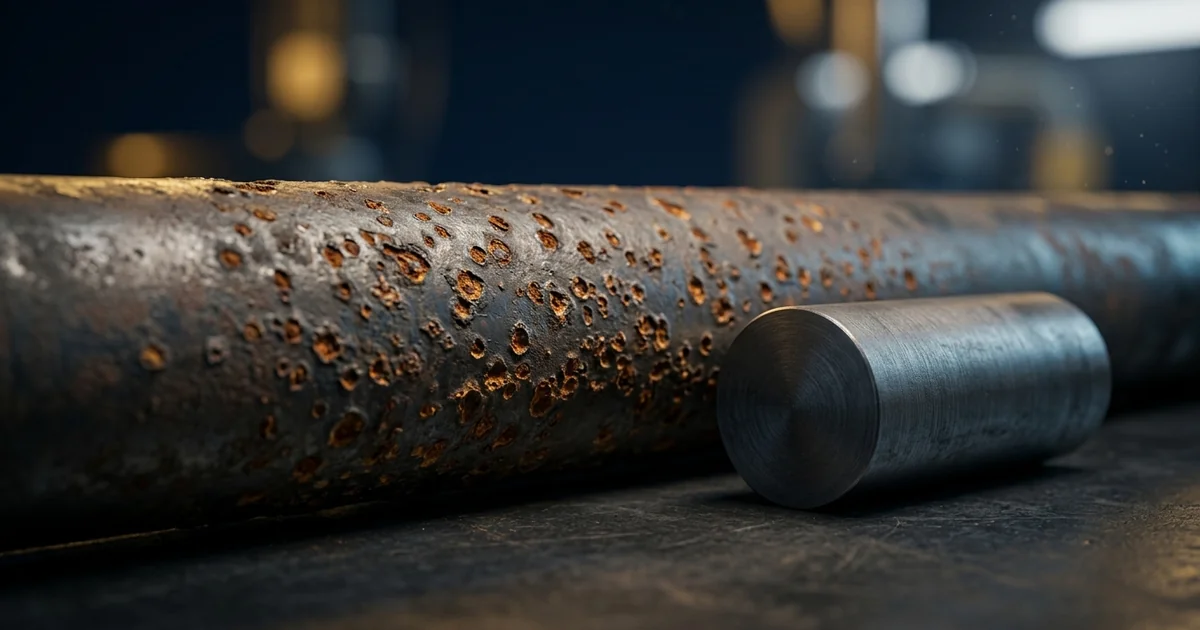
A well-run deaerator leaves 7 parts per billion of oxygen or less in the feedwater, yet even that can pit an economiser or a feed line. Pits are small, deep and hard to see, so the damage often shows up only when a tube leaks. The chemical chosen to finish the job brings its own problems, from extra dissolved solids to organic acids in the condensate. This guide to oxygen scavenger boiler feedwater chemistry compares sodium sulphite, hydrazine, carbohydrazide, DEHA and hydroquinone by what they do and what they leave behind. It draws on the Veolia Water Handbook, the US food-contact steam rule and an open-access 2024 study of scavenger decomposition. It also reflects the formulation support Global Formulation gives water treatment chemical makers.
Oxygen Scavenger Boiler Feedwater: Why Dissolved Oxygen Still Matters
Oxygen is highly corrosive in hot water, and even small concentrations cause serious problems. Veolia puts the solubility of oxygen in water at about 8 ppm at 60 °F (16 °C) and atmospheric pressure. Efficient mechanical deaeration brings that down to 7 ppb or less, but the handbook states that a chemical scavenger is required for complete protection from oxygen corrosion. Our overview of internal and external boiler water treatment places the scavenger inside the wider programme, and this guide goes deeper on the scavenger itself.
Dissolved oxygen corrosion in a boiler is electrochemical. Veolia's corrosion chapter writes the anode reaction as iron dissolving to ferrous ion, and the cathode reaction as oxygen and water taking up electrons to form hydroxide. The overall result is ferrous hydroxide. Active pits have sharp edges and a reddish-brown oxide cap called a tubercle, and removing the cap exposes black iron oxide inside the pit.
- Where pits form — feedwater distribution holes, the steam drum waterline, downcomer tubes, economiser inlets and condensate lines.
- Why temperature matters — a temperature rise in feedwater heaters and economisers speeds the surface reactions and makes the corrosion rapid and severe.
- Secondary damage — iron oxide from the corrosion becomes iron deposit in the boiler.
- Idle boilers — units left idle even over a weekend, or started on undeaerated water, take random oxygen pitting that can stay unnoticed for years.
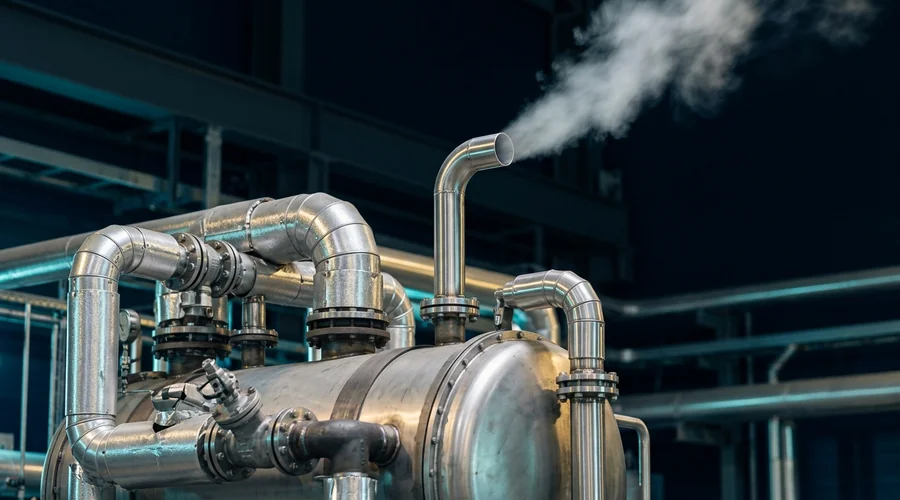
Once the oxygen load is as low as mechanics allow, the first scavenger to consider is the oldest one.
Sodium Sulphite Oxygen Scavenger: The Default and Its Limits
Sodium sulphite remains the default because it is cheap, easy to handle and easy to test. Veolia names sodium sulphite and concentrated catalysed sodium bisulphite solution as the most common choices below 1,000 psig (69 bar). The reaction is two sulphite ions plus one oxygen molecule giving two sulphate ions. Every strength of the method comes from that equation, and so does every weakness.
The equation gives a theoretical 7.88 parts of pure sodium sulphite per part of dissolved oxygen. Veolia reports that technical grades, handling losses and blowdown losses push plant use to about 10 parts per part. By the same equation, the sulphate formed is roughly 8.9 parts per part of oxygen, calculated here from molar masses of 284.1 and 32.0. That sulphate stays in the boiler water as dissolved solids, so scavenger use raises the blowdown the boiler needs.
| Sulphite Factor | What Veolia Reports | Consequence for the Programme |
|---|---|---|
| Catalysts | Heavy metal cations with a valence of two or more, including iron, copper, cobalt, nickel and manganese, speed the reaction | Catalysed grades suit cold feedwater, short residence time, economisers and incomplete deaeration |
| Inhibitors | Trace organics in surface-water make-up and in contaminated condensate complex the catalyst metals and slow the reaction | The reaction runs slower than expected, so make-up and condensate quality belong in the investigation when oxygen appears |
| Reaction product | Sodium sulphate, which adds dissolved solids | Blowdown demand rises with oxygen load |
| High-pressure behaviour | In high-pressure boilers, sulphite decomposes to sulphur dioxide and hydrogen sulphide | Both gases corrode the condensate system, and they have been reported to contribute to stress corrosion cracking in turbines |
| Steam purity | Sulphite must not contaminate feedwater used for attemperation or desuperheating, which would add solids to the steam | Feed sulphite where it cannot reach attemperation or desuperheating water |
Feed location matters as much as grade. Veolia recommends continuous feed, usually into the drop leg between the deaerator and its storage compartment, so the chemical has time to react before the water reaches the boiler. Where hot process softeners feed hot zeolite units, the handbook adds a second feed point ahead of the zeolite to protect the resin and softener shells.
Sulphite reacts with oxygen wherever it meets it, including the oxygen in the air above a product tank. The sodium sulphite reference entry notes that the heptahydrate crystals oxidise to sulphate in air and that the anhydrous form resists oxidation better. Tank headspace and drum closures therefore matter for product stability. When solids, pressure or steam purity rule sulphite out, the choice moves to organic and solids-free chemistry.
DEHA Boiler Treatment, Carbohydrazide and Hydroquinone: What They Leave Behind
Hydrazine has been used for years where sulphite cannot be used, because it reacts with oxygen to give only nitrogen and water. It brought a health problem with it. The EU classifies hydrazine as a category 1B carcinogen ("may cause cancer") under Regulation (EC) No 1272/2008, and replacement chemicals are actively sought. Each replacement trades hydrazine's toxicity for its own decomposition chemistry, and the open-access 2024 VTT study in Corrosion Science measured it for carbohydrazide and DEHA.
| Scavenger | Reaction With Oxygen | What It Becomes at Temperature | Trade-Off |
|---|---|---|---|
| Hydrazine | Forms nitrogen and water, with no added solids | Ammonia and nitrogen, starting near 400 °F (204 °C) and rapid at 600 °F (316 °C) | Toxic and slow at low temperature, and ammonia together with oxygen increases copper alloy corrosion |
| Carbohydrazide | Consumes oxygen and releases carbon dioxide, which VTT identified from the gas bubbles seen during scavenging | Hydrolyses above 135 °C to hydrazine and carbon dioxide, and above 200 °C to ammonia, nitrogen, hydrogen and carbon dioxide | Fastest initial oxygen reaction in the VTT ranking, but it releases hydrazine at temperature |
| DEHA | Oxidises through a nitrone intermediate that hydrolyses to acetaldehyde | Acetaldehyde, acetic acid, ethylamine and diethylamine were all found in the VTT autoclave outlet | Acetic acid can lower pH and form sodium or calcium acetate deposits |
| Hydroquinone | Forms benzoquinone, then polyquinones, and the steps are not reversible in alkaline feedwater | Low molecular weight organics such as acetates, and finally carbon dioxide | Reacts quickly even at ambient temperature, so it suits storage, start-up and condensate |
| Erythorbic acid and ascorbate | Organic scavengers; erythorbic acid is an isomer of ascorbic acid | Not covered in the VTT decomposition paper | Initial oxygen reaction rate close to hydrazine in the VTT ranking |
VTT's earlier work ranked the initial oxygen reaction rate, at an eightfold scavenger excess, with carbohydrazide fastest. Hydrazine and erythorbic acid came next and about equal, then DEHA, with 2-butanone oxime (MEKO) far behind. Those tests used simulated pressurised-water-reactor steam generator conditions, so the order is a comparison under those conditions and not a universal ranking. In the 2024 autoclave test at 228 °C, about 0.29 mg/L of hydrazine was measured in the outlet water from carbohydrazide. DEHA left acetic acid in the outlet water, and on carbon steel at the lower test temperature its oxide was thinner than with hydrazine or carbohydrazide, more porous and cracked.
Veolia adds a practical point about organic scavengers. When they are fed in excess of the oxygen demand, or directly to the condensate, some carry forward and protect the steam and condensate systems. They also add no solids, so the feedwater that carries them is generally suitable for attemperation.
Where the steam touches food, regulation narrows the list further.
Steam End Use and the US Food-Contact Rule
Steam that touches food narrows the scavenger choice before any chemistry comparison starts. In the United States, 21 CFR 173.310 permits boiler water additives for steam that contacts food only if they are made from the listed substances, within stated limits. The rule also caps the additive at the amount its functional purpose requires. A formulator selling into food, beverage or dairy plants needs this list in hand before a product is designed.
- Listed scavenger chemistry — sodium sulphite (neutral or alkaline), sodium metabisulphite and cobalt sulphate as a catalyst all appear in the list of substances.
- Hydrazine — listed with the limitation "Zero in steam".
- Neutralising amines — cyclohexylamine, morpholine, diethylaminoethanol and octadecylamine appear with parts-per-million limits in steam, and use with steam that contacts milk and milk products is excluded.
- Not named — DEHA, carbohydrazide, hydroquinone and erythorbic acid do not appear in the current eCFR text of section 173.310.
Absence from this list is not a statement about toxicity. It means a product built for food-contact steam in the US cannot rely on that regulation for those chemicals. Other regulations and other jurisdictions have their own rules, so confirm the local position for each target market before launch.
With the regulatory boundary set, selection becomes a sequence of practical filters.
Choosing an Oxygen Scavenger by Pressure, Steam Use and Layup
No scavenger wins on every criterion, so selection works best as a series of filters applied in a fixed order. Steam end use comes first because it can rule out whole chemical classes. Pressure comes second, because Veolia reports that hydrazine or organic scavengers normally replace sulphite at 1,000 psig and above. The remaining filters cover residence time, metallurgy and how the boiler is laid up.
| Condition | Practical Consequence | Direction |
|---|---|---|
| Steam contacts food | US rule names sulphite and metabisulphite, and sets hydrazine at zero in steam | Sulphite, with the catalyst checked against the list |
| Boiler at or above 1,000 psig | Sulphate solids and sulphite decomposition become significant problems | Hydrazine or an organic scavenger |
| Feedwater used for attemperation | Sulphite would add solids to the steam | Solids-free scavenger |
| Cold feedwater, short residence time or economiser | Reaction speed limits protection | Catalysed sulphite or a fast organic scavenger |
| Copper alloys in the feed train | Ammonia from hydrazine decomposition increases copper alloy corrosion when oxygen is present | Close control of hydrazine feed, or an organic scavenger |
| Layup, start-up and shutdown | Idle boilers and undeaerated start-up water cause random pitting | Fast ambient-temperature scavenger such as hydroquinone |
pH sets the reaction window. Veolia reports the sulphite reaction runs fastest between pH 8.5 and 10.0, and the hydrazine reaction has an optimum pH range of 9.0 to 10.0. Hydrazine also helps form magnetite on iron and cuprous oxide, a more protective form of copper oxide. Our guide to cooling water corrosion inhibitors shows how a different system protects the same metals with anodic and cathodic inhibitors.
- Confirm the steam end use — food, pharmaceutical or process contact decides which chemicals are even eligible.
- Check operating pressure — sulphite below 1,000 psig, hydrazine or organic chemistry at and above it.
- Assess residence time and temperature — short contact or cold feed calls for a catalysed or fast-reacting grade.
- List the metals — copper alloys limit ammonia, and some chemistry affects oxide quality on steel.
- Plan the layup — decide separately how the boiler is protected when it is not steaming.
A chosen chemistry still has to be controlled, and Veolia names a better control signal than the residual.
Monitoring Oxygen Scavenger Control: Dissolved Oxygen, Residuals and Iron
Scavenger control fails quietly when the signal is wrong. Veolia states that oxygen monitoring is the most effective way to control scavenger feed rates, because volatility and decomposition make boiler water residuals an unreliable guide. A residual shows excess chemical but says nothing about whether oxygen reached the pipework. The programme therefore needs oxygen data and corrosion-product data alongside the residual.
- Dissolved oxygen — measure at the deaerator outlet and in the feedwater, since this is the signal the scavenger exists to correct.
- Chemical residual — use it to confirm slight excess, and compare chemical fed against oxygen found.
- Iron and copper oxides — test them to judge how well the programme works, taking representative samples.
- Trend breaks — with sulphite, a falling boiler residual or a rising feed demand points to a problem that needs a cause.
The test method has to reach the oxygen level being controlled. ASTM D888 covers dissolved oxygen in water, and the 2018 edition lists its probe procedures from 0.05 mg/L. A deaerator outlet at 7 ppb is 0.007 mg/L, so that is well below the probe range. ASTM D5543 covers low-level dissolved oxygen in deaerated boiler feedwater and thermal-cycle condensate. The 2009 edition describes a colorimetric procedure with a range up to 100 µg/L.
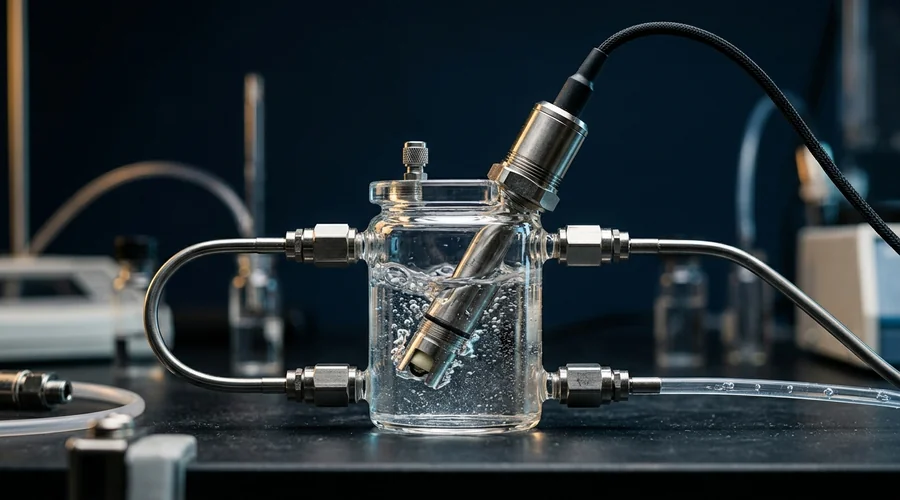
Good control data also gives a formulator the evidence to show that a scavenger product works.
Formulating Oxygen Scavenger Products: Where a Consultant Helps
An oxygen scavenger product is a reactive chemical sold in a drum, so its handling matters before it reaches the boiler. Sulphite is consumed by any oxygen it meets, organic scavengers carry their decomposition behaviour into the steam, and blends add compatibility questions. A water treatment formulation consultant tests the product against the feedwater, the steam use and the dosing hardware it will meet. Independent water treatment chemical product development services also keep the claims on the data sheet inside what the regulations and the test data support.
- Chemistry selection — sulphite, catalysed bisulphite or an organic scavenger, chosen from steam end use, pressure and metallurgy.
- Storage stability — closure, headspace and material choices that limit oxidation of the reductant before use.
- Compatibility — behaviour with neutralising amines, polymers and pump and tank materials in blended products.
- Trial design — a protocol built on dissolved oxygen and iron monitoring, not on residual alone.
- Scale-up — transfer to industrial water chemicals contract manufacturing with specifications that hold batch to batch.
Manufacturers entering the category can start with our scale and corrosion inhibitor manufacturing guide, and the wider category sits under water treatment. The way chemistries are built is covered in water treatment technology and formulations. Before committing to a product, run a short check. Confirm the steam end use, match the chemistry to pressure and residence time, and set the control plan around dissolved oxygen. Then verify the result on the metal at the first inspection.
Frequently Asked Questions
What is an oxygen scavenger in boiler feedwater?
An oxygen scavenger is a reducing chemical fed to boiler feedwater so that it reacts with the dissolved oxygen the deaerator leaves behind. Sodium sulphite, hydrazine, carbohydrazide, DEHA and hydroquinone are the common examples.
Veolia's handbook states that efficient mechanical deaeration reduces dissolved oxygen to 7 ppb or less. It also states that a chemical scavenger is required for complete protection from oxygen corrosion.
Why does a boiler need a scavenger when it already has a deaerator?
Oxygen corrosion is localised, so even trace oxygen can drive deep pits. Veolia notes that pits can penetrate deep into the metal and cause rapid failure of feedwater lines, economisers, boiler tubes and condensate lines.
Oxygen also reaches the system through poor deaerator operation, air in-leakage on pump suction, tank breathing and undeaerated seal water. The scavenger handles that residual load, and fixing the mechanical sources cuts how much scavenger is consumed.
How do sodium sulphite, DEHA and carbohydrazide compare?
Sodium sulphite is cheap and easy to test, but its sulphate product adds dissolved solids, and it decomposes in high-pressure boilers to sulphur dioxide and hydrogen sulphide. Veolia names it the common choice below 1,000 psig.
In VTT's earlier ranking of initial oxygen reaction rate, carbohydrazide was fastest and DEHA was slower. Carbohydrazide hydrolyses to hydrazine above 135 °C, and DEHA leaves acetaldehyde, acetic acid and amines. The right choice depends on pressure, steam use and metallurgy.
Why is hydrazine being replaced as an oxygen scavenger?
Hydrazine is solids-free and effective, but the EU classifies it as a category 1B carcinogen, "may cause cancer", under Regulation (EC) No 1272/2008. In the US rule for food-contact steam it is listed with the limitation "Zero in steam".
It also reacts slowly at low temperature, and its ammonia decomposition product increases copper alloy corrosion when oxygen is present. Those limits explain the search for replacements.
Does carbohydrazide turn into hydrazine in a boiler?
The 2024 VTT study gives the chemistry. Above 135 °C carbohydrazide hydrolyses to hydrazine and carbon dioxide, and above 200 °C it decomposes to ammonia, nitrogen, hydrogen and carbon dioxide.
In their 228 °C autoclave test, about 0.29 mg/L of hydrazine was measured in the outlet water. A carbohydrazide programme at high temperature should therefore be reviewed against the same steam-use and handling rules as hydrazine.
Which oxygen scavengers can be used where steam touches food?
In the United States, 21 CFR 173.310 names sodium sulphite (neutral or alkaline), sodium metabisulphite and cobalt sulphate as a catalyst. It lists hydrazine with the limitation "Zero in steam".
DEHA, carbohydrazide, hydroquinone and erythorbic acid are not named in the current text. The rule also caps the additive at the amount its functional purpose requires. Other jurisdictions have their own rules, so confirm the position for each target market.
How should oxygen scavenger feed be controlled?
Veolia states that oxygen monitoring is the most effective way to control scavenger feed, because volatility and decomposition make boiler residuals unreliable. Record the chemical fed against the oxygen found, and test for iron and copper oxides to judge the programme.
Match the method to the oxygen level. ASTM D888's probe procedures start at 0.05 mg/L in the 2018 edition, while a deaerator outlet at 7 ppb is 0.007 mg/L. ASTM D5543 is a colorimetric low-level method for deaerated boiler feedwater.
What can a formulation consultant do for an oxygen scavenger product?
A consultant selects the chemistry for steam end use, pressure and metallurgy, and designs storage and packaging that limit oxidation of the reductant before use. The work also covers blend compatibility with amines, polymers and pump materials.
Consultants build trial protocols around dissolved oxygen and iron monitoring, review regulatory limits for food-contact steam, and support transfer to contract manufacturing with batch specifications that hold.
Developing an Oxygen Scavenger Range or Reviewing a Boiler Programme?
Global Formulation supports water treatment chemical makers with scavenger chemistry selection, blend stability testing, trial design around oxygen monitoring, regulatory review for steam end use, product development and scale-up.
Talk to Our Formulation Team