Dissolution Method Development and IVIVC Explained
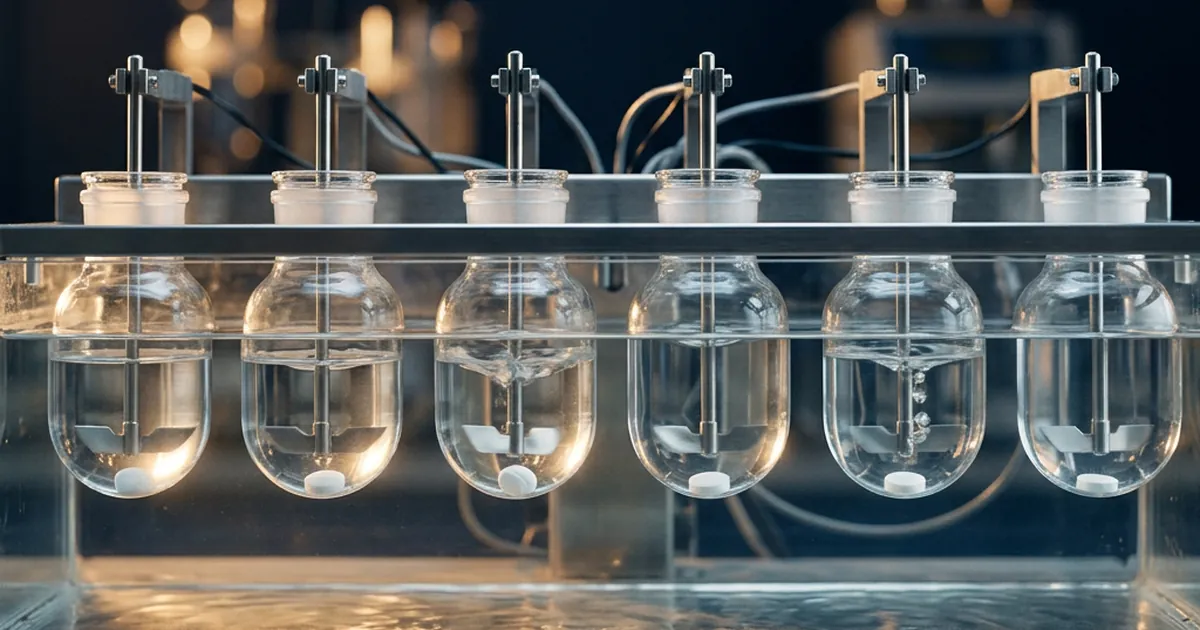
A dissolution method that cannot tell a good batch from a poor one gives false comfort at release and an expensive surprise at the next change. FDA says dissolution tests are used to assess lot-to-lot quality, guide formulation development and confirm quality after changes, so the method carries every one of those decisions. This guide explains dissolution method development from apparatus and media through discriminating methods, specifications, profile comparison and IVIVC. It draws on three FDA guidance documents, read from the primary text. It also reflects the formulation support Global Formulation gives pharmaceutical developers.
Dissolution Method Development: What the Test Must Achieve
Drug absorption from a solid dosage form depends on release of the drug substance from the product, its dissolution under physiological conditions and its permeability across the gastrointestinal tract. Because the first two steps are critical, FDA's immediate-release dissolution guidance says in vitro dissolution may be relevant to predicting in vivo performance. It names three uses: assessing lot-to-lot quality, guiding development of new formulations and ensuring quality after changes in formulation, process, site or scale. Each use asks the method to do something different, so the purpose comes before the apparatus.
| BCS Case | Solubility and Permeability | What FDA's 1997 Guidance Says |
|---|---|---|
| 1 | High solubility, high permeability | 85 percent dissolution in 0.1 N HCl in 15 minutes can ensure bioavailability is not limited by dissolution; the product behaves like a solution |
| 2 | Low solubility, high permeability | Dissolution may be the rate-limiting step, an IVIVC may be expected, and a profile in multiple media is recommended |
| 3 | High solubility, low permeability | Permeability is rate controlling and only a limited IVIVC may be possible |
| 4 | Low solubility, low permeability | Presents significant problems for oral drug delivery |
The Biopharmaceutics Classification System therefore predicts where the development effort should go. FDA's 2018 guidance calls a product highly soluble if its highest strength dissolves in 250 mL or less of aqueous media. The test range is pH 1 to 6.8 at 37 ± 1 °C. Our guide to the FDA, ICH and USP regulatory pathway shows where dissolution data enter a filing.
With the purpose set, the next decision is the physical set-up of the test.
Apparatus, Medium and Agitation: Building the Method
Apparatus, medium and agitation are the three levers that set what a dissolution test can detect. FDA's guidance says the basket and paddle methods are simple, robust, well standardised and used worldwide, so USP Apparatus 1 and 2 should be used unless shown to be unsatisfactory. The reciprocating cylinder (Apparatus 3) and flow-through cell (Apparatus 4) may be considered if needed, on the basis of proven superiority for a particular product. Medium and agitation then follow from the physicochemistry of the drug substance.
| Parameter | FDA Appendix A Recommendation for Immediate-Release Products |
|---|---|
| Apparatus | Basket (Apparatus 1) or paddle (Apparatus 2); Apparatus 3 and 4 only on proven superiority |
| Medium volume | Generally 500, 900 or 1000 mL |
| Medium | Aqueous, pH 1.2 to 6.8; pH 1.2 without enzymes for gastric fluid, pH 6.8 for intestinal fluid; a higher pH needs justification and should not generally exceed 8.0 |
| Surfactant | Recommended for water insoluble or sparingly soluble products, such as sodium lauryl sulfate; need and amount justified |
| Media to avoid | Water is discouraged because pH and surface tension can vary and change during the test; hydroalcoholic media are discouraged |
| Temperature | 37 ± 0.5 °C |
| Agitation | Basket 50 to 100 rpm; paddle 50 to 75 rpm; mild agitation preserves discriminating power |
| Sink conditions | Desirable but not mandatory |
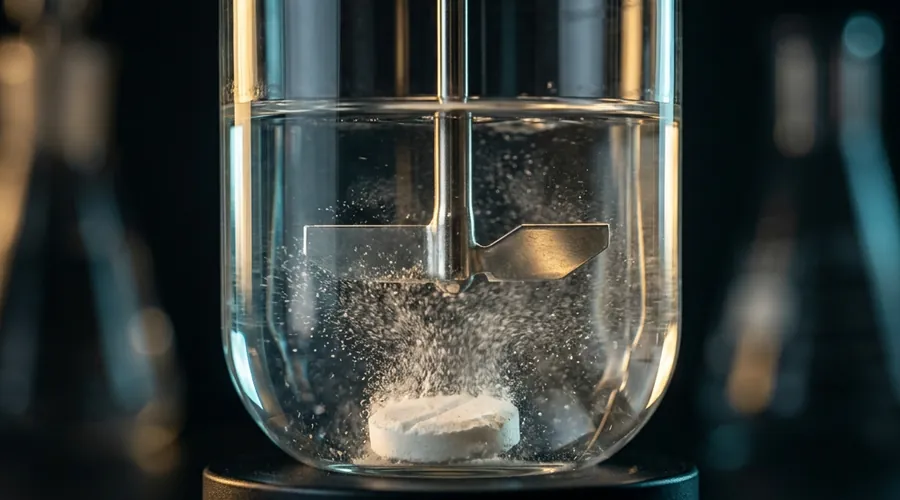
FDA's extended-release guidance adds that an aqueous medium preferably not above pH 6.8 should be the initial medium for developing an IVIVC. For poorly soluble drugs it says a surfactant such as 1 percent sodium lauryl sulfate may be appropriate. It asks for profiles of at least 12 units per lot, with a coefficient of variation for the mean profile of a single batch below 10 percent. FDA's 2018 guidance points to USP General Chapter <711> Dissolution for apparatus information and the number of units to test.
- Dissolved air — FDA notes that certain products are sensitive to dissolved air in the medium and need deaeration.
- Floating capsules — capsules tend to float with the paddle method, so FDA recommends a few turns of a wire helix around the capsule.
- Pellicle formation — gelatin capsule products may need pepsin in gastric fluid or pancreatin in intestinal fluid to dissolve a pellicle if one forms. Our guides to gelatin and HPMC capsule shells and softgel capsule manufacturing cover the shell side.
Conditions only matter if the method can tell formulations apart, which is the test of a discriminating method.
Discriminatory Dissolution Methods: Detecting the Changes That Matter
A discriminating method responds to formulation and process differences that could change performance. FDA's immediate-release guidance prefers a more discriminative method from a quality assurance viewpoint, because the test will signal changes in product quality before in vivo performance is affected. The same guidance observes that the in vitro test is often more sensitive and discriminating than the in vivo test. Building that sensitivity takes a deliberate screening step, not a default set of conditions.
- Characterise the drug substance — FDA says the method should be developed from the pH solubility profile and pKa, and permeability or octanol-water partition data may help.
- Choose starting conditions — begin with USP Apparatus 1 or 2 and a medium that follows the physicochemistry.
- Screen several methods early — FDA's extended-release guidance says dissolution testing can use several methods during formulation screening.
- Challenge the method with deliberate variants — FDA's mapping approach tests products with the fastest and slowest dissolution, called side batches.
- Fix the conditions — once a discriminating system exists, the same conditions apply to all formulations tested in the biostudy.
- Validate the method — follow the validation steps in the section below.
The 2018 guidance also creates an exception. For eligible highly soluble immediate-release products it describes a standard method and says the standards remove any requirement to show discriminatory ability during development. Once the method discriminates, or qualifies for the standard route, the specification can be set around it.
Setting Dissolution Specifications: Single-Point, Two-Point and Profiles
FDA's immediate-release guidance describes three types of dissolution specification: single-point, two-point and profile comparison. Which one applies depends mainly on the solubility and dissolution rate of the drug product. The 2018 guidance adds a streamlined route for eligible highly soluble products. The table summarises the options.
| Situation | FDA Approach |
|---|---|
| Eligible highly soluble immediate-release product | Standard conditions with the criterion Q = 80 percent in 30 minutes (2018 guidance) |
| Highly soluble, rapidly dissolving product outside the 2018 conditions | Single-point specification of not less than 85 percent (Q = 80 percent) in 60 minutes or less (1997 guidance) |
| Slowly dissolving or poorly water soluble product (BCS case 2) | Two-point specification: one point at 15 minutes to set a dissolution window and a later point at 30, 45 or 60 minutes to ensure 85 percent dissolution |
| Scale-up and postapproval changes, or waivers for lower strengths | Dissolution profile comparison |
The 2018 route applies only when the product meets every eligibility condition. FDA lists them, and its standard conditions are narrow.
- Dosage form — a solid immediate-release tablet or capsule meant to be swallowed, not an orally disintegrating or sublingual product.
- Solubility — the highest strength divided by 250 mL must not exceed the lowest solubility over pH 1 to 6.8 at 37 ± 1 °C. The drug must also be stable in the medium.
- Therapeutic index and onset — narrow therapeutic index products are excluded, and so are products with a claim of early or rapid onset.
- History and excipients — manufacturing and stability history must show the product meets the criterion, and excipient levels must suit their labelled function.
- Standard conditions — basket at 100 rpm or paddle at 50 rpm, 500 mL of 0.1 N HCl, no surfactant and 37 ± 0.5 °C.
A specification judges one batch against a limit, whereas comparing profiles judges whether a change altered performance.
Dissolution Profile Comparison and the f2 Similarity Factor
FDA's guidance uses dissolution profile comparison to accept product sameness after scale-up or postapproval changes and to support waivers for lower strengths. It describes a model-independent approach built on a difference factor, f1, and a similarity factor, f2. The f2 factor is a logarithmic reciprocal square root transformation of the sum of squared error between two curves. Values of f1 up to 15 and f2 above 50, within a range of 50 to 100, ensure sameness or equivalence of the two curves.
The formulas are f1 = {[Σ|Rt − Tt|] / [ΣRt]} × 100 and f2 = 50 × log {[1 + (1/n) Σ(Rt − Tt)2]−0.5 × 100}. Here n is the number of time points, Rt is the reference batch value and Tt is the test batch value at time t. FDA says the method suits profiles with three to four or more time points.
- Units and conditions — profile both products with 12 units each, under exactly the same conditions and with the same time points.
- Reference batch — use the most recently manufactured prechange product.
- Points after 85 percent — consider only one measurement after both products reach 85 percent dissolution.
- Variability limits — the coefficient of variation should not exceed 20 percent at early time points, such as 15 minutes, or 10 percent at the others.
- High variability — where within-batch variation exceeds 15 percent, FDA suggests a multivariate confidence region procedure instead.
For biowaivers, FDA says lower strengths with linear kinetics can be waived on dissolution profile comparison. They must be proportionately similar in composition under 21 CFR 320.22. Our guide to generic drug formulation development and bioequivalence shows how those waivers fit a development plan.
Profile comparison links two dissolution curves, and an IVIVC links dissolution to the body.
IVIVC: Levels A, B, C and Multiple C
An in vitro–in vivo correlation, or IVIVC, is a predictive model relating an in vitro property, such as dissolution, to an in vivo response, such as plasma concentration. FDA's extended-release IVIVC guidance defines four levels of correlation. Level A is the most informative and the one it recommends. The levels differ in how much of the in vivo curve they describe.
| Level | What It Relates | FDA's View |
|---|---|---|
| A | A point-to-point relationship between in vitro dissolution and the in vivo input rate, usually estimated by deconvolution and comparison of fraction absorbed with fraction dissolved | Most informative and recommended; the most common type in NDAs |
| B | Statistical moment analysis comparing the mean in vitro dissolution time with the mean residence time or mean in vivo dissolution time | Least useful for regulatory purposes; rarely seen in NDAs |
| C | A single dissolution parameter, such as the time for 50 percent dissolved or the percent dissolved in 4 hours, against one pharmacokinetic parameter | Useful in early development when selecting pilot formulations |
| Multiple C | One or several pharmacokinetic parameters against the amount dissolved at several time points | Can be as useful as Level A, but if it is possible a Level A is likely and preferred |
FDA describes the usual route to a Level A correlation in three steps. Develop formulations with different release rates, such as slow, medium and fast. Obtain in vitro dissolution and in vivo plasma profiles for each. Then estimate the in vivo absorption time course with a deconvolution technique such as Wagner-Nelson or numerical deconvolution.
- Number of formulations — two release rates define an IVIVC, and three or more are recommended, with release rates that differ adequately, for example by 10 percent dissolved.
- One system for all — the same dissolution system should be used for every formulation, and it should discriminate among them.
- Human data — FDA says human data should be supplied, in studies that have ranged from 6 to 36 subjects, with crossover designs preferred and the fasted state usual.
- Predictability — internal prediction error applies in all instances. External prediction error is appropriate when only two formulations are used, when internal results are inconclusive or when the drug has a narrow therapeutic index.
- Applications — once predictability is established, FDA outlines biowaivers for certain manufacturing changes without an in vivo bioequivalence study. Our guide to modified-release tablet technology covers the product design side.
A correlation is only as good as the method behind it, so the last technical question is how that method is validated and protected from common failures.
Validation, Calibration and Common Failure Points
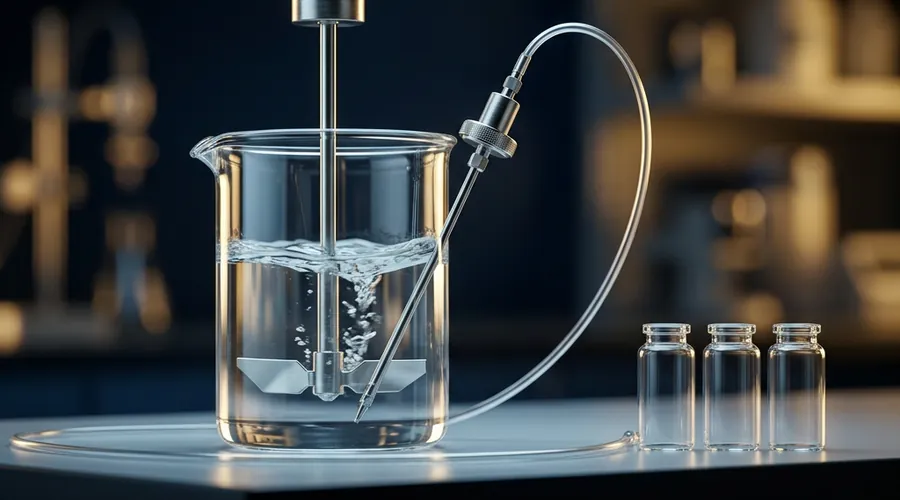
FDA's Appendix A says validation of the dissolution apparatus and method should include four elements. These are the system suitability test using calibrators, deaeration if necessary, validation between manual and automated procedures, and validation of the determinative step, meaning the analytical method for dissolution samples. The determinative step should include all appropriate steps of analytical method validation. FDA also says apparatus suitability tests with a performance standard should be run at least twice a year and after any significant equipment change or movement.
| Failure Point | Cause According to FDA | Response |
|---|---|---|
| Floating capsule | Capsules tend to float with the paddle method | A few turns of a wire helix around the capsule |
| Slower release on ageing | Pellicle formation in gelatin capsules | Two-tiered testing with pepsin in gastric fluid or pancreatin in intestinal fluid |
| Variable results | Dissolved air in the medium | Deaerate the medium |
| Drifting medium | Water as a medium changes with its source and with the test | Use buffered media within pH 1.2 to 6.8 |
| Coning | Low paddle speeds | 50 rpm, or 75 rpm with justification |
| Equipment drift | No regular performance check | Calibrators at least twice a year and after any move |
FDA's 2018 guidance also cites its guidance on mechanical calibration of Apparatus 1 and 2 under current good manufacturing practice. Our guide to quality by design in pharmaceutical formulation development shows how a validated method fits a design-space approach. A method that survives these checks is ready for the development partner who will run it.
Working With a Pharmaceutical Formulation Consultant
Dissolution method development sits between physical pharmacy, analytical chemistry and regulatory strategy, and the method has to work on the real product. A pharmaceutical formulation consultant characterises the drug substance, screens methods and challenges them with side batches. Pharmaceutical product development services also cover specification writing, profile comparison and stability planning. Contract formulation CDMO support then carries the validated method and the product into a facility that can run both under GMP.
- Define the purpose — release testing, formulation screening, change control or an IVIVC.
- Characterise the drug substance — pH solubility profile, pKa, BCS class and permeability data.
- Screen apparatus, media and agitation — compare methods at the formulation screening stage.
- Challenge the method — run side batches and compare discrimination.
- Set the specification — choose single-point, two-point or profile-based criteria.
- Validate and transfer — complete validation, then transfer the method with the process.
- Plan the stability and change-control programme — keep dissolution on the protocol and define the profile comparisons for future changes.
Our pharmaceutical and healthcare range shows where oral solid dosage forms sit among the other dosage forms. Our guide to choosing a pharmaceutical formulation consultant explains how to select a partner. The formulation side is covered in our guide to excipient selection for oral solid dosage forms. Global Formulation provides dissolution method development, specification support, profile comparison and scale-up for pharmaceutical developers. Product-specific release data and formulation ratios stay outside this guide by design.
Frequently Asked Questions
What is dissolution method development?
Dissolution method development is the process of choosing the apparatus, medium, agitation and sampling conditions of a dissolution test so that it can serve its purpose. FDA's immediate-release guidance names three purposes: assessing lot-to-lot quality, guiding development of new formulations and ensuring quality after changes.
The method should be built from the pH solubility profile and pKa of the drug substance, then challenged with deliberate variants and validated.
Which apparatus and medium are used for dissolution testing?
FDA says USP Apparatus 1 (basket) and Apparatus 2 (paddle) should be used unless shown to be unsatisfactory, and Apparatus 3 and 4 may be considered on proven superiority.
For immediate-release products the medium is aqueous at pH 1.2 to 6.8 and the temperature is 37 ± 0.5 °C. Agitation is 50 to 100 rpm for baskets or 50 to 75 rpm for paddles.
A surfactant such as sodium lauryl sulfate is recommended for water insoluble or sparingly soluble products, and its need and amount must be justified.
What is a discriminating dissolution method?
A discriminating method responds to differences in formulation or manufacturing that could change product performance. FDA's guidance prefers a more discriminative method from a quality assurance viewpoint, because the test then signals changes before in vivo performance is affected.
Mild agitation helps preserve discrimination. Developers also screen several methods during formulation development and challenge them with fast and slow side batches.
When can the standard Q = 80 percent in 30 minutes criterion be used?
FDA's 2018 guidance applies to solid immediate-release tablets and capsules with a highly soluble drug substance. The highest strength must dissolve in 250 mL or less over pH 1 to 6.8 at 37 ± 1 °C. It excludes narrow therapeutic index products, products with early or rapid onset claims, and orally disintegrating or sublingual forms.
Eligible products use a basket at 100 rpm or a paddle at 50 rpm in 500 mL of 0.1 N HCl without surfactant. Products outside the guidance follow the 1997 recommendations.
What does the f2 similarity factor tell you?
The f2 factor compares two dissolution profiles. FDA says f2 values greater than 50, within a range of 50 to 100, together with f1 values up to 15, ensure sameness or equivalence of the two curves.
The comparison needs 12 units of each product, the same time points and only one measurement after 85 percent dissolution. The coefficient of variation should not exceed 20 percent at early time points or 10 percent at later ones.
What are IVIVC levels A, B and C?
Level A is a point-to-point relationship between in vitro dissolution and the in vivo input rate, and FDA calls it the most informative. Level B compares the mean in vitro dissolution time with the mean residence time or mean in vivo dissolution time.
Level C relates a single dissolution parameter to a pharmacokinetic parameter, and multiple Level C relates several parameters to the amount dissolved at several time points.
FDA treats Level B as least useful for regulatory purposes and Level C as useful early in development.
How does BCS class affect dissolution method development?
BCS class tells you whether dissolution is likely to limit absorption. For a highly soluble, highly permeable case 1 product, FDA says 85 percent dissolution in 0.1 N HCl in 15 minutes can ensure that bioavailability is not limited by dissolution.
For a low solubility, high permeability case 2 product, dissolution may be rate limiting, an IVIVC may be expected and a profile in multiple media is recommended.
The class therefore decides how much effort the method deserves.
Developing a Dissolution Method or IVIVC?
Global Formulation supports method development, specification setting, profile comparison and transfer to a qualified facility.
Talk to Our Formulation Team