Softgel Capsule Formulation and Manufacturing
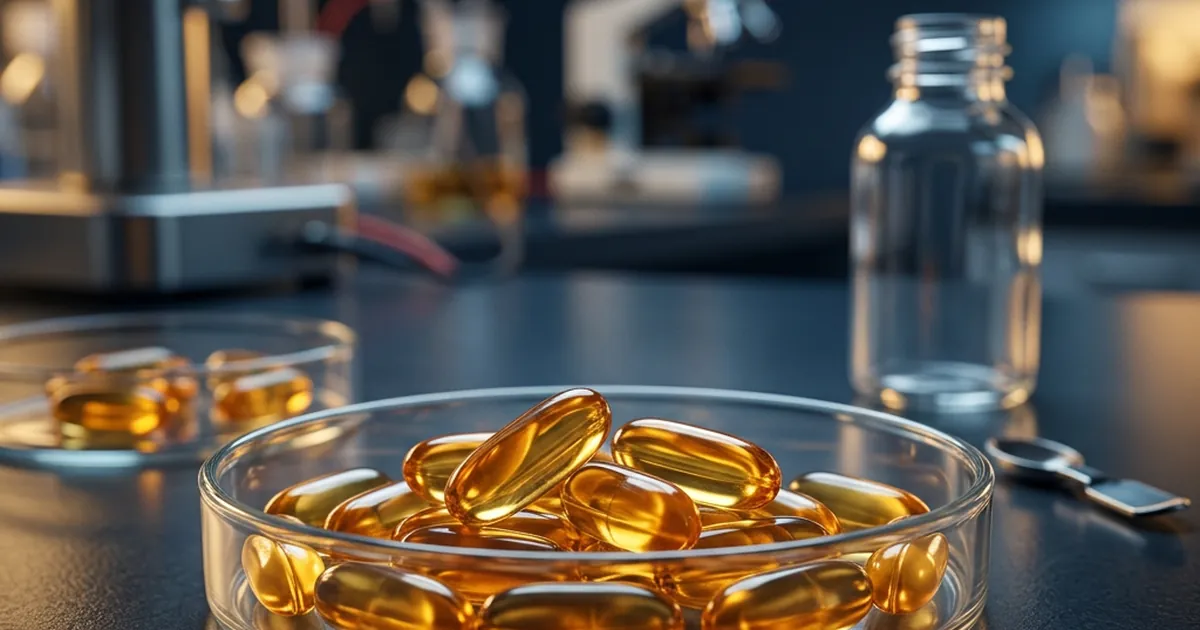
A softgel can leak, harden or release slowly weeks after a batch passed release testing. The shell is a reactive gelatin film, so the fill, the humidity and the drying history all change how the capsule behaves. A formulator who treats the shell as inert packaging meets these failures late and pays for them in stability studies. This guide explains softgel capsule formulation, from shell chemistry and fill matrix selection to rotary die encapsulation, drying, testing and scale-up. It draws on the European Pharmacopoeia general monograph on capsules and peer-reviewed reviews of shell design and dissolution, and reflects the formulation support Global Formulation gives pharmaceutical and supplement manufacturers.
Softgel Capsule Formulation: What a Softgel Is and When to Use One
The European Pharmacopoeia general monograph on capsules describes soft capsules as having thicker shells than hard capsules, with a shell of a single part in various shapes. Soft capsules are usually formed, filled and sealed in one operation, and liquids can be enclosed directly. Solids are usually dissolved or dispersed in a suitable vehicle to give a solution or a paste-like dispersion. That one-step, liquid-fill design explains both the strengths of the softgel and every formulation constraint that follows.
| Feature | Hard Capsule | Soft Capsule (Softgel) |
|---|---|---|
| Shell | Two prefabricated cylindrical sections, each with one closed end | A thicker shell of a single part in various shapes |
| Filling | The sections are filled and closed after the shells are made | Usually formed, filled and sealed in one operation |
| Contents | Usually solid, as powder or granules | Liquids enclosed directly, or solids dissolved or dispersed in a vehicle |
| Disintegration test | Water, 30 minutes, with a disc added if the capsules float | Water, 30 minutes, with a disc in each tube unless a liquid active attacks it |
| Contents and shell | The contents must not cause deterioration of the shell, which applies to all capsules | The same rule applies, and constituents can also migrate partly between the contents and the shell |
The table follows the pharmacopoeial text as reproduced in the British Pharmacopoeia 2012, so check the current edition before quoting it. Lipid-based fills suit softgels because liquids can be enclosed directly. In Pouton's lipid formulation classification, as summarised by Shrestha and colleagues, Type I fills are oils without surfactants and Type II fills are oils with water-insoluble surfactants. Type III adds co-solvents, and Type IV relies on water-soluble surfactants and co-solvents. After digestion the drug partitions from the emulsion droplets and bile salt mixed micelles to the intestinal wall. Our guide to nutraceutical formulation and bioavailability covers the supplement side of lipid delivery.
The shell comes first, because every fill and every process step has to be compatible with it.
Soft Gelatin Capsule Shell: Gelatin, Plasticiser and Water
In softgel capsule formulation, the soft gelatin capsule shell is a gelatin film made flexible by a plasticiser and water. The European Pharmacopoeia says the shells are made of gelatin or other substances, with consistency adjusted by substances such as glycerol or sorbitol. Surface-active agents, opaque fillers, antimicrobial preservatives, sweeteners, colouring matter and flavouring substances can be added. Each component changes how the finished capsule behaves in storage and in the body.
- Gelatin — a 2024 review in Advanced Healthcare Materials describes it as the denaturation product of collagen from pig, cow or fish. Extraction by acid gives type A, by alkali type B and by enzymes type E.
- Bloom strength — gelatin is graded as low, medium or high bloom, and the review states that the medium range is preferred for softgel manufacture.
- Plasticiser — glycerin is the reference plasticiser because of its low molecular weight and high hygroscopicity, and sorbitol is mainly used with PEG-based fills.
- Water — the wet gel mass carries a large share of water, and drying reduces it to a small final content.
- Opacifiers, colours and preservatives — titanium dioxide, colourants and parabens are the examples the review names.
- Non-gelatin shells — starch, carrageenan, HPMC, chitosan, pullulan and pectin are named as alternatives, and commercial examples include shells based on pea starch and carrageenan.
The review explains that glycerin's strong hygroscopicity lets the shell pick up water quickly, which promotes sticking. Plasticiser choice therefore has to match both the fill and the storage climate. Our guide to capsule shell technology compares gelatin and HPMC for hard capsules, and this guide covers the soft shell.
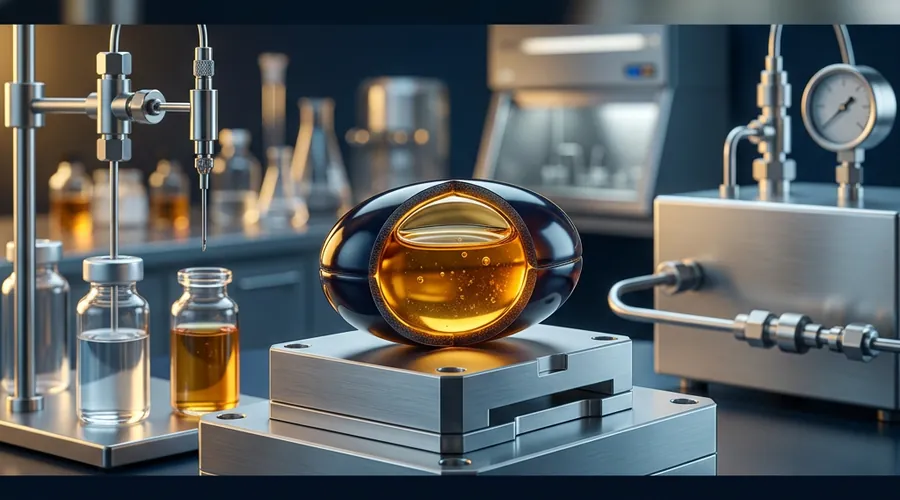
The fill that sits inside that wall is the second half of the formulation.
Softgel Fill Matrix: Lipid, Hydrophilic and Suspension Fills
A softgel capsule formulation needs a fill matrix that dissolves or suspends the active ingredient, stays liquid or paste-like through manufacture, and leaves the shell intact. The pharmacopoeia states that the contents do not cause deterioration of the shell, and that rule sits behind every fill choice. Liquids can be enclosed directly, while solids are dissolved or dispersed in a suitable vehicle. The vehicle class then decides which shell, which plasticiser and which tests apply.
| Fill Class | Composition | Main Compatibility Concern |
|---|---|---|
| Lipid solution (Type I) | Oils without surfactants | Needs digestion for release, and the Shrestha review reports excellent capsule compatibility |
| Self-emulsifying (Types II and III) | Oils with surfactants, and with co-solvents in Type III | Hydrophilic co-solvent components can migrate toward the shell |
| Hydrophilic solution | A water-miscible vehicle such as a low-molecular-weight polymer | Diffuses into the shell during drying and shelf life, so the shell design has to allow for it |
| Suspension or paste | Solid dispersed in a suitable vehicle | A paste-like consistency is a processing requirement as well as a formulation choice |
The 2024 review lists what to keep out of a softgel fill, and each rule reflects a chemical interaction with gelatin. Our guide to drug excipient compatibility studies explains how to screen the active and the vehicle against the shell materials.
- Water and hydrophilic liquids — high levels of water or low-molecular-weight hydrophilic liquids such as glycerin, propylene glycol and short-chain PEGs migrate into the shell and act as plasticiser, which alters the shell structure.
- Extreme pH — acidic or alkaline components promote hydrolytic degradation of gelatin, and the review gives a compatible pH range of 2.5 to 7.5.
- Volatile solvents — ethanol diffuses quickly through the shell.
- Aldehydes and carbonyl groups — they promote cross-linking and change the dissolution profile.
Shell and fill meet on the rotary die, where the process fixes how well the two stay together.
Rotary Die Encapsulation: How Softgels Are Formed and Sealed
Modern softgel manufacture uses variations of the Scherer rotary die process, developed in 1933, as Wikipedia's capsule article records. Two gelatin ribbons are brought together between rotating dies, the fill is dosed as the capsule forms, and the capsule is sealed and cut free in one continuous motion. This is the formed, filled and sealed in one operation that the pharmacopoeia describes. Ribbon thickness, die condition and fill dosing therefore decide capsule weight, seam quality and leak rate.
- Feed the gel mass — the hot gel mass flows through heated transfer pipes to two metering devices.
- Cast two ribbons — each device meters shell mass onto a rotating drum, and ribbon thickness is checked frequently and controlled to ±0.1 mm.
- Lubricate the ribbons — a small quantity of food-grade lubricating oil, such as medium-chain triglycerides, is applied.
- Form and fill — the ribbons pass between two rollers rotating in opposite directions, which print the mould shape on the shell sheets.
- Seal and cut — the ribbons are sealed hermetically at about 37 to 40 °C, and the filled capsules are cut out.
- Dry — the soft, wet capsules go to a two-stage drying process.
These steps and temperatures come from the 2024 review, and a given machine and shell formula will set its own windows. Our guide to scale-down models that predict the plant explains how to carry pilot settings across to production.
Newly formed capsules are soft and wet, so drying decides what the final shell will be.
Softgel Drying and Storage: Where Shell Quality Is Won or Lost
Freshly sealed softgels carry a lot of water in the shell, and drying removes it in a controlled sequence. The 2024 review describes primary rotary drying with dry air below 35 °C for one to three hours. It then describes secondary tray drying at 21 to 24 °C and 20 to 30 percent relative humidity for hours to days. Drying conditions therefore link the process directly to later brittleness, sticking and cross-linking.
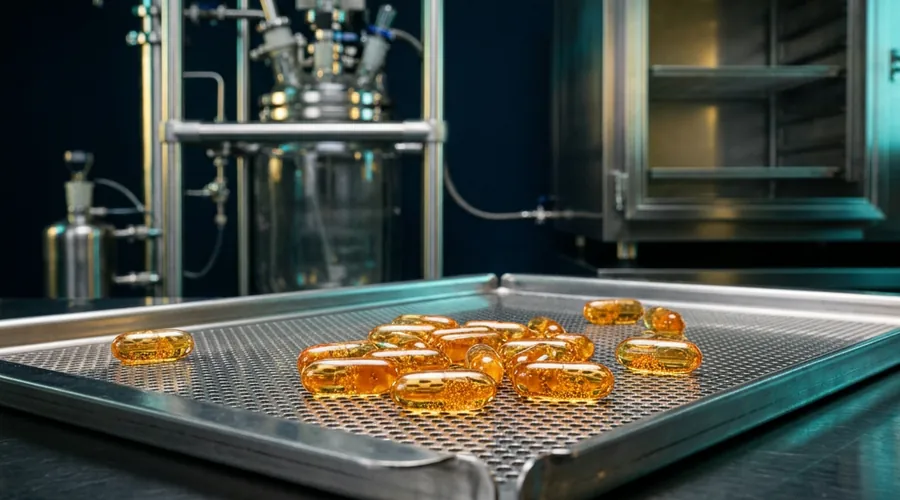
- Primary drying — a rotary dryer pumps dry air continuously while the shell is still semifluid enough to seal properly.
- Secondary drying — trays hold the capsules under controlled temperature and humidity, and the duration depends on the fill and the shell formulation.
- Heat history — the review reports that films dried at high temperature showed higher brittleness and worse fracture properties.
- Moisture — shell moisture above the target range increases the risk of sticking and microbiological problems.
- Storage — the pharmacopoeia says to store capsules at a temperature not exceeding 30 °C, and the review recommends a relative humidity of not more than 50 percent for finished softgels.
Moisture and heat also feed the main chemical failure of the shell, which is the interaction with the fill.
Shell-Fill Interactions: Migration, Cross-Linking and Brittleness
In a softgel capsule formulation, the interface between shell and fill is where migration and cross-linking occur. The pharmacopoeia warns that partial migration of constituents between the contents and the shell can occur because of the materials and the surfaces in contact. Gelatin can also cross-link, forming bonds between amino acid groups that raise its molecular weight and reduce its solubility. The result is a shell that dissolves slowly, turns rubbery or becomes brittle.
| Interaction | Reported Triggers | Consequence |
|---|---|---|
| Plasticiser migration | High levels of water or low-molecular-weight hydrophilic liquids in the fill | The shell structure changes |
| Hydrolysis | Acidic or alkaline fill components outside the compatible pH range | Gelatin degrades |
| Solvent loss | Volatile solvents such as ethanol | The solvent diffuses through the shell |
| Cross-linking | Aldehydes, ketones, peroxides, epoxides, metal salts, oxidising agents, UV light, and humidity or temperature extremes | Slower swelling and dissolution, and a rubbery pellicle |
| Brittleness | High-temperature drying | Worse fracture properties |
The dissolution review by Damian and colleagues describes a pellicle as a gelatin shell that swells, becomes rubbery and stays insoluble in water. The 2024 review describes three defences: use excipients without aldehyde groups, add cross-linking inhibitors, or use chemically modified gelatins designed to resist cross-linking. Our guide to excipient selection for oral solid dosage forms covers excipient screening in general.
These interactions show up in the laboratory as changes in how fast the capsule opens, which is why testing needs its own approach.
Softgel Testing: Disintegration, Dissolution and Rupture
Softgel capsule formulation testing has to account for a shell that must rupture before anything is released. The European Pharmacopoeia requires soft capsules to comply with the disintegration test for tablets and capsules, using water, a disc in each tube and 30 minutes unless justified. Damian and colleagues describe dissolution as a series of steps: shell swelling and rupture, release and dispersion of the fill, and dissolution of the active. The slowest step controls the rate, which is why methods built for tablets and hard capsules cannot be copied across.
| Test | Reference | Softgel-Specific Point |
|---|---|---|
| Disintegration | Ph. Eur. 2.9.1 | A disc is added and can be omitted if a liquid active attacks it. A failure caused by sticking to the discs is invalid and repeated on 6 capsules without discs |
| Dissolution | Ph. Eur. 2.9.3 and USP chapter 711 | A two-tier assessment with enzymes is allowed where there is evidence of cross-linking |
| Rupture test | USP chapter 2040 for dietary supplements | Used for semi-solid or liquid contents, in apparatus 2 at 50 rpm in 500 mL for 15 minutes |
| Uniformity of dosage units | Ph. Eur. 2.9.40 | Applies to capsules in the general monograph |
| Shell mechanical and thermal tests | 2024 review | Tensile and puncture strength, texture analysis, water vapour permeability and differential scanning calorimetry |
- Oil fills in baskets — an oil fill that does not disperse into droplets fine enough to pass through the mesh delays dissolution in a way that does not represent the capsule.
- Basket clogging — the shell can break into a soft, sticky mass that clogs the mesh and raises variability.
- Floating after rupture — in the paddle method, capsules float once they break, and wire sinkers hold them at the bottom of the vessel.
- Surfactants and enzymes — a protein-denaturing surfactant requires a two-step method that dissolves the shell with enzyme first, and enzymes need mixing, have limited stability in solution and are affected by surfactants.
Test methods only protect the product if the stability programme and the plant keep the shell consistent, which brings in scale-up.
Softgel Scale-Up, Stability and Quality Considerations
Softgel capsule formulation scale-up changes the heat, humidity and dwell time that a shell experiences, so the stability programme has to follow the process. The pharmacopoeia says suitable measures are taken to ensure the microbial quality of capsules. The ICH Q1A(R2) guideline sets the framework for stability testing of new drug substances and products. Our guide to pharmaceutical stability testing explains how storage conditions map to real markets.
- Stability attributes — include appearance, shell integrity and leak checks, disintegration or dissolution after storage, and assay, because cross-linking and moisture changes act on the shell.
- Packaging — protect the shell from humidity, since the shell is the component that reacts to it.
- Process transfer — gel mass preparation, ribbon settings, sealing and drying conditions transfer with the formula, so they belong in the technology transfer package.
- Non-gelatin shells — starch, carrageenan, HPMC, chitosan, pullulan and pectin appear in the literature as alternatives, and each starts its own compatibility programme.
Many brand owners meet these needs through partners, and our guide to pharmaceutical CDMO selection explains how to test a partner's capability early. Rotary die capability, gel mass preparation and drying capacity are the qualifications to test. Specialist support shortens that path.
Working With a Pharmaceutical Formulation Consultant
Softgel capsule formulation combines lipid formulation, gelatin chemistry and a specialised process, and a project needs all three. A pharmaceutical formulation consultant profiles the active, selects the fill class and matches the shell to it. Pharmaceutical product development services also cover test methods, stability protocols and technology transfer packages. Contract formulation and CDMO support then carries the product onto a qualified rotary die line.
- Profile the active ingredient — solubility in candidate vehicles, chemical stability and carbonyl reactivity.
- Select the fill class — lipid solution, self-emulsifying system, hydrophilic solution or suspension.
- Match the shell — gelatin type, plasticiser and opacifier, or a non-gelatin alternative.
- Screen compatibility — pH, water, volatiles and aldehydes, with early stability data.
- Develop test methods — disintegration, dissolution with enzyme tiers and a rupture test where applicable.
- Run pilot encapsulation and drying — fix ribbon, seal and drying conditions at pilot scale.
- Transfer to a CDMO — move the process with the stability and method data.
Our pharmaceutical and healthcare range shows where softgels sit among other dosage forms, and our guide to choosing a pharmaceutical formulation consultant explains how to judge candidates. Enteric-coated softgels raise additional design questions, which our guide to enteric-coated formulations covers. Global Formulation provides softgel capsule formulation, compatibility screening, stability planning and CDMO technology transfer support for pharmaceutical and supplement manufacturers.
Frequently Asked Questions
What is a softgel capsule formulation?
A softgel is a soft capsule with a thicker, single-part shell than a hard capsule. The European Pharmacopoeia says soft capsules are usually formed, filled and sealed in one operation.
Liquids can be enclosed directly, and solids are usually dissolved or dispersed in a suitable vehicle to give a solution or a paste-like dispersion. That liquid-fill design is what distinguishes the softgel from the hard capsule.
What is a softgel shell made of?
The shell is made of gelatin or another film-forming material, adjusted with a plasticiser such as glycerol or sorbitol. The pharmacopoeia lists surface-active agents, opaque fillers, preservatives, sweeteners, colouring matter and flavouring substances as possible additions.
Gelatin comes from the denaturation of collagen from sources such as pig, cow or fish. Non-gelatin shells based on starch, carrageenan, HPMC, chitosan, pullulan or pectin are described in the literature.
How are softgel capsules manufactured?
Modern softgel manufacture uses variations of the Scherer rotary die process, developed in 1933. Two gelatin ribbons are formed, brought together between rotating dies, filled, sealed and cut in one continuous operation.
The capsules are then dried in two stages, first in a rotary dryer with dry air and then on trays under controlled temperature and humidity. Drying sets the final moisture of the shell, which controls flexibility, sticking and stability.
Why can a softgel dissolve more slowly after storage?
Gelatin can cross-link, forming bonds between amino acid groups that raise its molecular weight and lower its solubility. The shell then swells and turns rubbery instead of dissolving, a state called a pellicle.
Aldehydes, other carbonyl groups, humidity and temperature extremes, light and oxidising agents are reported triggers. USP chapter 711 allows a two-tier dissolution assessment with enzymes where there is evidence of cross-linking.
What can go inside a softgel and what must stay out?
Oils, lipid solutions, self-emulsifying systems, hydrophilic solutions and paste-like dispersions can all be filled, provided they do not damage the shell. High levels of water or low-molecular-weight hydrophilic liquids migrate into the shell and change its structure.
Extreme pH promotes hydrolysis of gelatin, and a compatible pH range of 2.5 to 7.5 is reported. Volatile solvents such as ethanol diffuse through the shell, and aldehydes promote cross-linking.
How is softgel disintegration tested?
The European Pharmacopoeia requires soft capsules to comply with the disintegration test for tablets and capsules. The test uses water as the medium, adds a disc to each tube and runs for 30 minutes unless otherwise justified.
Some liquid actives attack the disc, so the disc may be omitted where authorised. If capsules fail because they stick to the discs, the result is invalid and the test is repeated on 6 more capsules without discs.
Are there softgels that do not use gelatin?
Yes. Published reviews describe softgel shells based on starch, carrageenan, HPMC, chitosan, pullulan and pectin, and some commercial non-gelatin shells combine pea starch with carrageenan.
They offer an option where a gelatin-free shell is wanted. Each one needs its own process, compatibility and stability work, because the shell chemistry differs from gelatin.
Developing a Softgel Product?
Global Formulation supports softgel capsule formulation, shell and fill compatibility, stability planning and scale-up to a qualified plant.
Talk to Our Formulation Team