Effervescent Tablet Formulation and Manufacturing
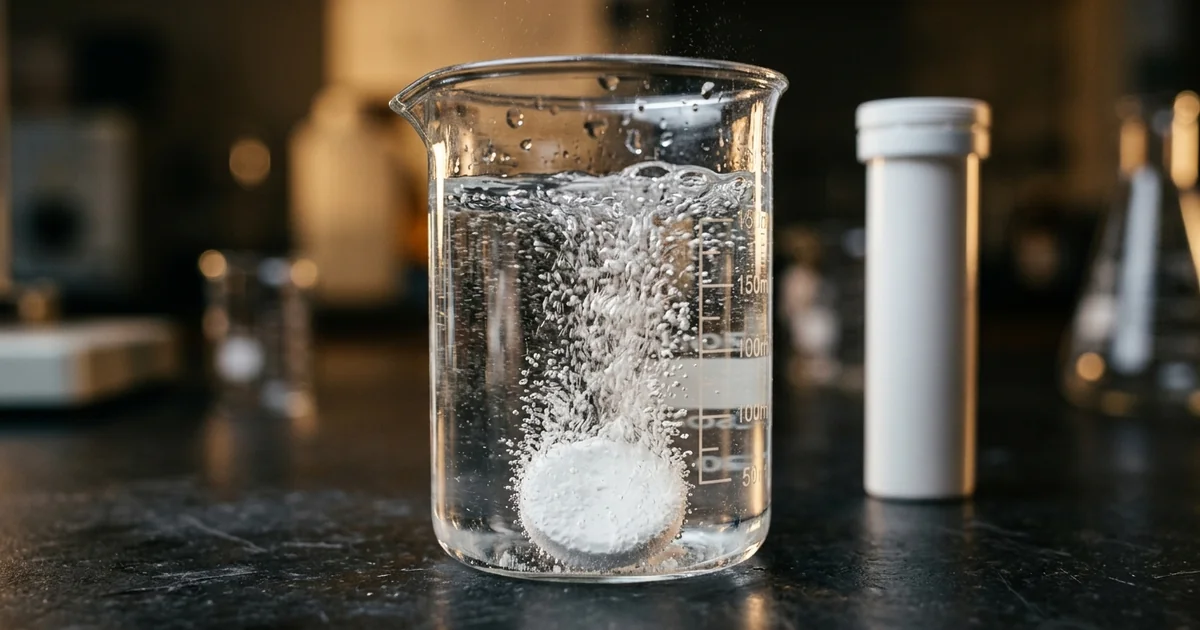
A batch of effervescent tablets leaves the plant perfect and reaches the pharmacy swollen, discoloured, and flat, because moisture found the carbonate on the way. Effervescent products fail in ways most tablets do not, since water reacts with the formulation itself. A humidity lapse anywhere in manufacture, packaging, or storage can therefore destroy the product. This guide covers effervescent tablet formulation, from the acid and carbonate couple and granulation routes to soluble lubricants, sodium content, disintegration testing, and packaging. It reflects how Global Formulation supports pharmaceutical and supplement manufacturers with formulation, process development, and CDMO technology transfer.
Effervescent Tablet Formulation: What the Dosage Form Must Do
An effervescent tablet is a dosage form that finishes its work in a glass of water, not in the stomach. The European Pharmacopoeia defines it as an uncoated tablet containing acid substances and carbonates or hydrogen carbonates that react rapidly with water to release carbon dioxide. The tablet is dissolved or dispersed in water before administration, which suits patients who struggle to swallow tablets. That single design goal explains every formulation and packaging decision that follows.
| Tablet Type | Medium and Intent | Ph. Eur. Disintegration Limit |
|---|---|---|
| Effervescent | Dissolved or dispersed in water, with carbon dioxide from an acid and carbonate reaction driving disintegration | Each of 6 tablets within 5 min in 200 mL of water at 15-25 °C, unless otherwise justified |
| Soluble | Uncoated or film-coated, dissolved in water before use, with a solution that can be slightly opalescent | Within 3 min in water at 15-25 °C |
| Dispersible | Uncoated or film-coated, dispersed in water to give a homogeneous dispersion | Within 3 min in water at 15-25 °C |
Our guide to orally disintegrating tablet formulation covers the related form that disperses in the mouth. Only the effervescent type carries its own disintegration engine, so the acid and carbonate chemistry comes next.
The Effervescent Couple: Acid and Carbonate Chemistry
The effervescent couple is the acid and carbonate pair that produces carbon dioxide on contact with water. Citric acid is the most widely used acid, and sodium bicarbonate is the most widely used carbonate source. In solution the acid protonates bicarbonate to form carbonic acid, which releases carbon dioxide gas and leaves a soluble salt. The gas breaks the tablet apart, speeds dissolution, and gives the drink its fizz.
| Component Class | Common Examples | Main Selection Trade-Off |
|---|---|---|
| Acid source | Citric, tartaric, malic, fumaric, and adipic acids | Solubility, hygroscopicity, taste, and the solubility of the salt formed |
| Carbonate source | Sodium bicarbonate, sodium carbonate, potassium bicarbonate, calcium carbonate, magnesium carbonate | Reactivity, solubility, sodium load, taste, and thermal stability |
| Active ingredient | Vitamins, minerals, analgesics, mucolytics, and similar actives | Stability in the acid and carbonate environment and in solution |
Effervescent tablets generate carbon dioxide from a bicarbonate compound and an acid such as citric or tartaric acid. Citric acid is triprotic, so each molecule can neutralise up to three bicarbonate ions, and the monohydrate carries water of crystallisation that matters in moisture-sensitive systems. Sodium bicarbonate begins to decompose to sodium carbonate on heating, which limits drying and fusion temperatures. Some pairings leave poorly soluble salts, so the clarity of the finished solution belongs on the test list. Our guide to drug excipient compatibility studies explains how to screen the active against the couple.
That shared trigger makes moisture the defining constraint of the whole product.
Effervescent Tablet Moisture Control: Why Humidity Decides the Product
The acid and carbonate do not wait for the patient's glass, because they react with any water they meet, including atmospheric moisture. A published potassium citrate study noted that effervescent materials are highly hygroscopic and degrade in humid air, and it specified low relative humidity and cool to moderate temperatures for manufacture. Premature reaction consumes the couple, releases gas, and leaves a tablet that fizzes weakly or swells in its pack. Moisture control is therefore a formulation decision, a plant decision, and a packaging decision at once.
- Raw material moisture — specify and test the water content of acids, carbonates, fillers, and the active before they enter the blend.
- Suite conditions — run granulation, blending, compression, and packing in controlled low-humidity, cool areas with monitored dew point.
- Exposure time — limit how long open powder, granules, and tablets wait between steps.
- In-process moisture checks — measure granule and tablet moisture during the run, not only at the end.
- Barrier packaging — seal tablets in foil strips or in tubes with desiccant closures.
- Climate-matched stability — test at the humidity the product will meet in its target market.
Our guide to GMP facility design for pharmaceutical manufacturing covers air handling and humidity zoning. Our guide to pharmaceutical stability testing under ICH guidelines explains how storage conditions map to real markets.
With the moisture limits defined, the next decision is how to turn the powder into granules that compress well without reacting.
Effervescent Granulation: Direct Compression, Dry, Wet and Fusion Routes
Effervescent blends rarely compress well as simple powders, so the route from powder to tablet is a central choice in effervescent tablet formulation. Each route manages the same conflict: the granule needs binding and flow, but the binder and the process must not start the reaction. The right choice depends on the active, the batch size, and the humidity control available. The table compares the four routes.
| Route | How It Works | Strength | Limitation |
|---|---|---|---|
| Direct compression | Dry blend compressed without granulation | Fewest steps and no added liquid | Depends on flow and compressibility; segregation risk |
| Dry granulation | Roller compaction or slugging densifies powder without liquid | Suits moisture-sensitive blends | Fines and dust; reduced compressibility after compaction |
| Wet granulation with a non-aqueous binder | A binder dissolved in a solvent such as ethanol wets and binds the powder | Improves flow and hardness while avoiding water | Solvent handling, drying, and residual solvent control |
| Fusion (heat) granulation | Controlled heating releases the water of crystallisation of citric acid monohydrate to bind the mass | No added solvent | Tight temperature and time control; released water can start the reaction |
In a published study of potassium citrate effervescent tablets, direct compression and fusion gave good flow but low hardness for that formula. Wet granulation with an ethanolic binder gave acceptable tablets. Treat that result as a data point, not a rule, because the active, the acid, and the equipment all shift the answer. Sodium bicarbonate decomposes on heating, so dryer and fusion temperatures need a defined ceiling. Our guide to pharmaceutical granulation technology covers the equipment behind the wet and dry routes. A non-aqueous wet route also brings residual solvent limits into the specification.
Granules still need excipients that dissolve cleanly, and the wrong lubricant is the classic way to ruin an otherwise sound tablet.
Lubricants, Binders and Sweeteners: Excipients That Must Dissolve Cleanly
Every excipient in an effervescent tablet has to dissolve, because the patient drinks the result. A lubricant is essential, since production on high-speed presses is not possible without one. Insoluble lubricants such as magnesium stearate leave a scum or film on the water surface, so effervescent tablets use water-soluble lubricants instead. Binders, sweeteners, flavours, and colours follow the same rule.
- Water-soluble lubricants — sodium benzoate, polyethylene glycol (PEG 6000), adipic acid, and L-leucine are used in place of insoluble stearates.
- Water-soluble binders — polyvinylpyrrolidone (PVP) and PEG bind the granules and dissolve with the tablet.
- Sweeteners and flavours — mask the acid taste and the bitterness of the active, and must survive the acid and carbonate environment.
- Colours — water-soluble colourants give a uniform colour in solution without particles.
- Fillers and diluents — soluble fillers keep the solution clear, while insoluble ones cloud it.
Our guide to excipient selection for oral solid dosage forms compares binder and diluent classes. Our guide to taste masking in pediatric formulation covers sweetener and flavour strategy.
Even with the right excipients, the press adds its own problems, because the blend is hygroscopic and strength competes with speed of dissolution.
Tablet Compression: Sticking, Hardness and Dissolution Time
Compression decides whether a well-made granule becomes a usable tablet. Hygroscopic, acidic blends stick to punch faces when the press room is humid. Compaction force creates a trade-off: harder tablets survive packing and handling, while more porous tablets let water in faster and effervesce sooner. The formulation and the press settings have to be tuned together.
- Sticking and picking — control press-room humidity, blend moisture, and the lubricant system, and check tooling condition.
- Hardness versus effervescence time — more compaction force adds strength and removes porosity, so measure both together.
- Friability and handling — tablets must survive strip packing, tube filling, and transport without chipping.
- Tablet size — high-dose products make large tablets, and edge strength becomes a packing issue.
Treat effervescence time, moisture, hardness, and solution appearance as critical quality attributes, and treat compression force, press-room humidity, and granule moisture as process parameters to characterise. Our guide to quality by design pharmaceutical formulation explains how to set those ranges with designed experiments.
Strength and speed settle the physical tablet, but a separate question concerns what the dissolved tablet delivers to the patient, starting with sodium.
Sodium Content in Effervescent Tablets: Labelling and Formulation Options
Sodium bicarbonate and sodium carbonate are the usual carbonate sources, so effervescent tablets often carry a meaningful sodium load. EMA's annex to the European Commission excipient labelling guideline notes that effervescent medicines commonly pair sodium-containing salts with acids such as citric or tartaric acid. Package leaflets should state the sodium content once a dose reaches 1 mmol (23 mg), and below that threshold the leaflet describes the product as essentially sodium-free. An observational UK nested case-control study linked sodium-containing effervescent, dispersible, and soluble medicines with higher odds of cardiovascular events than standard formulations of the same drugs.
Because the study was observational, it shows association, not cause. Formulators still treat sodium as a design variable and weigh the alternatives below.
- Potassium bicarbonate or carbonate — removes sodium but adds a potassium load, which matters for patients with reduced kidney function.
- Calcium carbonate — supplies calcium in mineral products, but dissolves less readily than sodium salts.
- Magnesium carbonate — supplies magnesium, with similar solubility limits.
- Blended carbonate sources — balance effervescence, taste, and mineral load across more than one source.
Test each alternative for effervescence time, clarity, and stability before committing, because the substitution changes all three.
Testing Effervescent Tablets: Disintegration, pH, Moisture and Clarity
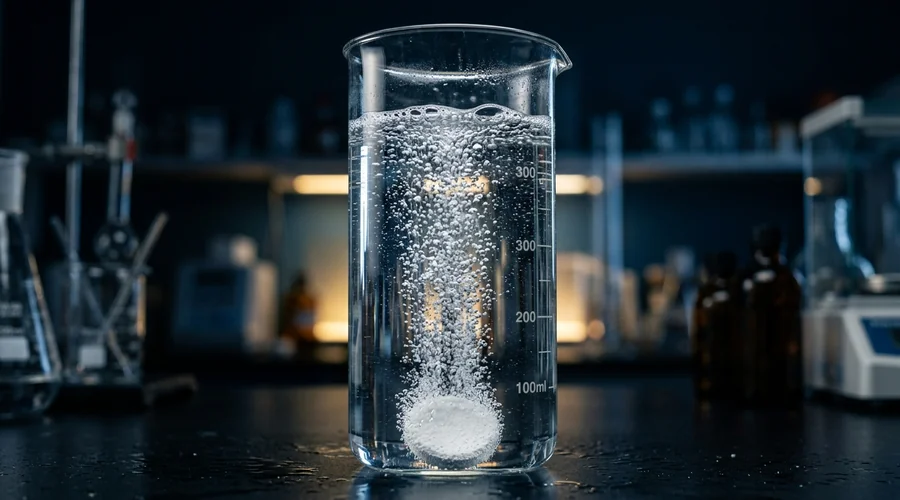
Effervescent tablet testing checks that the product reacts fast enough in the glass and not at all before it gets there. The European Pharmacopoeia test places one tablet in 200 mL of water at 15-25 °C and watches the gas evolution. The tablet has disintegrated when gas evolution around it ceases and no agglomerates remain. All 6 tablets tested must disintegrate within 5 minutes, unless otherwise justified and authorised.
| Test | What It Measures | Why It Matters |
|---|---|---|
| Disintegration (effervescence time) | Time until gas evolution ceases and no agglomerates remain | Pharmacopoeial criterion for the dosage form |
| Moisture content | Water in granules and tablets | Predicts premature reaction and shelf life |
| Solution pH | Acidity of the prepared drink | Affects taste and the stability of the active |
| Solution appearance | Clarity, scum, and sediment | Reveals insoluble lubricants and poorly soluble salts |
| Carbon dioxide content | Gas released on reaction | Confirms reactivity of the couple |
| Hardness, friability, weight variation | Mechanical strength and mass uniformity | Protect the tablet through packing and use |
| Assay and content uniformity | Active content per tablet | Confirms the dose |
A tablet that passes every test at release can still fail in storage, which is the job of packaging.
Packaging and Stability: Foil Strips, Tubes and Desiccants
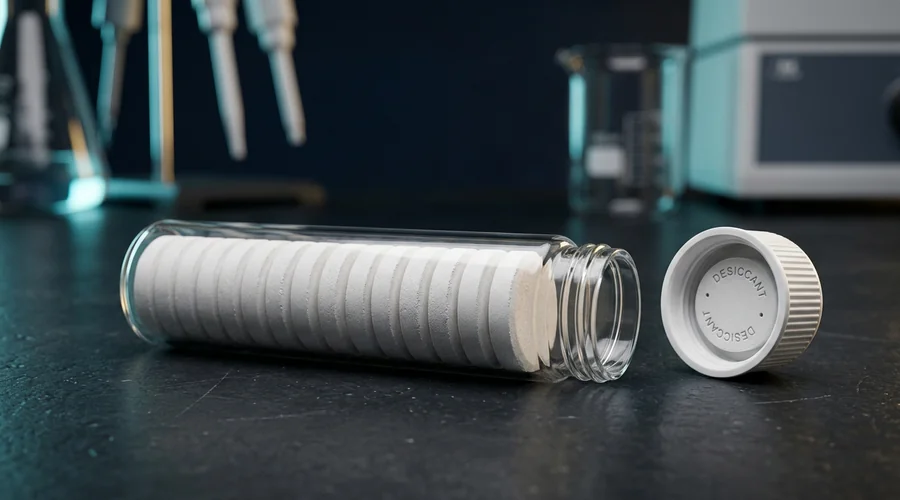
Effervescent tablets are packed to keep water out for their whole shelf life. They are commonly supplied in blister packs or in hermetically sealed packages with a desiccant built into the cap. The pack is part of the formulation, because a moisture leak consumes the couple and releases gas inside the container. Pack choice therefore follows the same logic as excipient choice: protect the reaction until the patient wants it.
- Foil strip or blister — each tablet is sealed separately, so opening one does not expose the others.
- Tube with desiccant closure — holds many tablets, but every opening admits humid air, so desiccant capacity and closure seal matter.
- Aluminium barrier — a foil layer blocks moisture, oxygen, and light, and published effervescent work describes foil-wrapped tablets in plastic tubes.
- Headspace and gas — moisture that enters the pack produces carbon dioxide inside it, which builds pressure.
- Stability programme — ICH Q1A(R2) sets the long-term, intermediate, and accelerated conditions, and regulators accept more stringent humidity conditions where the applicant chooses them.
Humid-climate markets need stability data that match their climatic zone, so choose the pack and the study conditions together. Packaging, process, and formulation all change with scale, so scale-up needs its own plan.
Scale-Up and Plant Design for Effervescent Tablet Manufacturing
An effervescent process that works at bench scale can fail in the plant because humidity, dwell time, and equipment contact all change. Large batches spend longer exposed between steps, and bigger equipment offers more surface for powder to pick up moisture. Plant design therefore starts with a dedicated low-humidity zone, not a general oral solids suite. Scale-up work finds the limits before commercial batches do.
- Dedicated low-humidity zone — separate dehumidified air handling with airlocks and continuous humidity and temperature monitoring.
- Closed, short transfers — move material between granulation, blending, compression, and packing in closed systems with short hold times.
- Equipment qualification — prove that the dryer, press, and packing line perform at production humidity.
- Scale-down models — test dwell and exposure effects at small scale first, using the approach in our guide to scale-down models that predict the plant.
- Technology transfer — test a contract partner's humidity control early, as our guide to pharmaceutical CDMO selection describes.
Specialist support shortens this learning curve, which is where a consultant adds value.
Working With an Effervescent Tablet Formulation Consultant
Effervescent products sit between pharmaceutical and supplement markets, and brand owners often lack an in-house humidity-controlled plant. A pharmaceutical formulation consultant selects the couple, the route, and the excipients, and designs the moisture strategy around the product. Pharmaceutical product development services also cover test methods, packaging selection, and stability protocols. Contract formulation and CDMO support then carries the process into a qualified low-humidity suite.
- Define the product — the active, the dose, the market, and the target solution volume.
- Choose the couple and the sodium strategy — select acid and carbonate sources against taste, solubility, and labelling.
- Screen excipients — test soluble lubricants, binders, and sweeteners for clarity and compatibility.
- Select the granulation route — confirm it on prototype batches against flow, hardness, and effervescence time.
- Set humidity limits — derive them from sorption testing and verify them in the press room.
- Select packaging and run stability — test in the climate of the target market.
- Transfer to a low-humidity plant — use a scale-up protocol that records hold times and humidity.
Our guide to choosing a pharmaceutical formulation consultant explains how to judge candidates. Supplement brand owners will also find our guide to nutraceutical formulation and bioavailability useful. The wider pharmaceutical and healthcare range shows where effervescent products sit among other dosage forms. Global Formulation provides effervescent tablet formulation, process development, packaging and stability planning, and CDMO technology transfer support for pharmaceutical and supplement manufacturers.
Frequently Asked Questions
What is an effervescent tablet and how does it work?
An effervescent tablet is an uncoated tablet that contains an acid together with a carbonate or hydrogen carbonate. When it meets water, the two react rapidly and release carbon dioxide.
The gas breaks the tablet apart, and the tablet dissolves or disperses in the water before the patient drinks it. The dosage form therefore finishes its disintegration in the glass, not in the stomach.
Why must effervescent tablets be packed in moisture-proof packaging?
The acid and carbonate react with any water they meet, including humidity in the air. A leaking pack lets that reaction begin early, which consumes the couple and releases gas inside the container.
Foil strips and tubes with desiccant closures are used because they keep moisture out until the patient adds water. Pack choice is therefore part of the formulation, not an afterthought.
Which acids and carbonates are used in effervescent tablets?
Citric acid is the most widely used acid, and tartaric, malic, fumaric, and adipic acids are also used. Sodium bicarbonate is the most widely used carbonate source, with sodium carbonate, potassium bicarbonate, and calcium or magnesium carbonate as alternatives.
The choice depends on solubility, taste, hygroscopicity, sodium content, and compatibility with the active ingredient. Each pairing also decides how clear the finished solution is.
Why is magnesium stearate avoided as a lubricant in effervescent tablets?
Magnesium stearate is insoluble in water, so it leaves a film or scum on the surface of the prepared drink. Effervescent tablets use water-soluble lubricants such as sodium benzoate, polyethylene glycol, adipic acid, or L-leucine instead.
Soluble lubricants are less efficient than stearates, so lubrication is tuned together with the press settings and the blend moisture. The prepared solution, not only the press performance, decides whether a lubricant is acceptable.
How is effervescent tablet disintegration tested?
The European Pharmacopoeia test places one tablet in 200 mL of water at 15-25 °C and watches the gas evolution. The tablet has disintegrated when gas evolution around it stops and no agglomerates of particles remain.
The test is repeated on 5 more tablets. All 6 tablets must disintegrate within 5 minutes, unless a different time is justified and authorised.
Do effervescent tablets contain a lot of sodium?
Many do, because sodium bicarbonate and sodium carbonate are the usual carbonate sources. EMA's excipient labelling guidance asks for the sodium content to be stated in the package leaflet once a dose reaches 1 mmol (23 mg) of sodium.
An observational UK study associated sodium-containing effervescent, dispersible, and soluble medicines with higher odds of cardiovascular events than standard formulations. Formulators therefore consider potassium, calcium, or magnesium carbonates as alternatives, each with its own trade-offs.
Can effervescent tablets be made by direct compression?
Yes, when the blend has enough flow and compressibility and humidity control is strict. Direct compression adds no liquid and has the fewest steps, but it depends on raw material quality and carries a segregation risk.
When flow or hardness is inadequate, dry, wet, or fusion granulation gives more control. A published potassium citrate study found low hardness from direct compression and fusion, while wet granulation with an ethanolic binder gave acceptable tablets.
Developing an Effervescent Tablet Product?
Global Formulation supports effervescent tablet formulation, moisture strategy, packaging and stability planning, and scale-up to a qualified plant.
Talk to Our Formulation Team