NPK Fertilizer Formulation: Grades, Routes and Quality
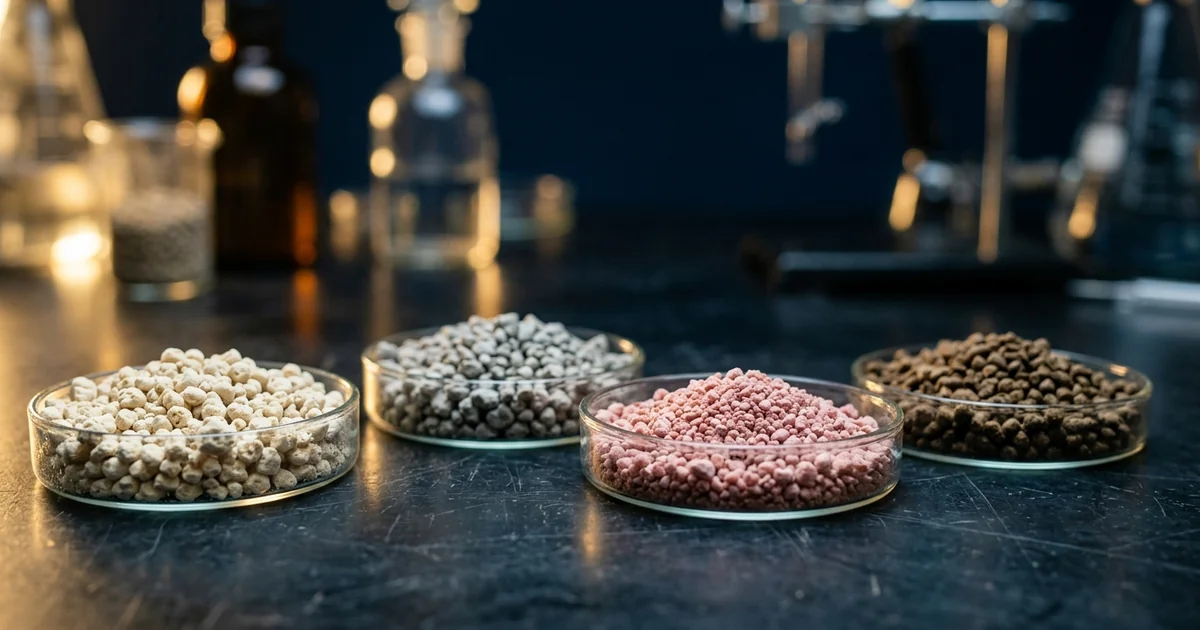
A bag labelled 15-15-15 makes a promise that three numbers hold, and the route used to make the product decides whether the promise is kept. Blends segregate when granule sizes differ, granules cake when the humidity rises, and some ammonium nitrate based products decompose when heated or contaminated. Each failure costs a batch, a customer or a licence, and each one starts in the design of the product. This guide explains NPK fertilizer formulation from grade arithmetic through blending, granulation and complex manufacturing to compatibility, safety and Indian rules. It draws on the Fertilizers Europe best available techniques booklets, a Fertilizers Europe compatibility guidance, an Ohio State physical properties fact sheet and India's Fertiliser (Control) Order. It also reflects the formulation support Global Formulation gives agrochemical manufacturers.
NPK Fertilizer Formulation Starts With the Grade Label
A grade is a legal and commercial statement before it is a recipe. The three numbers give the percentage of nitrogen, phosphorus as P2O5 and potassium as K2O. The Fertilizers Europe booklet on mixed acid NPK gives 24-6-12 as an example, meaning 24 percent N, 6 percent P2O5 and 12 percent K2O. India's Fertiliser (Control) Order defines grade as the nutrient element contents in the fertiliser expressed in percentage.
- Total nutrient content — in complex NPK fertilisers the sum of N, P2O5 and K2O normally falls in the range of 40 to 60 percent, according to the booklet. Products can also carry magnesium, boron, sulphur and micronutrients.
- NP and NK grades — grades with no P2O5 or no K2O belong to the same product range. The booklet says they can normally be produced in NPK plants.
- Oxide convention — phosphorus is declared as P2O5 and potassium as K2O. By stoichiometry P2O5 is about 43.6 percent phosphorus and K2O is about 83.0 percent potassium. These factors are our own arithmetic from atomic masses.
- Nitrogen forms — Indian specifications for NPK complex grades list total, ammoniacal and urea nitrogen as separate parameters.
- Phosphate and potash solubility — the same specifications list neutral ammonium citrate soluble P2O5 and water-soluble P2O5 separately, and they declare potash as water-soluble K2O.
| Straight Source | Minimum Nutrient Content in the Order | What It Brings Besides the Main Nutrient |
|---|---|---|
| Urea | 46 percent total nitrogen | A biuret limit applies to the grade |
| Ammonium sulphate | 20.6 percent ammoniacal nitrogen | Sulphur, with a minimum of 23.0 percent |
| Calcium ammonium nitrate | 25 or 26 percent total nitrogen | Half the nitrogen as ammoniacal nitrogen |
| Single superphosphate, granulated | 16 percent water-soluble P2O5 | Sulphur, with a minimum of 11.0 percent |
| Triple superphosphate | 46 percent total P2O5 | A water-soluble fraction is specified separately |
| Diammonium phosphate | 18 percent N and 46 percent P2O5 | Two nutrients in one source; the Order also lists a 16-44-0 grade |
| Potassium chloride | 60 percent water-soluble K2O | Sodium chloride is limited |
| Potassium sulphate | 50 percent K2O | Sulphur, with chloride and sodium limits |
The table lists the legal minimums for commodity materials, read from a consolidated copy of the Order, so check the current Schedule I before quoting them. Several sources carry two nutrients, and each one drags sulphur, chloride or sodium into the product. That is why grade design is arithmetic with constraints, which the next section works through.
NPK Grade Calculation: From Target Grade to Raw Material Masses
Grade calculation is mass balance. Each raw material contributes its nutrient fraction multiplied by its mass, and the batch must reach the target for every nutrient at the same time. Compound sources complicate the order of work, because one material supplies two nutrients. A written sequence prevents fixing one nutrient while breaking another.
- Set the target grade — fix N, P2O5 and K2O, plus any sulphur, magnesium, boron or micronutrient claim.
- Choose the phosphate source first — ammonium phosphates, superphosphates and phosphoric acid routes fix P2O5. Ammonium phosphates also supply part of the nitrogen.
- Top up nitrogen — add the straight nitrogen source for the remaining N. Ammonium sulphate and calcium ammonium nitrate also bring sulphur or calcium.
- Add potash — potassium chloride or potassium sulphate covers K2O, and the choice sets chloride, sodium and sulphur in the product.
- Compute each mass — the mass of a source is the nutrient still needed divided by the nutrient fraction of that source.
- Close with filler — the Order defines mixtures as made with or without inert material, and the balance of the batch carries no nutrient.
- Check the declaration — compare the calculated analysis with the label and with the tolerance the rules allow.
- Check compatibility and regulations — sections 5 and 8 cover both.
Our guide to starting a liquid fertilizer manufacturing unit covers the liquid side of the business. For solids, the next decision is how the nutrients get into the granule.
Blending, Granulation or Complex Manufacturing: Choosing the Route
The same grade can be made in more than one way, and each way creates a different product. India's Fertiliser (Control) Order defines three categories. Mixtures are physically mixed, granulated mixtures are granulated together without chemical reaction, and compound or complex fertilisers react chemically during production. The Fertilizers Europe booklet adds that complex NPK grades are hard to define because the N/P/K ratios and production processes are so numerous.
| Route | Definition in the Order | Main Strength | Main Limit |
|---|---|---|---|
| Physical mixture (bulk blend) | Physical mixing of two or more fertilisers, with or without inert material | Wide grade range from granular straights with no reaction step | Segregation and caking depend on size, density and humidity |
| Granulated mixture | Intimate mixing and granulating together without chemical reaction | Components are granulated together, so the granule carries the mixture | Needs a granulation and drying line, and components must still be compatible |
| Compound or complex fertiliser | A chemical reaction takes place during production | Ammoniation builds the phosphate compound inside the product | Needs reactors, gas scrubbing and strict safety control |
- Four routes in the booklet — ammonium phosphate or ammonium nitrate based NPK, nitrophosphate NPK by the mixed acid route and nitrophosphate NPK by the Odda route. The fourth is mechanical blending of single or multi-nutrient components.
- Selection factors — the booklet names the target product range, raw material basis, quality parameters, flexibility, plant size, integration with other processes and economics.
Whichever route is chosen, the physical quality of the granule decides whether the product survives handling.
Fertilizer Blending Granulation Quality: Size, Density and Humidity
A fertiliser is judged in the warehouse and on the field long after the laboratory assay is signed. The Ohio State fact sheet on granular fertilizers states that particle size, followed by particle density, has the greatest influence on how granules are deposited when spread. Segregation in a blend and caking in storage follow from the same physical properties. A formulator therefore specifies physical quality as carefully as the analysis.
- Size Guide Number — SGN is the average particle size in millimetres multiplied by 100, so 1.5 mm gives 150. The fact sheet rates blend components with SGN differences of 0 to 10 as good, 11 to 20 as moderate with special handling, and above 20 as incompatible.
- Uniformity index — values from 40 to 60 indicate uniform particle size, and values outside that range indicate large variability.
- Granulometric spread index — a lower value means a more uniform product, and the fact sheet prefers a computed value under 15.
- Particle density — variation in density within a load raises the potential for segregation, and density has more impact on segregation and trajectory than bulk density.
- Particle shape — urea and DAP are spherical and potash is irregular. Irregular particles segregate more readily, although size difference has much more impact than shape.
- Crushing strength — IFDC defines it as the resistance of granules to deform or fracture under pressure, expressed in kg per granule, and it indicates handling and storage behaviour.
- Critical relative humidity — CRH is the air humidity above which a material absorbs moisture. Fertilizers Europe measures it at 30 °C, and values fall slightly as temperature rises.
- Blend CRH — for most blends and compounds the CRH is below the average of the components. Ammonium nitrate with urea is the extreme example, because the blend picks up moisture very quickly.
| Defect | Physical Cause | Specification Lever |
|---|---|---|
| Segregation in a blend | Different size, density or shape between components | SGN difference, uniformity index, matched density |
| Caking | Moisture uptake above the critical relative humidity, and stickiness | Blend CRH, moisture content, surface coating, storage conditions |
| Dust and fines | Weak granules that break in handling | Crushing strength and screening after storage |
| Uneven spreading | Wide particle size range | Size distribution and a defined sieve band |
The Indian specification for NPK complex grades read for this article sets a sieve band. It requires 90 percent of the material between 1 mm and 4 mm and at most 5 percent below 1 mm. Our guides to soluble granule formulation and water-dispersible granules show how granule specification works for pesticide products. A blend can meet every physical target and still fail on chemistry, so the next section turns to compatibility.
Raw Material Compatibility in NPK Fertilizer Formulation
Not every pair of fertiliser materials can share a blend. The Fertilizers Europe compatibility guidance assesses pairs on safety, production and quality grounds, for example toxic gas release, liquid formation, stickiness, corrosive free acidity and caking. It sorts each pair into compatible, limited compatibility or incompatible. Legislative limits sit outside that assessment, so the rules must be checked first.
- Select the blend analysis — the N:P:K target.
- Select the raw materials — one source per nutrient requirement.
- Calculate the composition — the proposed blend analysis.
- Check the regulations — if the formulation fails, change the raw materials or the analysis.
- Check each pair of components — green means the blend can be produced, yellow means check the footnote and assess, and red means change the raw materials or abandon.
- Ammonium nitrate definition — most regulations define ammonium nitrate as any mixture containing ammonium and nitrate ions, whatever the source. Ammonium phosphate with sodium nitrate is the guidance's own example.
- Sulphur — elemental sulphur is combustible and can react with nitrates such as ammonium nitrate and potassium nitrate. Its dust is also a dust explosion hazard during mixing.
- Free acid — free acid can hydrolyse urea to ammonia and carbon dioxide, and it can cause very slow decomposition of ammonium nitrate.
- Micronutrients — adding copper or manganese to chloride-containing blends based on ammonium nitrate can enhance thermal decomposition potential. That can turn a non-classified type into a self-sustaining decomposition type.
- Coatings and additives — anti-caking agents and additives can change compatibility. For blends containing ammonium nitrate, total combustible and organic matter, including coating oil, must stay within the specified limit.
- Process history — materials made by the nitrophosphate process can behave differently from those made by the mixed acid route.
Compatibility decides what can be blended. When the chemistry must be built into the granule, complex manufacturing takes over.
Complex Fertilizer Manufacturing: Ammoniation, Granulation and Drying
Complex manufacturing builds the compound inside the granule. Acids are neutralised with ammonia, other solids are added, and the slurry or mixture is granulated, dried and screened. The booklet describes three processes and notes that any process meeting its emission levels qualifies as best available technique. Granulation can use a drum, a blunger or pugmill, a spherodiser or prilling.
| Process | How Phosphate Enters | Features Listed in the Booklet |
|---|---|---|
| Granulation with a pipe reactor | Phosphoric acid, or phosphoric with sulphuric acid, neutralised with ammonia in a pipe reactor | Broad range of formulations, simple gas scrubbing, low labour, maintenance and investment cost, high cost of P2O5 raw material |
| Drum granulation with ammoniation | Acids neutralised in the granulation drum, with mainly solid raw materials | Broad range of formulations including low nitrogen grades, with the same cost profile as the pipe reactor option |
| Mixed acid with rock digestion | Phosphate rock digested with nitric acid | Phosphorus from low-cost rock, flexible control of liquid phase reactions, high product quality, complex gas scrubbing, medium costs |
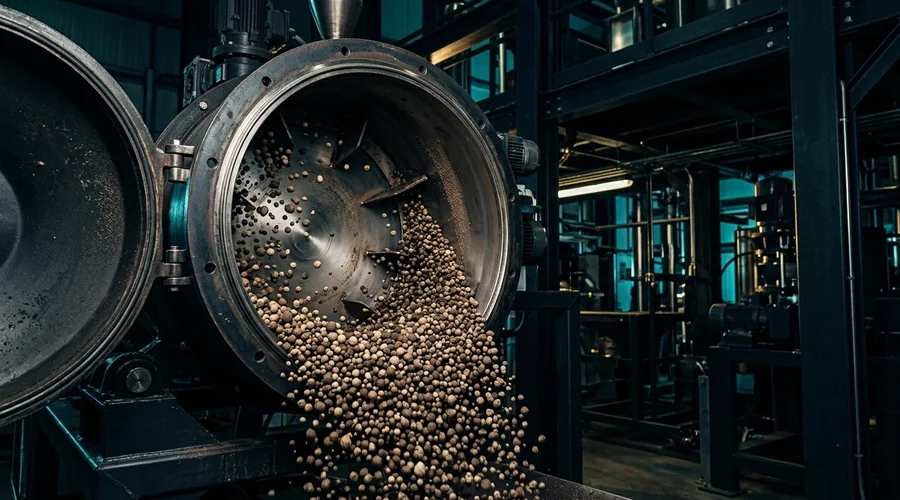
- Granulation and drying — solid raw materials, recycle and liquid feeds enter the granulator. All processes except the spherodiser dry the granules afterwards with heated air.
- Screening and recycle — dry granules are screened into three fractions. The oversize is crushed and returned with the fines, and part of the product fraction can return to stabilise the loop.
- Cooling and coating — a fluidised bed cooler or cooling drum cools the product, and a coating drum applies a surface coating to prevent caking. In the mixed acid process the coating can combine an organic agent with an inorganic powder.
- Slurry conditions — in the mixed acid process the buffer tank slurry holds between 5 and 30 percent water at 100 to 140 °C. When raw materials contain chloride, a slurry pH of 5 to 6 avoids hydrogen chloride formation.
- Phosphate solubility — the mixed acid process produces grades with varying degrees of phosphate water solubility.
- Grade limits — NPK grades with very low nitrogen suit the spherodiser poorly, because a sprayable slurry would demand an unrealistically high water content.
For plant engineering, safety and registration context, see our overview of agrochemical manufacturing. A process that reaches a wide grade range also carries hazards, which the next section sets out.
Safety, Decomposition and Storage of NPK Products
Fertilizers Europe describes ammonium nitrate based compound fertilisers as basically harmless when handled correctly. The hazards sit in the process and the formulation. The booklet lists slurry pump explosions, slurry decomposition and product decomposition as the main hazards, and it states that they depend on the formulation. Knowing the hazardous properties of each formulation is therefore a design task.
- Slurry pump explosions — the main causes are no or insufficient flow through the pump, and incorrect design or maintenance practice.
- Slurry decomposition — low pH, incorrect or contaminated raw materials and too high a temperature.
- Product decomposition in manufacture — overheating during drying, from an external heat source or through friction, plus low pH and contamination with elements that favour decomposition.
- Formulation tests — the booklet requires knowing whether a formulation shows self-sustaining decomposition, by the trough test, and its decomposition temperature, by the stationary oven test.
- Storage — decomposition during storage is the biggest hazard because of the quantities involved. Causes are an external heat source or contamination by organics and other materials.
- Humidity control — fertilisers are hygroscopic, so the booklet recommends air-conditioned storage. Fines and lumps are screened out after bulk storage.
- Occupational risk — heated fertiliser or slurry containing ammonium nitrate can evolve toxic gases that cause lung oedema a long time after exposure, and hot salt melts burn on contact.
Safety and quality sit inside a legal frame, which in India is the Fertiliser (Control) Order.
Rules and Quality Control for NPK Fertilizer Products in India
Indian rules treat fertiliser as a controlled commodity, and the route decides which clauses apply. The Fertiliser (Control) Order, 1985 defines mixtures, granulated mixtures and compound fertilisers and sets conditions for each. The text read for this article is a consolidated copy hosted by a state agriculture department, and the Order has been amended repeatedly. Check the current Gazette text and State rules before relying on any clause.
- Certificate of manufacture — clause 12 bars anyone from preparing a mixture of fertilisers except under a certificate of manufacture. Applicants must also hold the minimum laboratory facility that the Order specifies.
- Standards for mixtures — clause 13 requires mixtures to conform to standards notified by the Central or State Government. Liquid fertilisers and 100 percent water-soluble N, P, K fertilisers are excluded from the State mixture rule.
- Complex grade parameters — Schedule I Part A specifies NPK complex grades by moisture, nitrogen forms, citrate soluble and water-soluble P2O5, water-soluble potash and a particle size band.
- Tolerances — Part B sets tolerance limits in nutrient units, which differ by product type and widen with nutrient level.
- Customised fertilisers — clause 20B lets the Central Government notify specifications for a customised fertiliser made by a manufacturing unit, valid for a period not exceeding three years.
- Packing and marking — clause 21 requires every container to be superscribed with the word FERTILISER and sealed so that the contents cannot be tampered with.
- Soluble class — 100 percent water-soluble NPK products sit in a separate part of Schedule I with their own parameters, such as moisture and water-insoluble matter.
In Google Keyword Planner data, grade names dominate Indian search demand, with 19-19-19, 10-26-26 and 12-32-16 among the most searched. A new product therefore competes against well-known labels. Our guide to starting a bio-pesticide and bio-fertilizer business covers the separate rules for biological products. Rules and physics together make a development plan, and outside help is most useful when that plan is written down.
Working With an Agrochemical Formulation Consultant
Grade, route and compatibility decisions are linked. A grade that calculates correctly can still segregate, cake or fall outside notified limits. An agrochemical formulation consultant tests those links before capital is committed. Agrochemical product development services then carry the work through trials, documentation and scale-up.
- Grade and route screening — which grades suit blending, granulated mixture or the complex route for the raw materials available in the target market.
- Compatibility assessment — a pairwise review of raw materials against the compatible, limited and incompatible categories, plus the legal classification check.
- Physical quality specification — size guide number, uniformity, density, crushing strength and humidity targets for the product and its coating.
- Safety gate — decomposition test planning for ammonium nitrate based and chloride-containing formulations.
- Regulatory file — the certificate of manufacture application, mapping to notified standards, and label and tolerance checks.
- Scale-up and supply — pilot blending or granulation trials, then transfer to a contract formulation agrochemical manufacturer with defined quality checks.
The full range of services sits under agro chemicals. Before committing to a product, write down the target grade, the route you can afford and the raw materials you can source locally. Those three inputs shape every decision in this article.
Frequently Asked Questions
What does an NPK grade such as 15-15-15 mean?
The three numbers give the percentage of nitrogen (N), phosphorus as P2O5 and potassium as K2O in the product. A grade written 24-6-12 means 24 percent N, 6 percent P2O5 and 12 percent K2O.
India's Fertiliser (Control) Order defines grade as the nutrient element contents expressed in percentage. The Fertilizers Europe booklet adds that the total of the three usually falls in the range of 40 to 60 percent for complex NPK products.
How do you calculate an NPK grade from raw materials?
Grade calculation is mass balance. Each raw material contributes its nutrient fraction multiplied by its mass, and the batch must reach the target for every nutrient together.
Start with the phosphate source, because ammonium phosphates also supply nitrogen. Then top up nitrogen, add potash, close the batch mass with filler and compare the result with the label and its legal tolerance.
What is the difference between a blend, a granulated mixture and a complex fertiliser?
India's Fertiliser (Control) Order defines all three. A mixture is made by physically mixing fertilisers, with or without inert material.
A granulated mixture is mixed intimately and granulated together without chemical reaction. A compound or complex fertiliser is one in which a chemical reaction takes place during production, for example the ammoniation of phosphoric acid.
Why do NPK blends segregate?
Particle size is the main cause. The Ohio State fact sheet reports that size, followed by density, has the greatest influence on how granules are deposited when spread.
It rates blends with size guide number differences of up to 10 as good and differences above 20 as incompatible. Irregular particles such as potash segregate more readily than round urea or DAP, although size matters far more than shape.
Which fertilizer materials should not be blended together?
Fertilizers Europe classifies each pair as compatible, limited or incompatible on safety, production and quality grounds. Ammonium nitrate with urea is its extreme example, because the blend picks up moisture very quickly.
Elemental sulphur is combustible and can react with nitrates. Regulations also define ammonium nitrate by its ions, so a blend of ammonium phosphate and sodium nitrate can fall under the same limits as ammonium nitrate.
Why does NPK fertilizer cake in storage?
Caking follows moisture uptake. Every material has a critical relative humidity, the level above which it absorbs water, and Fertilizers Europe measures it at 30 degrees Celsius.
The value of a blend is usually below the average of its components. The booklet recommends air-conditioned storage and a surface coating on the product to prevent caking.
Do I need a licence to make NPK mixtures in India?
The Fertiliser (Control) Order bars anyone from preparing a mixture of fertilisers except under a certificate of manufacture. Applicants must also hold the minimum laboratory facility that the Order specifies.
Mixtures must conform to the standards notified by the Central or State Government. The Order has been amended repeatedly, so confirm the current text and the State rules with the registering authority.
How can a formulation consultant help with NPK products?
A consultant screens which grades suit blending, granulation or the complex route for the raw materials available. The same team reviews pairwise compatibility, sets size, density and humidity targets and plans decomposition testing for ammonium nitrate based products.
The work continues into the regulatory file, pilot trials and transfer to a contract manufacturer with defined quality checks.
Developing an NPK Product or Fixing a Quality Problem?
Global Formulation supports fertilizer and agrochemical manufacturers with grade design, blending and granulation trials, compatibility and safety screening, product development and contract manufacturing.
Talk to Our Formulation Team