Soluble Liquid Formulation Agrochemical: SL and SG Guide
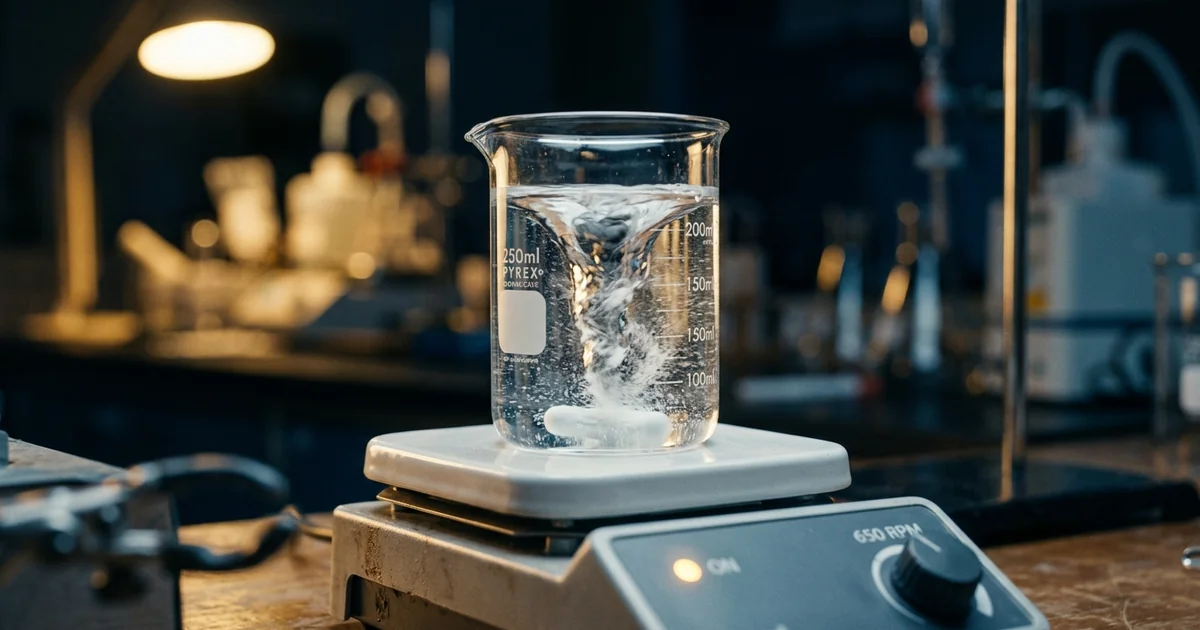
Holding a water-soluble active ingredient still leaves the formulator a choice between liquid and granule, and both can fail in ways a lab bottle does not show. A soluble liquid can crystallise in a cold store, cloud on dilution or block a nozzle. Soluble granules bring dust, attrition and residue in the tank. This guide explains the soluble liquid formulation agrochemical makers rely on, and its granule alternative. It covers solvents and surfactants, FAO/WHO specification tests, spray water effects and granule processing. It draws on the FAO/WHO specification manual, CropLife's formulation catalogue and extension guidance, plus the formulation support Global Formulation gives agrochemical manufacturers.
Soluble Liquid Formulation Agrochemical Basics: SL, SP and SG Compared
The formulation code tells the user how a product behaves in the spray tank, so the first decision is whether the active should stay dissolved. CropLife's formulation catalogue defines a soluble concentrate (SL) as a clear to opalescent liquid applied as a solution after dilution in water, and it allows water-insoluble formulants. A water soluble powder (SP) and a water soluble granule (SG) are solids applied as a true solution after dissolution in water, and both can contain insoluble inert ingredients. The FAO/WHO specification manual adds that an SL carries the active ingredient dissolved in suitable solvents and must be free from visible suspended matter and sediment.
Few actives suit these types. University of Florida extension guidance notes that few pesticides come as soluble powders because few active ingredients are readily soluble in water. A patent on soluble granules states the condition more precisely: the pesticide must be water soluble at the concentration at which it is employed.
| Type | Physical Form | Behaviour in the Tank | Main Specification Concerns |
|---|---|---|---|
| SL, soluble concentrate | Clear to opalescent liquid | Dilutes to a solution; can contain water-insoluble formulants | Cold-storage separation, dilution stability, foam |
| SP, water soluble powder | Powder | Dissolves to a true solution; insoluble inerts are allowed | Wettability, degree of dissolution |
| SG, water soluble granule | Granules | Dissolve to a true solution; insoluble carriers must not interfere | Degree of dissolution, dustiness, attrition, flowability |
| EC, emulsifiable concentrate | Solution in a water-immiscible solvent | Forms an emulsion on dilution, not a solution | Emulsion stability; see our EC guide |
| WP and WG | Powder or granules of a poorly soluble active | Disperse as particles and need agitation | Suspensibility, wet sieve; see our WP and WG guide |
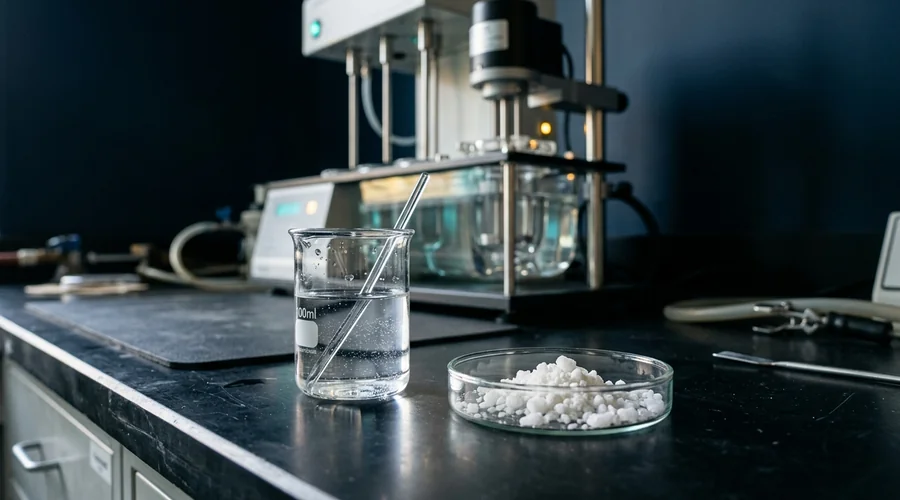
Keeping the active in solution is mostly a solvent and surfactant problem, which is where SL design begins.
SL Agrochemical Solubility: Salts, Co-Solvents and Solubilisers
An SL has to hold the active in solution at concentrate strength through cold nights, and again after dilution. There are two broad routes. Either the active is itself a water-soluble salt, or it is dissolved in solvents with solubilising surfactants that keep it in solution when water arrives. A surfactant supplier's formulation guide shows one worked example of each.
In its glyphosate example the acid active is neutralised with an amine in water to form the soluble salt. A built-in wetting surfactant, an antifoam and propylene glycol as antifreeze complete the concentrate. In its triazole fungicide example the water-insoluble active is dissolved in an alcohol solvent and a paraffinic co-solvent, with a non-ionic solubiliser and a little water. Treat both as one supplier's illustrations rather than a standard recipe.
| Ingredient Role | What It Does | Example in the Supplier Guide |
|---|---|---|
| Water | Carrier solvent for salt-type SLs | Main solvent in the glyphosate example |
| Neutralising base | Converts an acidic active into its water-soluble salt | An amine in the glyphosate example |
| Solubiliser surfactant | Holds a poorly water-soluble active in solution | Non-ionic surfactant in the triazole example |
| Built-in adjuvant | Wetting agent supplied in the concentrate for the spray liquid | Amphoteric surfactant in the glyphosate example |
| Co-solvent | Extends the solvent system for the active | Alcohol and paraffinic hydrocarbon in the triazole example |
| Antifreeze | Protects the concentrate in cold storage | Propylene glycol in the glyphosate example |
| Antifoam | Limits foam when the spray tank is filled | Silicone antifoam in the glyphosate example |
The order of addition differs between the routes. In the salt route, the guide charges water and base, adds the acid active gradually and neutralises with warming. It then adds the surfactant, antifreeze and antifoam, cools the batch and filters out impurities from the technical material. In the solvent route it dissolves the active in the solvents first and adds the solubiliser last. A water-based SL also carries a controlled pH, which is why the FAO/WHO template includes an acidity, alkalinity or pH range clause.
A recipe is only as good as the tests it passes, and the FAO/WHO specification sets those out.
FAO/WHO Specification Tests for Soluble Liquid Formulations
The FAO/WHO specification manual gives a reference template for an SL. Its clauses define what a buyer or regulator can reasonably test: content, impurities, acidity or pH, dilution behaviour, foam and storage. Each clause has an aim written into the manual, which turns the list into a design brief for the formulator. The table follows the SL template.
| Clause | Method | What the Template Says |
|---|---|---|
| Active ingredient content | CIPAC, AOAC or equivalent | Declared in g/kg or g/L at 20 ± 2 °C; in a dispute the result is calculated as g/kg |
| Water | MT 30.6, if required | The clause is not appropriate for formulations made in water |
| Acidity, alkalinity or pH range | MT 191 or MT 75.3, if required | The method to be used must be stated |
| Dilution stability | MT 41.1 | CIPAC standard water D, 30 ± 2 °C for 24 h; a clear or opalescent solution with no more than a trace of sediment, and any particles pass a 75 µm sieve |
| Persistent foam | MT 47.3 | Maximum foam after 1 min; the manual's general rule is normally 60 ml |
| Stability at 0 °C | MT 39.3 | 7 days at 0 ± 2 °C; separated solid or liquid not more than 0.3 ml |
| Stability at elevated temperature | MT 46.4 | 54 ± 2 °C for 14 days; active content not below the stated percentage, and continued compliance with the other clauses |
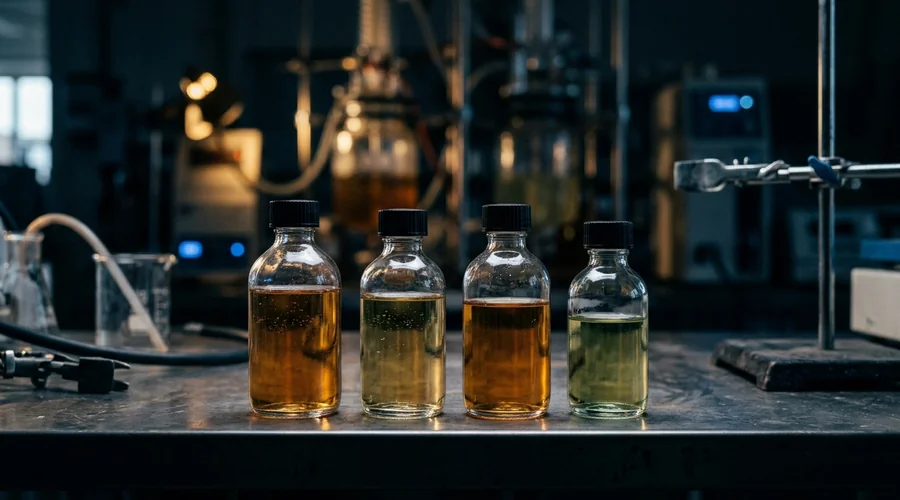
Two notes in the template deserve attention. The dilution test concentration should correspond to the highest rate of use recommended by the supplier. The foam test also uses the highest recommended rate, in CIPAC standard water D at 25 ± 5 °C. For storage, the manual's general rule is that average active content should not fall below 95 percent of the initial value. Our guide to emulsifiable concentrate formulation shows how the same storage tests apply when the solvent is water-immiscible.
Passing the laboratory tests still leaves the farmer's water, which no specification controls.
Spray Water Quality: Hardness, pH and Weak-Acid Actives
A soluble formulation meets the farmer's water as soon as it enters the tank, and that water is rarely pure. Dissolved minerals, suspended solids and pH can all change how a dissolved active behaves. University of Florida extension guidance rates water below 60 mg/L calcium carbonate as soft and water above 180 mg/L as very hard. These ranges frame the compatibility questions that a formulator has to anticipate.
| Water Factor | Effect Reported by Extension Guidance | Source |
|---|---|---|
| Hard water cations | Weak-acid herbicides such as 2,4-D, dicamba and glyphosate carry a negative charge and form complexes with calcium and magnesium; herbicide bound this way is taken up poorly | UF/IFAS PI245 |
| Ammonium sulfate | Studies since the 1970s show it overcomes glyphosate antagonism, because calcium and magnesium prefer to bind sulfate; it goes into the tank before the herbicide | UF/IFAS PI245 |
| Suspended solids | Certain herbicides adsorb to silt, clay and organic matter and become unavailable for plant uptake | UF/IFAS PI245 |
| Alkaline pH | Carbamate and organophosphate insecticides undergo alkaline hydrolysis; spray water at pH 8 to 9 can cause rapid breakdown | UF/IFAS PI193 |
These effects sit on the use side, but they shape formulation work. The FAO/WHO dilution test fixes a defined CIPAC standard water, so results can be compared between laboratories and batches. Field waters vary far more than any standard water, which is why the technical sheet should state the water-quality limits that the test data support. Our agro chemicals technology and formulations guide places these questions within the wider formulation toolkit.
The same dissolving behaviour is what a soluble granule must deliver from a solid.
Soluble Granule SG Formulation: Granule Design, Processing and Tests
A soluble granule trades the liquid's handling problems for a solid's. The FAO/WHO template describes granules of the technical active with suitable carriers and formulants. They must be homogeneous, free from extraneous matter and hard lumps, free flowing and nearly dust free. The active has to be soluble in water, and insoluble carriers must not interfere with the dissolution test.
The patent cited earlier gives a complete route. It blends a water-soluble pesticide with a water-soluble filler, adds water, extrudes the wet blend through a die and dries the granules. It names lactose, sucrose and glucose as preferred fillers, with wetting and dispersing surfactants and a defoamer as optional components. The patent argues that an SG gives easier handling and lower eye irritation than the corresponding liquid. Treat that as one patent's view and verify it for your own active.
Our guide to wettable powder and water-dispersible granule formulation compares fluid-bed, spray-drying and extrusion routes for granules that disperse. An SG differs because anything in the carrier system that does not dissolve has to pass the dissolution test.
| Clause | Method | What the Template Says |
|---|---|---|
| Degree of dissolution and solution stability | MT 179.1 | Residue on a stated sieve after dissolution in CIPAC standard water D at 25 ± 5 °C, limited after 5 min and after 24 h; the manual's general clause is a maximum of 2 percent retained on a 75 µm sieve |
| Dustiness | MT 171.1 | Maximum collected dust of 30 mg by the gravimetric method, or a dust factor of 25 by the optical method |
| Attrition resistance | MT 178.2 | A minimum percentage is set per product; the manual says general limits cannot be given |
| Flowability | MT 172.2 | At least a stated percentage of the formulation passes a 5 mm sieve after 20 drops of the sieve |
| Persistent foam | MT 47.3 | Maximum foam after 1 min at the highest recommended use rate |
| Stability at elevated temperature | MT 46.4 | 54 ± 2 °C for 14 days, then continued compliance for dissolution, dustiness and attrition |
| Sealed water soluble bag option | MT 176 | The bag dissolution flow time is tested with the SG; the manual says temperatures above 50 °C are likely to be avoided for bag packs |
Dust is a safety property as much as a handling one. The manual's stated aim for the dustiness clause is to restrict dust that granules can liberate into the air. For attrition resistance, the aim is to avoid dust and fines generated in handling and transport.
Choosing between the liquid and the granule then comes down to handling, storage and market.
Choosing SL or SG: Handling, Storage and Registration
Both forms deliver the same true solution in the tank, so the right one depends on the active, the market and the supply chain. An SL is simple to dose and make, but it carries the cold-storage and solvent questions. An SG avoids liquid handling but adds dust, attrition and granule-processing questions. CropLife's catalogue states that more than one formulation type can apply in individual cases and that the most appropriate one should be chosen.
| Consideration | SL | SG |
|---|---|---|
| Handling | Liquid that pours and dilutes | Solid that is measured by mass or volume; dust control needed |
| Main storage test | Separation at 0 °C and content after 54 °C | Dustiness, attrition and compliance after 54 °C |
| Water content clause | Not appropriate for water-based products | Applies where required (MT 30.6) |
| Main design lever | Solvent and surfactant system | Carrier choice and granulation route |
| Packaging option | Bottles and drums | Also sealed water soluble bags (SG-SB) |
- Measure solubility — at the concentrate strength and at the spray strength, in more than one water.
- Check stability in solution — the 54 °C test asks whether active content holds when the active sits dissolved for weeks.
- Test cold behaviour — screen liquids at 0 °C early.
- Test the dust and attrition profile — screen granules before scale-up.
- Compare supply chains — weigh liquid logistics against solid logistics for the target market.
In India, pesticide formulations are registered through the Central Insecticides Board and Registration Committee under the Insecticides Act, 1968. The PPQS website publishes the list of registered products. This article covers formulation science only and gives no crop doses, label claims or registration advice for a specific active ingredient. A formulation consultant supports the technical work behind a filing, but the registration decision belongs to the authority.
Working With an Agrochemical Formulation Consultant
Soluble formulations look simple because nothing needs suspending or emulsifying, yet their failures arrive late and cost more. An agrochemical formulation consultant screens solvents, surfactants and carriers against the active's solubility and stability before the first pilot batch. Agrochemical product development services extend that work to specification drafting, stability studies and registration documents. A contract formulation agrochemical manufacturer then carries the validated process into production.
- Characterise the active — solubility, pH sensitivity, hydrolysis and thermal stability.
- Choose the route — salt-type SL, solvent-type SL, SG or SP.
- Screen the system — solvents, surfactants, carriers, antifreeze and antifoam.
- Run the specification tests — dilution, cold, heat, foam, dissolution and dust.
- Check spray water behaviour — standard waters and representative field waters.
- Plan stability and registration — study design and dossier needs.
- Scale up and transfer — move the process to a qualified manufacturer with quality limits defined.
Our agro chemicals range shows where soluble formulations sit among the other types. Entrepreneurs planning a plant will find the practical route in our guide to starting an agrochemical formulation business. For contrast with suspension types, see our guide to suspension concentrate formulation. Global Formulation provides solvent and surfactant screening, SL and SG specification testing, stability planning and transfer support for agrochemical manufacturers. Active loadings, co-formulant ratios and dose recommendations stay outside this guide by design.
Frequently Asked Questions
What is an SL (soluble liquid) formulation in agrochemicals?
CropLife's formulation catalogue defines a soluble concentrate (SL) as a clear to opalescent liquid applied as a solution of the active ingredient after dilution in water. The liquid can contain water-insoluble formulants.
The FAO/WHO specification template describes the active ingredient as dissolved in suitable solvents, with the liquid free from visible suspended matter and sediment.
In practice an SL is a concentrate that must stay clear in cold storage and dilute to a clear or opalescent solution in the spray tank.
What is the difference between SL, SP and SG formulations?
All three are applied as a solution of the active ingredient in water. An SL is a liquid concentrate, an SP is a powder and an SG is a granule, and the two solids can contain insoluble inert ingredients.
The form decides the specification tests. An SL is tested for dilution stability, foam and storage at 0 and 54 degrees Celsius, while an SG is also tested for dustiness, attrition resistance and flowability.
An SG is usually chosen to avoid handling a liquid, and an SP is the simpler powder version without granulation.
Why do SL formulations separate or crystallise in cold storage?
The FAO/WHO manual says the main problems at low temperature are precipitation or separation of liquid phases. A concentrate that is clear at room temperature can hold the active or a solvent phase in a state that does not survive cold.
The manual tests this by storing the formulation at 0 degrees Celsius for 7 days, and the separated solid or liquid should normally be no more than 0.3 ml.
The original properties must be restored on warming and mixing, otherwise field application is likely to be unsatisfactory.
Which FAO/WHO tests apply to an SL formulation?
The SL template covers identity and active ingredient content, relevant impurities, water content where appropriate, and acidity, alkalinity or pH range. It then sets dilution stability in CIPAC standard water D, persistent foam, stability at 0 degrees Celsius and stability at 54 degrees Celsius for 14 days.
The dilution test requires a clear or opalescent solution after 24 hours at 30 degrees Celsius, with no more than a trace of sediment that passes a 75 micrometre sieve.
The elevated temperature test requires continued compliance with the other clauses, including solution stability.
How do hard water and pH affect soluble pesticide formulations?
University of Florida extension guidance reports that weak-acid herbicides such as 2,4-D, dicamba and glyphosate form complexes with calcium and magnesium in hard water. Herbicide bound this way is taken up poorly by the plant.
The same guidance says carbamate and organophosphate insecticides can undergo alkaline hydrolysis, and spray water with a pH of 8 to 9 can cause rapid breakdown.
A formulator cannot control the farmer's water, so standard-water tests and clear technical guidance carry the compatibility message.
How are water soluble granules manufactured?
One patent on soluble granules describes a four-step route: blend the water-soluble pesticide with a water-soluble filler, add water, extrude the wet blend through a die and dry the granules. Wetting and dispersing surfactants and a defoamer are optional components in that patent.
The FAO/WHO template then judges the granule on dissolution residue, dustiness, attrition resistance and flowability. It requires the granules to be homogeneous, free flowing and nearly dust free.
Other granulation routes exist, and the right one depends on the active, the carrier and the plant available.
Do SL and SG formulations need registration in India?
In India, pesticide formulations are registered through the Central Insecticides Board and Registration Committee (CIB&RC) under the Insecticides Act, 1968. CropLife's Technical Monograph No. 2 is the reference for assigning formulation type codes such as SL and SG during development and registration.
This article covers formulation science only and gives no label claims, crop doses or registration advice for a specific active ingredient.
A formulation consultant supports the technical work behind a filing, but the registration decision belongs to the authority.
Developing a Soluble Agrochemical Formulation?
Global Formulation supports solvent and surfactant screening, SL and SG specification testing, stability studies and transfer to a qualified manufacturer.
Talk to Our Formulation Team