Wettable Powder Formulation and Water-Dispersible Granules

A powder that floats on the spray-tank surface, settles overnight or blocks a nozzle turns a good active ingredient into a failed product. Each of these failures maps to a physical property that FAO and WHO specifications test directly. This guide explains wettable powder formulation and its granular counterpart, the water-dispersible granule, covering components, milling and granulation routes, specification tests and troubleshooting. It reads the FAO/WHO specification manual, CropLife's formulation catalogue and the patent literature at source. It also reflects the formulation support Global Formulation gives agrochemical manufacturers.
Wettable Powder Formulation: What WP and WG Are
CropLife International's formulation catalogue defines a wettable powder (WP) as a powder formulation applied as a suspension after dispersion in water. It defines water dispersible granules (WG) as granules applied after disintegration and dispersion in water. Both are suspension-forming solids, so the active ingredient is carried as solid particles and the physical behaviour of those particles decides performance. The FAO/WHO specification templates reflect this by testing wetting, dispersion and particle size rather than solution behaviour.
| Property | Wettable Powder (WP) | Water-Dispersible Granule (WG) |
|---|---|---|
| Physical form | Dry, finely ground powder that looks like a dust | Small, easily measured granules that break into fine particles in water |
| Operator handling | Inhalation hazard while measuring and mixing the concentrated powder | Low dust, so less inhalation hazard; easier to measure and mix |
| Spray tank | Needs good, constant agitation or it settles quickly | Needs constant agitation to stay suspended |
| Equipment wear | Abrasive to many pumps and nozzles | Shares many of the same advantages and disadvantages as WP |
| Extra specification tests | Wettability, wet sieve, suspensibility, persistent foam | Adds dispersibility, dustiness, flowability and attrition resistance |
The handling comparison follows a University of Florida extension publication on pesticide formulations. A patent on water-dispersible granular compositions argues that granules are more stable in storage and transport than aqueous suspension concentrates, which can settle. It also notes that they avoid the toxicity, environmental and odour problems of solvent-based emulsifiable concentrates. Our guides to suspension concentrate formulation and emulsifiable concentrate formulation cover those liquid alternatives within our wider agro chemicals range.
Both forms rely on the same small set of ingredient classes, so the next step is to see what each one does.
Formulation Components: Carriers, Wetting Agents and Dispersants
The FAO/WHO template describes a wettable powder as a homogeneous mixture of the technical active ingredient with fillers and any other necessary formulants. A water-dispersible granule is the same kind of mixture, with carriers in place of fillers, shaped into dry, free-flowing granules. One patent on extruded granules lists the additive classes as wetting agents, dispersants, lubricants, anti-caking agents, chemical stabilisers and inert diluents. Each class protects one of the properties that the specification tests.
| Component Class | Role | Test That Exposes a Weakness |
|---|---|---|
| Technical active ingredient | Carried as solid particles; content is declared in g/kg and must stay within the tolerance table | Active ingredient content and identity |
| Inert diluent or carrier | Dilutes the active and gives a free-flowing solid; water-insoluble diluents include clays and silicas, water-soluble ones include salts and carbohydrates | Flowability, dustiness, wet sieve |
| Wetting agent | Helps the powder or granule wet rapidly when mixed with water in the tank | Wettability (MT 53.3) |
| Dispersant | Keeps the active ingredient homogeneously dispersed in the spray liquid | Suspensibility (MT 184.1), dispersibility (MT 174) |
| Lubricant | A polymeric additive in extruded granules; higher levels are less desirable because they tend to slow disintegration | Dispersibility (MT 174) |
| Anti-caking agent | Prevents clumping of granules stored under hot warehouse conditions | Flowability after storage (MT 172.2) |
| Chemical stabiliser | Protects a sensitive active ingredient during storage | Active content after accelerated storage (MT 46.4) |
The same patent observes that the urea modifiers it uses are well known to function as wetting and dispersing agents in agricultural formulations. One ingredient can therefore serve two roles, which is why any component change has to be re-tested against the whole specification. Four decisions are worth settling before a pilot batch.
- Active ingredient stability — heat and water tolerance decide which granulation route is viable.
- Target test list — the FAO/WHO templates and any national requirements define what the product must pass.
- Dilution water — the FAO/WHO manual says water hardness and temperature affect the physical properties of formulations diluted with water.
- Packaging — standard packs and sealed water-soluble bags (WP-SB, WG-SB) carry different test sets.
Components set what is possible, and the manufacturing route decides whether the particles arrive in the right state.
WDG Granulation for Agrochemicals: Milling and Granulating
Wettable powder production is a blending and milling operation. A herbicide patent describes fine solid compositions as made by blending and, usually, grinding in a hammer or fluid energy mill. Water-dispersible granules add a granulation step, and the FAO/WHO manual says the route depends on the active ingredient and the equipment available. That choice shapes disintegration speed and particle size range.
| Granulation Route | How Granules Form | Patent Observation |
|---|---|---|
| Fluid-bed or pan granulation | Water is sprayed onto the powder to build granules | Water must be removed later; granules generally disintegrate rapidly when diluted |
| Spray drying | A water-based slurry is dried into granules | Water must be removed later; granules generally disintegrate rapidly when diluted |
| Paste extrusion | A water-wet paste is extruded | Generally does not give rapidly disintegrating granules and needs a drying step |
| Dry compaction | Non-effervescent powder is compacted without water | Generally does not give rapidly disintegrating granules |
| Heat extrusion | A dry premix is extruded through a die at elevated temperature, then chopped or sieved | No water is added; granulation is by fusion of heat-sensitive components |
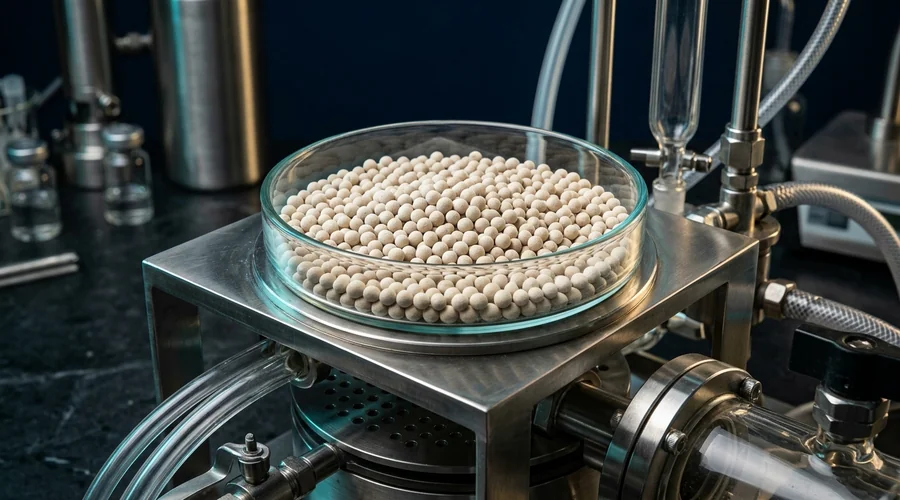
The disintegration observations come from a patent that promotes heat extrusion, so treat them as one view and verify them on your own formulation. The FAO/WHO manual adds a practical point about size. Because the mixture from which WGs are formed is homogeneous, a wider particle size range is acceptable than for ordinary granules. A wide range can still cause some segregation in containers. Our guide to pharmaceutical granulation technology explains the same unit operations in another industry.
Whichever route is used, the finished product is judged by the same set of specification tests.
Powder Wettability and Dispersion Tests: FAO/WHO Clauses
FAO and WHO publish specification templates for WP and WG that list the physical tests a product is expected to meet. The FAO/WHO manual states the aim of each clause, such as ensuring that powders and granules are rapidly wetted when mixed with water in a spray tank. The test methods come from CIPAC, the Collaborative International Pesticides Analytical Council. Because these properties depend on dilution conditions, the manual notes that water hardness and temperature affect them.
| Test | CIPAC Method | FAO/WHO Aim or Requirement | Applies To |
|---|---|---|---|
| Wettability | MT 53.3 | Rapid wetting in the tank; normally wetted in 1 minute without swirling | WP and WG |
| Wet sieve | MT 185 | Restricts particles that could block nozzles or filters; the manual suggests a maximum of 2 percent retained on a 75 µm sieve | WP and WG |
| Suspensibility | MT 184.1 | Active stays homogeneously dispersed; 60 to 105 percent after 30 minutes, otherwise a re-suspensibility test of 95 to 105 percent | WP and WG |
| Dispersibility | MT 174 | Easy, rapid dispersion on dilution; at least 60 percent after 1 minute of stirring | WG |
| Persistent foam | MT 47.3 | Limits foam when filling the tank; normally a maximum of 60 mL after 1 minute | All formulations diluted in water |
| Dustiness | MT 171.1 | Limits dust released in handling; maximum 30 mg collected dust by the gravimetric method or a dust factor of 25 by the optical method | WG and other granules |
| Flowability | MT 172.2 | Granules flow freely rather than clumping after storage; general limits cannot be given | WG |
| Attrition resistance | MT 178.2 | Granules stay intact and do not generate dust or fines; general limits cannot be given | WG |
| Accelerated storage | MT 46.4 | After 54 ± 2 °C for 14 days, active content must not fall below the limit and key clauses must still be met | WP and WG |

Two notes in the manual matter in the laboratory. Chemical assay is the only fully reliable way to measure the active ingredient still in suspension. A simpler gravimetric method is acceptable for routine work only if shown to give equal results. Where products are packed in sealed water-soluble bags, separate WP-SB and WG-SB templates add a bag dissolution test (MT 176) and test suspensibility and foam with the bag material present.
With the tests mapped, a complaint from the field can be traced back to a clause and then to a formulation lever.
Troubleshooting WP and WG Performance
Most complaints about wettable powders and granules show up first in the spray tank. Floating powder, settling, blocked nozzles, slow break-up and dust at loading each correspond to a clause the FAO/WHO templates already test. Tracing a complaint to its clause turns a vague report into a targeted formulation change. The table pairs each symptom with its test and with the levers worth examining first.
| Symptom | Test That Detects It | Lever to Examine |
|---|---|---|
| Powder floats or wets slowly | Wettability (MT 53.3) | Wetting agent type and level |
| Active settles in the tank | Suspensibility (MT 184.1) | Dispersant and particle size from milling |
| Nozzle or filter blockage | Wet sieve (MT 185) | Particle size control and removal of coarse or extraneous material |
| Granules break up slowly | Dispersibility (MT 174) | Granulation route and lubricant level |
| Dust at loading | Dustiness (MT 171.1) | Granule integrity and fines content |
| Crumbling or fines in transport | Attrition resistance (MT 178.2) | Granule strength and granulation route |
| Clumping after storage | Flowability (MT 172.2) | Anti-caking agent, moisture control and packaging |
| Foam when filling the tank | Persistent foam (MT 47.3) | Surfactant selection |
| Performance changes with water source | Tests in CIPAC standard water D | Re-test across the target hardness range |
Settling deserves one further note. Particle settling rate falls as particle size falls, as Stokes' law describes, so milling to a finer particle size and choosing an effective dispersant work together. The manual says the wet sieve test exists to restrict the coarse particles that could block nozzles. It also says the clause is sometimes left out of a specification because other tests effectively include it.
Once a product passes its tests, the remaining decision is which form to take to market.
Choosing WP or WG and Planning Registration
Choosing between WP and WG is a decision about handling, equipment and market rather than about the active ingredient alone. WG gives lower dust and easier measuring, which is why extension guidance rates it better for operator exposure. WP is simpler to make because the route is blending and grinding with no granulation step. Registration then adds a regulatory layer to the technical decision.
- Check active ingredient stability — heat and water tolerance decide whether a granulation route is viable.
- Weigh handling and exposure — WG is the lower-dust form and is more easily measured and mixed.
- Check spray equipment and water — both forms need constant agitation, and WP is abrasive to many pumps and nozzles.
- Choose the packaging — decide between standard packs and sealed water-soluble bags before writing the specification.
- Assign the formulation code — CropLife's catalogue is the leading reference for assigning formulation types during development and registration.
In India, pesticide formulations are registered through the Central Insecticides Board and Registration Committee under the Insecticides Act, 1968. The PPQS website publishes the list of registered products. This article covers formulation science only and gives no crop doses, label claims or registration advice for a specific active ingredient. A formulation consultant supports the technical work behind a filing, but the registration decision belongs to the authority.
Working With an Agrochemical Formulation Consultant
Wettable powder and granule development sits between surface chemistry, particle engineering and regulation, and the product has to pass standard CIPAC test methods. An agrochemical formulation consultant characterises the active ingredient, selects the form and builds the test programme. Agrochemical product development services extend that work to specifications, pilot batches and stability studies. A contract formulation agrochemical manufacturer then runs the validated process at scale under its own quality system.
- Characterise the active ingredient — heat, water and milling behaviour.
- Select the form — WP or WG, standard pack or water-soluble bag.
- Screen wetting agents and dispersants — judge each against wettability and suspensibility.
- Choose the granulation route — for WG, based on the active's stability and the equipment available.
- Write the specification — adopt the FAO/WHO clauses and the national requirements.
- Run accelerated storage — re-test the key clauses after 54 ± 2 °C for 14 days.
- Scale up and transfer — move the validated process to a qualified plant.
Our agro chemicals range shows where solid dispersible formulations sit among the other formulation types. The agrochemical manufacturing guide covers the wider safety and formulation chemistry. For the business side, read how to start an herbicide and pesticide formulation unit. A guide to choosing the right product consultant explains how to pick a partner. Global Formulation provides WP and WG development, specification writing, granulation trials and scale-up for agrochemical manufacturers. Active ingredient loadings and co-formulant ratios stay outside this guide by design.
Frequently Asked Questions
What is a wettable powder formulation?
CropLife International defines a wettable powder (WP) as a powder formulation applied as a suspension after dispersion in water. The FAO/WHO template describes it as a homogeneous mixture of the technical active ingredient with fillers and other formulants. It must be a fine powder free from visible extraneous matter and hard lumps.
Because the active ingredient is carried as solid particles, wetting, dispersion and particle size decide how the product performs in the spray tank.
What is the difference between WP and water-dispersible granules?
Water-dispersible granules (WG, also called WDG or dry flowables) carry the same kind of mixture in granule form. Extension guidance describes them as small, easily measured granules that give less inhalation hazard than a dust-like wettable powder.
Both still need constant agitation in the spray tank, and the guidance notes that WG share many of the advantages and disadvantages of WP.
The FAO/WHO WG template adds dispersibility, dustiness and flow properties to the tests used for WP.
How are wettable powders and water-dispersible granules manufactured?
Patent literature describes fine solid compositions as made by blending and, usually, grinding in a hammer or fluid energy mill. That blend-and-mill route is how wettable powders are made.
Water-dispersible granules add a granulation step. Conventional routes are water-spraying in fluidised bed or pan equipment, spray-drying, extrusion of a water-wet paste and dry compaction, and a heat-extrusion route that adds no water.
The right route depends on the active ingredient and the equipment available, as the FAO/WHO manual notes.
Which tests do FAO/WHO specifications use for WP and WG?
Both templates include wettability (CIPAC MT 53.3), the wet sieve test (MT 185), suspensibility (MT 184.1) and persistent foam (MT 47.3). They also include accelerated storage at 54 ± 2 °C for 14 days (MT 46.4).
The WG template adds dispersibility (MT 174), dustiness (MT 171.1), flowability (MT 172.2) and attrition resistance (MT 178.2).
Test concentrations should relate to the label's recommended use rates, using the highest and lowest where several are given.
What is suspensibility and why is it tested after storage?
Suspensibility measures how much of the active ingredient stays homogeneously dispersed in the spray liquid. FAO/WHO guidance is 60 to 105 percent after 30 minutes in CIPAC standard water D. If that is not met, a re-suspensibility test of 95 to 105 percent applies.
The templates require WP and WG to continue to comply with suspensibility after accelerated storage, because a product that suspends well when fresh can change on the shelf.
Chemical assay is the only fully reliable measure of active ingredient in suspension. A simpler gravimetric method is acceptable for routine use only if it has been shown to agree.
What causes poor wettability or slow dispersion in WP and WG?
Poor wettability shows up as powder that floats or takes a long time to sink, and the wettability test times exactly that event. Slow dispersion in granules shows up in the dispersibility test after one minute of stirring.
Formulation levers include the wetting agent, the dispersant and the granulation route. One patent also notes that higher lubricant levels in extruded granules tend to slow disintegration.
Water hardness and temperature affect physical properties, so test in CIPAC standard water D and across the hardness range of the target market.
Do WP and WG formulations need registration in India?
In India, pesticide formulations are registered through the Central Insecticides Board and Registration Committee (CIB&RC) under the Insecticides Act, 1968. CropLife's Technical Monograph No. 2 is the reference for assigning formulation type codes such as WP and WG during development and registration.
This article covers formulation science only and gives no label claims, crop doses or registration advice for a specific active ingredient.
A formulation consultant supports the technical work behind a filing, but the registration decision belongs to the authority.
Developing a Wettable Powder or Granule?
Global Formulation supports WP and WG development, granulation trials, specification writing and scale-up to a qualified plant.
Talk to Our Formulation Team