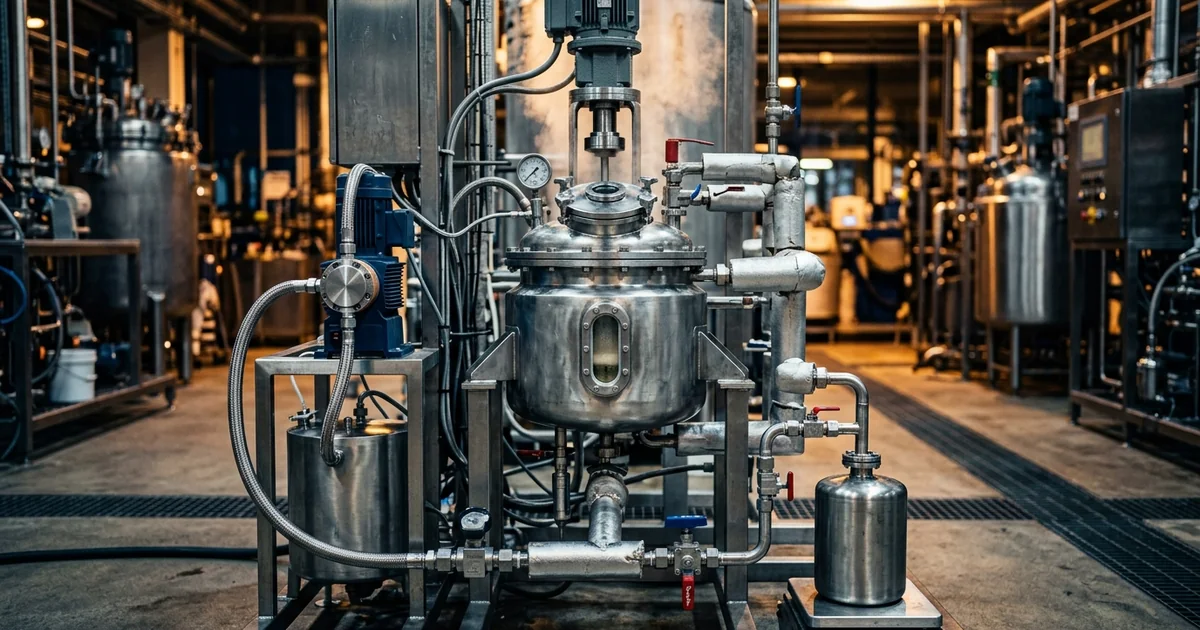
A development team has a reaction that works at 2 L and a board that wants a commercial plant. Someone says the project needs a pilot plant, but nobody can say how large it should be or what it must prove. Pilot plant sizing is where that conversation becomes an engineering decision or an expensive guess. Built too small, a pilot returns flattering data that the commercial reactor never repeats; built too large, it spends capital and months on questions the laboratory had already settled. This guide shows how to decide whether you need a pilot plant at all, then size it from the questions it must answer, using worked arithmetic and sourced benchmarks. It reflects the route-selection and scale-up work in our chemical reaction engineering practice, including the scale-down model studies that should come first.
What a Pilot Plant Is For: Questions, Not Capacity
A pilot plant exists to learn, and its size follows from what it must teach. Wikipedia’s entry, citing a 2016 Research Policy paper, defines it as a pre-commercial system used mainly to learn about a new technology. The knowledge feeds full-scale plant design and investment decisions, so the right pilot is the smallest system that still answers the questions the laboratory cannot. A pilot sized for output instead of evidence adds cost and schedule without adding a single design number.
CPI process engineer Andrew Bosman, writing in The Chemical Engineer in June 2026, puts the value in one line. Pilot plants help identify problems that are negligible at laboratory scale but can derail a full-scale process. He lists six, and each has a plant consequence you can name:
- Non-linear mixing effects — selectivity or particle size shifts as mixing times grow, and the plant makes more by-product than the bench did.
- Heat-transfer limitations — a vessel cools more slowly as it grows, so dosing stretches and the batch cycle lengthens.
- Feedstock variability — industrial raw materials carry impurities that analytical-grade reagents do not, and those impurities poison catalysts or colour the product.
- Solids handling issues — filtration, drying and conveying behave differently at larger scale, so bench observations on solids do not transfer directly.
- Process control challenges — loops tuned on a small, fast vessel need retuning on a large, slow one.
- Material compatibility problems — corrosion and metal pickup appear only in the wetted materials the commercial plant will use.
Few projects need all six answered. The next subsection shows why the purpose, not the problem list, decides what you build.
Five Purposes That Need Five Different Pilots
“To scale up” is not a purpose. Bosman recommends asking why repeatedly until the root need appears: satisfying investors, proving process safety, generating product samples, gathering design data or validating economics. The answers diverge sharply: one CPI project needed a bespoke stainless-steel reactor for explosive atmospheres (ATEX), costing more than £5 million over around 18 months. Another fitted in an intermediate bulk container (IBC) with an air-driven agitator, and finished in one to two months for under £50,000.
| Purpose | What the pilot must prove | What sets its size |
|---|---|---|
| Product samples | Representative, saleable material in the quantity a customer needs for qualification | Kilograms of finished product and the number of runs needed to make them |
| Design data | Scale-dependent parameters such as heat removal, mixing response and separation performance | Similarity to the commercial equipment, within a workable scale-up ratio |
| Process safety | Behaviour of the hazardous step in representative equipment, with the controls tested | The hazard inventory and the containment the hazard demands |
| Economics | Yield, raw-material and utility consumption, recycle and waste under realistic operation | Run length and a closed mass balance, including recycle loops |
| Investor or lender confidence | Independent evidence that the route works at a recognised scale | The evidence threshold the funder sets; Horizon 2020 work programmes refer to technology readiness levels |
Both CPI projects delivered what their customers needed, and their costs differed by a factor of 100. Write your pilot’s purpose as one sentence before any pilot plant sizing begins. If it names more than two purposes, expect none to be answered well, because, as Bosman warns, attempting every question leaves no good answer to any of them. With the purpose fixed, the next decision is whether any pilot is needed at all.
Do You Need a Pilot Plant? A Go/No-Go Test
Plenty of projects skip the pilot and succeed, and plenty skip it and fail, so the useful question is what remains unknown. A pilot is the most expensive place to discover a gap in kinetics, thermal data or safety data. RAND’s 1981 study of 44 process plants from 34 companies opens by stating that misestimating the cost and performance of innovative plants creates fundamental planning problems. A pilot plant exists to shrink that misestimate before commercial capital is committed.
| Factor | Pilot plant usually needed | Scale-down model or lab study usually enough |
|---|---|---|
| Route novelty | The route has never run above laboratory scale | The chemistry is established and the commercial reactor type has run similar duties |
| Controlling step | Selectivity or particle properties respond to mixing or heat removal | The rate is kinetically controlled and calorimetry shows ample cooling margin |
| Feedstock | Real industrial feed carries impurities the laboratory cannot reproduce | The feed is a well-defined, specified raw material |
| Solids | A new crystallisation, filtration or drying step sits in the flowsheet | The process is liquid-phase throughout |
| Time-dependent effects | Recycle build-up, catalyst life, fouling or corrosion appear only over days of running | Short runs capture the time-dependent behaviour |
| Product qualification | The customer needs kilograms of product made on representative equipment | Laboratory-batch samples are accepted for qualification |
| Cost of failure | A failed transfer would cost far more than the pilot budget | An existing multipurpose reactor can take a trial batch |
Count the entries in the left column. Several justify a pilot; a single entry justifies a narrower study aimed at that one unknown. The cheaper evidence comes first, since Bosman notes that going back to check the basics before building a pilot plant can save time and money.
Where a technology is implemented successfully, the Wikipedia entry observes, commercial-scale savings from pilot testing significantly outweigh the cost of the pilot plant itself. That asymmetry is the case for piloting whenever the left column dominates. Once the answer is yes, the next question is which kind of facility to build.
Pilot Plant vs Demonstration Plant vs Bench Scale
These terms are used loosely, and loose use produces mis-sized budgets. Wikipedia notes that the differences between bench, pilot and demonstration scale are strongly influenced by industry and application, and that some industries use pilot plant and demonstration plant interchangeably. The US Department of Energy’s technology readiness level (TRL) scale gives a neutral yardstick, separating laboratory scale, engineering/pilot scale and full-scale prototype demonstration. The DOE defines the move from TRL 5 to TRL 6 as the step up to engineering scale and the determination of scaling factors for designing the operating system.
| Stage | What it settles | Batch example (pharmaceutical) | Continuous example (petroleum catalyst volume) | DOE readiness wording |
|---|---|---|---|---|
| Bench scale | Chemistry, kinetics and the first process window | 1–20 kg or less | Under 1,000 mL, once-through | TRL 5: laboratory scale, similar system validation in relevant environment |
| Pilot plant | Scaling factors and design data; a closed mass balance with recycle | 20–100 kg | 1–100 L, with product separation and recycle | TRL 6: engineering/pilot-scale, similar (prototypical) system validation in relevant environment |
| Demonstration plant (semi-works) | Operating stability and lifetime at commercial feed rates over extended periods | Commercial feed rates, extended time | 100–1,000 L | TRL 7: full-scale, similar (prototypical) system demonstrated in relevant environment |
Sources: Wikipedia, Pilot plant (size ranges); US DOE Technology Readiness Assessment Guide, Appendix F (TRL wording). The stage-to-TRL alignment is approximate, and the size ranges are examples from two industries, not rules for specialty chemicals.
Two practical points follow from the pilot plant vs bench scale comparison. First, the pilot is where scaling factors are determined, so it must run the step that scales badly and need not run every step. Second, a demonstration plant is a different purchase. The same Wikipedia entry says its design closely resembles the anticipated commercial plant, with the goal of studying performance and operating lifetime over an extended period. Choose the stage from the question, then start pilot plant sizing, which is the subject of the next section.
Pilot Plant Sizing: Six Constraints That Set How Big It Should Be
No single scale factor sizes a pilot plant, because six independent constraints each set a floor or a ceiling. The right size is the smallest volume that clears every floor without breaching a ceiling. Working through the constraints in order shows which one binds, and the binding constraint deserves the engineering attention. The list below names all six, and the subsections work the arithmetic for the four that involve numbers.
- The question — the parameter that must match the commercial plant (heat removal, mixing response, feed quality or materials) sets the minimum fidelity.
- The scale-up ratio — a pilot too close to bench scale teaches little, and one too far from commercial scale transfers poorly.
- Sample and campaign demand — the kilograms of saleable product the decision needs, divided by what one run yields.
- Run length — the time to line out at steady state, plus the longer times set by recycle, fouling or catalyst life.
- Minimum practical size — pumps, instruments and sampling hardware have a floor, and cost does not fall in proportion to volume.
- Hazard inventory — the quantity of hazardous material in the equipment, which sets containment and review obligations.
The question and the scale-up ratio set the floor on fidelity. Demand and run length set the quantity of product and feed. Minimum practical size and hazard inventory cap cost and risk, and the ratio comes first because it decides how much of the commercial plant the pilot can reproduce.
The Pilot Plant Scale-Up Factor: What 10:1 and 1000:1 Do to Your Data
Matt Benz of EPIC Systems Group, in a 2019 Chemical Processing article, advises a 10:1 rule. A plant making 1,000 US gal/d (about 3.8 m3/d) should choose equipment for 10,000 US gal/d (about 38 m3/d). Beyond that scale, he says, heat-transfer and reaction-kinetics data stop being reliable; a 1,000:1 gap is too big for confidence, and 2:1 is too small for proper data. Geometry shows why the upper limit bites.
Take two geometrically similar jacketed vessels. Volume scales with the cube of the linear dimension (L) and jacket area with its square, so the jacket area per unit volume (A/V) falls as 1/L. A commercial vessel with 10 times the pilot’s volume is 2.15 times larger in each dimension and keeps 46% of the pilot’s A/V. At 100:1 it keeps 22%, and at 1000:1 it keeps 10%.
Read the 100:1 bar as a plant consequence. The pilot has 4.6 times the jacket area per unit volume of the commercial vessel. A cooling-limited step that takes an hour in the pilot cannot be assumed to take an hour in the plant. The commercial cycle then runs longer than the pilot data promised, and the capacity case suffers. Internal coils and external loops add area, but they are separate design choices that the pilot must then reproduce.
In pilot plant sizing, keep the commercial-to-pilot ratio inside the range where the pilot’s heat and mixing behaviour still brackets the plant’s. Benz’s 10:1 is a practitioner starting point, and calorimetry plus a scale-down study show how much more your process tolerates. Our guide to batch, semi-batch and continuous reactor selection covers the reactor choice that the pilot must then mirror.
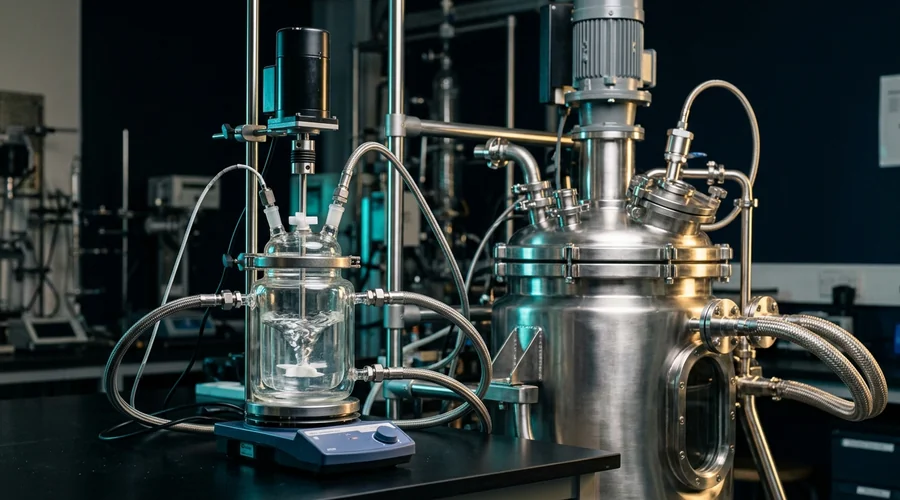
Pilot Plant Sample Quantity and Run Length: Working Backwards From Kilograms
Product demand and run length are the two constraints teams forget until the pilot is built. Sample demand fixes how many runs the pilot must make. Pilot plant run length fixes how much feed each run consumes, and feed is the recurring cost of a pilot. Both can be estimated before any equipment is ordered.
Consider an illustrative batch case. A customer’s qualification programme needs 200 kg of finished product. Assume each pilot batch delivers 25 kg of saleable product at 85% yield, and assume the first batch is lost while the process lines out. Eight good batches deliver the 200 kg, and the lost batch brings the run to nine. The raw-material charge must cover about 265 kg of product equivalent (9 × 25 kg ÷ 0.85). These numbers are assumptions chosen to show the method, not benchmarks.
Continuous operation changes the arithmetic. After a step change in conditions, an ideal continuous stirred-tank reactor (CSTR) reaches a fraction 1 − e−t/τ of the new steady state. Here t is the elapsed time and τ is the mean residence time, the reactor volume divided by the volumetric flow. That is 95% at 3τ and 99.3% at 5τ. Each new operating condition therefore consumes about five reactor volumes of feed before the data are usable. That is 100 L for a 20 L reactor and 1,000 L for a 200 L reactor. Pilot plant throughput follows from the same quantities: a 20 L reactor with a 2 h residence time passes 10 L/h.
Recycle loops and slow phenomena stretch the schedule further. A recycle loop must line out as a whole, so its holdup adds to the time needed. A question about catalyst life runs on the deactivation timescale, not the residence time, as our guide to catalyst deactivation and regeneration explains. Run length multiplies pilot feed cost, so it belongs in the sizing and not in the schedule afterwards.
Pilot Plant Cost and Minimum Practical Size
In pilot plant sizing, shrinking the vessel saves less money than intuition suggests. Equipment cost follows a power law with capacity, and the common default exponent of 0.6 is known as the six-tenths rule. A 2012 AusIMM paper by Kingsbury and colleagues describes it as an aggregate indicator of economy of scale and found that volume closely follows it. Pilot plants also carry engineering design, process safety review, procurement, construction and operations support, according to Bosman, and much of that effort is independent of vessel size.
Under the rule, cost scales with capacity raised to the power 0.6. A vessel at one-tenth of the capacity costs about 25% of the larger one (0.10.6 = 0.25), and one at one-hundredth costs about 6% (0.010.6 = 0.063). Halving the volume cuts equipment cost by only about a third (0.50.6 = 0.66). Treat these as order-of-magnitude figures, because exponents vary by equipment type and instrumentation does not follow the vessel.
Benz notes that a single flow meter can cost several thousand dollars and that every sampling point requires extra design and equipment. The instrument list therefore sets a cost floor that vessel size does not change. Below the representative scale, a smaller pilot saves little money and costs a lot of evidence. Pilot plant size should come down to what the question requires and no further.
Hazard Inventory: Small Does Not Mean Exempt
A smaller pilot holds less hazardous material, which reduces the consequence of a release or a runaway. It does not remove the regulatory or engineering obligation. OSHA has stated that research facilities are not exempt from its Process Safety Management standard when a process holds a threshold quantity or more of a highly hazardous chemical. In a 2003 letter about a pilot plant, OSHA added that a proprietary product not offered for sale had no bearing on the scope.
Coverage depends on the amount of chemical in the process, not on the purpose of the facility. Whether a particular pilot is covered is a site-specific determination, and the first technical input to it is measured thermal data. Reaction calorimetry gives the heat of reaction, and the adiabatic temperature rise follows from it. Our guide to adiabatic temperature rise and the maximum temperature of the synthesis reaction explains what the result means.
Treat the hazard review as a pilot plant sizing input, because containment and inventory limits feed back into the largest pilot you can build. With the size fixed by these six constraints, the remaining choice is how to build it.
Pilot Plant Design: Fixed vs Skid-Mounted vs Stock Laboratory Equipment
Once the size is set, the build route decides cost and schedule for any pilot plant for chemical processes. Wikipedia’s pilot plant entry notes that some pilot plants are built in laboratories from stock lab equipment, while others need substantial engineering effort and cost millions of dollars. Because pilot plants exist for learning, they are typically more flexible than production plants, and that flexibility can cost economy. Fixed vs skid-mounted pilot plant is therefore a question of purpose before it is a question of budget.
| Build route | Best when | Trade-off |
|---|---|---|
| Stock laboratory equipment | The question concerns chemistry or feed quality, not large-vessel behaviour | Data stay close to bench scale, so scaling factors are weakly determined |
| Skid-mounted modular unit | A defined step must be tested at engineering scale on a short schedule | Scope is fixed at the design freeze, so late changes to the question are costly |
| Fixed, purpose-built plant | Safety features, novel equipment or long campaigns justify the investment | Highest cost and longest lead time; one CPI example exceeded £5 million and took around 18 months |
Four design disciplines keep a skid-mounted pilot plant lean, and the first three follow Benz’s article:
- Modular construction — designing, building and testing the unit off-site runs in parallel with site work and, in his words, can shave months off a project timeline. Wikipedia notes that some pilots are built as portable modules.
- Selective instrumentation — keep the points that feed a design decision and cut the rest, since not all data will lead to design decisions.
- Limited automation — for a temporary setup, manual operation usually costs least, and valves that stay open need no programmable logic controller (PLC).
- Matched materials — build the wetted parts in the commercial material when compatibility is one of the questions, as our reactor materials selection guide explains.
A pilot is a temporary instrument, so spend on the measurements that feed design decisions and automate nothing an operator can do by hand. That discipline keeps the pilot a learning tool instead of a second plant. The next section shows what goes wrong when the sizing or scoping decisions above are skipped.
Troubleshooting: Why Pilot Plant Results Fail to Predict the Commercial Plant
Pilot results fail in recognisable patterns, and most trace back to a pilot plant sizing or scoping decision made before the first run. The failure usually shows at the first commercial batches, when the pilot’s good news does not repeat. Reading the pattern backwards locates the cause faster than another round of experiments. Each symptom below pairs with its usual cause and its consequence.
- Pilot plant results do not match the commercial plant — the pilot’s jacket area per unit volume was too generous for the commercial vessel. Cooling-limited steps run slower in the plant, so cycle time and capacity fall short of the case.
- A pilot plant too small to be representative — it cannot reproduce the mixing regime or solids behaviour of the plant. Selectivity shifts and off-spec lots follow, and a scale-down model of the mixing step finds the cause before the pilot is rebuilt.
- Pilot data fail on real feedstock — the pilot ran analytical-grade or purified material. Bosman notes that some risks emerge only when moving to real industrial feedstocks, and the consequence is catalyst life, colour or filtration the pilot never predicted.
- The pilot plant never reached steady state — runs were shorter than about five residence times, or the recycle loop had not lined out. Yield and impurity numbers in the design basis then come from transient data.
- Corrosion or metal pickup at start-up — the pilot used different wetted materials from the plant. Product contamination or equipment damage follows, and the pilot never showed it.
- Pilot plant cost overrun — the pilot was budgeted as a vessel, not as a project with engineering design, safety review, procurement, construction and operations support. Bosman calls the point where pilot spending starts the tipping point into the valley of death.
- No firm answer to any question — the pilot was scoped to answer everything at once. Further trials, repeated spend and a delayed investment decision follow.
Run the sizing checks before ordering equipment, and most of these patterns can be designed out. The final section turns the checks into a sequence you can apply to your own project.
Pilot Plant Sizing Decision Framework: Five Questions Before You Commit Capital
Sizing a pilot plant starts with five questions, answered in order, that turn a vague request into a defined scope and budget. They also expose the cases where no pilot is the right answer. The sequence mirrors the sections above, so each answer feeds the next. The output is the core of a route-selection file and of the technology transfer package that follows.
- What decision will the pilot data support? — Write it as one sentence with a named owner: a design basis, a customer qualification or a funding gate.
- What is still unknown after calorimetry and a scale-down study? — Only the remainder justifies pilot hardware.
- Which parameters must match the commercial plant? — Feed quality, wetted materials, the heat-removal ratio and the mixing regime come first; everything else can stay small.
- How many kilograms and how many residence times does the decision need? — Work back from sample demand and steady-state arithmetic to a pilot reactor volume.
- Has the hazard basis been reviewed for the pilot inventory? — Measured thermal data and a qualified process safety review come before the first charge.
If questions 1 to 3 show a narrow set of unknowns, a scale-down model or a contract trial batch can answer them with less spend and a shorter schedule. The pilot plant vs contract trial batch choice follows the same logic: use someone else’s equipment when the unknown is narrow. If several unknowns appear at once, the pilot is justified and questions 4 and 5 size it.
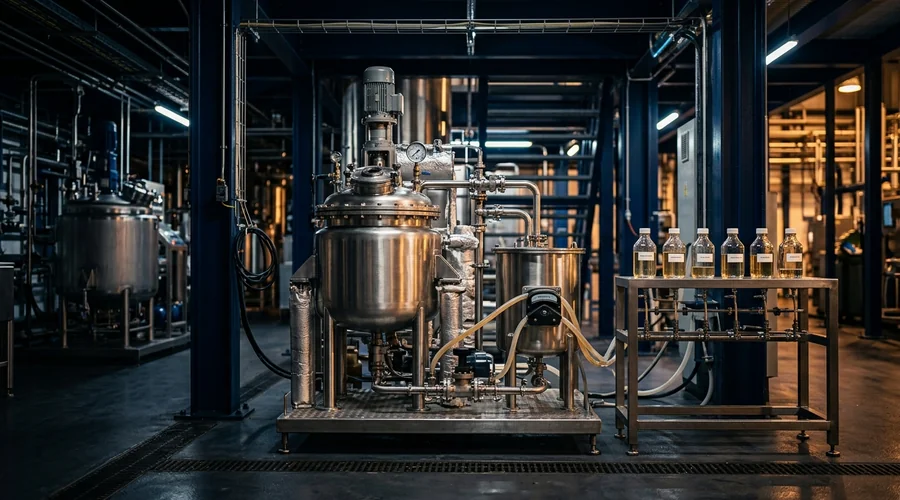
The value of an outside reaction engineering consultant sits in the scoping, not the steel: deciding which questions deserve hardware and which do not. For producers in India and the Middle East adding first-of-kind capacity, that decision belongs before equipment is ordered. Our process development consulting team provides chemical process development services and contract process development for new routes. Our scale-up support works as a scale-up partner and delivers pilot plant support, and our lab-to-market service carries the chosen route through technology transfer, including R&D outsourcing for chemical manufacturing. Formulators facing the same transfer problem in finished products can start with our construction chemical scale-up guide.
Frequently Asked Questions
Do I need a pilot plant?
You need one when the unknowns that remain after calorimetry and a scale-down study are expensive to get wrong. The usual triggers are a route that has never run above laboratory scale and a step whose selectivity responds to mixing or heat removal. Others are real feedstock the laboratory cannot reproduce and a new solids step. Effects such as recycle build-up, fouling or catalyst life, which appear only over days of running, are further triggers.
If only one trigger applies, a narrower study aimed at that unknown is usually enough. RAND’s analysis of 44 process plants found inaccurate cost estimates typical of pioneer plants, and that is the risk a pilot exists to reduce. Our process development consulting team scopes this decision before any hardware is ordered.
How big should a pilot plant be?
As small as the questions allow and as large as the evidence demands. Pilot plant sizing uses six constraints. They are the question the pilot must answer, the scale-up ratio, the product quantity needed, the run length, the minimum practical size of hardware and the hazard inventory.
One practitioner starting point for sizing a pilot plant is 10:1 over the scale you already operate; 2:1 is too small for proper data and 1000:1 too large for confidence. Geometry explains the upper limit: a commercial vessel with 100 times the pilot’s volume keeps only about 22% of its jacket area per unit volume, assuming the same shape.
What is a pilot plant used for?
A pilot plant is used to learn about a process before the commercial plant is built. It produces design data such as scaling factors, shows problems that are negligible at laboratory scale but can derail a full-scale process, and makes representative product for customer qualification. It also supplies the evidence behind investment decisions.
Its use depends on its purpose: generating samples, proving process safety, gathering design data or validating economics each implies a different pilot. Bosman’s warning applies here: a pilot that tries to answer every question ends up with no good answer to any of them.
What is the difference between a pilot plant and a demonstration plant?
A pilot plant determines scaling factors and design data at engineering scale, while a demonstration plant proves operating stability and lifetime at close to commercial conditions. On the US Department of Energy readiness scale, pilot scale is TRL 6 and full-scale prototype demonstration is TRL 7. Wikipedia describes demonstration plants as typically larger than pilot plants but smaller than full-scale plants.
For petroleum catalyst work, Wikipedia gives 1–100 L of catalyst for a pilot and 100–1,000 L for a demonstration plant. Some industries use the two terms interchangeably, so agree the definition with your funder or customer before you budget.
How much does a pilot plant cost?
The range is enormous because cost follows purpose. In a June 2026 article, CPI’s Andrew Bosman describes a safety-driven build for explosive atmospheres that cost more than £5 million and took around 18 months. A simple set-up in an intermediate bulk container for another client cost under £50,000 and took one to two months. Wikipedia likewise notes that pilot plants range from stock laboratory equipment to custom-assembled plants costing millions of dollars.
Equipment is only part of the cost. Bosman lists engineering design, process safety review, equipment procurement, construction and operations support as the drivers. Scope the purpose first, and the budget follows from it.
How long should a pilot plant run?
Long enough to reach steady state for every condition you need to report, and longer for effects that develop slowly. For an ideal continuous stirred-tank reactor, the output reaches 95% of a new steady state after three residence times and 99.3% after five. Recycle loops need the whole loop to line out, and catalyst-life questions run on the deactivation timescale.
Each condition therefore consumes about five reactor volumes of feed, which is why reactor volume drives the running cost of a continuous pilot. Plan replicates on top of that, and count the feed before you fix the reactor size.
When can you skip a pilot plant and go straight to commercial scale?
Sometimes. The conditions are established chemistry and a commercial reactor type that has run similar duties. The rate must not be limited by mixing or heat removal, the feed must be well defined, and the flowsheet must contain no new solids step. Reaction calorimetry and a scale-down model should confirm the thermal and mixing assumptions first.
Without a pilot, the first commercial batches become the pilot, at commercial cost. A trial batch at an existing facility under contract is one compromise. Weigh the cost of a failed transfer against the pilot budget before you choose.
Does a small pilot plant need a process safety review?
Yes, because small inventories reduce consequences but not obligations. OSHA has stated that research facilities are not exempt from the Process Safety Management standard when a process holds a threshold quantity or more of a highly hazardous chemical. Coverage depends on the amount of chemical in the process, not on the purpose of the facility.
A pilot also runs the hazardous step in new equipment at a larger inventory than the bench, so measured heat-of-reaction and adiabatic temperature rise data should come first. Hazard evaluation and the basis of safety are site- and recipe-specific and must be performed by qualified process safety engineers.
Planning a Pilot Plant, or Deciding Whether You Need One?
Global Formulation provides route selection, process development and scale-up partnership, from scoping the pilot question to pilot plant sizing, technology transfer and R&D outsourcing for chemical manufacturing.
Talk to Our Process Team