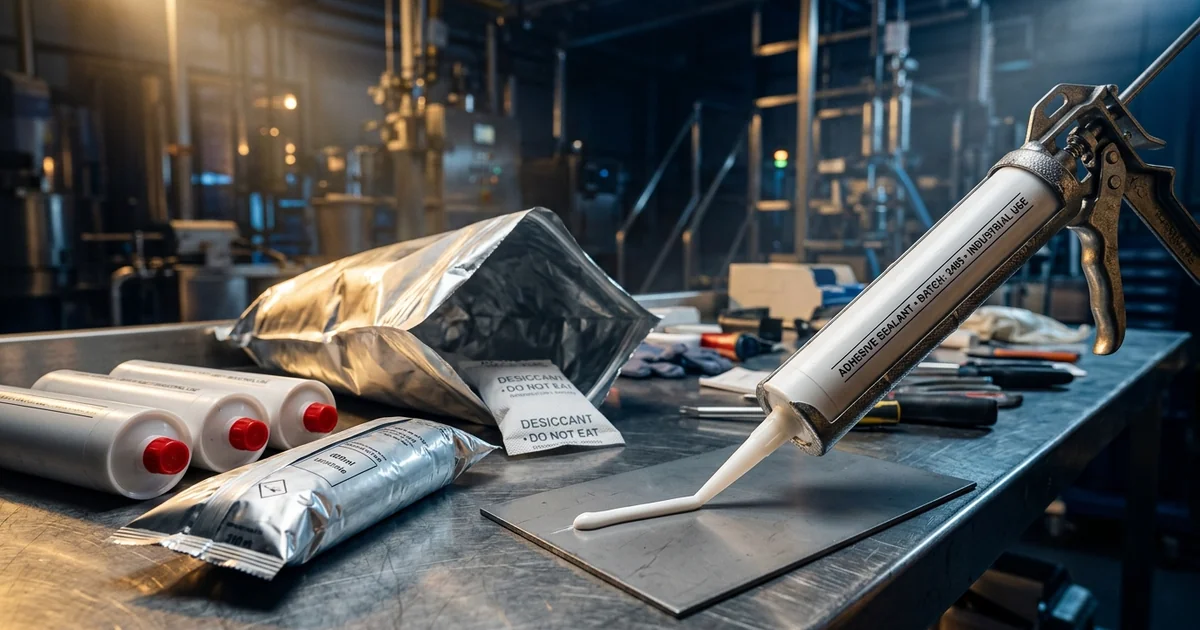
You open a cartridge that was sealed at the factory and find a stiff, lumpy paste, or a rubbery plug jammed in the nozzle. The product never reached a joint, yet it has already cured. Sealant adhesive shelf life is the clock behind this failure, and it runs on moisture, temperature, and packaging quality as much as on the formulation itself. Every failed cartridge means scrapped stock, distributor returns, and a warranty conversation nobody wants. This article explains what shelf life measures, why moisture-cure chemistries can cure inside the package, and how two-part systems age. It also covers how barrier packaging and desiccants protect stock, so manufacturers and startups can set a defensible date and then keep it.
Sealant Adhesive Shelf Life: What the Date on the Cartridge Measures
Does sealant expire? Yes, but the date on the cartridge is a performance guarantee rather than a safety limit. Manufacturers define shelf life as the period, counted from manufacture, during which an unopened product in its original package still meets specification when stored as directed. Once a specified property drifts outside its limit, the clock has run out.
- Chemical reaction — reactive groups consume themselves early, which thickens the product, shifts cure speed, or weakens the final bond.
- Physical change — fillers settle, plasticisers migrate, emulsions break, resins crystallise, or solvent escapes through the closure.
- Contamination — water, oxygen, carbon dioxide, or microbes enter the package and trigger one of the first two.
Knowing which property fails first tells you which part of the system to fix, so shelf life belongs to the whole system: formulation, package, and storage conditions together. For reactive one-part products, contamination by moisture is the dominant route, and it deserves its own section.
Moisture Cure Sealant Packaging: Why One-Part Systems Cure Inside the Cartridge
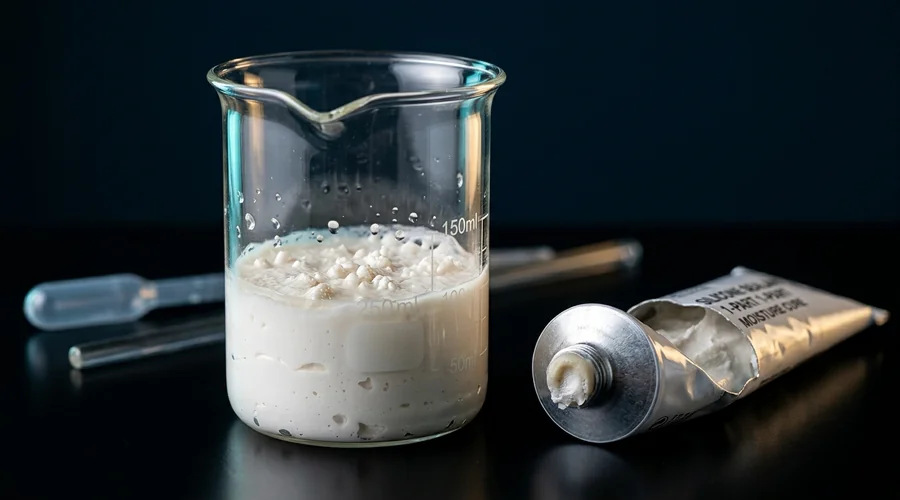
One-part moisture-cure sealants are built to react with water, so every cartridge holds a chemical that is waiting for moisture to arrive. Water that reaches the paste before the joint starts the same cure reaction early, whether it came from filler, plasticiser, headspace air, or slow permeation through the package wall. The result is cure-in-package: skinning, lumps, thickening, or a fully gelled cartridge. The table below compares the main families and shows how each one responds to water.
| Chemistry | What moisture does inside the package | Cure-in-package symptom | Main stabilisation strategy |
|---|---|---|---|
| One-part silicone (acetoxy, oxime, alkoxy) | Water hydrolyses the crosslinker, and silanol groups condense into a silicone rubber network | Skin at the nozzle, lumps, stiff or gelled paste | Dried fillers, moisture scavenger, barrier packaging |
| One-part polyurethane | Water converts isocyanate groups to amine and carbon dioxide, and the amine forms urea links | Viscosity rise, gel particles, bulging cartridge | Dried fillers and pigments, isocyanate-reactive scavenger, foil-laminate packs |
| Silyl-terminated (MS) polymer | Water hydrolyses alkoxysilane end groups, which condense into a network | Thickening, gel lumps, slow cure after storage | Vinylsilane-type scavenger, dried fillers, sealed barrier packaging |
| Reactive hot melt (PUR) | Residual isocyanate groups react with water vapour and crosslink the adhesive | Gelled or hardened adhesive in the cartridge or melter | Foil-lined sealed packaging and dry handling |
| Cyanoacrylate | Water and other weak bases initiate anionic polymerisation of the monomer | Thickening, then a solid plug in the nozzle or bottle | Acidic stabilisers, sealed polyethylene container, cool storage |
The polyurethane case stands out because its side reaction makes gas. Carbon dioxide raises pressure inside a sealed cartridge, which shows up as bulging walls, a hiss on opening, or foamy bubbles in the cured bead. Our guides to polyurethane sealant bubbling and blistering and reactive hot melt PUR adhesives cover the same chemistry in the joint and in the melter.
Understanding the mechanism is half the job, and the other half is recognising the failure when it appears in the field.
Cure-in-Package Failure in Sealants: Reading the Symptoms
A failed cartridge reveals where the moisture came from if you read it correctly. Skinning at the nozzle points to the closure, while thickening throughout the mass points to water inside the formulation or permeating through the wall. Sorting symptoms by location turns a vague complaint into a short list of suspects. The patterns below cover the failures seen most often in one-part sealants and adhesives.
- Skin or plug at the nozzle only — moisture entered through the nozzle seal or an opened and resealed cartridge, so inspect the closure and the user's handling.
- Lumps or gel particles through the paste — cure started around pockets of water, so audit raw-material moisture, mixing, and filling-line air.
- Uniform thickening or stiff extrusion — water entered the whole mass, either with the formulation or by permeation through the package wall over months.
- Bulging cartridge or foamy bead (polyurethane) — carbon dioxide from the isocyanate–water reaction built pressure in the package.
- Slow or patchy cure after storage — organotin and titanate catalysts hydrolyse in the presence of water and lose activity, so a wet product can thicken and cure slowly.
- Oil bleed or settled filler — a physical stability problem rather than a cure problem, so look at rheology and storage temperature.
Prevention starts in the plant, well before the package is sealed. The controls below follow the water from the raw-material drum to the filled cartridge.
- Measure water in every hygroscopic raw material by Karl Fischer titration, and dry fillers before use.
- Mix and deaerate under vacuum, which removes entrained air and moisture from the batch.
- Add a chemical moisture scavenger matched to the cure chemistry, so it consumes residual water before the crosslinker does.
- Blanket the batch and the filling line with dry air or nitrogen.
- Fill into barrier packaging quickly and seal with an effective closure or piston.
- Test retained samples from every batch for extrusion rate and cure behaviour before release.
Moisture-cure products fail when water gets in. Two-part systems fail differently, because their risk lies in the slow drift of each separate component.
Epoxy Shelf Life and Two-Part Systems: Each Component Ages Differently
Two-part systems do not cure until mixed, which suggests they should last indefinitely. They do not, because each component has its own route to failure, and the shorter-lived component sets the shelf life of the kit. Epoxy shelf life, for example, depends on the resin and the hardener separately. This is shelf life before mixing, which differs from the pot life that starts running after mixing.
- Epoxy resin (Part A) — liquid bisphenol-A epoxy resins crystallise in cold storage and turn cloudy or solid, gentle warming restores the liquid, and fillers settle over time.
- Amine hardener (Part B) — amines absorb carbon dioxide and moisture from headspace air and form carbamate crusts or haze, and oxidation darkens them.
- Polyol component (polyurethane) — polyols are hygroscopic, so absorbed water reacts with isocyanate on mixing and releases carbon dioxide that foams the cured mass. Formulators add molecular sieve powders to keep the polyol side dry.
- Isocyanate component — any moisture forms insoluble polyurea solids, which appear as haze or sediment, and the container headspace is the entry route.
Headspace is the common thread. Every time a container is opened, fresh humid air replaces the protective atmosphere, so partly used containers age faster than sealed ones. Users should reseal promptly, and suppliers can pack smaller units so less headspace sits above the product. Chemistry sets how a product fails, and temperature sets how fast, which is the subject of the next section.
Adhesive Storage Temperature Stability: Heat, Cold, and Freeze–Thaw
Temperature decides how fast chemical aging proceeds and whether physical damage occurs at all. Heat speeds every unwanted reaction, while cold brings a different set of failures: crystallisation, freezing, and condensation on opening. A warehouse or shipping container that swings between extremes can damage stock that a controlled room would preserve. The right storage range depends on the chemistry, so no single rule fits every adhesive.
- Waterborne acrylic and PVA adhesives — ice crystals destabilise the polymer emulsion, and the coagulum does not recover on thawing, so these products must never freeze.
- Solvent-based contact adhesives — solvent escapes through a poor closure and viscosity climbs, while heat raises container pressure and fire risk.
- Cyanoacrylates — cool storage slows anionic polymerisation, and warming to room temperature before opening prevents condensation on the product.
- Anaerobic adhesives — oxygen keeps the radical-cure chemistry inhibited, so these ship in partly filled, air-permeable polyethylene bottles and should not be stored in sealed containers that starve them of oxygen.
- One-part heat-cure epoxy adhesives — the latent hardener still reacts slowly at room temperature, so suppliers specify cold or frozen storage.
- Dry cementitious adhesives — cement absorbs humidity and begins to hydrate in the bag, which shortens the life of tile adhesives in humid climates.
For chemical reactions, the link between temperature and rate follows Arrhenius kinetics. Engineers commonly plan accelerated aging with the rule that a ten-degree rise roughly doubles reaction rate. The rule holds only while one mechanism operates across the tested range, and crystallisation, freezing, and phase change do not follow it at all.
Temperature sets the pace of aging, and packaging decides how much moisture and air take part in it.
Desiccant Adhesive Packaging and Barrier Design: Slowing Moisture Ingress
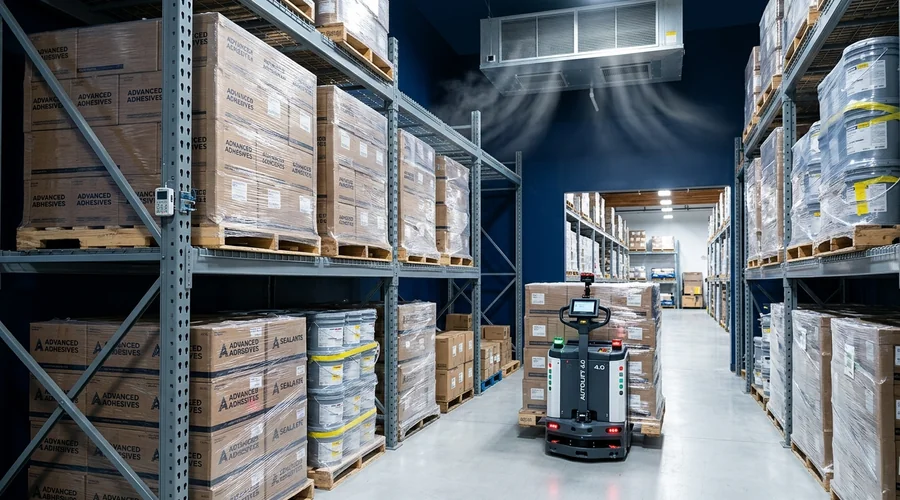
Packaging is the second line of defence after a dry formulation, and adhesive cartridge shelf life depends on how slowly the package lets moisture in. Barrier performance is measured as water vapour transmission rate for moisture and oxygen transmission rate for air, and the two rarely move together. Polyethylene blocks water vapour relatively well but passes oxygen, while aluminium foil laminate blocks both. Matching the barrier to the chemistry's real sensitivity avoids both failure and needless cost.
| Packaging element | What it protects against | Watch point |
|---|---|---|
| Polyethylene or polypropylene cartridge | Bulk moisture at modest cost, the commodity format for sealants | Slow permeation through the wall over long storage, and weak points at the rear piston and nozzle seal |
| Foil-laminate sausage pack | Near-zero moisture and gas permeation for sensitive polyurethane and high-performance products | Pinholes and seal defects, and a dispensing system built for the format |
| Metal tube, can, or pail with liner | Impermeable wall | Closure gasket and lid seal, and fresh headspace air after every opening |
| Induction-sealed foil under the cap | Seals the mouth of the container until first use | Must be intact at the point of sale |
| Secondary foil bag with desiccant | Extends the life of primary packs during long sea freight and humid storage | Added cost, and a desiccant that must be sized to the bag and kept dry before sealing |
Desiccants belong in secondary packaging, not in the product. Silica gel, clay, and molecular sieve desiccants adsorb water from the air trapped around a sealed primary pack, and humidity indicator cards show whether the bag stayed dry. Inside the paste, the job belongs to dried fillers and chemical scavengers, because a physical desiccant mixed into the product would contaminate it. Our overview of packaging industry chemistry covers barrier materials in more depth.
Even the best barrier only slows the clock, so the final step is to prove how long the clock runs and to manage stock against it.
Testing Sealant Adhesive Shelf Life and Managing Stock
A shelf life printed on a label is only as credible as the data behind it. Manufacturers establish it by storing production-representative packages at the stated conditions and testing them at intervals, while accelerated aging gives an early signal. Distribution consumes the clock too, because product often sits in distributor stock for months before it reaches a joint. For a new manufacturer, a conservative date backed by real data protects the brand better than an ambitious one.
- Extrusion rate — shows how easily the product leaves the cartridge, and ASTM C1183 describes the method for elastomeric sealants.
- Skin-over and tack-free time — shows whether cure speed held, and ASTM C679 covers tack-free time for elastomeric sealants.
- Viscosity — rotational viscometer readings track thickening in pastes and liquids between pulls.
- Cured properties — bond strength on a reference substrate, such as lap shear per ASTM D1002, confirms the aged product still bonds. ASTM D1337 covers storage life of adhesives by consistency and bond strength.
- Package condition — bulging, separation, crystals, and crusts recorded at every pull.
Test data only protects the brand when it feeds a routine. The sequence below turns shelf life from a label into a controlled process, and it works as a development brief for new products.
- Classify the chemistry by its sensitivity: moisture, oxygen, freezing, or heat.
- Dry the formulation and add scavenging capacity sized to the stated shelf life.
- Choose packaging whose barrier matches the sensitivity and the time the product will spend in distribution.
- Write storage and transport limits on the technical data sheet, including the warm-up step before opening cold stock.
- Run real-time aging in the final package, with accelerated aging for early warning.
- Print the date from manufacture, keep retained samples from every batch, and rotate stock first in, first out.
- Investigate field complaints by symptom, and feed each finding back into steps two and three.
The same accelerated-aging logic appears in our cosmetic stability testing protocol. The moisture chemistry behind sealant curing is explained in our guides to silicone sealants and MS polymer sealants. New manufacturers planning a line can start with our guide to starting a silicone sealant manufacturing unit, and the wider range sits in our adhesives and sealants hub. Get moisture, temperature, and packaging right together, and the date on the cartridge becomes a promise you can keep.
Frequently Asked Questions
Does sealant expire, and can I still use it past the date?
What is cure-in-package failure in a sealant?
Why do polyurethane sealant cartridges bulge?
Why does epoxy shelf life depend on two separate components?
Should adhesives and sealants be refrigerated?
Does a desiccant sachet inside a tube or cartridge help?
How do I set a defensible shelf life for a new sealant or adhesive?
Need Expert Formulation Support?
Our team provides end-to-end technical consultancy — from sealant and adhesive formulation and moisture-scavenger selection to packaging specification, shelf-life studies, and plant setup for new manufacturers.
Get a Free Consultation