Concrete Retarder Guide: Hot-Weather Set Control

A truck leaves the plant on a hot afternoon, queues in traffic and arrives with concrete that has already begun to stiffen. A concrete retarder buys back the lost working time by slowing the setting reaction, yet it does not cool the batch and a wrong dose creates new problems. The alternative is water added on site, which raises the water-cementitious materials ratio and costs strength and durability. This guide explains retarder chemistry, how heat changes the job, how to trial a product and how surface retarders expose aggregate. It draws on FHWA technical briefs, NRMCA guidance, published hydration research and product declarations of performance, with formulation support from Global Formulation.
What Is a Concrete Retarder? Three Products Share the Name
The term concrete retarder covers three unrelated products, and confusing them leads to wrong purchases and wrong specifications. A set-retarding admixture goes into the mix and slows setting throughout the batch. A surface retarder is sprayed onto the placed surface and slows setting only in the top layer of paste. An evaporation retarder forms a thin film on the surface and slows water loss without touching the cement chemistry.
| Product | Where It Acts | What It Changes | Typical Use |
|---|---|---|---|
| Set-retarding admixture | Added to the mix at batching | Delays initial and final set of the whole batch | Hot weather, long haul, large placements |
| Surface retarder | Sprayed on the placed surface | Delays set of the top few millimetres of paste | Exposed aggregate finishes, construction joints |
| Evaporation retarder | Applied to the fresh surface before texturing | Forms a monomolecular film that slows moisture loss | High-evaporation conditions before curing starts |
The evaporation retarder is described in an FHWA technical brief on curing slipformed pavements, which treats it as an initial curing measure. A fourth term, vapor retarder, names a sheet placed under slabs on grade and has no connection with set time. This guide covers the first two products, starting with the chemistry of the first.
Concrete Retarder Chemistry: Four Compound Families
Set-retarding admixtures are built from a short list of compound families, and the family shapes how a product behaves in a given cement. An FHWA brief on paving admixtures lists four general categories drawn from the ACI and PCA literature. The vast majority of products also reduce water demand, which blurs the line between a retarder and a water reducer. That overlap is strongest in the lignosulfonate category.
| Family | Examples | What to Know |
|---|---|---|
| Lignosulfonic acids and salts | Modified and fractionated lignosulfonates | Strongly water-reducing; residual wood sugars add retardation that varies between production batches |
| Hydroxylated carboxylic acids and salts | Gluconates, citrates, tartrates | Gluconate is a widely used retarding additive and binds calcium strongly |
| Carbohydrate-based compounds | Sugars, sugar acids, polysaccharides | Sucrose is among the most powerful retarders of Portland cement hydration |
| Inorganic salts | Borates, phosphates | Named by FHWA as a fourth category beside the organic families |
According to the FHWA brief on chemical admixtures for paving mixtures, the effect of any one admixture varies greatly. The cement, the addition sequence, the water-cementitious materials ratio, the mixing temperature and the ambient temperature all change it. Our guide to plasticizers and superplasticizers explains the water-reducing side of the same chemistry. Why such different molecules all delay setting is the subject of the next section.
Retardation Mechanism: Calcium Complexation and Nucleation
Hydration products such as calcium silicate hydrate and calcium hydroxide precipitate from the pore solution, and the concrete sets as solids interlock with them. A retarder interferes with that precipitation. FHWA, summarising standard texts, describes retarders as inhibiting the growth of certain crystalline phases by delaying nucleation. Some categories also form a shell on the cement grain that limits access to water until the shell ruptures and hydration resumes.
Laboratory work on specific molecules adds detail at the calcium level. Researchers at Dijon, Empa and Grenoble measured how gluconate and three hexitols bind calcium in the high-pH conditions of cement.
- Gluconate — forms strong calcium complexes. With portlandite present at pH 12.5, a heteropolynuclear calcium-gluconate-hydroxide complex dominates, which lowers the free calcium concentration.
- Ranking — complex strength follows the order gluconate far above sorbitol, then mannitol, then galactitol. That is the same order as sorption on portlandite and C-S-H.
- Retardation order — the order of retarding tricalcium silicate differs slightly: gluconate, then sorbitol, then galactitol, then mannitol.
- Dissolution — the dissolution of alite is negligibly affected by gluconate and the hexitols, so the action is attributed to precipitation.
- Concentration — the products are used in small amounts, yet their concentration in the pore solution reaches tens of millimolar in the first hours.
The same preprint, Bouzouaid and colleagues on portlandite solubility and calcium activity, states that the mechanisms behind retardation are not fully understood. Sucrose shows a different pattern. A 2018 ACI symposium paper by Juilland and Gallucci tested sucrose on alite. Dissolution was barely affected, and C-S-H nucleation changed only to a limited extent and only at high pH. Calcium hydroxide nucleation and growth were extremely sensitive to sucrose even at low dosages and at every pH studied.
Mechanisms explain the molecule, but a real cement adds a second layer through its aluminate phase, and the next section covers it.
Cement Chemistry, C3A and Fly Ash Interactions
A retarder that works well in one cement can behave differently in the next. The tricalcium aluminate phase, C3A, reacts early and interacts with the retarder, so cement composition changes how much product a mix needs. Supplementary cementitious materials and the sulfate balance add further variables. The FHWA brief on paving admixtures lists the main interactions and a troubleshooting path.
- C3A content — more retarder is required as the C3A content of the cement rises.
- Time of addition — the effectiveness of the retarder increases as the addition is delayed.
- Abnormal setting — early stiffening or abnormal retardation occurs with certain cements, and certain fly ashes interact with retarders in hot weather.
- Workability — setting can be delayed by early C3A reactions without a significant gain in workability.
Early stiffening has been noted when lignosulfonate-based Type D admixtures are used with certain Class C fly ashes, particularly in high temperatures. The brief gives a sequence to follow when it appears.
- Check that the source of cement and fly ash has not changed, and re-evaluate the mixture if it has.
- Change the admixture in the short term if that is possible.
- Cool the concrete mixture, which can remove the problem.
- Delay the addition of the admixture or change the batching sequence.
Our guide to cement and superplasticizer compatibility covers the aluminate and sulfate balance behind these effects. Our guide to supplementary cementitious materials covers the role of fly ash and slag. With the chemistry in place, the next step is to see what hot weather demands of a retarder.
Hot-Weather Concreting: What Heat Does to Fresh Concrete
ACI 305R defines hot weather by its effect, not by a single temperature. It is any combination of high ambient temperature, high concrete temperature, low relative humidity, high wind speed and solar radiation that impairs concrete by speeding moisture loss and cement hydration. NRMCA notes that arid and tropical climates can meet these conditions at any time of year. The consequences fall into the fresh state, early-age cracking and long-term strength.
- Water demand — higher concrete temperature raises water demand, which raises the water-cementitious materials ratio and lowers strength and durability unless the mix is corrected.
- Slump and air — slump loss is faster and entrained air can be lost.
- Setting — concrete sets sooner, so finishing must happen at a faster rate.
- Plastic shrinkage — cracks form when evaporation outpaces bleeding before the concrete sets.
- Thermal cracking — a hot day followed by a cool night, or a thick section, drives cracking from temperature change.
- Later strength — concrete cured at high temperature at an early age is not as strong later as the same concrete cured near 20°C.
These effects are set out in NRMCA's CIP 12 on hot weather concreting. For plastic shrinkage, the FHWA curing brief puts the trigger at an evaporation rate above 1.0 kg/m2 per hour (0.2 lb/ft2 per hour). Above that rate, preventive measures such as fogging or an evaporation retarder are needed. Crews estimate the rate from the ACI nomograph by monitoring temperature, wind and relative humidity. These effects define what a retarder must do and what it cannot do.
Hot-Weather Strategy: Where a Concrete Retarder Fits
A retarder is one lever in a set of hot-weather measures, and it acts on only one of the problems. It slows the rate of hydration, so working time extends and the peak temperature of the pour falls, as FHWA describes. It does not change the temperature of the batch at discharge, which depends on the materials and any cooling. The NRMCA rules therefore list admixtures beside cooling, planning, curing and crew size.
| Lever | Problem Addressed | Detail From the Sources |
|---|---|---|
| Chilled water or ice in the mix | Concrete temperature at placement | Chilled water lowers temperature by up to 6°C (10°F); ice by up to 12°C (20°F) |
| Shading and sprinkling aggregate, liquid nitrogen | Concrete temperature at placement | Liquid nitrogen gives larger reductions but needs set-up cost and precautions to protect the mixer |
| Moderate-heat cement, slag cement, fly ash | Heat of hydration | Reduce high concrete temperature problems |
| Retarder, water reducer, extended set-control admixture | Setting time and slump loss | Named in NRMCA's first rule for mixture changes |
| Windbreaks, sunscreens, fogging, evaporation retarders | Evaporation | Used when low humidity and high winds are forecast |
| Curing compound, wet burlap | Moisture retention | Start curing as soon as finishing is complete; continue for at least 3 days |
Our guide to concrete curing compounds covers the moisture side of the plan. Once a retarder is part of the plan, the standard and the type determine what the label promises.
Retarder Standards: Type B, Type D, Type G and Hydration Stabilizers
Standards group retarders by what else the product does besides delaying set. ASTM C494 and AASHTO M 194 define Type B as set-retarding without affecting water requirements and Type D as set-retarding and water-reducing. Type G adds high-range water reduction to the retardation. Europe uses EN 934-2, whose Table 8 covers set-retarding admixtures.
| Class | Definition | Notes |
|---|---|---|
| ASTM C494 / AASHTO M 194 Type B | Set-retarding | No effect on water requirement |
| Type D | Set-retarding and water-reducing | Most commercial retarders also reduce water, notably the lignosulfonates |
| Type G | Set-retarding and high-range water-reducing | Combines retardation with superplasticizer action |
| Hydration stabilizer | Extended set retarder | Delays setting for a longer but manageable period on large projects and long hauls |
| EN 934-2 Table 8 | Set-retarding admixture | Initial set at least 90 min and final set at most 360 min later than the control mix |
The EN 934-2 limits above come from product Declarations of Performance, such as those for SikaTard 930 and Centrament Retard 350. Check the current standard text before you rely on them. The same declarations list a 7-day strength of at least 80 percent and a 28-day strength of at least 90 percent of the control mix. They also cap air content at 2 percent by volume above control and declare chloride ion content, alkali content and corrosion behaviour. A declaration records what the product did in a standard test, and the job decides what it does on site.
Trial Batching: Temperature, Time of Addition and Test Methods
FHWA's guidance is direct: without specific information, run a testing programme with the job materials at the temperatures expected on site. Temperature has a big influence on retarder behaviour, so the trial must cover the range expected over the whole project. Not every set-retarding admixture stays effective at elevated temperature. The sequence and timing of the addition during batching also change the result.
| Test | What It Shows |
|---|---|
| ASTM C403 penetration resistance | Initial and final set, read from the time a sieved mortar sample takes to reach specified penetration resistances |
| Semi-adiabatic calorimetry | Heat signature curves with and without retarder, including the shift in peak temperature |
| ASTM C232 bleeding | Bleed rate and capacity, which govern plastic shrinkage risk |
| Slump retention and air content | Slump loss over the haul time and any change in air |
| Strength at early and later ages | The early-age loss and later-age gain that retarders cause |

The FHWA summary of retarders calls semi-adiabatic calorimetry a very good tool for evaluating the effect of a retarder on a given mixture. It also cautions that interactions with other admixtures and material sources are not always predictable. Each trial should vary one factor at a time:
- Temperature — the low and high ends of the expected range, not the midpoint.
- Materials — each cement source and fly ash or slag source in use.
- Addition point — with the batch water or delayed, since later addition raises effectiveness.
Trial data define the working window of a dose, and the next section covers what happens outside it.
Over-Retardation, Bleeding and Other Side Effects
Every retarder trades time for something, and the trade grows with dose. Normal dosages delay both initial and final set and reduce strength in the first days, while later-age strength typically rises above the untreated mix. An excessive dose delays setting excessively and can permanently hinder cement hydration. The FHWA retarder summary adds several side effects that a specification must account for.
- Early strength — strength can fall in the first one to three days.
- Air content — air can rise, so it must be re-checked in every trial batch.
- Bleeding — bleeding rate and bleeding capacity increase.
- Plastic shrinkage and sawing — delayed set raises the risk of plastic shrinkage cracking and can disturb the saw-cutting window on pavements.
- Workability — set delay does not guarantee better workability, because early C3A reactions limit the gain.
The same trade appears in a different form when a retarder is applied to a surface, as the next section shows.
Surface Retarders for Exposed Aggregate Concrete
A surface retarder turns retardation into a finishing tool. It slows setting only in the top layer of paste, so that layer can be washed or brushed away to reveal the stone beneath while the slab below sets normally. One manufacturer data sheet puts the action at a depth of 2 to 5 mm. Timing then decides the result, because the wash-off must happen inside the retardation period.
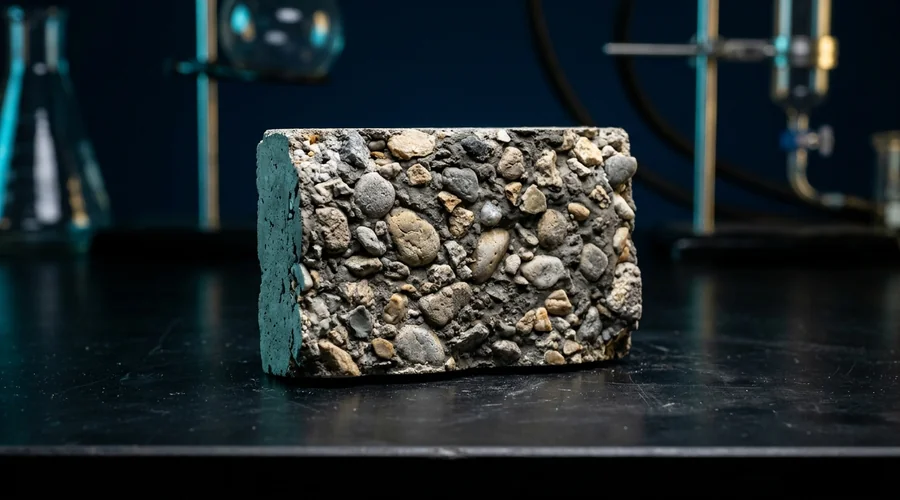
Two manufacturer data sheets, from Sika and Bon Tool, describe the same working sequence for horizontal surfaces.
- Place, compact, screed and lightly trowel the concrete to an even finish.
- Let the bleed water disappear, then spray the retarder evenly with a low-pressure sprayer, without puddling and before setting has begun.
- Cover the treated surface with plastic sheeting or continuously wetted burlap until the retarded paste is removed.
- Probe the surface with a toothpick or steel wire to check the depth of retardation, and test a small area first.
- Wash and brush off the retarded paste within the retardation period. The Sika sheet gives that as up to 24 hours in warm weather and up to 36 hours in cooler conditions.
- Seal the exposed aggregate, which brightens the colour and creates a water-resistant surface.
Researchers treat the timing as a measured variable. A German research project reported on TRID tested brushing with a conventional wire brush. That shows only whether and how deep a retarder acts, not how long it allows brushing in practice. The team built a pendulum-mounted steel broom with a repeatable pressure and a turnover mould, which reproduced the brushing window known from practice. The setup also detected the influence of cement and temperature. Polish researchers published experimental work on the appropriate time for aggregate exposure on cement concrete pavement. Our guide to decorative concrete sealers covers the final step. The product-specific values above show why every project needs a test patch, and the last section turns to the product developer's side.
Formulating Retarders: Working With a Construction Chemicals Consultant
Retarders look simple on the label and demanding in the plant, because the response depends on the cement, the temperature and the other admixtures in the batch. A construction chemicals formulation consultant works across all three. The brief usually starts with a target market, a standard to claim and a set of local cements. Construction chemical product development services then carry the work from bench to batch.
- Family selection — a lignosulfonate, hydroxycarboxylate, carbohydrate or inorganic base, matched to the target Type B, D or G.
- Raw material control — residual sugars in lignosulfonates vary between batches and wood sources, so incoming material needs specification.
- Compatibility — checks against polycarboxylate superplasticizers, air-entraining agents and other admixtures in the same batch.
- Trial matrix — local cements, supplementary cementitious materials, temperatures and addition times, as the FHWA guidance sets out.
- Conformity evidence — test data for ASTM C494 or EN 934-2 Table 8 and the Declaration of Performance.
- Surface retarder products — visibility aids such as a fugitive dye for monitoring application, and wash-off window testing.
- Scale-up — a contract formulation scale-up partner for pilot batches and plant trials, as in our guide to starting an admixture manufacturing business.
The full range of services sits under construction chemicals. Before approaching a consultant, collect your cement and supplementary material sources, the temperature range, the haul time and the finish required. Those inputs define the dose window a product must cover.
Frequently Asked Questions
What is a concrete retarder?
A concrete retarder is an admixture that delays the setting of concrete so that the crew has more time to place, compact and finish it. It is added at batching and acts on the whole batch.
The same name is also used for surface retarders, which delay set only in the top layer of paste for exposed aggregate finishes. It is used as well for evaporation retarders, which are films that slow water loss. They are different products with different uses.
How does a concrete retarder work?
Retarders slow cement hydration by delaying the nucleation of hydration products, and some also form a shell on the cement grain that limits access to water. Laboratory work shows that gluconate binds calcium strongly and lowers the free calcium concentration, while sucrose strongly hinders the nucleation and growth of calcium hydroxide.
The effect depends on the cement, the temperature and the addition sequence, so a product needs trial batches with the job materials.
When should a retarder be used in hot weather?
Retarders are often used in hot weather to offset the faster hydration that comes with high temperatures. They are also used for delayed delivery over long distances and for large placements that must stay monolithic. They are one part of a plan that also needs cooling of the materials, curing and enough crew to place and finish.
A retarder does not replace evaporation control, because a longer plastic period gives evaporation more time to work.
Does a concrete retarder lower the temperature of concrete?
No, a retarder does not lower the temperature of the batch at discharge. It slows cement hydration after placing, which reduces the peak temperature of the pour.
The placing temperature is controlled by other means. Chilled water lowers concrete temperature by up to 6°C and ice by up to 12°C. Shading and sprinkling aggregate also help, and liquid nitrogen gives larger reductions.
What is the difference between Type B, Type D and Type G retarders?
In ASTM C494 and AASHTO M 194, Type B is set-retarding without affecting water requirements, and Type D is set-retarding and water-reducing. Type G is set-retarding and high-range water-reducing.
Most commercial retarders also reduce water, especially the lignosulfonates. Hydration stabilizers are extended set retarders that delay setting for a longer but manageable period, for example on large projects and long hauls.
What happens if too much retarder is used?
An excessive dose delays setting excessively and can permanently hinder cement hydration. Even normal doses reduce strength in the first one to three days, raise bleeding and can raise air content.
Delayed set also raises the risk of plastic shrinkage cracking and can interfere with the saw-cutting window on pavements. Temperature has a big influence on retarder behaviour, so a dose that works at one temperature must be re-checked at another.
How long does a surface retarder keep working for exposed aggregate?
It depends on the product, the mix and the weather. One manufacturer data sheet states a retardation depth of 2 to 5 mm. Its retardation period is up to 24 hours in warm weather and up to 36 hours in cooler conditions.
The retarder only delays surface setting and does not stop the set, so the surface must be washed or brushed off within the retardation period. Test a small area first to check the depth before treating the rest.
How can a construction chemicals formulation consultant help with retarders?
A consultant selects the retarder family for the target type, checks compatibility with water reducers and local cements, and designs a trial matrix across the temperature range. They also prepare the test evidence for ASTM C494 or EN 934-2 Table 8.
Construction chemical product development services then cover pilot batches and technology transfer, including support from a contract formulation scale-up partner.
Developing a Concrete Retarder or Hot-Weather Admixture?
Global Formulation supports construction chemical makers with retarder formulation, cement compatibility trials across temperature ranges, standards conformity data and scale-up to a contract manufacturing partner.
Talk to Our Formulation Team