Supplementary Cementitious Materials: Fly Ash vs GGBS
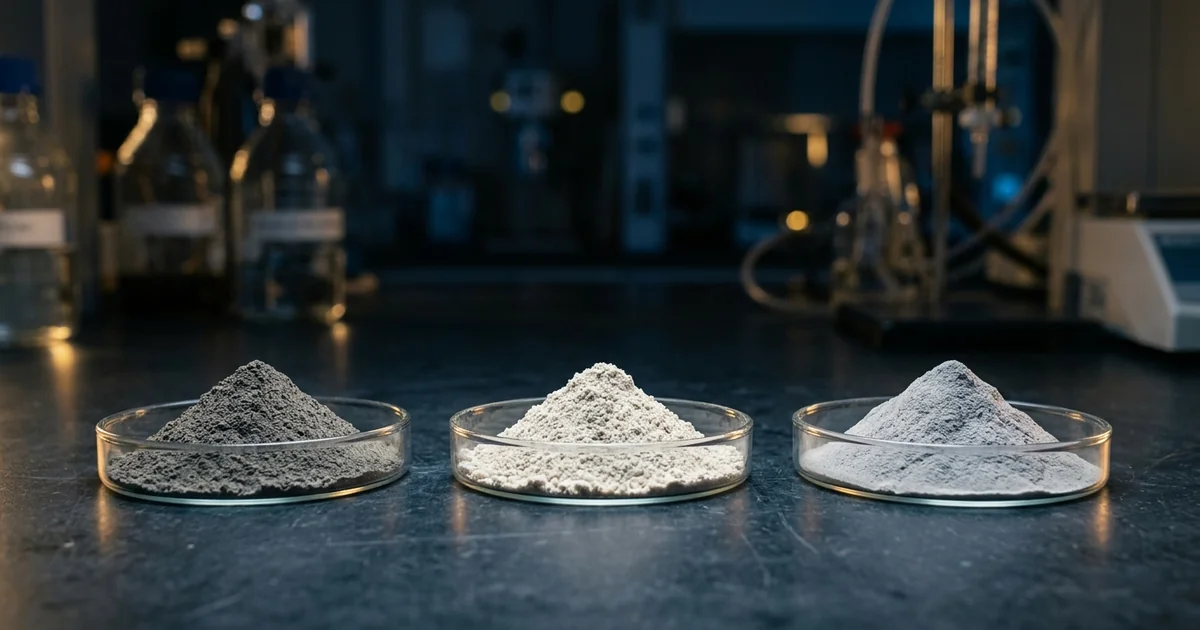
A concrete plant that swaps part of its cement for fly ash, slag or silica fume changes more than the cement bill. Setting time, early strength, air entrainment, water demand and curing sensitivity all move, and they move differently for each material. Supply is shifting too, because coal-fired plants close and slag depends on steel production. This guide to supplementary cementitious materials explains how fly ash, GGBS and silica fume react, what ASTM and Indian standards actually test, and where admixtures and formulations have to adapt. It draws on a federal highway tech brief, the standards themselves and open-access research. It also reflects the formulation support Global Formulation gives construction chemical makers.
Supplementary Cementitious Materials: Hydraulic and Pozzolanic Action
Every SCM does one of two jobs, and some do both. ASTM defines an SCM as an inorganic material that contributes to the properties of a cementitious mixture through hydraulic or pozzolanic activity, or both. Portland cement hydration forms calcium silicate hydrate, which gives strength, and calcium hydroxide, which gives little strength and features in many materials-related distress mechanisms. A pozzolan consumes that calcium hydroxide and forms more calcium silicate hydrate, which is why FHWA's SCM tech brief ties durability gains to the pozzolanic reaction.
| SCM | Source | Activity | Main Standards |
|---|---|---|---|
| Fly ash | Residue of pulverised coal combustion, collected from flue gas | Pozzolanic, hydraulic or both, depending on composition | ASTM C618, IS 3812 (Part 1) |
| GGBS (slag cement) | Blast-furnace slag quenched with water into a mainly glassy solid, then ground | Hydraulic but slower than portland cement | ASTM C989, IS 16714 |
| Silica fume | By-product of silicon and ferrosilicon arc furnaces | Highly pozzolanic, with no hydraulic properties | ASTM C1240, IS 15388 |
| Natural and calcined pozzolans | Volcanic ash, diatomaceous earth, calcined clays and shales | Pozzolanic, with properties that vary widely | ASTM C618, with metakaolin named in IS 456 |
| Alternative SCMs | Materials outside C618, C989 and C1240 | Evaluated case by case | ASTM C1709 guide |
Mixtures often combine two SCMs. FHWA notes that ternary mixtures perform in a manner predictable from their ingredients, and that the negative properties of one SCM can be offset by the positive properties of another. The same by-products can also be activated chemically to replace most of the clinker, a route covered in our guide to geopolymer cementitious binders.
Fly ash is the most used SCM and the most variable, so it comes first.
Fly Ash Concrete Replacement: Classes, Carbon and Variability
Different fly ash sources can have vastly different performance characteristics. FHWA concludes that fly ash should not be viewed as an interchangeable part, and that a change of power plant, fuel or combustion conditions calls for verification in concrete. FHWA describes ASTM C618 as sorting ash by the sum of silica, alumina and iron oxides. Class F needs 70 percent or more and Class C needs 50 percent or more.
| Property | Class C Replacement | Class F Replacement |
|---|---|---|
| Initial set | Delayed | Delayed |
| Rate of strength gain | Same or higher | Slower |
| Heat of hydration | Lower | Significantly lower |
| Early strength (3 to 7 days) | Higher | Lower |
| Late strength (28 to 56 days) | Same or higher | Same or higher |
| ASR mitigation | Only at high replacements | Significant above the pessimum level |
The sum-of-oxides rule is widely criticised, because fly ash properties such as ASR and sulfate resistance correlate more strongly with calcium oxide content. FHWA places the transition between Class C and Class F near 18 percent CaO, plus or minus 4. Canadian specifications use CaO directly, and the Indian standard splits siliceous fly ash, with reactive CaO below 10 percent, from calcareous fly ash at 10 percent or more. IS 3812 (Part 1): 2013 describes siliceous ash as normally from anthracite or bituminous coal and pozzolanic. It describes calcareous ash as normally from lignite or sub-bituminous coal, with both pozzolanic and hydraulic properties.
- Carbon — residual carbon adsorbs air-entraining admixture, so less is left to stabilise air bubbles.
- Loss on ignition — it measures total volatiles and not the adsorption capacity of the carbon, so two ashes with the same value can affect air very differently.
- Adsorption tests — the foam index, iodine number and direct adsorption isotherm test the property that matters.
- Mercury control — powdered activated carbon added in the combustion process is more adsorptive than normal ash carbon and can change adsorption sharply with little change in loss on ignition.
The Indian standard sets its own window. IS 3812 (Part 1) requires 70 percent minimum silica, alumina and iron oxides for siliceous ash and 50 percent for calcareous ash, and loss on ignition of 5.0 percent maximum. It sets fineness at 320 m²/kg minimum by Blaine, lime reactivity at 4.5 N/mm² minimum and 28-day mortar strength at not less than 80 percent of plain cement mortar. It also requires specific surface, 45-micron residue and lime reactivity to stay within 15 percent of the average of the previous ten samples. The standard allows beneficiation, but it does not allow grinding coarse ash to meet the fineness limit.
Slag raises a different problem, because its reaction is slow and its curing demands are high.
GGBS and Slag Cement Concrete: Slower Reaction, Longer Curing
Slag cement starts as molten blast-furnace slag, which is quenched with water to lock in a mainly glassy structure with a composition close to portland cement. It is hydraulic and forms calcium silicate hydrate, but it reacts more slowly than portland cement. Portland cement hydration releases calcium hydroxide, and that calcium hydroxide helps break down the glass phases of the slag so they can react. FHWA concludes that slag is not pozzolanic, yet it consumes calcium hydroxide by binding alkalis in its hydration products and so provides the benefits of a pozzolan.
- Fresh concrete — it consolidates more easily under vibration, and setting time can increase significantly.
- Curing — it matters even more than with plain portland cement, and the lower reaction rate at low temperature is often overlooked and can cause scaling.
- Mass concrete — the slower heat evolution makes slag cement an ideal ingredient where internal temperature control is critical, and high replacement levels are used.
- ASR and sulfate — it is effective, but it needs higher replacement than Class F fly ash, and its lower permeability helps resist external sulfate attack.
The specifications grade the material differently. ASTM C989 classes slag cement as Grade 80, 100 or 120 by the strength activity index of mortar cubes, with the numeric grade tied to the relative strength reached. FHWA notes that the result depends strongly on the reference cement, so the standard now uses a CCRL reference cement. India's IS 16714: 2018 asks for glass content of at least 85 percent and fineness of at least 320 m²/kg. Its slag activity index is at least 60 percent at 7 days and 75 percent at 28 days, measured in a 50:50 blend with OPC 43 grade cement.
IS 16714 also caps magnesium oxide at 17.0 percent, sulphide sulphur at 2.0 percent, sulphate at 3.0 percent and chloride at 0.1 percent. Its foreword explains that IS 12089 covers granulated slag for making Portland slag cement. A separate standard was needed for ground slag blended with cement or added directly to concrete. A formulator buying GGBS should therefore ask which standard the supplier certifies against.
Silica fume sits at the opposite end of the particle-size range, and its problems come from fineness.
Silica Fume Concrete: Fine Packing, Water Demand and Dispersion
Silica fume is a by-product of silicon and ferrosilicon production in electric arc furnaces, collected as amorphous silica spheres. IS 15388 gives the average diameter as 0.10 to 0.15 micrometre, and FHWA gives 0.1 to 0.2 micrometre. That fineness raises water demand, packs the paste more densely and speeds the reaction. Those three effects explain both its value and its handling problems.
- Nucleation and heat — silica fume provides nucleation sites for portland cement hydration products and increases the heat of hydration, particularly at early ages.
- Packing and interface — it packs around aggregate, consumes calcium hydroxide at the interfacial zone and greatly improves its strength and impermeability.
- Durability — with its low permeability, it is very effective at mitigating ASR and sulfate attack.
- Water demand — high-range water reducers hold or lower the water-to-cementitious ratio.
- Dispersion — clumps of silica fume can act like an expansive aggregate and contribute to ASR.
Specifications focus on silica content and reactivity. ASTM C1240 requires at least 85 percent silicon dioxide and an accelerated pozzolanic strength activity index of at least 105 percent of control at 7 days. That test holds flow and water-to-cementitious ratio constant, allows a high-range water reducer, and cures the specimens at 65 °C after the first day. IS 15388: 2003 requires at least 85.0 percent silicon dioxide, moisture of 3.0 percent maximum and loss on ignition of 4.0 percent maximum. It also requires 7-day strength of at least 85 percent of control, and it limits alkalis to 1.5 percent where reactive aggregate is present. The standard defines three forms: silica fume in its natural state, a densified form with bulk density above 500 kg/m³, and a slurry.
Each of these materials changes what the admixtures in the mix have to do.
SCM Admixture Compatibility: Air Entrainment, Water Demand and Set
Admixtures are tuned to a cement, and an SCM changes the cement they see. Air entrainment, water reduction, setting and early strength all move when a new SCM enters the mix. The movements differ by material, so a mix design cannot be copied from one SCM to another. The table below sets cause beside the response a formulator must plan for.
| Effect | Material | Mechanism | What the Admixture System Must Handle |
|---|---|---|---|
| Lost air entrainment | Fly ash with adsorptive carbon | Admixture adsorbed on carbon cannot stabilise air bubbles | Re-test the air system with every ash source |
| Higher water demand | Silica fume | Very fine particles | High-range water reducer and good dispersion |
| Delayed set | Slag and both fly ash classes | Slower reaction | Set control in cool conditions, plus curing |
| Slower early strength | Class F ash and slag | Slower reaction | Choice of SCM class, curing and strength targets by age |
| Faster early heat | Silica fume | Nucleation of hydration products | Thermal control in thick sections |
The ASTM C618 scope itself carries the warning. Its note says that finely divided materials can reduce the entrained air content of concrete. It calls for air content tests and extra air-entraining admixture, or an air-entraining hydraulic cement, to keep the specified air content. Our guides to air entraining admixtures, plasticizers and superplasticizers and cement and superplasticizer compatibility cover the admixture side.
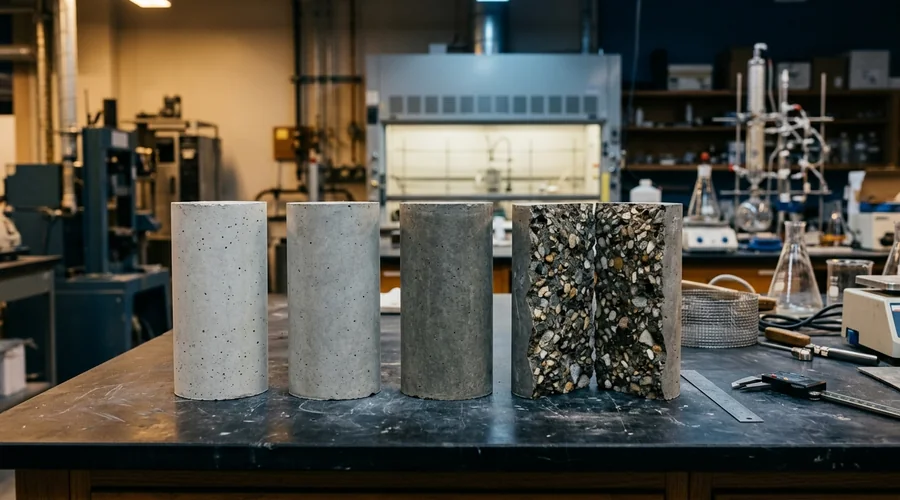
Because so much depends on the actual material, it matters what a specification can and cannot promise.
SCM Specifications: What ASTM and IS Tests Prove and Miss
A standard shows that a material sits inside a window, not that it will work in your mix. FHWA calls the strength activity index the most problematic fly ash property for predicting performance. ASR, sulfate and air-void behaviour need tests on the actual combination. Indian practice adds a wrinkle, because IS 456:2000 cites an older grade system that IS 3812 has since replaced.
| Test or Rule | What It Measures | Limit of the Test |
|---|---|---|
| Strength activity index | Mortar strength against a control at a fixed replacement | Inert materials can pass the fly ash version |
| Sum of oxides | Bulk composition used for ASTM C618 classes | CaO content predicts ASR and sulfate performance better |
| Loss on ignition | Total volatile content of ash | It does not measure carbon adsorption capacity |
| ASTM C1567 | ASR potential of cementitious material and aggregate combinations within 16 days | Valid only for the specific combination tested |
- Fly ash and pozzolans — the current ASTM C618 scope covers coal ash and raw or calcined natural pozzolan. It excludes fluidised-bed combustion residue and ash from burning refuse.
- Blended cements — ASTM C595 covers blended hydraulic cements using slag, pozzolan, limestone or a combination, and it prescribes ingredients and proportions with some performance requirements.
- Performance route — ASTM C1157 governs by performance criteria alone.
- Alternative SCMs — the C1709 guide states that passing its tests does not mean a material meets C618, C989 or C1240.
- Indian concrete code — IS 456:2000 clause 5.2 allows pozzolanas conforming to Indian Standards with the engineer-in-charge's permission, provided uniform blending is ensured.
- Named materials in IS 456 — fly ash to Grade 1 of IS 3812, silica fume to an approved standard, and slag to IS 12089. It also names metakaolin of 700 to 900 m²/kg fineness.
The IS 3812 foreword explains that its 2003 revision replaced the former Grade I and Grade II with two parts. IS 16714 arrived later as a new standard for ground slag. Confirm the current edition of every referenced standard with BIS before writing a specification.
Specifications also shape the market, since supply determines which of these materials a formulator can rely on.
Fly Ash, Slag and Calcined Clay: Supply, Carbon and Substitutes
Clinker substitution is one of five supply-side measures in the global cement technology roadmap, and SCMs are its main tool. A 2020 Nature Communications study puts cement production at about 22 percent of global CO2 emissions from industrial processes in 2014. The materials that make substitution possible are not equally available. Fly ash depends on coal power, slag depends on steel, and silica fume depends on silicon alloys.
- Fly ash supply — FHWA reports that US production fell by about 25 percent from 2007 to 2013. Much unused ash is unsuitable for concrete without processing or sits far from users.
- Recovered ash — ash from landfills or impoundments needs processing to remove carbon and contaminants, and the concrete industry has limited experience with it.
- Slag supply — a 2020 review in Materials states that global slag supply is far below potential demand and that slag is available only where a steel industry exists.
- India — the same review cites a 2013 roadmap that put Portland pozzolana cement at about 65 percent of Indian cement production, with fly ash the main addition. Treat that figure as dated.
The calcined clay review argues that calcined clays are the only potential materials available in large quantities for eco-efficient binders. FHWA notes growing interest in natural pozzolans and alternative SCMs. Each substitute raises the questions that fly ash already raised: variability, water demand and admixture response. A formulator who builds the test routine now can qualify a new source without redesigning the product.
That routine is where consultancy support pays off.
Working With a Construction Chemicals Formulation Consultant
SCMs turn a cement-and-admixture system into a multi-component system whose inputs change with every supplier. A construction chemicals formulation consultant builds a test matrix around the real materials and not around data sheets. Construction chemical product development services then convert the results into admixture, grout or mortar formulations that stay robust when the SCM source shifts. A contract formulation and scale-up partner carries those formulations into production.
- Source audit — loss on ignition, fineness, CaO and adsorption tests for ash, glass content and fineness for slag, and form and dispersion for silica fume.
- Admixture re-optimisation — air system, water reduction and set control checked against each SCM and each class.
- Blended-system testing — setting, strength at several ages, heat, shrinkage and permeability on the real combination.
- Durability checks — ASR and sulfate behaviour tested on the combination, as our guide to sulfate attack in concrete explains.
- Product forms — SCM use in dry-mix mortars, grouts and repair products, supported by the raw-material discipline in our dry-mix mortar guide.
- Incoming quality control — uniformity checks in the spirit of the IS 3812 rule that key properties stay within 15 percent of recent averages.
The wider category sits under construction chemicals, and the chemistry behind each product family is in construction chemicals technology and formulations. Before committing to an SCM, run a short check. Confirm the class and the standard it is certified to, test it with your admixtures, and verify durability on the real combination. Then set incoming checks that catch the next change of source.
Frequently Asked Questions
What are supplementary cementitious materials?
A supplementary cementitious material is an inorganic material that contributes to the properties of a cementitious mixture through hydraulic or pozzolanic activity, or both. Fly ash, ground granulated blast furnace slag and silica fume are the three common types.
Natural pozzolans such as calcined clays and shales also qualify, and ASTM C1709 gives a method for evaluating alternative materials.
How do fly ash, GGBS and silica fume differ?
Fly ash is a coal combustion residue that is pozzolanic, hydraulic or both, depending on its composition. Slag cement is a ground, glassy blast-furnace slag that is hydraulic but reacts more slowly than portland cement.
Silica fume is an ultrafine amorphous silica from silicon alloy furnaces. It is highly pozzolanic and raises water demand.
Why does fly ash affect air entrainment?
Residual carbon in fly ash adsorbs air-entraining admixture. The admixture is then not available to stabilise air bubbles, and the hardened air content falls.
Loss on ignition measures total volatiles and not adsorption capacity, so the foam index, iodine number or adsorption isotherm are better guides. Re-test the air system whenever the ash source changes.
Why does slag cement need longer curing?
Slag cement reacts more slowly than portland cement, so setting is slower and strength builds later. The reaction slows further at low temperature.
FHWA warns that this is often overlooked and can lead to durability problems such as scaling. Plan curing as part of the mix design, especially in cool weather.
Which Indian standards cover fly ash, GGBS and silica fume?
Fly ash for use as pozzolana is covered by IS 3812 (Part 1): 2013, ground granulated blast furnace slag by IS 16714: 2018, and silica fume by IS 15388: 2003. IS 456:2000 clause 5.2 sets the conditions for mineral admixtures in concrete.
IS 456 still cites Grade 1 of IS 3812, while the current IS 3812 has no grades. Confirm the current edition of each standard with BIS before writing a specification.
Can a strength activity index prove that an SCM works?
No. FHWA calls the fly ash strength activity index the most problematic property for predicting performance. The test needs only 75 percent of control strength at a fixed replacement, and inert materials can pass it.
Use composition, carbon adsorption and tests on the real combination alongside the index.
Which SCM best mitigates alkali-silica reaction and sulfate attack?
FHWA describes Class F fly ash as an excellent ASR mitigation tool and silica fume as very effective against both ASR and sulfate attack. Slag cement is effective, but it needs higher replacement than Class F fly ash.
Results depend on the specific materials, so verify the combination with tests such as ASTM C1567 or C1293.
How can a formulator manage SCM variability?
Audit each source for loss on ignition, fineness, calcium oxide content and carbon adsorption, and re-test the admixture system whenever the source changes. Then test setting, strength, heat and durability on the real combination.
A consultant sets up those routines and supports scale-up with a contract manufacturer, so a change of supplier does not force a product redesign.
Qualifying a New Fly Ash, Slag or Silica Fume Source for Your Products?
Global Formulation supports construction chemical makers with SCM source audits, admixture re-optimisation, blended-system and durability testing, mortar and grout formulation, product development and scale-up to contract manufacturing.
Talk to Our Formulation Team