Spray Drying Pharmaceutical Amorphous Solid Dispersions
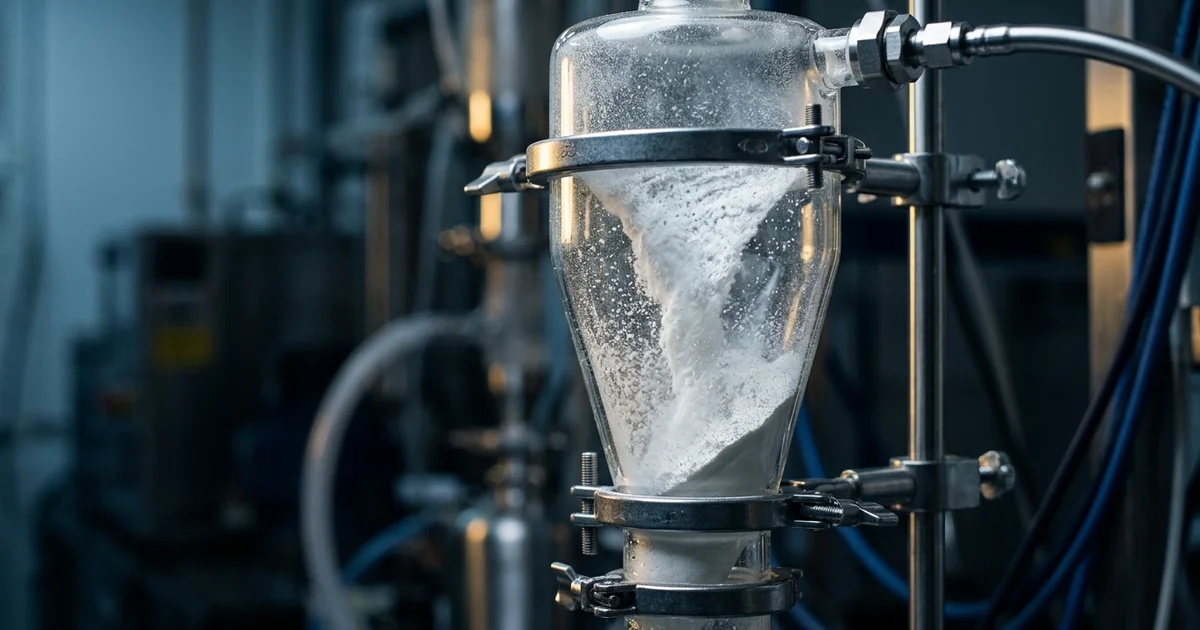
A drug that dissolves too slowly cannot be absorbed well, however potent it is. An amorphous solid dispersion (ASD) raises apparent solubility by holding the drug in a non-crystalline state within a polymer. Spray drying is one of the most widely used ways to make one. The route is unforgiving, because solvent choice, drying rate and storage moisture all decide whether the drug stays amorphous. This guide explains spray drying pharmaceutical amorphous solid dispersions, from polymer and solvent selection through process parameters, ICH Q3C residual solvents, stability and scale-up. It draws on open-access reviews and the ICH guideline at source, and on the formulation support Global Formulation gives pharmaceutical developers.
Spray Drying Pharmaceutical Powders: Why Amorphous Solid Dispersions
A review of ASD manufacturing strategies defines an ASD as a solid dispersion in which the active ingredient is dispersed within an excipient matrix in a substantially amorphous form. With the drug amorphous, no energy is needed to break the crystal lattice, so many poorly water-soluble drugs reach higher apparent solubility and faster dissolution than their crystalline forms. The hydrophilic polymers used also raise wettability. Spray drying is one of the widely used routes because it is continuous and commercially scalable.
The same review puts the scale of the problem in numbers: about 40 percent of marketed drugs and about 90 percent of those in the R&D pipeline are poorly water-soluble. Our guide to solubility enhancement techniques for poorly soluble drugs places ASDs among the other options. Our guide to dissolution method development and IVIVC explains how the resulting dissolution behaviour is measured.
| Route | Principle | Strength | Limitation |
|---|---|---|---|
| Spray drying | A solvent dissolves drug and polymer, and drying arrests the drug in the polymer | Continuous and commercially scalable; applicable to a wide variety of compounds; evaporation runs well below the drug melting point | Residual solvent; low bulk density powder; wall adhesion reduces yield |
| Hot melt extrusion | Heat disrupts the drug crystal lattice and cooling arrests the drug in the polymer | Continuous, single-step and solvent-free; capable of scaling up | Higher energy use; excludes thermolabile compounds |
| Fluid bed layering | A solution is sprayed onto particles in a fluidised bed | One-step granulation, coating and drying at lower temperatures than spray drying | Stickiness and over-agglomeration at larger scale |
Once spray drying is chosen, the next question is how the process turns a solution into a powder.
How the Spray Drying Process Works: Atomisation, Drying and Collection
A second review describes four fundamental stages of spray drying: atomisation of the liquid, interaction between liquid and drying gas, evaporation of the liquid and isolation of the dried particles. The feed containing drug and polymer is pumped through a nozzle into a drying chamber, where the droplets meet heated gas. Particle residence in the chamber is usually a few milliseconds, depending on equipment and parameters. The dried material is carried to a cyclone separator, while finer particles go to a filter with the exhaust gas.
| Nozzle Type | How It Atomises | Notes From the Review |
|---|---|---|
| Two-fluid nozzle | A gas provides the energy to atomise the liquid, mixed internally or externally | The most commonly used nozzle for spray-dried ASDs, particularly at laboratory scale |
| Pressure-swirl (pressurised) nozzle | The feed liquid pressure alone provides the atomisation energy | Does not atomise highly viscous liquids effectively; gives larger particles with better flow properties; easy to scale up |
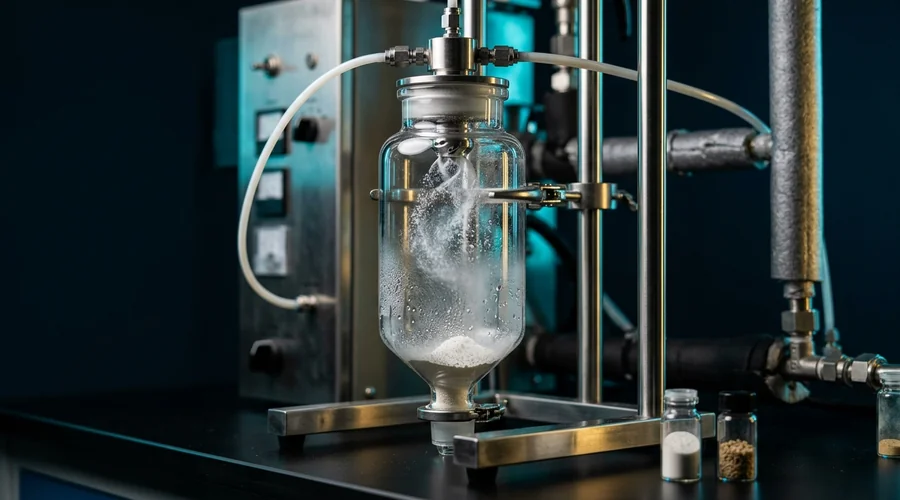
Inlet temperature and feed rate are two of the crucial variables. The review says optimising them is essential to obtain a homogeneous amorphous dispersion. Inlet temperature is dictated by the physical and chemical stability of the formulation constituents and the boiling point of the solvents. Rapid evaporation from the droplet gives a porous particle if the surface film is permeable and a hollow particle with a thicker shell if it is impermeable. Slower evaporation allows molecular rearrangement, which can cause phase separation or even crystallisation, to an extent that depends on the strength of drug-polymer interactions.
Because the feed must carry both components, the solvent and polymer choice sets what the dryer can achieve.
Solvent and Polymer Selection for Spray-Dried Dispersions
Selecting the solvent system is among the most consequential decisions in a spray-dried dispersion, because the feed has to dissolve both drug and polymer. The literature lists good solubility of API and polymer, non-combustibility, low toxicity and viscosity, chemical compatibility and ease of evaporation as the main criteria. Poor or partial solubility of the API can lead to non-homogeneous distribution in the dispersion. The polymer matters equally, because it stabilises the amorphous drug and shapes dissolution.
| Polymer Class | Role | What the Literature Reports |
|---|---|---|
| Povidone and vinylpyrrolidone-vinyl acetate copolymers | Hydrophilic matrix polymers named among those commonly used | In one study, spray-dried and extruded dispersions of a compound with a copolymer grade both showed a single Tg and an amorphous diffraction pattern |
| Polymethacrylate derivatives | Commonly used matrix polymers | The miscibility limit of one drug differed between film casting and spray drying, showing that solvent evaporation rate shapes miscibility |
| Hydroxypropyl methylcellulose (HPMC) | Commonly used cellulose ether polymer | Named with the others as a commonly used polymer for ASDs |
| HPMC acetate succinate (HPMCAS) | Well established in commercial ASD products | A review of marketed products lists several made by spray drying and others by hot melt extrusion |
The review of HPMCAS-based dispersions in the clinic names povidone, polymethacrylate derivatives, HPMC and HPMCAS derivatives as the commonly used polymers. A polymer with a high glass transition temperature is generally crucial, because the Tg of an ASD lies between that of the drug and the polymer. Most ASD polymers are hydrophilic and so enhance drug dissolution by increasing wettability. In some drug loading regimens, the dissolution of the drug is controlled by the dissolution of the polymer.
Solvent mixtures bring their own risk. The review says azeotrope-forming combinations, such as water with ethanol or isopropanol, are preferred, because binary solvents with different evaporation rates cause variable supersaturation. That can precipitate selected components early and create a strong potential for phase separation.
The solvent that works best for dissolution may not be acceptable for the product, which brings the regulatory limits into play.
Residual Solvents and Secondary Drying: ICH Q3C Limits
One of the concerns in spray drying is the amount of residual solvent, so the process is usually followed by secondary drying. ICH Q3C(R9) places residual solvents in three classes according to risk. Class 1 solvents are to be avoided, Class 2 solvents are to be limited, and Class 3 solvents have low toxic potential. The ASD review notes that Class 2 solvents can be used to a limited extent if Class 3 solvents cannot provide adequate manufacturing conditions.
| Class | ICH Q3C Definition | Limit or Example |
|---|---|---|
| Class 1 | Solvents to be avoided: known or strongly suspected human carcinogens and environmental hazards | Benzene is listed in this class |
| Class 2 | Solvents to be limited: non-genotoxic animal carcinogens or possible causes of other irreversible toxicity, and solvents suspected of other significant but reversible toxicities | Option 1 limits: dichloromethane 600 ppm (PDE 6.0 mg/day); methanol 3,000 ppm (PDE 30.0 mg/day) |
| Class 3 | Solvents with low toxic potential; no health-based exposure limit is needed | 50 mg/day or less (5,000 ppm or 0.5 percent under Option 1) is acceptable without justification; acetone and ethanol are listed |
The guideline offers two ways to set Class 2 limits. Option 1 uses the ppm limits in its Table 2, calculated by assuming a product mass of 10 g administered daily. These are acceptable for all substances, excipients and products. Option 2 uses the PDE with the known maximum daily dose, provided the residual solvent has been reduced to the practical minimum. Our guide to the FDA, ICH and USP regulatory pathway shows how ICH quality guidelines fit into a filing.
A powder that meets its solvent limit still has to stay amorphous on the shelf, which is the stability question.
Spray Dried Dispersion Stability: Moisture, Tg and Crystallisation
An amorphous dispersion is a metastable system, and its main risk is crystallisation during storage. Because the drug in an ASD is often supersaturated, reducing its molecular mobility is important, and a viscous polymer matrix provides kinetic stabilisation. Ambient humidity can introduce moisture into the hygroscopic dispersion. Moisture reduces the Tg, plasticises the system and raises both molecular mobility and the risk of crystallisation.
- High-Tg polymer — an ASD has a Tg between that of the drug and the polymer. Under the Tg minus 50 °C rule, the mobility of an amorphous solid becomes negligible 50 °C below its Tg.
- Miscibility — when the system is miscible and contains drug below its saturation solubility in the polymer, the ASD is thermodynamically stable.
- Moisture control — absorbed water can disrupt drug-polymer interactions by competing with hydrophilic polymers for hydrogen bonds.
- Particle surface — a higher surface ratio of drug to polymer increases the tendency of the amorphous drug to recrystallise, and solvent ratio can change the surface composition.
- Mechanical stress — grinding, crushing or compressing can promote deformation-induced molecular mobility.
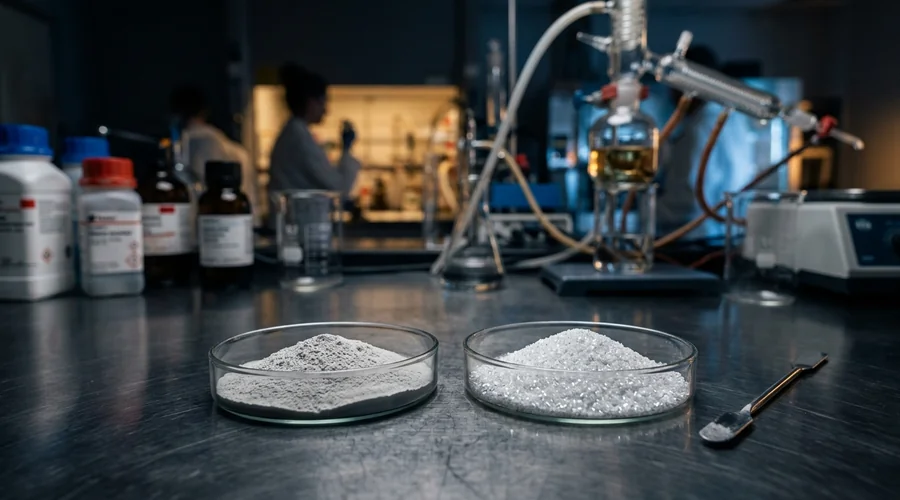
The process leaves a signature on stability. The review reports that exposure of ASDs to moisture on storage can cause amorphous-amorphous phase separation, in which drug-rich and polymer-rich phases form. It also reports that the miscibility limit of one drug in a polymer differed between film casting and spray drying. In another study, a spray-dried product showed signs of crystal growth in a three-month stability study while the extruded product did not. The authors linked this to the much higher surface area of the spray-dried particles. That result describes one compound and one polymer, and it is a reason to test rather than a rule. Our guide to pharmaceutical stability testing and ICH guidelines sets out the study design.
A stable powder still has to survive the handling that follows, and that is where scale-up decisions bite.
Scale-Up, Powder Handling and Downstream Processing
Spray-dried dispersions often leave the dryer as low-bulk-density powders, and that shapes everything downstream. The review notes that low bulk density powder often needs densification to improve its flow properties before it becomes a final dosage form. Adhesion of material to the equipment walls reduces yield, which matters most early in development when the active ingredient is scarce. Industrial dryers are large, with gas flow rates as high as 5,000 kg/h and solvent evaporation capacity up to 400 kg/h.
| Challenge | Evidence From the Review | Strategy to Evaluate |
|---|---|---|
| Low bulk density | Powder often needs densification to improve flow | Densification before dosage-form processing; one study found that silicon dioxide in the feed increased bulk density and recovery |
| Wall deposition and yield loss | Adhesion reduces yield; high-viscosity feeds stick inside the chamber | Feed viscosity control; scraping with vibratory devices or compressed air |
| Variation within the dryer | Miscibility differed between cyclone and collector samples in one study | Defined sampling points and blending of collected fractions |
| Atomiser and particle size | Pressurised nozzles give larger particles with better flow and are easy to scale up | Choose the atomiser with the downstream process in mind |
| Residual solvent | Secondary drying usually follows spray drying | Validated drying step and a residual-solvent test against ICH Q3C |
The review also reports that spray drying is more suited to scale-up than freeze-drying. In one example, a pressurised-nozzle process showed no significant change in properties or in vitro release on scale-up. Our guides to pharmaceutical granulation technology and quality by design in formulation development cover the powder-handling and design-space tools used after the dryer.
These choices are easier to make with a partner who has run the process at more than one scale.
Working With a Pharmaceutical Formulation Consultant and CDMO
Spray-dried dispersion development sits between solid-state chemistry, process engineering and regulatory strategy, and each choice affects the others. A pharmaceutical formulation consultant screens polymers and solvents, designs the spray drying trials and interprets the solid-state data. Pharmaceutical product development services extend that work to stability planning, specifications and regulatory documentation. Contract formulation CDMO support then carries the validated process into a facility that can run it under GMP.
- Characterise the drug — solubility, thermal stability and crystallisation tendency.
- Screen polymers and solvents — judge each on miscibility, feed solubility and ICH Q3C class.
- Run spray drying trials — vary inlet temperature, feed rate and solvent composition.
- Confirm the amorphous state — use thermal and diffraction analysis, such as a single Tg and an amorphous diffraction pattern.
- Plan stability — include moisture exposure and the final process conditions.
- Define secondary drying and solvent limits — validate removal to the ICH Q3C limit.
- Scale up and transfer — move the process to a qualified CDMO with downstream processing defined.
Our pharmaceutical and healthcare range shows where oral solid dosage forms sit among the other dosage forms. Our guide to choosing a pharmaceutical formulation consultant explains how to select a partner. Global Formulation provides polymer and solvent screening, spray drying trials, stability planning and transfer support for pharmaceutical developers. Drug loadings, polymer ratios and release-profile data stay outside this guide by design.
Frequently Asked Questions
What is spray drying in pharmaceutical manufacturing?
Spray drying is a continuous drying process. A feed solution or suspension is pumped through a nozzle into a drying chamber, where the atomised droplets meet heated gas and the solvent evaporates. The dried particles are carried to a cyclone separator and collected.
The literature describes four fundamental stages: atomisation of the liquid, interaction between liquid and drying gas, evaporation of the liquid and isolation of the dried particles.
In pharmaceutical work it is used for simple drying, encapsulation and, most importantly here, for making amorphous solid dispersions of poorly soluble drugs.
What is a spray-dried amorphous solid dispersion and why make one?
An amorphous solid dispersion (ASD) is a solid dispersion in which the active ingredient is dispersed within an excipient matrix in a substantially amorphous form. With the drug amorphous, no energy is needed to break a crystal lattice, so many poorly water-soluble drugs show higher apparent solubility and faster dissolution than their crystalline forms.
Spray drying makes an ASD by dissolving drug and polymer in a solvent and drying the droplets so quickly that the drug is held in the polymer.
The route is widely used because it is continuous and commercially scalable.
How do you choose a solvent for a spray-dried dispersion?
The literature lists the main criteria as good solubility of the drug and the polymer, non-combustibility, low toxicity and viscosity, chemical compatibility with the feed components and ease of evaporation.
Regulatory class matters as well. ICH Q3C classes solvents by risk. A review notes that Class 3 solvents are preferred, and Class 2 solvents are used to a limited extent only if Class 3 solvents cannot give adequate manufacturing conditions.
Check the dried particle, not only the feed, because adding water to a solvent system has been shown to cause phase separation during spray drying even from a one-phase feed.
Which spray drying process parameters matter most for ASDs?
A review of ASD manufacturing identifies inlet temperature and feed rate as two crucial variables. Optimising them is essential to obtain a homogeneous amorphous dispersion.
Inlet temperature is dictated by the physical and chemical stability of the formulation constituents and the boiling point of the solvents.
Other parameters include atomisation gas flow and pressure, feed concentration and viscosity, and nozzle type, all of which affect droplet drying and the resulting particle.
Why do spray-dried dispersions crystallise on storage and how is it prevented?
The drug in an ASD is often supersaturated, so it tends to move towards crystallisation unless its molecular mobility is kept low. Moisture works against this, because it lowers the glass transition temperature and plasticises the dispersion.
Stability is protected by choosing a polymer with a high glass transition temperature, keeping the drug within its miscibility limit in the polymer and limiting moisture uptake.
Process history matters too, since solvent evaporation rate and solvent composition change miscibility and particle surface composition.
How does spray drying differ from hot melt extrusion for ASDs?
Spray drying dissolves the drug and polymer in a solvent and dries the droplets. Hot melt extrusion uses heat to disrupt the drug crystal lattice and then cools the polymer to arrest the drug. Spray drying runs at temperatures well below the drug melting point, which suits thermolabile systems.
Hot melt extrusion is continuous, single-step and solvent-free, but it uses more energy and excludes thermolabile compounds.
Spray drying brings residual solvent, low bulk density powder and wall adhesion that reduces yield, so the choice starts with the properties of the molecule.
What are the ICH Q3C limits for residual solvents in spray-dried products?
ICH Q3C(R9) places solvents in three classes. Class 1 solvents are to be avoided, Class 2 solvents are to be limited and Class 3 solvents have low toxic potential.
Under Option 1, which assumes a product mass of 10 g per day, the concentration limit is 600 ppm for dichloromethane and 3,000 ppm for methanol, both Class 2. For Class 3 solvents such as acetone and ethanol, 50 mg per day or less, corresponding to 5,000 ppm under Option 1, is acceptable without justification.
Option 2 allows limits calculated from the actual maximum daily dose, provided the residual solvent has been reduced to the practical minimum.
Developing a Spray-Dried Dispersion?
Global Formulation supports polymer and solvent screening, spray drying trials, stability planning and transfer to a qualified CDMO.
Talk to Our Formulation Team