Suspoemulsion Formulation: SE Stability and Crystal Growth

Two actives that need different carriers are awkward to spray together, because tank mixing can lead to incompatibilities. A suspoemulsion puts a solid active and an oil-borne active into one concentrate, but the stability rules of a suspension and an emulsion then apply at the same time. A product that passes on the day of manufacture can develop sediment, a cream layer or large crystals during storage. This guide explains suspoemulsion formulation for agrochemical manufacturers, covering instability mechanisms, crystal growth, dispersant and emulsifier compatibility, mixing routes and the FAO and WHO stability tests. It draws on the FAO and WHO pesticide specification manual and published colloid science, plus the formulation support Global Formulation gives agrochemical manufacturers.
Suspoemulsion Formulation Basics: One Concentrate, Two Dispersed Phases
A suspoemulsion (SE) carries a solid active as suspended particles and a second, oil-based active as fine droplets, all in one water-continuous concentrate. The FAO and WHO manual defines it as a stable dispersion of solid particles and water-non-miscible fine globules in a continuous water phase, intended for dilution into water before spraying. Mixtures of active ingredients are often used to broaden pest control, and formulating them together removes the need for tank mixing. The price is a concentrate that must obey two sets of colloidal rules at once.
| Code | What Is Dispersed in Water | FAO and WHO Wording |
|---|---|---|
| SC | Solid particles | A stable suspension of active ingredient with water as the fluid |
| EW | Oil globules carrying the active | A solution of pesticide in an organic liquid dispersed as fine globules in a continuous water phase |
| SE | Solid particles and oil globules | A stable dispersion of active ingredients as solid particles and water-non-miscible fine globules in a continuous water phase |
| ZE | Capsules, solid particles and fine globules | A mixed formulation of CS and SE in a continuous water phase |
The same text lists the handling advantages of SEs: they are easy to handle and measure, dust free, non-flammable and miscible with water. It also warns that SEs are not stable indefinitely, which is why storage tests sit inside the specification. Our guides to suspension concentrate formulation and oil dispersion and emulsion in water formulation cover the two parent systems. Capsule actives that join an SE form the ZE type, described in our capsule suspension guide.
The next section shows what goes wrong inside the bottle.
Suspoemulsion Instability: Homoflocculation, Heteroflocculation and Phase Transfer
A suspension and an emulsion can each be stable on their own and still fail once they are mixed. Tadros describes four interactions that cause this, and each starts at an interface. Two come from competition between the particle dispersant and the droplet emulsifier. The other two come from direct contact between particles and oil droplets.
| Mechanism | Cause | Outcome |
|---|---|---|
| Homoflocculation of the particles | The particle dispersant is weakly adsorbed and is displaced by an emulsifier that adsorbs more strongly but stabilises particles poorly | Particles form flocs of their own |
| Emulsion coalescence | The emulsifier is weakly adsorbed and is displaced by the particle dispersant, which is a poor emulsion stabiliser | Droplets coalesce and oil eventually separates |
| Heteroflocculation | Particles partly wetted by oil sit at the oil and water interface, particularly when droplets are much larger than particles | Combined flocs of particles and droplets |
| Phase transfer and crystallisation | The solid has some solubility in the oil phase | Small particles dissolve in the oil and recrystallise on larger ones |
The FAO and WHO sampling note describes what these failures look like in a container. On standing, suspoemulsions usually develop a concentration gradient, which appears as a clear layer at the top or bottom. A sediment layer can also form, and it is detected by probing with a glass rod. If the SE has flocculated, the sticky layer at the base cannot always be redispersed. Our guide to emulsion separation, creaming and coalescence explains the single-phase versions of these breakdowns.
Phase transfer is the slowest of the four, and it needs its own section.
Mixed Formulation Crystal Growth: Oil Solubility, Particle Size and Temperature
Crystal growth develops during storage, so it shows up in ageing tests and not on the day of manufacture. Tadros explains that solid particles can enter the emulsion droplets, and that on leaving they can grow into large crystals. The process resembles Ostwald ripening, and it can modify crystal habit to give large and sometimes needle-shaped crystals. Control starts with the choice of oil and solvent, long before any stability test.
- Oil solubility — Phase transfer needs some solubility of the solid in the oil phase. Measure that solubility before choosing the oil or solvent.
- Particle size distribution — Tadros attributes the dissolution of small particles to their higher solubility than larger ones, a curvature effect. A narrow distribution leaves fewer small particles to dissolve.
- Temperature exposure — A Syngenta patent with SE and SC test formulations reports that extreme temperature change can induce significant particle growth of the active.
- Solvent choice — US 10,405,546 dissolves a triazole active in an oil phase with an alkyl carboxylic acid amide. That amide acts as both solvent and crystal growth inhibitor, and a polymeric stabiliser is added.

Surfactant choice and mixing order then decide whether these risks stay controlled.
Suspoemulsion Compatibility and Process Design: Dispersants, Emulsifiers and Mixing Routes
Suspoemulsion compatibility is mostly a question of which stabiliser sits on which surface. Tadros lists three routes to an SE: mix a prepared suspension with a prepared emulsion, emulsify an oil into a prepared suspension, or disperse a solid into an emulsion. Each route changes which stabiliser meets which surface first. Tadros's agrochemical formulation volume describes methods for reducing these instabilities with particular reference to polymeric surfactants.
| Design Decision | Why It Matters | Source |
|---|---|---|
| Mix two prepared phases | Each phase is stabilised on its own before the two meet | Tadros; US 10,405,546 |
| Emulsify oil into a prepared suspension | The emulsifier meets particles that already carry a dispersant, the setting for displacement | Tadros |
| Pair the dispersant and emulsifier | Displacement of either stabiliser causes homoflocculation or coalescence | Tadros |
| Use strongly anchored polymeric surfactants | Polymeric surfactants are the method highlighted for reducing these instabilities | Tadros, De Gruyter volume 4 |
| Match droplet and particle sizes | Heteroflocculation is particularly likely when droplets are much larger than particles | Tadros |
| Test adjuvants in the finished system | An adjuvant that enhances biological efficacy is often added to SEs | Tadros, De Gruyter volume 4 |
The US 10,405,546 patent shows one architecture for a triazole and strobilurin pair. The triazole phase and the strobilurin particle dispersion are prepared separately and then combined. Its preferred dispersant classes are methacrylic acid and methyl methacrylate graft copolymers with polyethylene glycol, tristyrylphenol ethoxylates and propylene oxide and ethylene oxide block copolymers. One patent shows one fungicide pair, so treat it as an illustration of architecture and not a recipe. Our guide to agrochemical technology and formulations shows where SEs sit among the formulation types.
Whatever the architecture, the specification tests decide whether it holds.
Suspoemulsion Stability Testing: Dispersion Stability, Wet Sieve and Storage Tests
FAO and WHO state that suspo-emulsions are not stable indefinitely, so the specification checks that the product stays suitable for use after transport and storage. The parameters are quantified particularly after high and low temperature stability tests. Dispersion stability and the wet sieve test ensure that the diluted SE can be sprayed. Pourability confirms that the concentrate can be poured from its container.
| Clause | Method | What It Checks |
|---|---|---|
| Dispersion stability | MT 180, tested at 2 percent dilution | In CIPAC standard waters A and D at 23 ± 2 °C: cream, free oil and sediment at 0.5 hours; redispersion complete at 24 hours; readings again at 24.5 hours |
| Wet sieve | MT 185 | Maximum percentage retained on a stated test sieve |
| Pourability | MT 148.1 | Maximum residue left after pouring |
| Persistent foam | MT 47.3 | Maximum foam volume after 1 minute, in CIPAC standard water D at 25 ± 5 °C |
| Low temperature stability | MT 39.3 | 0 ± 2 °C for 7 days, then dispersion stability and wet sieve must still comply |
| Elevated temperature stability | MT 46.4 | 54 ± 2 °C for 14 days; active content must not fall below a stated fraction, and pourability, dispersion stability and wet sieve must still comply |
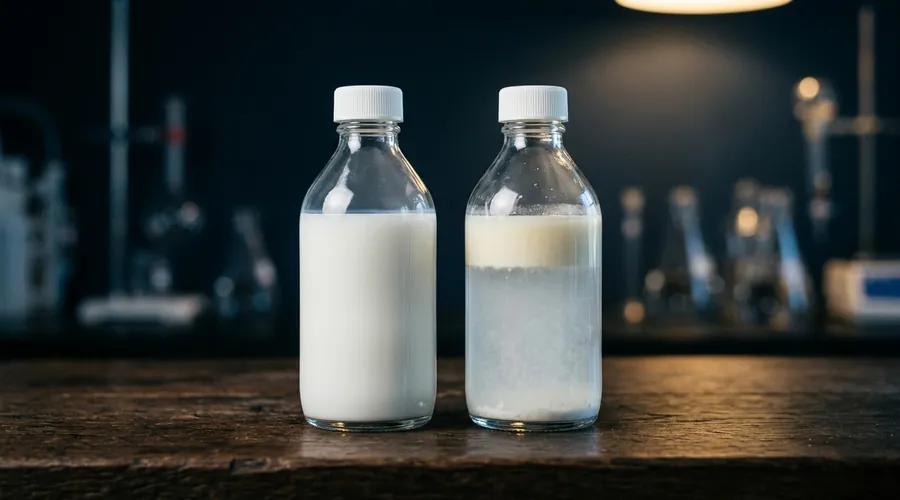
The template also gives a sampling rule. Inspect the container, then homogenise by the manufacturer's instructions or by gently inverting the closed container several times. After that, the container should hold no sticky layer of non-dispersed matter at the bottom. FAO and WHO add that other properties can be reported, but they do not normally form essential parts of the specification. Large crystals formed in storage would be retained on the sieve, which is why the wet sieve clause is repeated after both storage tests.
Joining these tests to formulation decisions is where a development partner helps.
Working With an Agrochemical Formulation Consultant
Suspoemulsion development joins suspension science, emulsion science, solvent and crystal risk, and specification testing, and a change in one shifts the others. An agrochemical formulation consultant defines the actives, the oil phase and the target markets first, then screens stabiliser pairs against them. Agrochemical product development services extend that into the ageing programme and specification writing. A contract formulation agrochemical manufacturer then carries the validated route into repeatable production.
- Define the actives — melting point, oil solubility, water solubility and chemical stability of each.
- Choose the oil phase — screen solvents for solubility of the oil-borne active and for low solubility of the solid.
- Pair the stabilisers — test dispersant and emulsifier together for displacement.
- Fix the route — compare mixing routes and record the order of addition.
- Age the samples — run 0 °C and 54 °C storage and temperature cycling on candidates.
- Run the specification tests — dispersion stability, wet sieve, pourability and foam, before and after storage.
- Transfer to manufacture — milling, emulsification and mixing steps for the contract manufacturer.
Our agro chemicals range shows where mixed formulations sit among the other product types. Global Formulation provides stabiliser pair screening, crystal growth risk assessment, stability programme design and manufacturing transfer for agrochemical manufacturers. Concentrations, ratios and proprietary co-formulants stay outside this guide by design, because they belong to each client's product.
Frequently Asked Questions
What is a suspoemulsion?
A suspoemulsion (SE) is a fluid heterogeneous formulation made of a stable dispersion of active ingredients as solid particles and as water-non-miscible fine globules in a continuous water phase. That is the FAO and WHO definition.
It is intended for dilution into water before spray application. One concentrate therefore carries a solid active and an oil-borne active together.
Why make a suspoemulsion instead of tank-mixing two products?
FAO and WHO note that mixtures of active ingredients are often used to give a broader spectrum of pest control. Formulating them together removes the need for tank mixing, which can lead to incompatibilities.
Like other aqueous liquid formulations, suspoemulsions are easy to handle and measure, dust free and non-flammable. The cost is that the concentrate must be stable against both suspension and emulsion failure modes.
What is heteroflocculation in a suspoemulsion?
Heteroflocculation is the formation of combined flocs of suspended particles and emulsion droplets. Tadros explains that the particles can be partially wetted by the oil and sit at the oil and water interface.
The risk is particularly high when the oil droplets are much larger than the suspended particles. It differs from homoflocculation, where the particles form flocs of their own.
Why does crystal growth happen in suspoemulsions?
Crystal growth through phase transfer occurs when the suspended particles have some solubility in the oil phase. Small particles have a higher solubility than larger ones because of curvature effects, so they dissolve into the oil.
They then recrystallise on the larger particles, in a process similar to Ostwald ripening. Tadros notes that this can modify crystal habit and produce large, sometimes needle-shaped crystals.
How do dispersants and emulsifiers conflict in a suspoemulsion?
The particle dispersant and the droplet emulsifier compete for surfaces. If the dispersant is weakly adsorbed, a more strongly adsorbed emulsifier can displace it, and the particles flocculate because the emulsifier does not stabilise them well.
The reverse also happens: a particle dispersant that displaces the emulsifier is a poor emulsion stabiliser, and the droplets coalesce until oil separates. Choosing the two as a matched pair is the design response.
How is suspoemulsion stability tested?
The FAO and WHO template for SE specifications tests dispersion stability (MT 180), wet sieve residue (MT 185), pourability (MT 148.1) and persistent foam (MT 47.3). Dispersion stability reports cream, free oil and sediment at 0.5 hours and again at 24.5 hours.
Storage tests follow, at 0 °C for 7 days and at 54 °C for 14 days. After each, the formulation must still comply with the dispersion stability and wet sieve clauses.
What is the difference between an SE, an EW and an SC?
An SC is a stable suspension of the active in water, and an EW is a solution of the active in an organic liquid dispersed as fine globules in water. An SE contains both a suspended solid and dispersed oil globules in one water phase.
FAO and WHO also define ZE, a mixed formulation of capsules and an SE. Each added dispersed phase adds another set of interfaces to stabilise.
Developing a Suspoemulsion Product?
Global Formulation supports dispersant and emulsifier pair screening, crystal growth risk assessment, stability programme design and contract manufacturing transfer for agrochemical manufacturers.
Talk to Our Formulation Team