Tank Mix Compatibility: Jar Test Methods for Agrochemicals
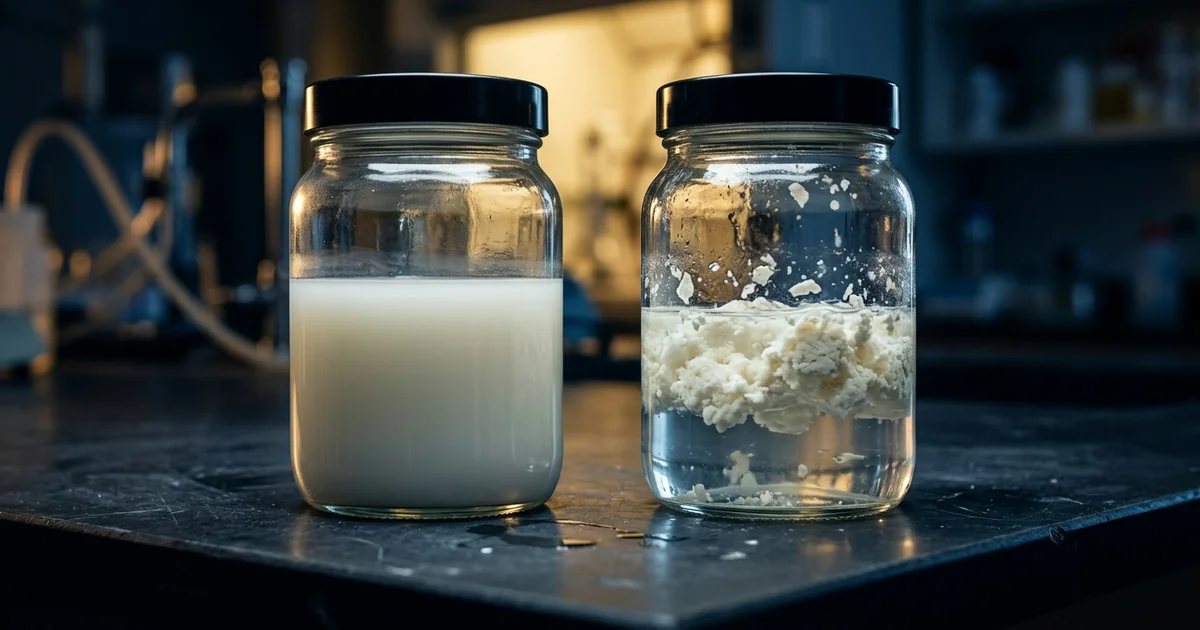
A tank mix that looks perfect in the jar can still clog a nozzle, bind its own active ingredient or kill a biological partner. Growers mix products to save passes, broaden the spectrum and manage resistance, and a product that fails in the tank takes that benefit away. This guide to tank mix compatibility separates physical, chemical, biological and legal failure, then shows how water, pH, mixing order and jar testing decide the outcome. It draws on university extension protocols, the FAO/WHO specification manual, ASTM E1518 and open-access research. It also reflects the formulation support Global Formulation gives agrochemical makers.
Tank Mix Compatibility: Four Ways a Mix Can Fail
The FAO/WHO specification manual defines compatibility as the absence of adverse or unwanted reactions when chemicals or formulations are mixed together. It names three kinds, physical, chemical and biological, and defines a tank mix as two or more formulations mixed in the spray tank, liquid fertilisers included. UF/IFAS Extension adds a fourth kind, legal incompatibility, which comes from the product labels. Each kind fails differently and is detected differently, so no single test clears a mix.
| Failure Type | What Happens | How It Shows Up | Does a Jar Test Catch It? |
|---|---|---|---|
| Physical | Components do not mix: layering, clumping, excessive foaming, settling or gels | Visible in the jar or the tank, and it can clog or damage the spray system | Yes, when the jar uses the real water, proportions and order |
| Chemical | A reaction or the water deactivates an active ingredient | Often invisible while mixing, sometimes heat, otherwise seen only as reduced control or crop injury after spraying | No |
| Biological | A partner reduces the viability of a microbial product | Seen in viability and growth assays | No |
| Legal | Labels forbid the mix, or their rules cannot be met together | Found by reading every label in the mix | No |
UF/IFAS gives a legal example that looks trivial until it happens. A product that requires no more than 20 gallons of carrier cannot be mixed with one that requires at least 50 gallons, even when the labels never mention each other. The extension guide also separates compatibility from antagonism, where two pesticides reduce overall efficacy, and from reduced selectivity, where a mix controls or harms more species than intended. It adds that the retreatment or equipment repair after a failed mix can outweigh what tank mixing saved.
- Physical failure — Arkansas Extension warns that the result can be total loss of the products and use of the tank or sprayer.
- Chemical failure — UF/IFAS notes that indicators are often absent during mixing, though an exothermic reaction can raise the solution temperature.
- Binding failure — paraquat and diquat are strong cations, and anions such as organic matter or soil deactivate them.
- Selectivity failure — an organophosphate insecticide in corn reduces the crop's ability to protect itself from a herbicide that is normally safe.
Of the four, chemical failure is the hardest to see, and it starts with the water in the tank.
Tank Mix pH and Water Hardness: The Chemical Side
Water is the largest ingredient in every spray tank, and its pH, hardness and temperature set how far chemical incompatibility goes. The PNW Plant Disease Management Handbook calls hydrolysis the predominant degradation pathway in the spray tank. Its speed depends on pH and temperature and, to a lesser degree, water hardness. For susceptible pesticides, extremes in pH and temperature speed the loss, and degradation rates generally double for each 10 °C rise.
| Active Ingredient | Half-Life at Near-Neutral pH | Half-Life at pH 9 |
|---|---|---|
| Captan | 8 hours at pH 7 | 4 minutes |
| Dimethoate | 12 hours at pH 6 | 48 minutes |
| Malathion | 7.8 days at pH 6, 3 days at pH 7 | 12 hours |
| 2,4-D | 4 years at pH 6 | 37 hours |
| Bifenthrin | Stable from pH 5 to 9 | Stable |
These values come from Table 4 of the PNW handbook and apply at temperatures around 25 °C. They show why one tank mix can be harmless for one active ingredient and ruinous for another. The same alkaline water that leaves bifenthrin untouched removes half the captan in four minutes. Fertilisers shift the picture further, because Arkansas Extension notes that they can change the pH of the mixture and that hard, mineral-rich water makes mixing more difficult.
Hard water carries the problem beyond hydrolysis. Penn State Extension notes that calcium and magnesium in hard water bind with the active ingredients of some pesticides and can decrease their performance. NDSU weed scientist Rich Zollinger states that cations antagonise glyphosate by complexing with it into salts, such as glyphosate-calcium, that plants do not readily absorb. None of this changes the look of the jar, so water chemistry needs its own check.
Mixtures also change the water they sit in. In an open-access dicamba study in Scientific Reports, glyphosate considerably lowered the pH of every tank mixture except those already acidified by an adjuvant. The same study saw a cream layer form in the mixture of dicamba and methylated soybean oil.
Physical failure is easier to see, and it depends on formulation type and the order of addition.
Spray Tank Mixing Order and Formulation Type: The Physical Side
Physical incompatibility depends on what each formulation is made of. Solid formulations such as wettable powders and water-dispersible granules need agitation to stay dispersed. Emulsifiable concentrates depend on an intact emulsifier system. Spray tank mixing order gives each type the best conditions as it enters the tank, but extension sources publish different orders.
| Source | Sequence When the Label Gives None |
|---|---|
| Penn State Extension | Compatibility, buffering or defoaming agents; then wettable powders, dry flowables and water-dispersible granules; then flowables, liquids and microencapsulated products; then solutions and soluble powders; then remaining adjuvants such as surfactants and crop oil concentrates |
| University of Arkansas (W-A-L-E-S) | Wettable powders or water-dispersible granules; agitate, then adjuvants such as anti-foaming compounds and buffers; flowable liquids; emulsifiable concentrates; surfactants last |
| UF/IFAS (A.P.P.L.E.S.) | Ammonium sulfate and conditioning agents; powder solubles; dry powders such as dry flowables, water-dispersible granules and wettable powders; liquid flowables; emulsifiable products; solutions; remaining surfactants such as crop oils and drift agents |
The three conventions agree on the core. Solids go early, oils and surfactants go late, and agitation runs throughout. They disagree on where conditioning agents, soluble powders and solutions belong, so the order printed on the product label takes precedence. Arkansas Extension adds a fallback for silent labels: add products from the most diluted to the most concentrated, with enough agitation time between them.
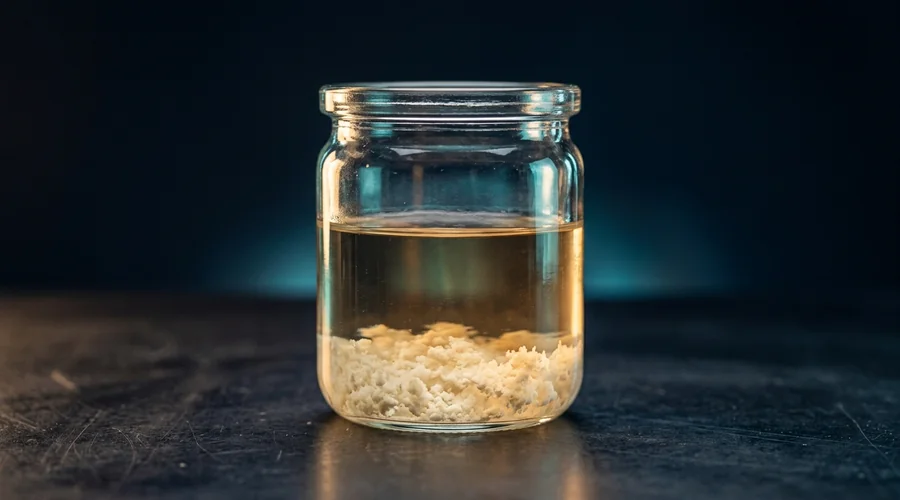
Formulation chemistry explains why emulsifiable products sit near the end. Tadros reports that nonionic ethoxylate emulsifiers become less water soluble as temperature or electrolyte concentration rises, which lowers their effective HLB and cuts emulsion stability. His data show that water hardness and temperature have a major effect on the cream that separates from a typical emulsifiable concentrate. A liquid fertiliser is a concentrated electrolyte, so the same mechanism applies when an emulsifiable concentrate meets one. That step is an inference from the mechanism and not a measured result.
The FAO/WHO manual builds the same sensitivity into its specifications. It tests emulsion and dispersion stability in both CIPAC standard waters A and D, at the highest and lowest recommended use rates. Those tests dilute one formulation in standard water, so they say nothing about a second product in the tank. Our guides to emulsifiable concentrate formulation and agricultural adjuvants explain the emulsifier and adjuvant side in detail.
The order is only half of a test, and the jar test itself needs a design.
Agrochemical Jar Test Compatibility: A Protocol That Predicts the Tank
A jar test is a small-scale copy of the tank, so it is only as good as its inputs. It must use the water that will fill the tank, the products in their real proportions and the order the label gives. Extension services publish near-identical protocols that differ mainly in standing time. The steps below merge them into one procedure.
- Fill the jar — half-fill a clear jar with the carrier, using the same source water as the tank.
- Add products in proportion — follow the label order, stir or shake after each addition, and rinse the measuring devices between products.
- Shake and stand — cap, shake, and let the jar stand for 15 to 30 minutes, then shake again and stand for another 15 to 30 minutes.
- Inspect the jar — look for scum, separation, solids that settle other than wettable powder, clumps, gels, heat and strong odour.
- Run a second jar — repeat with a compatibility agent when the first jar fails, and compare the two.
- Read the verdict — a mixture that separates but remixes readily can be sprayed with good agitation, and one that clumps or gels is probably not compatible.
An incompatible tank mix precipitate is the clearest warning, but not the only one. Penn State lists scum, separation, settled solids, clumps, gels, heat and strong odour as signs of incompatibility, and a strong odour means a chemical reaction has changed the product. Arkansas Extension adds that mixtures left sitting for extended periods are more likely to react. A jar left for hours can therefore give a different answer from one read after half an hour.
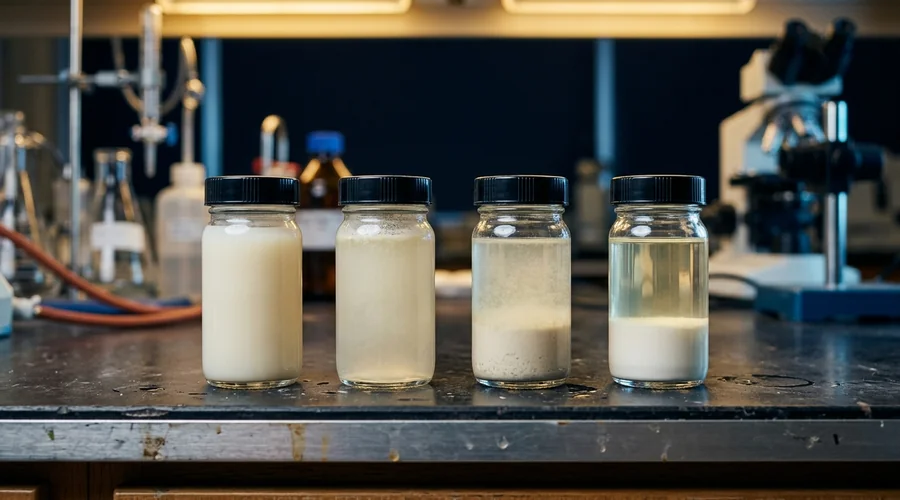
ASTM E1518 is the standard behind the lab version of this test. Its scope covers the physical compatibility and stability of pesticide tank mixtures diluted for aqueous application, and it can be adapted to liquid fertilisers in place of water. The practice addresses time, temperature, water hardness, method of agitation and degree of agitation. It states that order of addition, the pH of the dilution water and pumping shear also affect compatibility, and that laboratory results should be confirmed under field spray conditions.
Chemical and physical tests clear a conventional mix, but a microbial product asks a third question.
Biological Compatibility: Testing Microbial Products in the Tank
Microbial products add a failure mode that no jar can show, because the question is whether the organism survives its partners. The FAO/WHO definition of compatibility lists biological interaction alongside physical and chemical. An open-access 2024 study of Trichoderma biocontrol agents and soybean herbicides shows how much the test design decides the answer. It compared constant exposure on culture plates with timed exposures that simulate a tank.
- Constant exposure — none of the six herbicides was compatible with Trichoderma asperellum or T. harzianum.
- Timed exposure — sampling at 0, 2, 4, 8 and 16 hours to simulate tank mixing, both species showed compatibility within a window of 2 to 8 hours.
- Field trials — across two soybean seasons, the biocontrol agent combined with imazapic plus imazapyr gave significant reductions in white mold incidence.
- Least compatible partner — even glyphosate still gave a significant reduction in disease incidence and sustained yield against the untreated control.
The lesson is about method and not about any one herbicide. A constant-exposure plate is a worst case, and a timed exposure copies how long the organism actually sits in the tank. A formulator selling a microbial product should therefore state a maximum tank holding time and test viability against each named partner for that time. Our guide to bio-pesticide and bio-fertiliser manufacturing covers the commercial side of that segment.
Whatever the tests show, the label decides what is allowed in the tank.
Labels, Registration and Ready-Mix Alternatives
A mix that passes every test can still be unlawful, because legal incompatibility is a failure type of its own. UF/IFAS explains that FIFRA section 2(ee) allows mixing any pesticide, or a fertiliser and a pesticide, only if the product label does not explicitly prohibit it. Health Canada is stricter and has required label changes so that tank mixes are permitted only when labels expressly permit them. Rules differ by market, so confirm the position with the registration authority before writing a recommendation.
- Permitted — a label states the specific mix or carries a general tank-mix statement. All requirements of every label in the mix must be met, with the most restrictive label followed.
- Prohibited, silent labels — Health Canada prohibits a mix when both labels are silent, or when one carries the general statement and the other is silent.
- Prohibited, same active — partners that contain the same active ingredient are not allowed unless specifically recommended on the label.
- Exclusionary wording — a label that says not to mix with any other additive, pesticide or fertiliser blocks tank mixing with products it does not name.
These bullets summarise the Health Canada tank mix factsheet of January 2025. The practical consequence for a formulator is that a tank-mix claim is a regulatory asset. It exists only when the label carries it, so the compatibility data must be good enough to support the wording. For Indian registrations, check the position with the Central Insecticides Board and Registration Committee before relying on any tank-mix statement.
| Option | What It Is | Compatibility Burden |
|---|---|---|
| Tank mix of separate products | The user combines formulations in the spray tank | Falls on the user, backed by label wording and the formulator's data |
| Combi-pack (KK, KL, KP) | Two formulations in one outer pack, intended for simultaneous application in a tank mix | Shared, because the pairing is designed and labelled as a mix |
| Ready-mix (for example SE, ZC, ZW, ZE) | Two active ingredients formulated together in one product | Moves to the formulator, who must keep the combination stable in storage |
The FAO/WHO manual notes that formulating active ingredients together eliminates the need for tank mixing, which can lead to incompatibility. It also states that suspo-emulsions are not stable indefinitely, so the burden does not vanish. Our guides to suspoemulsion formulation and capsule suspension cover the ready-mix route.
Together these pieces form a compatibility programme that a formulator can build before a product reaches the market.
Building a Compatibility Programme: Where a Formulation Consultant Helps
A compatibility programme turns scattered jar tests into evidence that a registrant, a distributor and a grower can all rely on. An agrochemical formulation consultant designs the test matrix before the first jar is poured. Agrochemical product development services tie the results back to the formulation, so a failed jar leads to a formulation change and not only a label warning. Contract formulation support carries the fix through scale-up.
- Partner map — the fertilisers, adjuvants and pesticides customers actually combine with the product, and the wording of each label.
- Water matrix — CIPAC standard waters A and D plus the local waters of the target markets, at the highest and lowest use rates.
- Physical tests — jar tests in label order with a repeat after standing, and a dynamic test in the style of ASTM E1518 for products that carry a tank-mix claim.
- Chemical checks — hydrolysis sensitivity and cation binding for each active ingredient against pH and hardness, since the jar cannot show them.
- Biological assays — timed-exposure viability tests for microbial products.
- Redesign and scale-up — adjustments to the emulsifier, dispersant, anti-settling or conditioning system, then transfer to a contract formulation agrochemical manufacturer with batch specifications.
Manufacturers entering the segment can start with our agrochemical formulation business guide. The wider category sits under agro chemicals, and the chemistry behind each formulation type is in agro chemicals technology and formulations. Before committing to a tank-mix claim, run a short check. Read every label in the mix, test in the real waters and the label order, and confirm chemical and biological effects outside the jar. Then write the claim only as far as the data go.
Frequently Asked Questions
What is tank mix compatibility?
Tank mix compatibility is the absence of adverse or unwanted reactions when formulations are mixed in the spray tank. The FAO/WHO manual names three kinds of interaction: physical, chemical and biological.
UF/IFAS Extension adds legal incompatibility, which arises when labels forbid a mix or set rules that cannot be met together.
How do you run an agrochemical jar test?
Half-fill a clear jar with the water that will fill the tank. Add each product in proportion and in label order, mixing after each addition.
Cap and shake the jar, let it stand for 15 to 30 minutes, then shake and stand again. Look for scum, separation, settled solids other than wettable powder, clumps, gels, heat and strong odour. Repeat with a compatibility agent if the first jar fails.
What is the correct spray tank mixing order?
Follow the product label first. When the label is silent, extension guides give three conventions: Penn State's sequence, Arkansas's W-A-L-E-S and UF/IFAS's A.P.P.L.E.S.
All three put solid formulations early and oils and surfactants late. Arkansas adds a fallback of adding products from the most diluted to the most concentrated, with agitation time between them.
Why can a mix pass the jar test and still fail in the field?
A jar test checks only physical incompatibility. Chemical incompatibility, such as alkaline hydrolysis or cation binding, leaves the jar looking normal.
Arkansas Extension recommends spraying a small area to check for crop damage or reduced performance. Biological and legal incompatibility also need their own checks.
How do pH and water hardness affect a tank mix?
Hydrolysis is the predominant degradation pathway in the spray tank, and its speed depends on pH, temperature and, to a lesser degree, hardness. At pH 9 captan has a half-life of 4 minutes, against 8 hours at pH 7.
Calcium and magnesium in hard water bind with some active ingredients. Cations also antagonise glyphosate by forming salts that plants do not readily absorb.
Are tank mixes allowed if the label does not mention them?
It depends on the market. In the United States, FIFRA section 2(ee) allows mixing unless the label explicitly prohibits it.
Health Canada requires labels to expressly permit tank mixes and prohibits a mix when both labels are silent. Confirm the rule with the registration authority for each target market, including the CIB&RC for India.
Do microbial products need different compatibility testing?
Yes. A microbial product must survive its tank partners, so the test is a viability assay and not a jar. A 2024 Trichoderma study found no herbicide compatible under constant plate exposure, yet compatibility within 2 to 8 hours under timed exposure.
Quote the maximum tank holding time with the verdict, and confirm the result in the field.
How can a formulator reduce tank mix problems?
A formulation consultant maps the partner products and local waters, runs jar and dynamic tests in label order, and checks the hydrolysis and cation binding that a jar cannot show.
When a test fails, the fix usually sits in the emulsifier, dispersant or conditioning system, followed by scale-up with a contract formulation manufacturer. A ready-mix formulation is the alternative when two actives are routinely combined.
Need Tank-Mix Data for a Label Claim or a Product That Keeps Separating?
Global Formulation supports agrochemical makers with compatibility test design, water and fertiliser matrices, emulsifier and dispersant reformulation, stability testing, product development and scale-up to contract manufacturing.
Talk to Our Formulation Team